
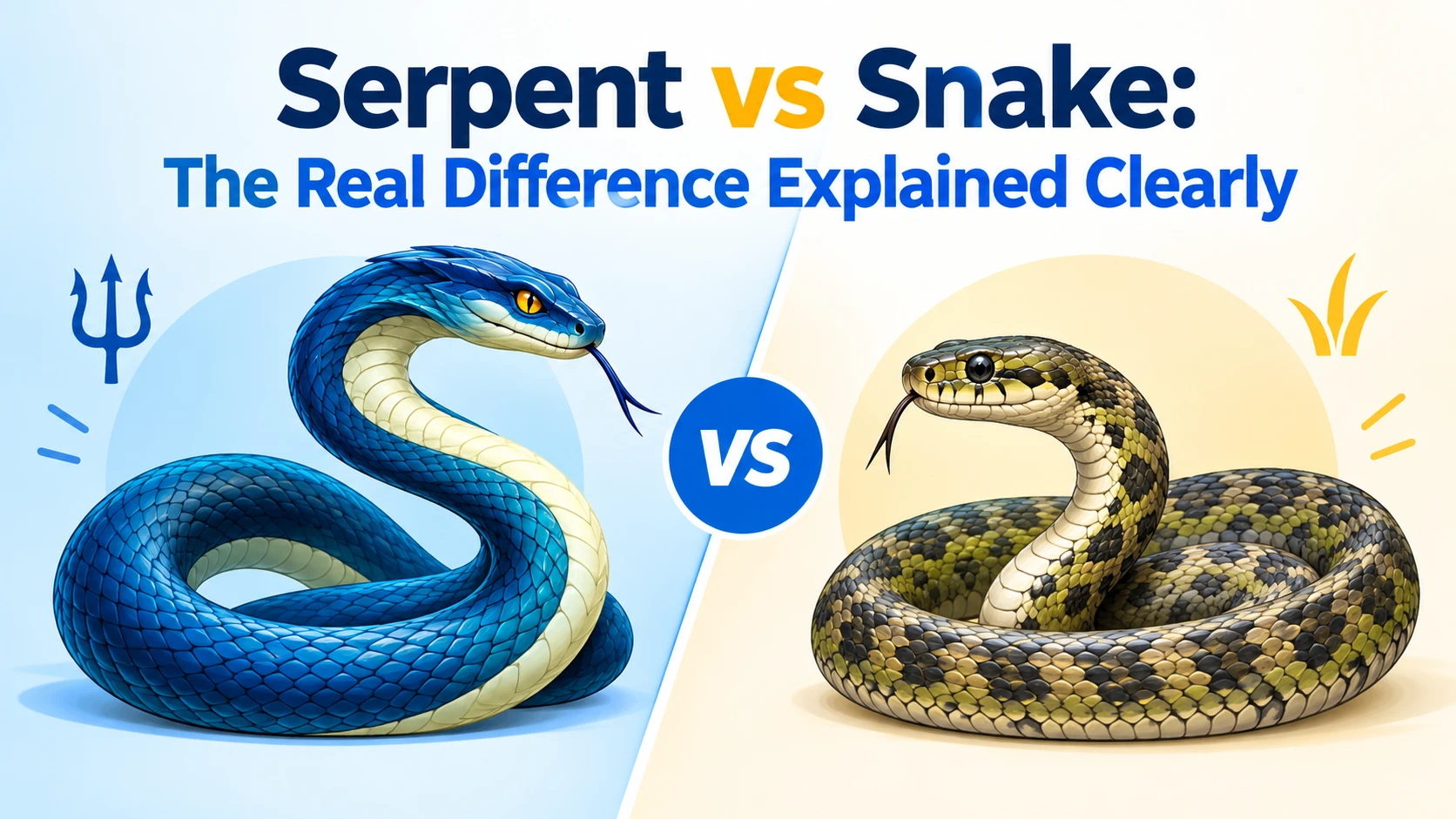
Serpent vs snake is usually not a comparison between two different animals. In ordinary English, both words can refer to a long, limbless reptile, and a cobra, python, or garter snake may correctly be called either one. The real distinction lies in usage, tone, history, and context. Snake is the familiar everyday word, while serpent often sounds literary, ancient, religious, poetic, or symbolic. Understanding that difference helps you choose the word that fits your sentence instead of assuming that one describes a separate creature.
The confusion becomes greater because Serpentes is also a scientific taxonomic name associated with snakes. However, lowercase serpent is simply an English noun, not the name of a special animal group. A dictionary may define serpent as “a snake,” but that does not mean the two words always create the same impression. One is usually direct and neutral; the other can suggest mystery, danger, grandeur, temptation, or mythology.
This guide explains the meaning of serpent and snake, their biological relationship, pronunciation, etymology, figurative uses, religious associations, and differences in modern writing. You will also see practical examples, common mistakes, and a decision guide showing when snake is the better choice and when serpent adds something important. By the end, you should be able to use both terms accurately without treating a difference in language and connotation as a difference in zoology.
Serpent vs Snake: The Short Answer
A snake is a limbless reptile with a long body. A serpent is generally another word for a snake, but it is less common in everyday modern English and often carries a more literary, historical, religious, or symbolic tone.
| Point of comparison | Snake | Serpent |
| Basic meaning | A long, limbless reptile | Usually a snake |
| Scientific status | Common English term | Not a separate animal group in ordinary English |
| Everyday frequency | Very common | Less common |
| Tone | Neutral and direct | Literary, dramatic, archaic, or symbolic |
| Religious usage | Used in some translations and discussions | Especially associated with traditional religious language |
| Mythological usage | Possible | Particularly common |
| Figurative meaning | Deceit, danger, betrayal | Deceit, danger, temptation, mystery, or power |
| Best general use | Everyday and factual writing | Literary, historical, religious, or evocative writing |
The simplest rule is:
Use “snake” for straightforward reference. Use “serpent” when the context benefits from its distinctive tone or symbolism.
What Does “Snake” Mean?
Snake as the Standard Modern Word
Snake is the normal word used in everyday English for a reptile with a long body and no legs. Cambridge defines a snake as “a reptile with a long body and no legs,” while Oxford describes it as a reptile with a very long, thin body and no legs.
The word is appropriate in almost any ordinary context:
- “A snake crossed the road.”
- “Some snakes are venomous.”
- “The snake coiled beneath the rock.”
- “She saw a snake in the garden.”
- “The wildlife guide explains how to identify local snakes.”
Because snake is familiar and precise enough for general communication, it is usually the best choice when your main goal is clarity.
Snake in Biological Writing
In biology, snake is a broad common name for members of the snake lineage. Snakes belong to the reptile order Squamata, which also includes lizards. They have evolved several distinctive adaptations, including:
- An elongated body
- The absence of external limbs
- Flexible jaws
- Specialized scales
- A highly mobile spine
- Internal organs adapted to a narrow body cavity
- Different forms of locomotion
Not every snake is dangerous, venomous, or large. The word includes harmless species as well as medically significant ones.
For example, a garter snake, ball python, king cobra, rattlesnake, and boa constrictor are all snakes, even though they differ greatly in size, habitat, behavior, and anatomy.
Snake as a Verb
The word snake can also function as a verb. It means to move along a route that contains many twists and bends. Cambridge gives examples such as a river or line that “snakes” through a landscape.
Examples include:
- “The narrow road snakes through the mountains.”
- “A queue snaked around the building.”
- “The river snakes across the valley.”
This verbal meaning is based on the winding movement associated with a snake.
What Does “Serpent” Mean?
Serpent as Another Word for Snake
The basic literal meaning of serpent is also snake. Cambridge lists serpent as a noun meaning “a snake,” and Oxford describes it as “a snake, especially a large one.” Oxford also labels the word literary, which is an important clue about its usual tone.
Examples:
- “A serpent lay coiled beside the temple.”
- “The hero faced a gigantic serpent.”
- “A serpent moved silently through the grass.”
In each case, the word may refer to an actual snake. It does not automatically identify a separate species.
Serpent as a Literary Word
Although serpent can be used literally, it often sounds more elevated than snake. Writers may choose it because it creates a particular atmosphere:
- Ancient
- Mysterious
- Ominous
- Majestic
- Supernatural
- Poetic
- Symbolic
Compare these sentences:
- “A snake moved across the path.”
- “A serpent emerged from the shadows.”
The first sentence is plain and factual. The second creates a stronger image and may suggest that the creature has a role in a larger story.
Serpent as a Symbol
In literature, religion, mythology, and art, serpent often represents more than an animal. Depending on the tradition, it may symbolize:
- Temptation
- Evil
- Deception
- Wisdom
- Rebirth
- Healing
- Transformation
- Fertility
- Hidden knowledge
- Power or danger
These associations do not belong to every use of the word. A writer may simply use serpent as a poetic synonym for snake. The surrounding context determines whether the word is literal or symbolic.
Is a Serpent a Different Animal From a Snake?
No. In ordinary English, a serpent is generally a snake.
The distinction is linguistic rather than zoological. Calling an animal a serpent does not tell you that it has different scales, a different number of vertebrae, a special type of venom, or a unique habitat.
For example, the same animal could be described in several ways:
- “The snake is a king cobra.”
- “The serpent appeared in the old legend.”
- “The large serpent was resting beneath the tree.”
The animal may be identical in all three sentences. The writer’s purpose changes the word choice.
What About Serpentes?
Serpentes is a scientific taxonomic term associated with snakes. It is not simply another everyday word for one individual snake. This distinction is important:
| Term | Meaning |
| snake | Ordinary English word for a limbless reptile |
| serpent | English word generally meaning snake, often with literary or symbolic associations |
| Serpentes | Scientific taxonomic name associated with the snake lineage |
Capitalization matters. Lowercase serpent is an ordinary noun. Capitalized Serpentes refers to a formal scientific classification.
A common mistake is to assume that because Serpentes appears in scientific terminology, serpent must describe a special kind of snake. It does not.
Snake vs Serpent: The Difference in Tone
The most useful difference between the two words is connotation.
Snake Usually Sounds Neutral
Snake is the natural choice when the writer is simply identifying an animal or explaining a fact.
Examples:
- “The snake was approximately one metre long.”
- “The researcher recorded the snake’s feeding behavior.”
- “Never handle an unfamiliar snake.”
- “The snake shed its skin.”
These sentences focus on information rather than atmosphere.
Serpent Often Sounds Deliberate
Serpent can make the same subject sound more dramatic or meaningful.
Examples:
- “The ancient serpent guarded the entrance.”
- “A golden serpent surrounded the crown.”
- “The serpent symbolized renewal and eternity.”
- “The knight entered the chamber where the serpent slept.”
The word is especially useful when the creature is part of a legend, ritual, poem, myth, or fantasy narrative.
A Tone Comparison
| Sentence | Effect |
| “A snake moved through the grass.” | Direct and realistic |
| “A serpent moved through the grass.” | More literary or ominous |
| “The snake was painted on the wall.” | Factual description |
| “The serpent was painted on the temple wall.” | Historical or symbolic suggestion |
| “He saw a snake near the doorway.” | Everyday observation |
| “He saw a serpent guarding the doorway.” | Dramatic or mythical image |
Neither word is automatically better. The correct choice depends on the effect you want.
The Biological Reality Behind the Words
What Snakes Have in Common
Although snakes vary enormously, most share a recognizable body plan:
- A long, narrow body
- No external legs
- A skull adapted for swallowing large prey
- Overlapping scales
- A flexible backbone
- A forked tongue used to collect chemical information
- Specialized movement through muscular coordination
Some snakes are excellent swimmers. Others climb trees, burrow underground, glide between branches, or live in deserts.
How Snakes Move
The familiar image of a snake “slithering” does not describe just one movement pattern. Snakes use several forms of locomotion, depending on their environment.
These include:
- Lateral undulation: The body forms waves that push against the ground.
- Concertina movement: The snake anchors parts of its body while extending other sections, useful in narrow spaces.
- Rectilinear movement: The snake moves in a relatively straight line through muscular and skin movements.
- Sidewinding: The snake uses a series of lifted body segments to cross loose or hot surfaces.
These biological details belong to snakes regardless of whether a writer calls them serpents. The vocabulary does not change the animal’s anatomy or behavior.
Why the Word Does Not Identify Danger
The word serpent may sound more threatening, but that is a matter of association. It does not mean the animal is more venomous or aggressive.
A harmless species can be called a serpent in a poem. A dangerous cobra can simply be called a snake in a scientific report.
A word’s emotional effect is not evidence of an animal’s actual risk.
Serpent vs Snake in Religion
Why “Serpent” Appears in Religious Language
The word serpent has a long association with religious writing, especially in traditional English translations and interpretations of biblical stories. In such contexts, the term may carry established historical meaning beyond the ordinary zoological reference.
This is one reason serpent can sound more solemn or symbolic than snake. Readers may connect it with stories involving temptation, evil, wisdom, judgment, or spiritual transformation.
However, religious translations do not always use exactly the same wording. A modern translation may use snake where an older or more traditional translation uses serpent. The choice can reflect:
- Translation philosophy
- Historical style
- Intended audience
- Literary tradition
- The translator’s interpretation of the original text
Religious Meaning Is Context-Dependent
A serpent in religious literature may represent evil or temptation, but that is not the only possible meaning. In different traditions, snakes and serpent-like figures may also be connected with:
- Healing
- Protection
- Fertility
- Rebirth
- Divine power
- Hidden wisdom
It is therefore inaccurate to claim that serpent always means evil. The symbolism depends on the specific text and tradition.
Serpent in Mythology and Ancient Culture
Why Serpents Appear So Often in Myths
Snakes have several features that make them powerful symbols:
- They move without visible legs.
- They can disappear into holes or vegetation.
- Some possess dangerous venom.
- Many shed their skin.
- Their movement is smooth and unfamiliar.
- Some species are exceptionally large.
- They can live in water, trees, deserts, and underground spaces.
These traits have encouraged cultures to associate serpent imagery with both fear and fascination.
Common Symbolic Associations
Across different myths and artistic traditions, serpent figures may represent:
- Cycles of life and death
- Renewal and regeneration
- Protection of sacred places
- Chaos or destruction
- Fertility and the earth
- Knowledge and transformation
- The boundary between the human and supernatural worlds
The symbolism is not universal. A serpent that represents wisdom in one tradition may represent danger in another.
The Ouroboros
The ouroboros is a symbolic serpent shown eating or holding its own tail. It is commonly associated with:
- Eternity
- Cycles
- Self-renewal
- Rebirth
- The continuity of life
- The unity of beginning and ending
In this context, serpent is more natural than snake because the image is not simply about an animal. It is about a symbolic creature with philosophical meaning.
Serpent vs Snake in Literature
Why Authors Choose “Serpent”
A novelist, poet, or storyteller may use serpent to make a creature seem:
- Ancient
- Intelligent
- Otherworldly
- Regal
- Menacing
- Enchanted
- Connected to prophecy or myth
For example:
“The serpent lifted its jeweled head and watched the travelers approach.”
The word helps establish a fantasy atmosphere. Replacing it with snake would make the sentence more ordinary and possibly less majestic.
Why “Snake” Can Be More Effective
A writer should not assume that serpent is always stronger. In realistic fiction, snake may be more effective because it feels immediate and believable.
Compare:
- “A snake bit him while he was clearing the garden.”
- “A serpent bit him while he was clearing the garden.”
The first sounds like a real-world event. The second may sound exaggerated or stylized unless the story has a deliberately literary tone.
Professional Writing Principle
Choose the word that supports the purpose of the passage:
- Report or guide: Use snake.
- Historical account: Use the term appropriate to the source or period.
- Poem: Choose according to sound and imagery.
- Fantasy: Use serpent when it contributes to the world-building.
- Scientific article: Use a precise common or taxonomic name.
- Religious discussion: Follow the terminology of the relevant translation or tradition.
Common Expressions With “Snake”
“Snake in the Grass”
A snake in the grass is a person who appears harmless but is secretly dangerous or untrustworthy.
Example:
- “I thought he was helping us, but he turned out to be a snake in the grass.”
The expression is based on the idea that a snake can remain hidden in vegetation until someone comes close.
“Snake Oil”
Snake oil originally referred to a supposed medicinal product associated with fraudulent claims. Today, it describes a product, service, or idea that is marketed as effective but is probably worthless or deceptive.
Examples:
- “The advertisement promised instant results, but the treatment was just snake oil.”
- “Be careful of online businesses selling snake oil solutions.”
“Snake in the Grass” and Personal Betrayal
The word snake is often used figuratively for someone considered:
- Dishonest
- Sneaky
- Disloyal
- Manipulative
- Treacherous
Examples:
- “He acted like a friend, but he was a snake.”
- “Nobody trusted the snake who betrayed the team.”
These uses are common in modern speech and do not usually require the more literary word serpent.
Common Uses of “Serpent”
Literary Description
- “The serpent coiled beneath the ancient tree.”
- “A silver serpent appeared in the moonlight.”
Religious Reference
- “The story describes a serpent in the garden.”
- “The serpent became a central figure in the religious interpretation.”
Mythological Creature
- “The hero fought a sea serpent.”
- “The temple was protected by a winged serpent.”
Figurative Description
- “The politician was portrayed as a serpent.”
- “A serpent of jealousy had entered his thoughts.”
In these examples, serpent often adds a sense of deliberate symbolism.
Common Mistakes and Misconceptions
Mistake 1: Treating Serpent as a Separate Species
A serpent is not automatically a special type of reptile. In ordinary English, it generally means a snake.
Better approach: Look at the context before assuming a biological distinction.
Mistake 2: Believing Serpent Always Means a Large Snake
Some dictionaries describe a serpent as especially a large snake, but everyday usage is broader. The word can refer to a snake of unspecified size, especially in literary or symbolic writing.
Better approach: Do not infer size unless the sentence provides that information.
Mistake 3: Assuming Serpent Always Means Evil
Religious and mythological associations can make serpent sound sinister, but the word can also suggest wisdom, renewal, protection, or majesty.
Better approach: Interpret the symbolism from the surrounding text.
Mistake 4: Using Serpent to Sound More Intelligent
Replacing snake with serpent does not automatically improve a sentence. In a wildlife guide or safety notice, it may make the writing less direct.
Better approach: Prefer the familiar word when the goal is clarity.
Mistake 5: Confusing Serpent With Serpentes
Serpent is an English noun. Serpentes is a formal taxonomic term.
Better approach: Pay attention to capitalization and the level of discussion.
Mistake 6: Confusing Poisonous and Venomous
This mistake concerns snakes generally, not the difference between snake and serpent. A snake is usually called venomous when it injects toxins through a bite or sting. Poisonous usually refers to something harmful when eaten, touched, or absorbed.
For factual writing about snakes, venomous is often the more accurate word.
How to Choose the Right Word
Use this decision guide when editing a sentence.
| Your context | Recommended word | Reason |
| Everyday conversation | Snake | Familiar and natural |
| Wildlife identification | Snake | Clear and practical |
| Safety advice | Snake | Direct and unambiguous |
| Scientific explanation | Snake or exact species name | More precise |
| Religious text | Serpent or the wording of the translation | Preserves established terminology |
| Ancient mythology | Serpent often fits | Historical and symbolic tone |
| Fantasy fiction | Serpent may fit | Creates atmosphere |
| Poetry | Either, depending on rhythm and imagery | Style determines the choice |
| Symbolic artwork | Serpent often fits | Emphasizes meaning beyond zoology |
| Casual social media post | Snake | Usually more accessible |
Ask Three Questions
Before choosing, ask:
- Am I describing a real animal or a symbolic figure?
- Does the sentence need everyday clarity or literary atmosphere?
- Would “serpent” add meaning, or would it merely sound more elaborate?
If the answer is simply “I mean the reptile,” snake will usually be the strongest choice.
Examples: Snake or Serpent?
Example 1: Wildlife Article
Preferred:
“The snake was found near a stream and released safely.”
Why? The sentence is factual and practical.
Example 2: Fantasy Novel
Preferred:
“The serpent guarded the doorway to the forgotten kingdom.”
Why? The word supports the mythical setting.
Example 3: Scientific Report
Preferred:
“The researchers recorded the snake’s feeding behavior.”
Why? The writing needs clarity and biological precision.
Example 4: Religious Discussion
Preferred:
“The serpent is an important figure in the traditional account.”
Why? The word reflects the established religious and historical vocabulary.
Example 5: Poetry
Possible:
“A serpent of silver wound around the moon.”
Why? The word contributes to the imagery and elevated tone.
Example 6: Everyday Warning
Preferred:
“A snake may be hiding beneath the woodpile.”
Why? A warning should be immediate and easy to understand.
Etymology: Where the Words Come From
The Origin of Snake
The word snake comes from Old English snaca and is connected with older Germanic vocabulary. Over time, it became the ordinary English term for the animal.
Its Germanic origin helps explain why it feels familiar and straightforward in modern English.
The Origin of Serpent
Serpent entered English through Middle English and Old French from Latin serpens, meaning “creeping.” The Latin word is connected with serpere, meaning “to creep.” Oxford identifies this Latin origin in its dictionary entry.
The word’s route through French and Latin helped it retain a more learned, literary, and historical character.
Why Etymology Matters
English often contains multiple words for similar ideas because it has borrowed vocabulary from different languages. In this case:
- Snake developed from Germanic English.
- Serpent entered through French and Latin.
- Both words came to refer to the same broad type of animal.
- Snake became the more common everyday term.
- Serpent retained stronger literary and symbolic associations.
Related Terms That Are Not Exact Synonyms
Snake vs Viper
A snake is a broad category. A viper refers to a particular group of venomous snakes.
Therefore, every viper is a snake, but not every snake is a viper.
Snake vs Adder
Adder is a common name used for certain snakes, especially in British English and in names such as “puff adder” or “common adder.” It is not a universal synonym for every snake.
Snake vs Eel
An eel may have a long, snake-like body, but it is a fish. A snake is a reptile.
Snake vs Worm
Worms are invertebrates, while snakes are vertebrates with backbones. Their similar body shapes do not make them biologically related in the same way.
Serpentine
The adjective serpentine means resembling a serpent or having a winding, twisting shape.
Examples:
- “The road followed a serpentine path.”
- “The dancer made a serpentine movement.”
- “The river had a serpentine course.”
Unlike serpent, serpentine is frequently used to describe shapes, movements, and patterns rather than an actual animal.
A Final Comparison Checklist
Before publishing or submitting a sentence, use this checklist:
- Does the sentence refer to an actual limbless reptile?
- Is the audience likely to prefer plain, modern language?
- Does the context involve mythology, religion, poetry, or fantasy?
- Does serpent add a meaningful tone or image?
- Would snake make the sentence clearer?
- Am I confusing the English noun serpent with the taxonomic term Serpentes?
- If the writing is scientific, have I used the correct species or taxonomic name?
- If the writing concerns danger, have I used accurate terms such as venomous where appropriate?
Conclusion
The real difference in serpent vs snake is usually not the animal itself but the purpose and tone of the language. Snake is the clear, familiar choice for everyday speech, wildlife information, safety advice, and most factual writing. Serpent can refer to the same reptile, but it often brings additional associations of history, mythology, religion, mystery, danger, or transformation. One final actionable tip: choose snake first when you need direct communication, then consider serpent if the context genuinely benefits from a more evocative word. A common mistake to avoid is assuming that a more dramatic term is automatically more accurate. Scientific precision comes from identifying the species or taxon, not from using a sophisticated-sounding synonym. The best word is the one that communicates both the literal meaning and the intended effect without confusing the reader.
Frequently Asked Questions
Q1. Is a serpent always a snake?
Yes. In ordinary English, serpent generally means a snake. The word may sound more literary, ancient, or symbolic, but it does not normally identify a separate type of reptile. In scientific writing, the exact species or taxonomic classification provides more information than choosing serpent instead of snake.
Q2. Is a serpent bigger or more dangerous than a snake?
Not necessarily. Some dictionaries associate serpent with a large snake, but the word does not guarantee a particular size, strength, or level of danger. A harmless small snake can be called a serpent in poetry, while a dangerous cobra may simply be called a snake.
Q3. Why does “serpent” sound more frightening than “snake”?
The difference comes from cultural and literary associations, not biology. Religious stories, myths, fantasy fiction, and dramatic descriptions often use serpent for creatures connected with temptation, evil, mystery, or power. As a result, the word can feel more ominous even when it refers to the same animal.
Q4. Should I use “snake” or “serpent” in formal writing?
Use snake when the writing is factual, scientific, educational, or intended for a general audience. Use serpent when the subject involves established religious terminology, mythology, poetry, history, or deliberate symbolism. Formal writing does not automatically require the more unusual word.
Q5. What is the difference between serpent and Serpentes?
Serpent is an ordinary English noun meaning a snake, often with literary or symbolic associations. Serpentes is a formal scientific taxonomic name associated with the snake lineage. They are related linguistically, but they operate at different levels: one is everyday vocabulary, and the other is biological classification.
