
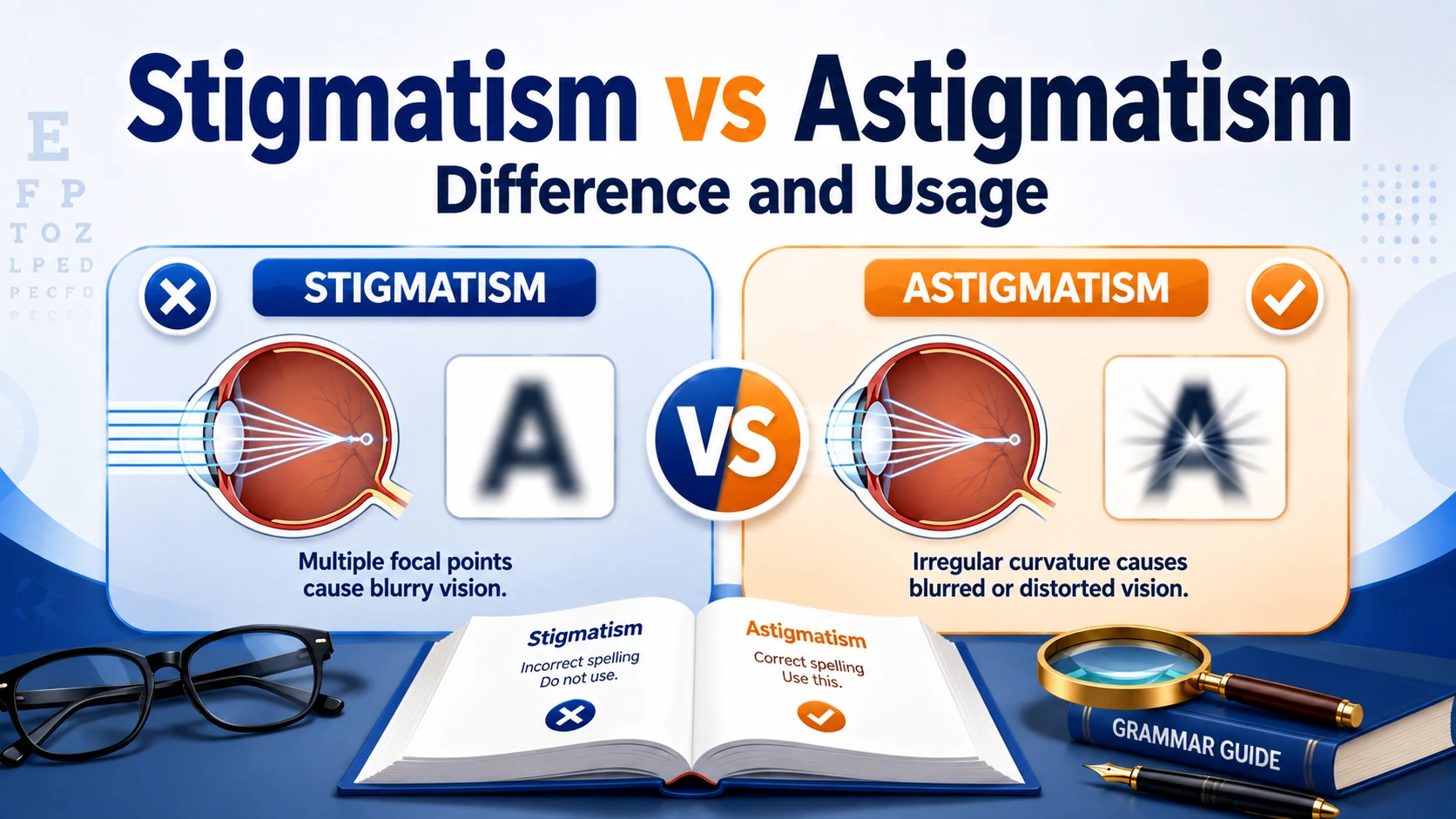
Stigmatism vs astigmatism is a confusing comparison because the two words look almost identical and are often treated as if one were simply a shortened version of the other. If you’re talking about the common eye condition that can make vision blurry or distorted, the word you want is astigmatism. It occurs when the cornea or lens has a shape that causes light to bend unevenly as it enters the eye. The National Eye Institute classifies astigmatism as a refractive error, alongside myopia, hyperopia, and presbyopia.
The tricky part is that stigmatism is actually a real English word. It isn’t merely a misspelling that someone invented after forgetting the first two letters of astigmatism. In optics, stigmatism describes an optical system in which rays from a single point converge to a single focal point. Dictionaries also record other technical meanings. In other words, the relationship between the terms is more interesting than “one is right and one is wrong.”
For everyday eye-care conversations, however, the choice is straightforward: use astigmatism when you mean the refractive condition. This guide explains the exact difference, why the words are confused, how astigmatism affects vision, what symptoms to watch for, how doctors diagnose and correct it, and how to use both terms accurately. You’ll also see practical examples, prescription terminology, common mistakes, and a quick decision guide you can use whenever you’re unsure.
Stigmatism vs Astigmatism: What’s the Difference?
The simplest answer is this: astigmatism is the standard term for the common refractive eye condition, while stigmatism has a different technical meaning and should not normally be substituted for astigmatism in patient-facing eye-care writing.
That distinction matters because dropping the initial “a” changes the word rather than merely shortening it.
The core difference
| Term | Main meaning | Use for the common eye condition? | Example |
| Astigmatism | A refractive error caused by an irregular shape of the cornea or lens | Yes | “She has mild astigmatism.” |
| Stigmatism | In optics, the property of focusing rays from a point to a corresponding point; it also has other technical meanings | No, not as the usual patient term | “The optical system has stigmatism.” |
The American Optometric Association describes astigmatism as a condition in which an irregularly shaped cornea or the curvature of the lens prevents light from focusing properly on the retina.
Why the two words are easy to confuse
There are several reasons people mix them up:
- Astigmatism is long and difficult to pronounce.
- The beginning of the word can sound like “a stigmatism.”
- In casual conversation, people may omit the initial sound.
- Once someone hears “stigmatism,” it can look perfectly plausible when written down.
- Stigmatism is already a legitimate dictionary word, which makes the confusion harder to detect.
So if someone says, “My doctor told me I have a stigmatism,” you can usually infer what they mean from context. But when writing a medical article, filling out health information, or describing an eye prescription, astigmatism is the precise term.
Quick rule: If you mean the refractive condition that can blur or distort vision, write astigmatism.
Is “Stigmatism” a Word?
Yes. Stigmatism is a word, but that doesn’t make it an alternative everyday spelling of astigmatism.
Merriam-Webster defines stigmatism in optics as the condition of an optical system in which rays from a single point converge at a single focal point. Other dictionaries record related technical and historical meanings.
That distinction is important because many spelling articles make the mistake of declaring stigmatism simply “wrong.” That’s too broad.
What “stigmatism” means in optics
In optical terminology, stigmatism describes successful point-to-point imaging. An optical system is stigmatic when light from a point object is brought to a corresponding point in the image.
That is almost the opposite of what most people mean when they accidentally say “stigmatism” while discussing blurry vision.
By contrast, astigmatism occurs when the optical system does not bring light to one clean focal point because the relevant optical surfaces have different curvature or power in different meridians.
This is why replacing astigmatism with stigmatism isn’t just a spelling shortcut. The technical meanings are different.
“Stigmatism” can also have other meanings
Dictionaries record stigmatism in more than one specialized sense. For example, it can refer to the presence of stigmata in pathology.
That meaning is uncommon in ordinary conversation, but it reinforces the main linguistic point:
Stigmatism and astigmatism are separate words.
Examples of correct usage
Astigmatism:
- “The eye exam showed that I have astigmatism.”
- “Her new glasses correct both myopia and astigmatism.”
- “Astigmatism can make letters appear blurred or distorted.”
Stigmatism in its technical optical sense:
- “The lens was designed to produce stigmatic imaging.”
- “The optical system demonstrates stigmatism under the specified conditions.”
The first group belongs naturally in ordinary eye-health discussions. The second belongs to specialized optics.
Astigmatism: Meaning and Medical Definition
Astigmatism is a refractive error that can make vision blurry or distorted. It happens when the cornea or lens has a shape that causes light to bend differently across the eye’s optical system. Instead of producing the clearest possible image on the retina, the optical system produces a blurred or distorted image.
Think about the difference between a basketball and a football. A basketball has a relatively uniform roundness. A football is curved but more elongated, so its curvature differs depending on the direction in which you measure it.
The comparison isn’t a literal description of every eye with astigmatism, but it helps explain the basic optical idea.
Corneal astigmatism
The cornea is the clear front surface of the eye. If its curvature isn’t uniform, light can be refracted differently along different directions.
This is the most familiar explanation of astigmatism and is often what eye-care professionals mean when they discuss corneal curvature.
Lenticular astigmatism
Astigmatism can also be related to the lens inside the eye.
The National Eye Institute notes that astigmatism can occur because the cornea or lens has a different shape than normal.
This distinction matters because not every case originates at the front surface of the eye.
Regular and irregular astigmatism
Astigmatism can also be classified according to how the principal meridians behave.
Regular astigmatism generally has two principal meridians that are perpendicular to one another and have different optical powers. It is commonly corrected with cylindrical lens power.
Irregular astigmatism involves more complex curvature. It can occur with conditions affecting the cornea and may not be corrected as simply with ordinary spectacles.
For most readers, the practical lesson is enough: not all astigmatism behaves exactly the same way, so treatment decisions should come from an eye-care professional rather than from the name of the condition alone.
How Astigmatism Affects Vision
To understand astigmatism, it helps to understand what normal focusing is trying to accomplish.
Light entering your eye passes through the cornea and lens, which bend the light so that an image can form on the retina. Refractive errors occur when the shape of the eye or its optical components prevents light from focusing correctly.
With astigmatism, different directions through the optical system have different focusing power.
Why vision becomes blurry or distorted
Instead of producing one crisp focal point, the optical system may create different focal positions along different meridians.
The result can be:
- General blur
- Distortion
- Shadowing around letters
- Streaking around lights
- Difficulty seeing fine details
- Reduced clarity at more than one distance
The experience isn’t identical for everyone. Someone with mild astigmatism may barely notice it, while a person with a more significant refractive error may notice substantial distortion.
Can astigmatism affect both near and far vision?
Yes.
Unlike a simplistic explanation that treats astigmatism as merely “bad distance vision,” astigmatism can affect near and far vision. The National Eye Institute specifically notes that it can make both far-away and nearby objects appear blurry or distorted.
That is one reason people sometimes struggle to identify the problem themselves.
Astigmatism Symptoms: What Does It Feel Like?
Astigmatism doesn’t always announce itself dramatically. Mild astigmatism may cause few or no noticeable symptoms, particularly when the visual system compensates reasonably well.
When symptoms do occur, they may include:
- Blurred vision
- Distorted vision
- Squinting
- Headaches
- Eye strain
- Trouble seeing at night
- Difficulty maintaining clear focus
What astigmatism can look like in everyday life
Imagine reading a street sign at night.
Instead of seeing a clean, sharp letter, you might notice a faint shadow or streak around it. Bright headlights may appear unusually spread out or distorted. Small text on a phone may seem clearer after you squint.
These experiences aren’t proof of astigmatism by themselves. Several eye conditions can produce similar symptoms, which is why an eye examination matters.
Astigmatism and screen use
People sometimes blame phones, computers, or poor lighting for causing astigmatism.
That’s an important distinction:
Eye strain is not the same thing as astigmatism.
Long periods of screen use can be associated with tired eyes, difficulty focusing, or discomfort. But those symptoms don’t establish that the screen caused a refractive error.
If blur persists even after resting your eyes, an eye examination is more useful than guessing at the cause.
Astigmatism in children
Children may not realize that their vision is different from someone else’s. A child may simply assume that a blurry classroom board, difficult reading, or squinting is normal.
The National Eye Institute specifically highlights the importance of eye examinations because children with mild astigmatism may not recognize that their vision isn’t clear.
What Causes Astigmatism?
The immediate optical cause is relatively clear: the cornea or lens has a shape that bends light unevenly. The deeper question—why that shape developed—is more complicated.
The National Eye Institute notes that some people are born with astigmatism, many develop it during childhood or young adulthood, and it can also occur after an eye injury or surgery.
Common factors associated with astigmatism
Astigmatism may be:
- Present from birth
- Associated with normal eye development
- Influenced by family tendencies
- Associated with changes in the eye over time
- Related to an eye injury
- Associated with certain eye surgeries or corneal conditions
Not every case has an identifiable single cause.
Can reading cause astigmatism?
There is no good reason to treat ordinary reading as the cause of astigmatism.
If reading gives you headaches or tired eyes, that symptom deserves attention. It may indicate an uncorrected refractive error or another cause of visual discomfort. But reading itself shouldn’t be assumed to have reshaped your cornea into astigmatism.
Can poor lighting cause astigmatism?
Poor lighting can make visual tasks uncomfortable or difficult, but it shouldn’t be confused with the structural or optical characteristics that define astigmatism.
This is a useful general rule:
A factor that makes vision feel harder isn’t automatically the cause of the refractive error itself.
How Astigmatism Is Diagnosed
You can’t reliably diagnose astigmatism by looking in a mirror or by testing yourself with an online chart.
An eye-care professional can identify refractive errors through a comprehensive eye examination. The National Eye Institute says astigmatism can be checked as part of a dilated eye exam.
What happens during an eye examination?
Depending on the examination and the patient’s needs, the clinician may assess:
- Visual acuity
- Refraction
- Corneal curvature
- Eye health
- Lens and corneal structures
- Other possible causes of reduced vision
A refraction helps determine which lens powers provide the clearest vision.
Understanding CYL and AXIS on an eyeglass prescription
This is where many beginners encounter the word astigmatism for the first time.
A prescription may contain:
- SPH (sphere): spherical lens power used for myopia or hyperopia.
- CYL (cylinder): cylindrical power used to correct astigmatism.
- AXIS: the orientation of the cylindrical correction, expressed in degrees.
The American Optometric Association explains that eyeglasses for astigmatism generally contain a cylindrical lens prescription that provides additional power in specific parts of the lens.
What does the axis number mean?
A common misunderstanding is that a higher axis number means more severe astigmatism.
It doesn’t.
The axis tells you the orientation of the cylindrical correction, not simply its severity. A prescription with an axis of 180 isn’t automatically “worse” than one with an axis of 90.
The amount of cylindrical power and the full prescription need to be interpreted together.
Astigmatism Correction and Treatment Options
Not everyone with mild astigmatism needs treatment. The National Eye Institute notes that mild astigmatism may not require treatment, depending on the person’s circumstances and visual needs.
When correction is needed, several options exist.
Eyeglasses
Eyeglasses are one of the most common ways to correct astigmatism.
The prescription can include cylindrical power designed to compensate for the eye’s uneven focusing characteristics.
Benefits:
- Simple to use
- Noninvasive
- Easy to remove
- Suitable for many patients
Limitations:
- Must be worn for clear corrected vision
- Prescription may need updating as vision changes
- Some people prefer the feel or appearance of contacts
Contact lenses
Certain contact lenses can correct astigmatism. Toric contact lenses are commonly used for regular astigmatism because their optical design incorporates different powers and an orientation that corresponds to the prescription.
Contacts can offer a wider field of view and may be preferred for some activities. However, because they sit directly on the eye, proper fitting, hygiene, replacement, and wear practices are essential.
Refractive surgery
Some adults may be candidates for refractive surgery.
These procedures can change the shape of the cornea to alter how light is focused. However, surgery isn’t automatically appropriate for everyone with astigmatism.
An individual’s corneal health, prescription, eye health, age, expectations, and other factors need to be evaluated.
Don’t choose a surgical procedure simply because someone else had good results. Suitability is personal.
Treatment decision table
| Situation | Possible approach | Why professional evaluation matters |
| Mild astigmatism with no symptoms | Observation may be appropriate | The amount of correction needed varies |
| Blurry vision affecting daily activities | Glasses or contacts may help | Prescription should be measured accurately |
| Regular astigmatism with contact-lens preference | Toric contacts may be considered | Fit and stability matter |
| Irregular corneal astigmatism | May require specialty management | Ordinary lenses may not provide ideal correction |
| Adult considering refractive surgery | Surgical evaluation | Not every eye is a suitable candidate |
Astigmatism vs Myopia vs Hyperopia: What’s the Difference?
These conditions are often grouped together because they’re all refractive errors, but they aren’t identical.
| Condition | Basic optical issue | Typical visual effect |
| Myopia | Light focuses in front of the retina | Distance vision is often blurry |
| Hyperopia | Light tends to focus behind the retina | Near vision may be difficult, particularly when accommodation is insufficient |
| Astigmatism | Unequal optical power in different directions | Blur or distortion at near and/or far distances |
| Presbyopia | Age-related loss of lens flexibility | Increasing difficulty focusing up close |
The National Eye Institute identifies myopia, hyperopia, astigmatism, and presbyopia as common refractive errors.
Can you have astigmatism and myopia together?
Absolutely.
A person can be nearsighted and astigmatic at the same time. That’s why an eyeglass prescription may contain both a sphere value and a cylinder value.
For example, a prescription might contain:
- SPH: -2.00
- CYL: -0.75
- AXIS: 180°
The negative sphere value indicates myopic correction, while the cylinder and axis describe the astigmatic component.
The numbers are illustrative only. A prescription should never be inferred from symptoms or copied from someone else’s glasses.
Common Mistakes With “Stigmatism” and “Astigmatism”
Mistake: “I have a stigmatism”
This is probably the most common wording problem.
Better: “I have astigmatism.”
The difference becomes especially important in formal medical writing, health records, educational material, and professional communication.
Mistake: Treating “stigmatism” as a simple abbreviation
It’s tempting to think:
astigmatism → stigmatism
But that isn’t how the vocabulary works.
Stigmatism already has its own technical meanings. It isn’t merely the casual version of astigmatism.
Mistake: Assuming every blurry image means astigmatism
Blurred vision has many possible causes.
The NEI lists several refractive errors and notes that symptoms can overlap.
So don’t use one symptom as a diagnosis.
Mistake: Assuming stronger symptoms always mean a higher prescription
Symptoms don’t map neatly onto prescription numbers.
Someone with a measurable refractive error may have surprisingly few symptoms, while another person may find a smaller uncorrected error bothersome.
Mistake: Thinking the axis measures severity
It doesn’t.
CYL describes the amount of cylindrical correction, while AXIS describes its orientation.
That distinction is especially useful when reading an eyeglass prescription.
Myths About Astigmatism Worth Clearing Up
“Astigmatism means the eyeball is completely misshapen.”
That’s an exaggeration.
Astigmatism generally relates to differences in the shape or curvature of the cornea or lens. The eye doesn’t need to look obviously abnormal from the outside.
“Everyone with astigmatism sees everything badly.”
Not necessarily.
Mild astigmatism may produce little noticeable visual difficulty.
“Astigmatism only affects distance vision.”
False.
It can affect both near and far vision and may cause distortion rather than simple blur.
“People with astigmatism can’t wear contacts.”
Also false.
Contact lenses, including toric designs, can correct many cases of regular astigmatism.
“Stigmatism is just another spelling of astigmatism.”
This is the most important myth to correct.
It isn’t.
The words have distinct meanings, even though stigmatism is often used incorrectly when someone intends to say astigmatism.
Stigmatism vs Astigmatism: Correct Usage Examples
Use “astigmatism” when discussing the eye condition
- “The eye exam showed mild astigmatism.”
- “My glasses correct myopia and astigmatism.”
- “She noticed more glare at night because of her uncorrected astigmatism.”
- “The prescription includes cylinder power for astigmatism.”
- “The doctor explained that astigmatism can cause distorted vision.”
Avoid “stigmatism” when you mean the refractive error
Less precise:
“I have stigmatism in my right eye.”
Preferred:
“I have astigmatism in my right eye.”
Less precise:
“These glasses are for my stigmatism.”
Preferred:
“These glasses correct my astigmatism.”
Use “stigmatism” only when its actual meaning fits
In technical optics, stigmatism can describe an optical system’s point-to-point imaging property. Merriam-Webster explicitly contrasts this meaning with astigmatism.
So:
“The optical system was designed to produce stigmatic imaging.”
is a completely different statement from:
“The patient has astigmatism.”
That’s the distinction a good editor should preserve.
A Quick Decision Guide: Which Word Should You Use?
Use this three-step test.
Step 1: Are you talking about blurry or distorted vision?
If yes, you’re probably discussing the refractive condition.
Use: astigmatism.
Step 2: Are you discussing an eye exam or prescription?
If you’re referring to CYL, AXIS, glasses, contacts, corneal curvature, or refractive error, use:
astigmatism.
Step 3: Are you discussing optics as a technical discipline?
If you’re talking about point-to-point imaging in an optical system, stigmatism may be the correct specialized term.
The easiest memory trick
A = Astigmatism = the common eye condition.
Don’t think of the extra A as a decorative letter. It’s part of the actual word.
A Practical Checklist for Writers and Students
Before publishing or submitting anything involving these terms, check:
- Does the sentence refer to the common refractive eye condition?
- If yes, did you write astigmatism?
- Did you accidentally write “stigmatism” because the shorter form looked familiar?
- If you used stigmatism, does its technical optical meaning actually fit?
- Are you distinguishing symptoms from diagnosis?
- If discussing a prescription, did you explain CYL and AXIS accurately?
- Did you avoid implying that axis alone measures severity?
- Did you avoid claiming that every case requires treatment?
- Did you distinguish astigmatism from myopia and hyperopia?
- Did you avoid diagnosing yourself based solely on symptoms?
Conclusion
The Stigmatism vs Astigmatism question becomes much easier once you separate everyday eye-care language from technical optics. If you’re describing the common refractive condition that can produce blurred or distorted vision, use astigmatism. Stigmatism is a legitimate word, but it has distinct technical meanings and isn’t simply a shorter spelling of astigmatism. When discussing glasses, contact lenses, eye examinations, CYL, or AXIS, astigmatism is the word you want. One final actionable tip: whenever you edit an eye-health sentence, check whether you mean the refractive condition before choosing the spelling. A common mistake to avoid is treating every familiar-looking word as a harmless abbreviation. Precision matters when one missing letter changes the meaning.
Frequently Asked Questions
Q1. Is “stigmatism” the same as “astigmatism”?
No. Astigmatism is the standard term for the common refractive eye condition that can cause blurry or distorted vision. Stigmatism is a separate technical word, particularly in optics, where it refers to point-to-point imaging. It shouldn’t normally replace astigmatism in ordinary eye-care writing.
Q2. Why do people say “stigmatism” instead of “astigmatism”?
The confusion likely comes from the word’s pronunciation and structure. Astigmatism is relatively long, and the beginning can be heard or interpreted as “a stigmatism.” Because stigmatism is itself a real word, the mistaken version can look surprisingly convincing when written down. In medical contexts, use astigmatism.
Q3. Can astigmatism affect vision at every distance?
Yes. Unlike myopia, which is commonly associated with blurry distance vision, astigmatism can blur or distort both near and distant objects. The exact visual experience depends on the person’s refractive error and other optical factors. Mild astigmatism may produce little noticeable disruption.
Q4. What do CYL and AXIS mean for astigmatism?
CYL represents the cylindrical lens power used to correct astigmatism. AXIS indicates the orientation of that cylindrical correction in degrees. The axis is not a simple severity score. Both values must be interpreted as part of the complete prescription.
Q5. Can astigmatism be corrected permanently?
Some forms of astigmatism can be treated with refractive surgery, while glasses and contact lenses can correct the resulting refractive error without surgically changing the eye. Whether surgery is appropriate depends on individual factors. An eye-care professional must evaluate the eyes and prescription before recommending a procedure.
