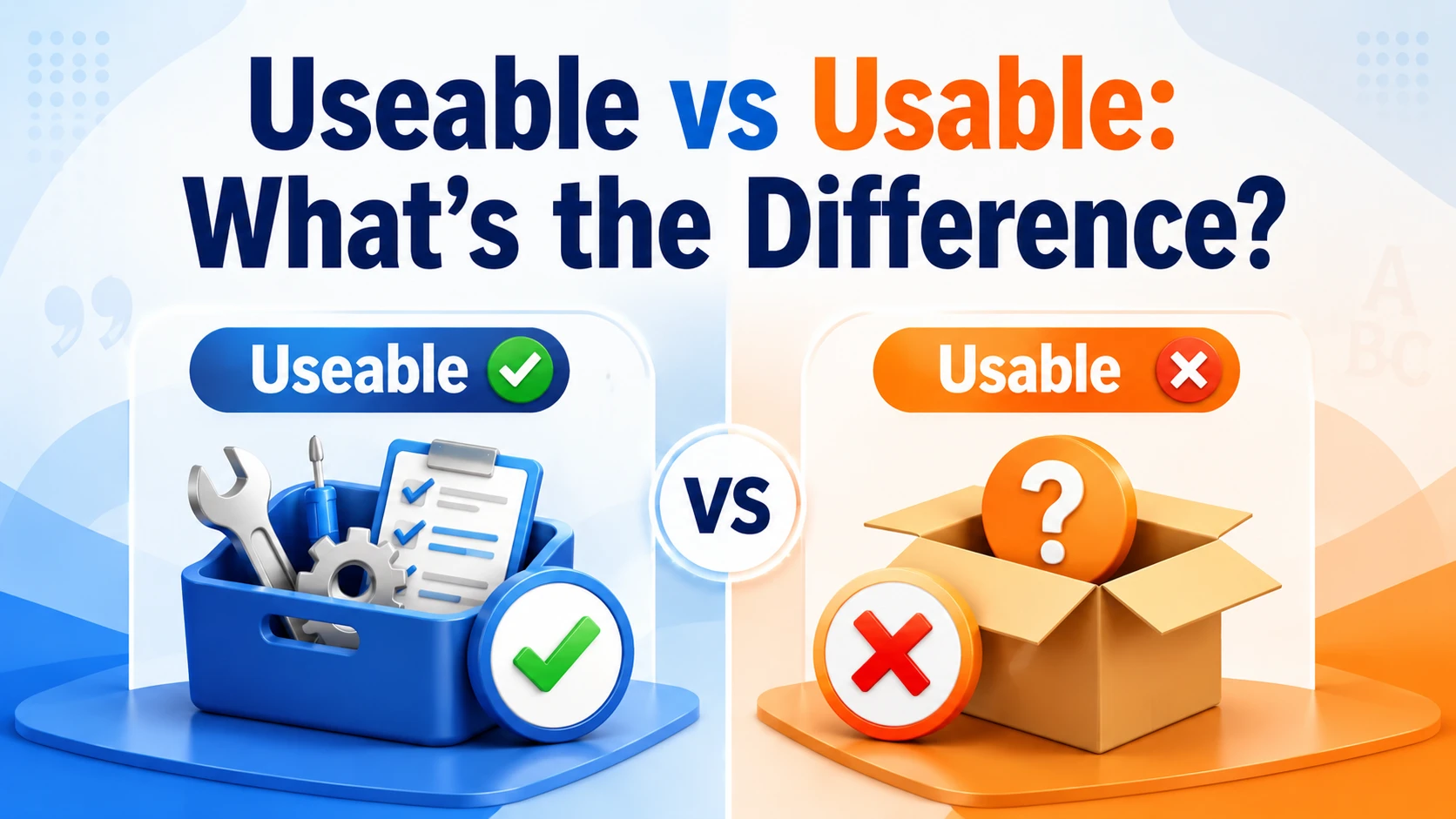
Useable vs usable is a spelling question that often causes unnecessary confusion because both forms appear in English. The important point is that they are not two completely different words with different meanings. Both can describe something that can be used. However, usable is the standard and more widely preferred spelling in modern English, especially in edited, academic, technical, and professional writing. Merriam-Webster lists useable as a less common variant of usable, while Cambridge and Oxford prominently list usable as the standard form.
The confusion comes from the way English forms adjectives with -able. Writers naturally see use + able and expect useable. That spelling looks logical because the base word already ends in e. Yet English spelling does not always follow a simple add-the-suffix rule. In this case, usable removes the final e before -able. The result is pronounced the same way as useable, which makes the difference almost invisible in speech.
So, which one should you choose? In most situations, choose usable. It means capable of being used, suitable for use, or practical enough to use. Useable is not simply a meaningless typo, though. It is recognized as a less common variant. That distinction matters when you’re editing an article, writing a report, preparing academic work, or deciding whether a spelling should be corrected.
Useable vs Usable: The Quick Answer
The simplest answer is this: usable is the preferred spelling, while useable is a recognized but less common variant. Merriam-Webster explicitly gives useable as a less common variant under usable.
Both forms generally carry the same meaning:
- Usable = capable of being used.
- Useable = also capable of being used, but less common.
- Usable = the safer choice for most formal and professional writing.
- Useable = may appear in dictionaries, publications, or individual writing, but usually isn’t necessary when usable works perfectly well.
| Feature | Usable | Useable |
| Basic meaning | Capable of being used | Capable of being used |
| Standard modern choice | Yes | Less common variant |
| Pronunciation | /ˈjuːzəbəl/ | Essentially the same |
| Formal writing | Preferred | Usually avoid unless a source/style requires it |
| Technical writing | Preferred | Less common |
| Academic writing | Preferred | Less common |
| Informal writing | Common | Possible |
| Dictionary recognition | Yes | Recognized as a variant by some dictionaries |
Is “Usable” the Preferred Spelling?
Yes. Usable is the form you should normally choose.
Oxford defines usable as something “that can be used” or something in good enough condition to be used. It also gives unusable as its opposite.
For example:
The old laptop is slow, but it is still usable.
Here, usable tells the reader that the laptop remains suitable for its intended purpose.
Is “Useable” Correct or Incorrect?
Calling useable simply “wrong” would be too strong.
Merriam-Webster lists useable as a less common variant of usable.Cambridge also has a pronunciation entry for useable, confirming that the form exists in English usage.
The practical distinction is therefore preference rather than meaning.
If you’re deciding between the two for an essay, website, report, manual, or business document, usable is usually the better choice.
What Does “Usable” Mean?
Usable is an adjective meaning that something can be used, is fit for use, or is in a condition that makes its intended use possible.
Cambridge gives the basic meaning as “that can be used.” Oxford similarly defines it as something that can be used or is in good enough condition to be used.
The word can describe physical objects:
- a usable chair
- a usable computer
- usable equipment
- usable furniture
It can also describe less tangible things:
- usable data
- usable information
- usable space
- usable evidence
- usable resources
- usable time
That flexibility makes usable particularly common in business, technology, research, engineering, education, and everyday conversation.
Definition and Core Meaning
At its heart, usable answers a practical question:
Can this thing actually be used for its intended purpose?
Something doesn’t have to be perfect to be usable.
A damaged table might still be usable. An old computer might still be usable. A rough dataset might contain enough usable information for a particular analysis.
Consider:
The printer is old, but it is still usable.
The sentence doesn’t say the printer works perfectly. It simply says it remains functional enough to use.
How “Usable” Describes Something Fit for Use
There is an important difference between usable and new, perfect, or even useful.
A product can be:
- old but usable,
- unattractive but usable,
- difficult but usable,
- limited but usable,
- incomplete but usable.
For instance:
The damaged road is still usable by small vehicles.
The road may not be ideal. Yet it remains suitable for a particular purpose.
This distinction is useful in professional writing because usable often describes practical availability, not quality.
Example Sentences With “Usable”
Here are several natural examples:
- The damaged equipment is no longer usable.
- We need to find a usable alternative.
- Only half of the collected data was usable.
- The room is small but perfectly usable.
- The designer created a more usable interface.
- Is this file still usable?
- The old furniture remained usable after the move.
- We don’t have enough usable evidence to support the claim.
- The software should be usable on older devices.
- The remaining water isn’t usable for drinking.
Notice how the word works across different subjects without changing its fundamental meaning.
Common Collocations With “Usable”
Some combinations sound especially natural because English speakers frequently use them together.
| Phrase | Meaning |
| usable data | Data suitable for analysis or another purpose |
| usable space | Space that can effectively be used |
| usable information | Information that can actually serve a purpose |
| usable condition | A condition in which something can be used |
| usable product | A product suitable for practical use |
| usable interface | An interface people can operate effectively |
| usable resources | Resources available and suitable for use |
| usable evidence | Evidence that can meaningfully support a purpose |
This is one reason usable is so common in technical and professional contexts.
What Does “Useable” Mean?
Useable generally carries the same meaning as usable: something that can be used.
The spelling comes from a very understandable assumption. A writer sees the verb use and the suffix -able and combines them as:
use + able = useable
That construction looks perfectly reasonable.
And that’s precisely why the spelling persists.
Definition and Relationship to “Use”
The base word is use. When English forms an adjective meaning “capable of being used,” writers may naturally preserve the e:
use → useable
However, the more established modern spelling is:
use → usable
The two forms therefore overlap in meaning rather than representing two separate concepts.
Why the Extra “E” Appears
The extra e isn’t random.
English contains many words where a final silent e interacts with suffixes in different ways. Writers therefore can’t always predict the spelling simply by attaching -able.
Compare:
- use → usable
- value → valuable
- move → movable
- advise → advisable
- debate → debatable
The spelling of derived words depends partly on established English usage and word history rather than a single universal mechanical rule.
Example Sentences With “Useable”
You may encounter sentences such as:
The damaged material is still useable for small repairs.
Or:
We found several useable parts inside the old machine.
These sentences are understandable, and useable can be found in English usage. But if you’re writing fresh copy and have no reason to preserve the variant, usable is generally the cleaner choice.
Usable vs Useable: Why Are There Two Spellings?
The existence of both spellings is largely a result of English spelling patterns and the productivity of the -able suffix.
English has borrowed and developed words from many sources over centuries. Its spelling system contains patterns that sometimes overlap rather than fitting into one neat formula.
The Role of the Suffix “-able”
The suffix -able commonly forms adjectives meaning “capable of” or “suitable for.”
Examples include:
- read → readable
- understand → understandable
- accept → acceptable
- rely → reliable
- comfort → comfortable
When writers encounter use, it is natural to think that useable should follow the same pattern.
But usable became the established spelling in standard modern usage.
Why Some Words Keep the Final “E”
The spelling behavior of final e isn’t completely uniform.
Consider:
- love → lovable
- move → movable
- use → usable
The final e is removed in these standard forms.
Yet English also has forms where spelling behavior can vary depending on the word, pronunciation, or historical development.
This is why learning individual established spellings remains important.
Why “Usable” Drops the Extra “E”
The standard spelling usable treats the final e in use as unnecessary before -able.
The result is shorter:
use + able → usable
That shorter spelling is now firmly established in dictionaries and common professional usage. Merriam-Webster’s current entry identifies usable as the main form and useable as less common.
How Pronunciation and Spelling Influence the Confusion
The biggest problem is that you usually can’t hear the difference.
Both spellings are pronounced essentially the same way.
Cambridge provides pronunciation information for both usable and useable, showing why spoken English doesn’t help much when you’re trying to choose the spelling.
That’s why this is primarily a writing problem, not a pronunciation problem.
Writing tip: If you learned the word by hearing it first, it’s easy to create useable because the spoken form gives you no clue about the missing e.
Is “Useable” a Misspelling?
Not necessarily.
This is where a good grammar guide should avoid an overly simplistic “right versus wrong” explanation.
Useable is recognized as a variant, but it is less common than usable. Merriam-Webster makes this distinction explicitly.
That means the best recommendation depends partly on your purpose.
When “Useable” Is Considered Acceptable
You may encounter useable when:
- quoting an older source,
- preserving someone’s original wording,
- discussing spelling variants,
- working with a house style that permits it,
- encountering a dictionary or publication that recognizes it,
- writing informally where strict standardization isn’t important.
If you see useable in an existing document, you shouldn’t automatically assume the writer doesn’t know English.
When “Usable” Is the Better Choice
Choose usable when you’re:
- writing an academic paper,
- preparing a professional report,
- creating technical documentation,
- publishing website content,
- writing a business proposal,
- editing formal copy,
- preparing educational material,
- writing for a broad international audience.
The reason isn’t that useable suddenly changes meaning. The reason is conventionality.
When two spellings mean the same thing, the more established form usually creates less friction for readers.
Why Context and Style Guide Matter
Professional writing isn’t only about whether a word can technically be found in a dictionary.
Editors also consider:
- consistency,
- audience expectations,
- house style,
- regional conventions,
- readability,
- established usage.
If an organization has a style guide that specifies usable, use usable consistently.
If you’re editing someone else’s work, avoid changing variants merely for personal preference unless the publication’s style or intended audience supports the change.
Usable vs Useable in American and British English
Neither American nor British English gives writers a compelling reason to replace usable with useable in ordinary modern writing.
The mainstream recommendation remains straightforward: usable is the safest choice.
American English Usage
In American English, usable is the familiar standard form.
It’s especially common in:
- software documentation,
- business writing,
- product descriptions,
- research,
- engineering,
- user-experience writing.
For example:
The new dashboard is more usable on mobile devices.
British English Usage
British English also commonly uses usable.
Oxford’s learner dictionaries list usable as the standard headword and define it as something that can be used or is in good enough condition to be used.
So this isn’t a situation where you need to switch between usable and useable simply because your reader is British or American.
Does Regional English Change the Recommendation?
Not in any important practical way.
If you’re writing for either audience and want the safest standard spelling, choose:
usable
The more interesting regional spelling differences tend to involve words such as color/colour, organize/organise, or center/centre. Usable/useable doesn’t function like that.
How Dictionaries Treat Usable and Useable
Dictionary treatment is particularly useful here because it shows why calling useable “wrong” is misleading.
Dictionary Recognition and Usage Labels
Merriam-Webster gives usable as the main entry and identifies useable as a less common variant.
Cambridge provides a pronunciation entry for useable, while its main English dictionary entry is usable.
Oxford’s learner dictionary likewise presents usable as the standard entry.
The combined evidence supports a practical conclusion:
Both forms exist, but they don’t have equal status in everyday modern writing.
Preferred vs Variant Spellings
A dictionary can recognize a spelling without recommending it as your first choice.
This distinction is crucial.
Think of dictionary entries as evidence about how English is actually used, not as a simple list where every listed form has identical frequency, style, or desirability.
For a writer, the question isn’t merely:
“Is this spelling found somewhere?”
A better question is:
“Which spelling should I use in this context?”
For most contexts, the answer is usable.
Why Dictionary Listings Do Not Always Mean Equal Usage
English dictionaries document variation.
A variant can be:
- rare,
- regional,
- old-fashioned,
- informal,
- technical,
- alternative,
- less common.
Therefore, seeing useable in a dictionary doesn’t mean you should treat it as equally preferable to usable.
How to Use “Usable” Correctly in a Sentence
The easiest way to use usable correctly is to connect it to something that can serve a practical purpose.
Usable for Objects, Tools, and Materials
The old toolbox is still usable.
Only a few of the damaged boards were usable.
The spare parts are usable despite their age.
Here, usable describes physical condition.
Usable for Software and Technology
Technology provides some of the most common modern uses of the word.
The application is fast but not very usable.
We need a more usable navigation system.
The update made the interface much more usable.
This is also where the related noun usability becomes important.
Usable for Information, Data, and Resources
Something doesn’t have to be physical to be usable.
The researchers collected enough usable data.
The report contains several usable insights.
We need more usable information before making a decision.
Here, usable means the information can actually serve the intended task.
Usable for Time, Space, and Capacity
The adjective can also describe practical availability:
We have only two hours of usable time.
The apartment has very little usable space.
The storage area provides more usable capacity than expected.
The underlying idea remains the same: something can actually be put to use.
How to Use “Useable” Correctly in a Sentence
If you choose useable, use it in the same semantic situations as usable.
For example:
The damaged equipment is still useable.
We recovered several useable components.
The remaining data was useable for the analysis.
The problem isn’t the meaning. The issue is that usable is the more conventional choice.
Situations Where the Variant Appears
Useable may survive because writers naturally connect use with -able.
It’s also possible to encounter it in:
- older texts,
- user-generated content,
- individual publications,
- variant spellings,
- quoted material.
Why It Can Look More Logical to Writers
There’s a strong visual reason for the confusion.
Writers already know:
use
and:
able
So:
use + able
appears to produce:
useable
The standard spelling requires a small adjustment that isn’t obvious from pronunciation.
This makes useable a predictable spelling formation, even though usable is the established preferred form.
When Choosing “Useable” May Create Unnecessary Distraction
Imagine you’re writing:
The system provides a useable interface.
The reader will understand it.
But if you’re producing polished professional documentation, there’s little benefit to choosing the less common spelling when usable is available.
Using usable removes a possible editorial question before it arises.
Usable vs Useable in Technology, UX, and Design
Technology is one area where usable has a meaning that goes beyond “not broken.”
A website can technically function while still being difficult to use.
What “Usable” Means in User Experience
In user-experience writing, usable often relates to whether people can successfully interact with a product or interface.
For example:
The website is attractive, but its checkout process isn’t very usable.
This doesn’t necessarily mean the checkout is broken.
It may mean that:
- navigation is confusing,
- buttons are difficult to find,
- instructions are unclear,
- the process takes too many steps,
- users struggle to complete tasks.
That distinction makes usable valuable in design discussions.
Usability vs Usefulness: What’s the Difference?
These words overlap but aren’t identical.
Usability concerns how effectively and easily something can be used.
Usefulness concerns whether something provides value or serves a purpose.
Consider a complicated piece of software.
It might be:
- highly useful but poorly usable,
- easy to use but not very useful,
- both useful and usable,
- neither useful nor usable.
| Term | Main question |
| Usable | Can people use it effectively? |
| Useful | Does it provide value? |
| Practical | Does it work well in real circumstances? |
| Accessible | Can people with different needs access and use it? |
| Functional | Does it perform its intended function? |
This distinction is especially helpful when writing about software, websites, products, tools, and services.
Examples From Websites and Software
The website is visually impressive but not very usable.
The new menu makes the application more usable.
The research tool provides usable results within seconds.
The mobile version is more usable than the desktop interface.
In these examples, usable communicates a practical judgment about how something performs in real use.
Usable vs Useable: Common Real-World Examples
The best way to internalize the difference is to see how the preferred spelling behaves across different fields.
Business and Workplace Writing
We need a usable report by Friday.
The spreadsheet contains several usable figures.
Please provide a usable version of the file.
Academic and Educational Writing
The study produced a small amount of usable data.
Students need access to usable learning materials.
The survey generated enough usable responses for analysis.
Technical Documentation
The device should remain usable after the update.
The manual provides a usable troubleshooting guide.
The software requires a usable network connection.
Product Descriptions
The bag has several pockets and a large amount of usable space.
The device includes a usable touchscreen.
Everyday Conversation
Is this old phone still usable?
The chair looks damaged, but it’s usable.
We have a usable spare room.
Professional and Formal Writing
In formal writing, consistency matters more than trying to defend every possible variant.
If you use usable in one section, don’t suddenly switch to useable later unless there’s a specific reason.
Common Mistakes With Usable and Useable
Mistake 1: Assuming the Extra “E” Is Always Required
A writer may think:
use + able = useable
That’s understandable, but it doesn’t give you the preferred modern spelling.
The standard form is:
usable
Mistake 2: Treating Both Spellings as Completely Interchangeable
They are close in meaning, but their usage status isn’t identical.
If you’re writing a polished document, choosing the more common form is sensible.
Mistake 3: Mixing Spellings Within the Same Document
This is a subtle editing problem.
Suppose a report says:
The software is highly usable.
Later, it says:
The new interface is more useable.
Even if both forms are understood, the inconsistency can make the document look poorly edited.
Pick one style and maintain it.
Mistake 4: Confusing “Usable” With “Useful”
These words aren’t always interchangeable.
The information is usable.
means it can be used.
The information is useful.
means it provides value.
Something can be usable without being particularly useful.
Mistake 5: Changing the Spelling Without Checking Your Style Guide
If you’re editing for an organization, publication, university, or technical team, follow its established style.
A house style can override your personal preference about variants.
Usable vs Useful: Why These Words Are Not Always Synonyms
This distinction deserves attention because writers sometimes substitute useful for usable.
What “Usable” Emphasizes
Usable emphasizes possibility and practicality of use.
The damaged machine is still usable.
It may not be good. It may not be efficient. But it can still be used.
What “Useful” Emphasizes
Useful emphasizes benefit or value.
The machine is useful for cutting small pieces of wood.
Here, the focus is what the machine helps you accomplish.
Compare “Usable,” “Useful,” and “Practical”
Consider these sentences:
- The room is usable.
- The room can be used.
- The room is useful.
- The room provides some valuable function.
- The room is practical.
- The room works well for a particular real-world purpose.
The differences are small in casual speech, but they become important in technical, academic, and professional writing.
Usable vs Useable: A Practical Decision Guide
When you’re unsure, don’t spend five minutes debating the extra e. Use a simple decision process.
Choose “Usable” When You Mean Fit for Use
If you mean:
- capable of being used,
- suitable for use,
- functional enough,
- practical to use,
choose usable.
Consider “Useable” Only When a Variant Is Appropriate
Use useable only when there’s a genuine reason to retain that spelling.
For example:
- you’re quoting a source,
- you’re preserving an author’s wording,
- you’re discussing spelling variants,
- your editorial style specifically permits it.
Otherwise, usable is the straightforward choice.
Follow the Required Style Guide in Professional Writing
If a client or publication has a style guide, follow it.
The purpose of style guidance is often to ensure that hundreds of pages maintain the same conventions.
Keep One Spelling Consistent Throughout a Document
Consistency is especially important in:
- manuals,
- websites,
- reports,
- books,
- academic papers,
- product documentation.
A consistent spelling looks deliberate. An accidental mixture looks like an editing oversight.
Usable vs Useable Example Sentences
Examples of “Usable” in Everyday Contexts
- The spare key is still usable.
- The damaged suitcase remains usable.
- Is this water usable for cleaning?
- We found a usable table at the warehouse.
Examples of “Usable” in Technology and Business
- The new dashboard is much more usable.
- The team needs usable data before the analysis begins.
- The document contains several usable recommendations.
- We need a more usable reporting system.
Examples of “Useable” as a Less Common Variant
- The damaged components were still useable.
- We found some useable materials in storage.
- The file contained enough useable information for the project.
These sentences aren’t difficult to understand. The point is simply that usable is the preferred modern form for most fresh writing.
Correcting “Useable” in Professional Sentences
Original:
The application needs a more useable interface.
Preferred:
The application needs a more usable interface.
Original:
We recovered several useable parts.
Preferred:
We recovered several usable parts.
Original:
The report contains useable information.
Preferred:
The report contains usable information.
The correction doesn’t change the meaning. It simply adopts the more conventional spelling.
A Quick Editing Checklist for Usable vs Useable
Before submitting your writing, ask:
| Question | What to do |
| Do I mean “capable of being used”? | Use usable |
| Am I writing formally? | Prefer usable |
| Am I writing technical documentation? | Prefer usable |
| Am I quoting someone? | Preserve the original if appropriate |
| Does my style guide specify a spelling? | Follow the style guide |
| Have I used both spellings? | Choose one and make the document consistent |
| Am I confusing “usable” with “useful”? | Check the intended meaning |
Best practice: When there is no special reason to preserve the variant, usable is the cleanest choice.
Conclusion
Usable vs useable isn’t really a battle between two words with different meanings. Both forms can describe something that can be used, but usable is the standard and preferred spelling for most modern writing. Merriam-Webster recognizes useable as a less common variant, while Oxford and Cambridge prominently use usable. The safest choice is therefore simple: write usable in academic, professional, technical, and general-purpose English unless you have a specific reason to preserve useable. One final actionable tip: when editing, search your document for both spellings and standardize them. A common mistake to avoid is assuming that a dictionary-recognized variant is automatically the best choice in every context. In polished writing, the familiar spelling usually wins: usable is the form to reach for first.
Frequently Asked Questions
Q1. Is “useable” a correct English word?
Yes. Useable is recognized as a spelling variant, although it is less common than usable. Merriam-Webster lists useable as a less common variant under usable. Therefore, it isn’t accurate to describe it as meaningless or universally incorrect. For most new writing, however, usable is the preferred choice.
Q2. Which is more common, “usable” or “useable”?
Usable is more common and is the standard form presented by major learner dictionaries such as Oxford and Cambridge. Merriam-Webster also treats useable as less common. If you want the spelling most readers expect in modern edited English, choose usable.
Q3. Should I use “usable” in formal writing?
Yes. Usable is the safest choice for formal writing, including academic papers, professional reports, business communication, and technical documentation. Useable can be recognized, but choosing the more established spelling avoids unnecessary questions about correctness and gives your writing a more consistent editorial appearance.
Q4. Is “useable” accepted in British English?
Useable can occur in British English, but usable is the standard spelling you should normally choose. Oxford’s British English learner dictionary lists usable as the main form. There is therefore no practical need to use useable simply because you’re writing for a British audience.
Q5. Why is “usable” spelled without the second “e”?
The spelling reflects established English word formation rather than a simple rule of attaching -able to the complete base word. The final e in use is omitted in usable, creating the established spelling. Because both forms sound essentially identical, writers often retain the extra e by analogy with the base word.
