
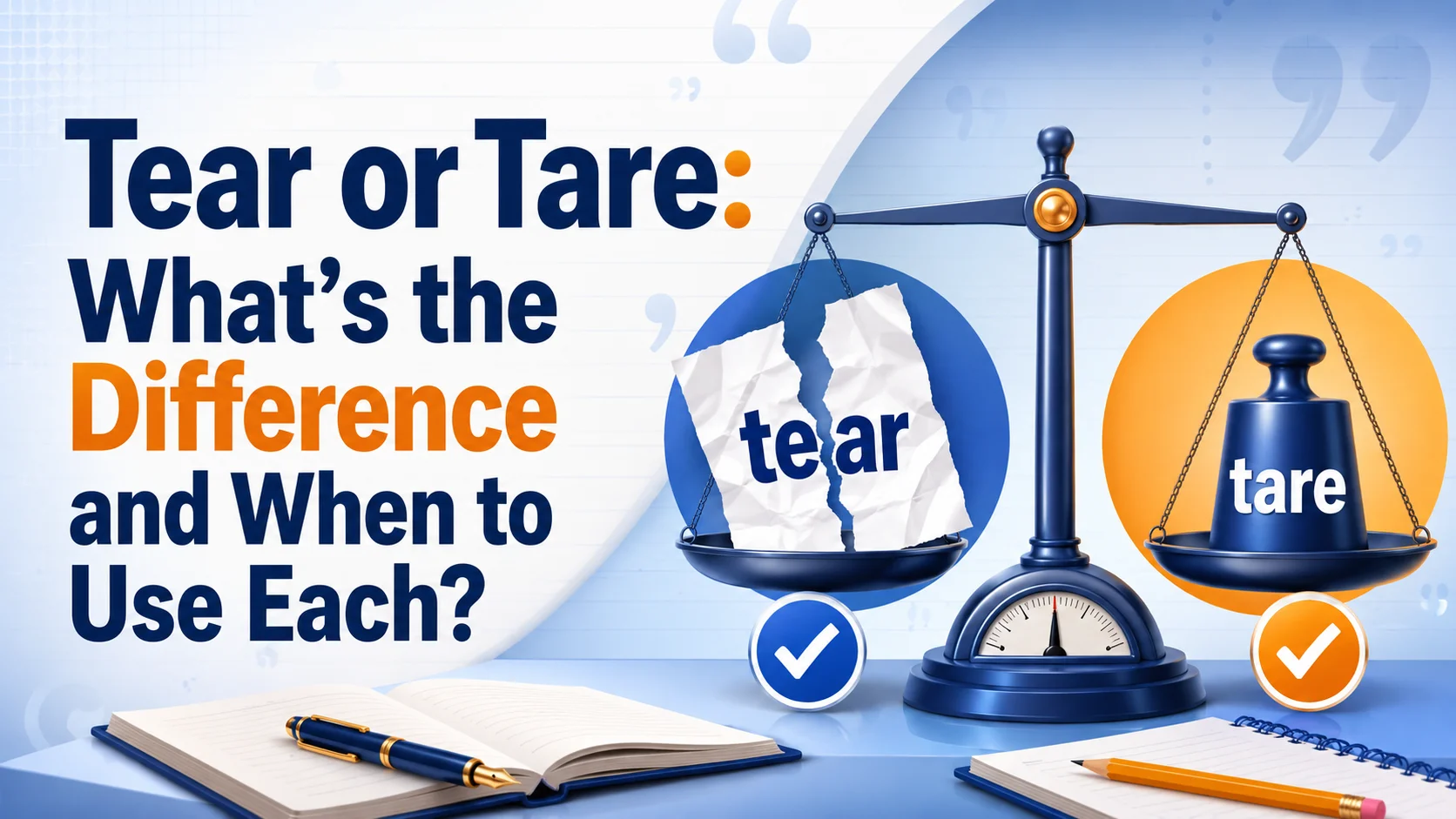
Tear or tare can be confusing because the two words can sound identical when tear means “rip.” Yet they refer to very different things. Tear is a common English word used for ripping, a hole in material, a drop from the eye, and even moving quickly. Tare, by contrast, is most often used in weighing to describe the weight of a container or packaging that must be excluded from the contents. Cambridge lists tare as the weight of an empty vehicle or container, while tear has several unrelated meanings and pronunciations.
The confusion becomes even more interesting because tear has two pronunciations. The verb tear meaning “rip” is pronounced /ter/ in American English and /teər/ in British English, while the noun tear meaning fluid from the eye has a different pronunciation, /tɪr/ in American English and /tɪər/ in British English. Tare is pronounced /ter/ in American English and /teər/ in British English, so it overlaps phonetically with the “rip” meaning of tear.
The good news is that you don’t have to guess from pronunciation. Meaning and context tell you which spelling you need. If you’re talking about ripping paper, damaging fabric, or a hole in a shirt, choose tear. If you’re discussing the weight of packaging, a weighing scale, or the amount subtracted from gross weight to calculate net weight, choose tare. This guide explains those distinctions, the word forms, pronunciation, technical terminology, common mistakes, and practical examples.
Tear vs. Tare at a Glance
| Word | Main meaning | Part of speech | Typical context | Example |
| tear | To pull something apart | Verb | Everyday English | Be careful not to tear the paper. |
| tear | A hole or damaged area | Noun | Clothing, paper, materials | There’s a tear in my jacket. |
| tear | Fluid from the eye | Noun | Emotion, pain, irritation | A tear rolled down her cheek. |
| tear | To move very quickly | Verb | Informal English | He tore down the road. |
| tare | Weight of an empty container or vehicle | Noun | Weighing, shipping, manufacturing | The tare weight is 3 kg. |
| tare | To account for container weight | Verb | Scales and measurement | Tare the scale before adding the ingredients. |
| tare | A type of vetch plant | Noun | Botany, agriculture, literary contexts | The field contained tare. |
The shortest rule
Tear = rip, a rip, eye fluid, or rush.
Tare = container weight or the weighing operation.
So:
- Tear the paper. ✅
- There is a tear in the paper. ✅
- She wiped away a tear. ✅
- Record the tare weight. ✅
- Tare the scale before weighing the contents. ✅
But:
- Tare the paper. ❌
- The tear weight of the package is 2 kg. ❌
The important point is that tear and tare aren’t alternative spellings of one word. They are separate words with different meanings.
What Does “Tear” Mean?
Tear has several dictionary meanings, which makes it substantially more versatile than tare. The context determines both its meaning and, in some cases, its pronunciation.
Tear as a Verb: To Rip or Pull Apart
The most familiar verb meaning is to pull something apart, damage it by pulling, or remove a piece from it.
For example:
- Don’t tear the page.
- I tore my shirt on a nail.
- She tore the envelope open.
- The children tore the wrapping paper apart.
Cambridge gives tear as a verb meaning to pull something apart or pull pieces from it, with the irregular past forms tore and torn.
The action can be deliberate:
He tore the letter into pieces.
Or accidental:
I tore my sleeve when I caught it on the door handle.
Tear as a Noun: A Hole or Damaged Area
Tear can also name the damage produced by tearing.
There’s a tear in my coat.
The document has a small tear near the corner.
She repaired the tear in the fabric.
Here, a tear means a hole, split, or opening created when something has been torn. Cambridge specifically identifies this noun meaning as a hole in paper, cloth, or another material.
This distinction is useful:
- tear as a verb → the action
- tear as a noun → the resulting damage
Compare:
I tore my jacket.
with:
My jacket has a tear.
Tear as a Noun: Fluid From the Eye
The second major noun meaning is completely different.
A tear is a drop of salty liquid produced by the eye. It may result from emotion, pain, irritation, or normal eye function.
Examples:
A tear ran down her cheek.
There were tears in his eyes.
The movie brought tears to her eyes.
Cambridge gives this meaning as a drop of salty liquid flowing from the eye, particularly in connection with strong emotion or pain.
Notice that the spelling stays tear, but the pronunciation changes.
Tear as a Verb: To Produce Tears
In some usage, particularly American English, tear can also be used as a verb meaning that the eyes produce tears:
My eyes tear when I cut onions.
This is different from tear meaning “rip.” Cambridge identifies this as a separate verb sense.
Tear as a Verb: To Move Quickly
There is another informal meaning that sometimes surprises learners: to tear can mean to move very quickly or rush.
She tore down the hallway.
He came tearing around the corner.
We were late, so we tore across town.
Cambridge includes this informal sense of tear meaning to move very quickly or rush.
This meaning is especially useful because it shows how broad tear can be. It isn’t limited to physical damage or crying.
Why Does “Tear” Have Two Pronunciations?
This is one of the biggest reasons tear causes confusion.
The spelling tear represents different words or senses that are pronounced differently.
“Tear” Meaning “Rip”
When tear means rip or pull apart, its pronunciation is approximately:
- US: /ter/
- UK: /teər/
So:
tear the paper
sounds like the word tare in the same accent.
“Tear” Meaning “Drop From the Eye”
When tear means a drop of fluid from the eye, its pronunciation is approximately:
- US: /tɪr/
- UK: /tɪər/
So:
a tear in her eye
does not sound like tare.
Cambridge distinguishes these pronunciations explicitly.
Why This Matters
You cannot determine the spelling of tear merely by hearing the word.
Imagine someone says:
“There is a tear in the fabric.”
You hear /ter/ or /teər/.
That pronunciation could correspond to:
- tear — a rip in the fabric
- tare — the weighing term
Only context tells you which spelling makes sense.
This is a classic example of why English spelling cannot always be reconstructed from pronunciation.
What Does “Tare” Mean?
Tare is a much more specialized word than tear. Its most important modern meaning appears in weighing and measurement.
Tare as a Weight
Tare weight is the weight of a container, packaging, vehicle, or other material that is not part of the product being measured.
Cambridge defines tare as the weight of an empty vehicle or container and also recognizes the weight of packaging material that is removed from the total to determine the net weight.
For example, suppose a box containing products weighs 12 kg in total.
If the empty box weighs 2 kg, then:
Gross weight = 12 kg
Tare weight = 2 kg
Net weight = 10 kg
The packaging is the tare.
Gross Weight, Tare Weight, and Net Weight
These three terms are worth learning together because they frequently appear in shipping, packaging, commerce, manufacturing, and weighing.
| Term | Meaning | Example |
| Gross weight | Total weight of contents plus container/packaging | 12 kg |
| Tare weight | Weight of the container or packaging | 2 kg |
| Net weight | Weight of the contents alone | 10 kg |
The basic relationship is:
Net weight = Gross weight − Tare weight
NIST describes the same relationship in weighing operations: the gross load consists of the tare load plus the net product load.
This isn’t merely vocabulary. In commercial weighing, getting the tare wrong can produce an incorrect net quantity.
What Does the “Tare” Button on a Scale Do?
If you’ve used a kitchen, laboratory, retail, or industrial scale, you’ve probably encountered the TARE function.
Suppose you’re weighing flour in a bowl.
- Place the empty bowl on the scale.
- The scale displays the bowl’s weight.
- Press TARE.
- The scale adjusts the displayed measurement so the bowl’s weight is excluded.
- Add flour.
- The displayed value represents the flour’s net weight.
The important concept is that tare accounts for the weight already on the scale.
NIST describes a tare operation as an operation that determines net weight by taking the tare weight into account during the weighing of a gross load.
Tare Is Not the Same as Calibration
This distinction matters in technical settings.
Taring adjusts the measurement to account for an existing load, such as a container.
Calibration is a broader process used to establish or verify measurement performance against a reference.
So if a kitchen scale says 0.00 after you place an empty bowl on it and press TARE, that doesn’t mean you’ve calibrated the scale. You’ve simply instructed it to account for the bowl’s weight.
Tare as a Verb
- Tare can also function as a verb in weighing contexts.
- Tare the scale before adding the ingredients.
- The operator tared the container before weighing the material.
The technician tared the balance before starting the measurement.
This use is much more likely in technical, laboratory, industrial, culinary, or measurement-related contexts than in ordinary conversation.
You probably wouldn’t say:
I tared my shopping bag.
unless you were specifically discussing a weighing procedure.
The specialized context makes the meaning clear.
Tare as a Plant Name
Tare has another, less common meaning: it can refer to certain plants in the vetch group.
This meaning is unlikely to be the one intended in ordinary questions about spelling, but it explains why tare is not simply “a technical word for container weight.”
If you encounter tare in an agricultural, botanical, or historical text, don’t automatically assume it refers to weighing.
Context remains decisive.
Tear vs. Tare: Side-by-Side Comparison
| Feature | Tear | Tare |
| Main everyday meaning | Rip or pull apart | Container/packaging weight |
| Another common meaning | Fluid from the eye | Weighing operation |
| Can mean a hole/damage? | Yes | No |
| Can mean “rush”? | Yes | No |
| Can be a noun? | Yes | Yes |
| Can be a verb? | Yes | Yes |
| Common in everyday conversation? | Very common | Relatively uncommon |
| Common in technical writing? | Sometimes | Very common in weighing contexts |
| Related to scales? | No | Yes |
| Related to packaging? | Sometimes, if packaging is torn | Yes, specifically its weight |
| Has multiple pronunciations? | Yes | No comparable meaning-based split |
| Past tense | tore | tared in the weighing sense |
| Past participle | torn | tared |
The key difference isn’t the spelling itself. The meaning determines the spelling.
Why Do People Confuse Tear and Tare?
They Can Be Homophones
In the pronunciation where tear means “rip,” it overlaps with tare.
For example:
tear the paper
tare the scale
The words can sound alike while having entirely different spellings and meanings.
This is the defining feature of many homophones: the spoken forms are identical or nearly identical in a given accent, but their meanings and spellings differ.
Other familiar examples include:
- pair / pear
- right / write
- brake / break
- flour / flower
Tear and tare are especially tricky because tear itself has another pronunciation.
Context Solves the Problem
If someone says:
“Put the container on the scale and tare it.”
The weighing context makes tare obvious.
If someone says:
“Don’t tear the label.”
The physical-action context makes tear obvious.
If someone says:
“She had a tear in her eye.”
The emotional context identifies the eye-related meaning of tear.
The practical lesson is simple:
When two words sound alike, don’t choose the spelling from sound alone. Identify the meaning first.
How to Choose Between Tear and Tare
Use the meaning-based test below.
If You Mean “Rip,” Use Tear
Please don’t tear the receipt.
The paper tore when I folded it.
She tore the package open.
If You Mean a Damaged Area, Use Tear
There’s a tear in my jeans.
The page has a small tear.
If You Mean a Drop From the Eye, Use Tear
A tear rolled down her face.
He wiped away a tear.
If You Mean Container Weight, Use Tare
The tare weight is printed on the container.
Subtract the tare from the gross weight.
If You Mean the Scale Function, Use Tare
Place the empty bowl on the scale and press tare.
If You Mean the Plant, Use Tare
Use tare when the surrounding context is botanical or agricultural.
Real-World Examples of Tear vs. Tare
Everyday Writing
I accidentally tore the corner of the page.
There’s a small tear in the envelope.
The movie brought a tear to her eye.
These are all ordinary uses of tear.
Shipping and Packaging
Suppose a shipment contains a product weighing 480 kg, while the packaging weighs 20 kg.
The measurements are:
- Gross weight: 500 kg
- Tare weight: 20 kg
- Net weight: 480 kg
A shipping document might therefore state:
Gross: 500 kg; Tare: 20 kg; Net: 480 kg
Writing tear weight here would be a spelling error because the document concerns weighing, not ripping.
Food Weighing
Imagine you’re measuring flour:
- Empty bowl: 650 g
- Bowl + flour: 1,150 g
- Flour: 500 g
The bowl’s 650 g is the tare.
After starting the scale, you can add the flour and read approximately 500 g directly.
Manufacturing
A manufacturer may weigh material inside reusable containers. The container’s weight needs to be excluded from the product measurement.
Here, tare is an essential technical vocabulary.
A document might contain:
Container tare: 4.25 kg
This is entirely unrelated to tear.
Clothing and Fabric
Now consider a different setting:
The seam developed a tear after repeated use.
This is ordinary material-damage vocabulary. Tare would be incorrect.
Common Mistakes With Tear and Tare
Mistake 1: Writing “Tare” When You Mean “Rip”
❌ Be careful not to tare the page.
✅ Be careful not to tear the page.
If an object is being pulled apart or damaged, use tear.
Mistake 2: Writing “Tear Weight”
❌ The tear weight of the box is 2 kg.
✅ The tare weight of the box is 2 kg.
The technical term is tare weight.
Mistake 3: Assuming “Tear” Always Has One Pronunciation
It doesn’t.
Compare:
tear = rip → /ter/ in US English
tear = fluid from the eye → /tɪr/ in US English
Cambridge distinguishes these senses and pronunciations.
Mistake 4: Confusing “Tare” With “Tear” in Technical Documents
In everyday writing, confusing these words may simply look like a spelling error.
In a measurement document, however, it can create a terminological error. Tare has a precise relationship with gross and net weight.
Mistake 5: Assuming Similar Sound Means Similar Meaning
English has many unrelated words that happen to sound alike. Their shared pronunciation doesn’t establish a semantic relationship.
Tear vs. Rip: Are They the Same?
Tear and rip overlap, but they aren’t interchangeable in every sentence.
Both can describe pulling material apart:
I tore the paper.
I ripped the paper.
Both are grammatical.
However, rip can sometimes emphasize force, speed, or a more abrupt action, depending on context.
Tear is also especially useful as a noun:
There is a tear in my shirt.
You can also say:
There is a rip in my shirt.
Both are natural, although individual speakers may prefer one based on context and dialect.
The important point for the tear/tare question is that rip belongs to the meaning of tear, not tare.
Tear: Important Verb Forms
The verb tear is irregular.
| Form | Word | Example |
| Base form | tear | Don’t tear the page. |
| Third-person singular | tears | The machine tears the material. |
| Past tense | tore | She tore the letter. |
| Past participle | torn | The letter was torn. |
| Present participle | tearing | He is tearing the paper. |
The past tense is tore, not teared, when you mean “rip.”
The past participle is torn, not tore.
So:
Yesterday, I tore my shirt.
But:
My shirt is torn.
Cambridge lists tore and torn as the irregular forms of the verb.
Don’t confuse the verb with the noun
Compare:
The paper tore.
Here, tore is the past tense of the verb.
There is a tear in the paper.
Here, tear is a noun.
Tare: Common Forms
The weighing verb is much less common than tear, but its forms follow a regular pattern:
- tare
- tares
- tared
- taring
Examples:
The operator tares the scale before each measurement.
The technician tared the container.
The balance is taring automatically.
In technical writing, however, you’ll often encounter the noun tare or the compound tare weight more frequently than the verb.
Tare Weight vs. Net Weight vs. Gross Weight: A Worked Example
Consider a sealed box of coffee.
The complete package weighs:
3.176 kg
The packaging weighs:
0.323 kg
Therefore:
Net = 3.176 − 0.323 = 2.853 kg
So:
| Measurement | Value |
| Gross | 3.176 kg |
| Tare | 0.323 kg |
| Net | 2.853 kg |
NIST uses this same conceptual relationship—Gross = Net + Tare—in its guidance on weighing operations.
One technical detail is worth knowing: displayed values can be rounded. NIST explains that digital scales may display gross, tare, and net values at the scale’s resolution, meaning the displayed rounded figures may not always add up exactly even when the underlying measurements do.
That is an important distinction in professional measurement: apparent arithmetic discrepancies can sometimes result from rounding, not an incorrect tare operation.
Is Tare Only Used for Weighing?
No.
The most relevant modern meaning for general readers is the weight of a container or packaging, but tare also has a botanical meaning associated with vetch plants.
That means context can change the interpretation.
If you read:
The tare weight is marked on the container.
you are clearly in a weighing context.
If you read:
The field contained tare.
you may be looking at the botanical meaning.
For everyday spelling questions, however, tare = weighing/container weight is the meaning most readers need to remember.
Tear vs. Tare in British and American English
The spellings tear and tare do not change between British and American English.
What can change is pronunciation.
For the “rip” meaning of tear, Cambridge gives:
- UK: /teər/
- US: /ter/
For tare:
- UK: /teər/
- US: /ter/
So in both varieties, tear meaning “rip” and tare can sound alike.
The eye-fluid meaning of tear, however, has a different pronunciation:
- UK: /tɪər/
- US: /tɪr/
This is why the spelling tear is particularly interesting: the same written form represents two pronunciations and different meanings.
Accent can change how a word sounds; it doesn’t turn “tare” into an alternative spelling of “tear.”
Tear and Tare in Professional Writing
Technical and Scientific Contexts
In technical contexts, tare has a specific measurement meaning. Writers should avoid replacing it with the more familiar tear simply because the words sound alike.
For example:
Tare weight: 1.75 kg
is precise technical terminology.
Shipping and Logistics
Shipping documentation may distinguish:
- gross weight
- tare weight
- net weight
These terms describe different components of a shipment’s measurement. NIST likewise treats gross, tare, and net as related quantities in weighing operations.
Academic Writing
In general academic writing, tear is much more likely to appear than tare unless the subject involves measurement, transportation, agriculture, or another specialized field.
A grammar paper might discuss:
The sentence contains a tear in the manuscript.
A logistics paper might discuss:
The tare weight must be recorded before calculating net load.
The subject area usually makes the choice obvious.
A Simple Decision Guide
| If you’re talking about… | Use | Example |
| Pulling paper apart | tear | Don’t tear the paper. |
| Damaging clothing | tear | I tore my sleeve. |
| A hole in fabric | tear | There’s a tear in my shirt. |
| Fluid from the eye | tear | A tear fell from her eye. |
| Rushing somewhere | tear | He tore down the street. |
| Container weight | tare | The tare weight is 2 kg. |
| Packaging weight | tare | Subtract the tare from the gross weight. |
| Scale function | tare | Tare the scale before weighing. |
| Certain plants | tare | The text refers to tare as a plant. |
The two-second test
Ask:
“Am I ripping, damaging, crying, or rushing?”
→ tear
“Am I weighing, packaging, or excluding container weight?”
→ tare
That distinction solves most real-world cases immediately.
Quick Practice: Tear or Tare?
Choose the correct word in each sentence.
- Be careful not to ___ the document.
- The empty container’s ___ weight is 750 grams.
- There was a small ___ in the curtain.
- Press ___ before adding the ingredients.
- A ___ rolled down her cheek.
- The truck’s ___ weight must be recorded.
- She ___ the letter into four pieces.
- The machine requires the operator to ___ the container first.
- He ___ down the hallway when he realized he was late.
- The fabric has a noticeable ___ near the seam.
Answers
- tear — pulling or damaging the document.
- tare — the container’s weight.
- tear — a hole or damaged area.
- tare — the scale operation.
- tear — fluid from the eye.
- tare — empty vehicle/container weight.
- tore — past tense of tear.
- tare — account for the container’s weight.
- tore — past tense of tear meaning rushed.
- tear — a damaged area in the fabric.
The exercise demonstrates why context is more reliable than pronunciation.
Memory Tricks for Tear vs. Tare
Tear = Rip
Picture a sheet of paper being pulled apart:
TEAR → RIP
That connects the everyday meaning with the spelling.
Tare = Take Away the Container
Use this as a mnemonic:
TARE → TAKE AWAY THE CONTAINER’S WEIGHT
It isn’t the historical origin of the word. It’s simply a practical memory aid.
Keep These Pairs Together
Memorize:
- tear the paper
- a tear in the paper
- a tear in the eye
- tare weight
- tare the scale
Learning the words inside familiar phrases is often easier than memorizing isolated dictionary definitions.
Quick memory rule: Tear affects the material; tare affects the measurement.
That isn’t true for every specialized meaning of either word, but it works exceptionally well for the two meanings that cause most everyday confusion.
Common Misconceptions
“Tear and tare are just two spellings of the same word.”
No. They are distinct words with different meanings.
“Tare means to rip.”
No. The spelling tare is used for weighing terminology and certain other specialized meanings.
“Tear always sounds like tare.”
No. The eye-fluid meaning of tear has a different pronunciation.
“Tare weight means the weight of the product.”
No. Tare refers to the container, packaging, vehicle, or other excluded weight. The product itself contributes to the net weight.
“Pressing TARE calibrates the scale.”
Not necessarily. Taring accounts for an existing load during a weighing operation. It should not automatically be described as calibration. NIST distinguishes tare operations as part of determining net weight.
Conclusion
Tear and tare are different words, not alternative spellings. Use tear when you’re talking about ripping something, a rip in material, fluid from the eye, or rushing. Use tare when you’re discussing container or packaging weight, gross and net weight, or the tare function on a scale. The distinction becomes much easier once you stop relying on sound and start identifying the intended meaning. One final actionable tip: whenever you hear a word that could be tear or tare, pause and ask what the sentence is actually describing. Ripping, damage, tears from the eyes, or rushing → tear. Weighing, packaging, or excluding container weight → tare. A common mistake to avoid is writing tear weight when you mean tare weight. In professional measurement contexts, that single letter changes a familiar word into a completely different term. Once you connect tare with measurement and tear with ripping or tears, the spelling becomes much easier to remember.
Frequently Asked Questions
Q1. What is the main difference between tear and tare?
Tear usually refers to ripping, a rip or damaged area, fluid from the eye, or rushing. Tare most commonly refers to the weight of a container or packaging that is excluded when calculating net weight. They can sound alike, but their meanings and spellings are different.
Q2. Are tear and tare homophones?
In the pronunciation where tear means “rip,” yes, they are pronounced alike in the relevant British and American forms. However, tear meaning fluid from the eye has a different pronunciation. This makes tear an especially tricky word for learners.
Q3. Is it “tare weight” or “tear weight”?
The correct technical expression is tare weight. It refers to the weight of an empty container, vehicle, or packaging material that is excluded from the gross weight to determine the net weight. Tear weight is not the standard term for this measurement.
Q4. What is the past tense of “tear”?
The past tense of tear meaning “rip” is tore, and the past participle is torn. For example: She tore the paper yesterday and The paper was torn in half. The form teared is not the standard past tense for this meaning.
Q5. What does “tare” mean on a digital scale?
Tare is a scale operation that accounts for the weight already on the weighing instrument, such as an empty bowl or container. After taring, the scale can display the net weight of the material added. NIST describes tare operations in terms of determining net weight.
