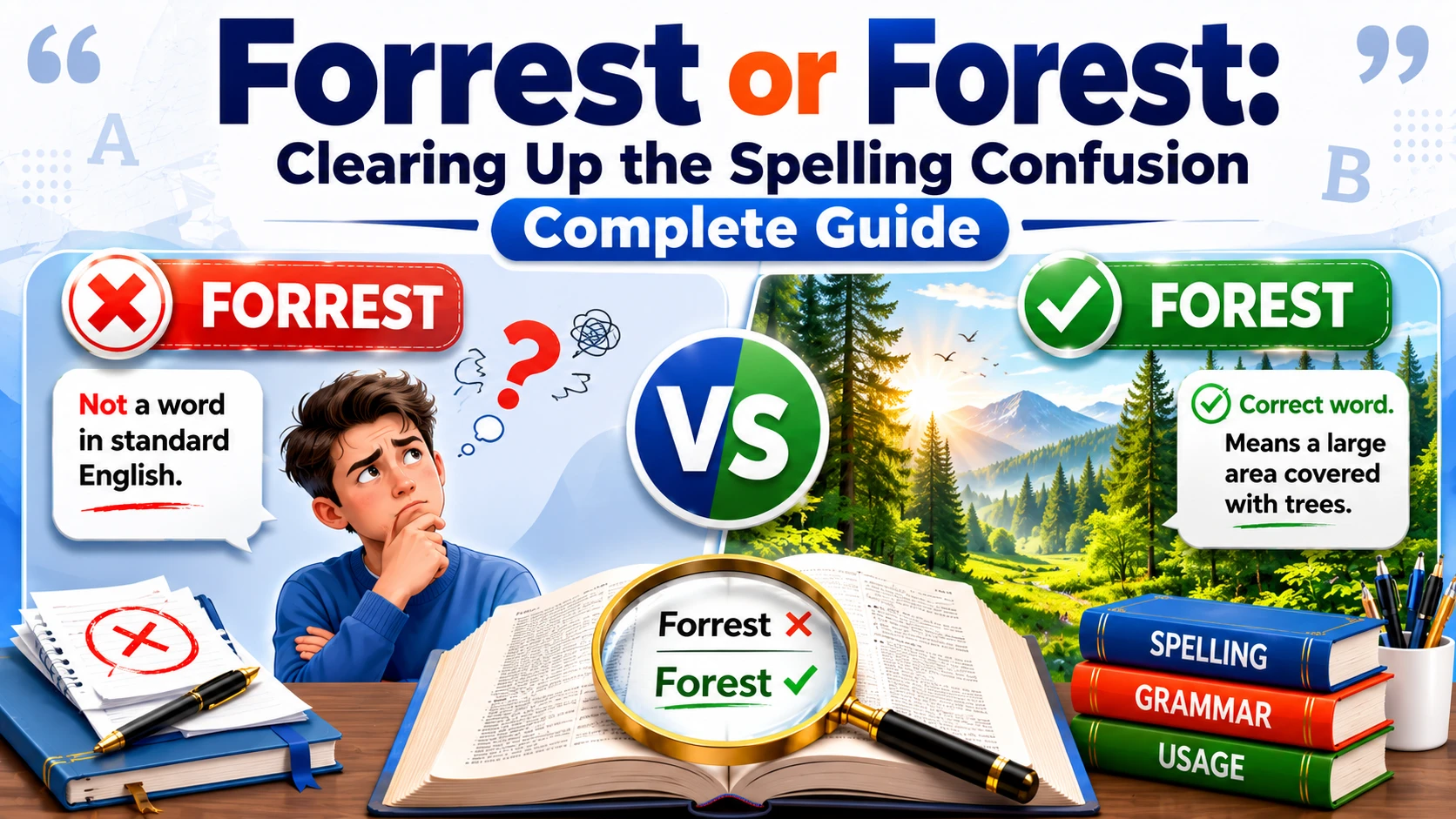
Forrest or forest can look like a tiny spelling difference, but the extra r can completely change what you mean. Forest is the standard English word for a large area covered with trees and undergrowth. Forrest, by contrast, is generally a proper name or surname. The two forms can sound very similar, which explains why writers sometimes hesitate when typing quickly. The good news is that you don’t need to memorize a complicated grammar rule. Once you connect each spelling with its usual role, the distinction becomes remarkably easy to recognize.
The confusion becomes especially noticeable when names, places, books, films, and ordinary English vocabulary appear in the same context. A sentence such as “Forrest walked through the forest” contains both spellings correctly, even though they differ by only one letter. That example captures the entire problem: Forrest identifies someone, while forest describes a wooded environment. This guide explains the difference, pronunciation, capitalization, word history, common mistakes, related vocabulary, and practical usage so you can choose the right form confidently in everyday and formal writing.
There is also an interesting historical reason the words feel connected. Forrest is associated with a surname meaning “forest,” so the similarity isn’t accidental. The English noun forest has a much older history, entering English through Anglo-French from Late Latin, while Forrest developed as a surname and later became a given name.By the end of this article, you’ll know not only which spelling is correct, but also why the two forms exist, when capitalization matters, and how context can solve the confusion instantly.
Quick Answer: Forrest or Forest?
If you’re referring to a large area covered with trees and undergrowth, use forest.
If you’re referring to a person’s first name or surname, use Forrest when that is the person’s established spelling.
| Word | Usual role | Meaning | Example |
| forest | Common noun | A large wooded area | We hiked through the forest. |
| Forrest | Proper noun | A person’s name or surname | Forrest joined us for lunch. |
The simplest rule is:
Forest = trees. Forrest = usually a person.
There is one important nuance. Forest can also be used as a personal name, so you shouldn’t assume that every person’s name connected with trees must contain two r’s. Names are individual spellings. If someone’s legal or established name is Forest, that spelling should be preserved.
Likewise, Forrest isn’t an alternative spelling you should use for ordinary woodland. Writing “We walked through the forrest” is normally a spelling error.
Forest vs. Forrest at a Glance
The difference is easier to understand when you separate meaning, grammar, and capitalization.
| Feature | Forest | Forrest |
| Basic meaning | A wooded area | Usually a person’s name |
| Part of speech | Mainly noun; also verb | Proper noun |
| Capitalization | Lowercase unless starting a sentence or part of a proper name | Usually capitalized |
| Common context | Nature, geography, ecology, travel | People, surnames, characters |
| Example | The forest was dense. | Forrest arrived early. |
| Standard spelling for woodland? | Yes | No |
The spelling difference
Forest contains one r:
F-O-R-E-S-T
Forrest contains two:
F-O-R-R-E-S-T
That additional r is not simply an optional spelling variation in standard English. It generally signals that you’re dealing with a proper name rather than the ordinary noun forest.
The capitalization difference
Capitalization provides another useful clue.
- forest → common noun
- Forrest → proper noun when used as a name
For example:
- We saw deer in the forest.
- Forrest saw the deer too.
The same sentence can therefore contain both forms without any contradiction.
What Does “Forest” Mean?
A forest is a large area characterized by trees and associated vegetation. Merriam-Webster defines the noun as a dense growth of trees and underbrush covering a large tract. It also records specialized historical and figurative meanings.
In ordinary modern English, however, you can usually think of forest as a substantial wooded area.
Forest as a noun
The noun is used in sentences such as:
- The hikers entered the forest before sunrise.
- A thick forest covered the hillside.
- The country is working to protect its remaining forests.
- We could hear birds throughout the forest.
Its plural form is forests.
Forest in environmental contexts
The word appears frequently in subjects such as:
- forestry
- ecology
- conservation
- biodiversity
- wildlife management
- climate and land use
- environmental science
For example:
Scientists are studying how rising temperatures affect forest ecosystems.
Here, forest is clearly an ordinary common noun. There is no reason to add a second r.
Forest as a verb
Less commonly, forest can also function as a verb meaning to cover land with trees or forest. Merriam-Webster records this use as well.
For example:
The organization plans to forest the degraded land.
In everyday writing, however, forms such as forested, reforest, and afforestation are more likely to appear.
How to Use “Forest” in a Sentence
The easiest way to use forest correctly is to ask whether you’re naming a wooded environment.
Everyday examples
- We spent the afternoon walking through the forest.
- The road disappears into the forest.
- A storm damaged several acres of forest.
- The cabin sits near a dense forest.
Academic examples
- The study examines changes in forest biodiversity.
- Researchers measured carbon storage across several forest ecosystems.
- Deforestation can significantly alter forest habitats.
Professional and environmental examples
- The agency introduced a new forest management plan.
- Local officials are monitoring the health of the forest.
- The company has committed to sustainable forest practices.
Figurative uses
Forest can also be used metaphorically when something appears in a dense or overwhelming quantity. Merriam-Webster gives examples such as a forest of microphones and a forest of skyscrapers.
For example:
A forest of antennas covered the rooftop.
Here, nobody means actual trees. The word is being used figuratively to describe something dense and numerous.
What Does “Forrest” Mean?
Forrest is primarily encountered as a proper name. It can function as a first name or surname.
Name references trace Forrest to an English surname meaning “forest,” originally associated with someone who lived near a forest. The surname is also treated as a variant of Forest.
That history explains why the two spellings are so closely related.
Forrest as a first name
Forrest can be used as a masculine given name.
For example:
Forrest moved to Chicago last year.
Because it is a person’s name, the first letter is capitalized.
Forrest as a surname
It can also appear as a family name:
Sarah Forrest works at the university.
Again, the capital letter isn’t optional. It identifies the word as a proper name.
Why “Forrest” isn’t normally the word for woodland
The fact that Forrest is historically connected with the meaning “forest” doesn’t make it an acceptable replacement for the common noun.
Compare:
- We explored the forest. ✅
- We explored the Forrest. ❌
The second sentence would only make sense if Forrest were the name of a particular person or named place.
Why Do People Confuse Forrest and Forest?
This is a classic example of a near-identical spelling pair. The difference is visually tiny, while the pronunciation may be very similar.
Similar pronunciation
In many varieties of English, forest and Forrest are pronounced similarly enough that listeners may not know which spelling is intended.
Merriam-Webster gives forest pronunciations including /ˈfȯr-əst/ and /ˈfär-/, while name references give Forrest pronunciations that are likewise very close.
That creates a practical problem: you can’t always solve the spelling from sound alone.
Names create visual confusion
English contains many surnames and given names derived from ordinary words.
Consider names such as:
- Hunter
- Baker
- Forest
- Forrest
- Taylor
- Cooper
Once a word becomes a proper name, its grammatical function changes even if its historical connection to the original word remains.
Famous references can reinforce the spelling
The name Forrest is particularly recognizable because of cultural references such as Forrest Gump. Name references note that the 1994 film’s title character helped increase use of the given name before its popularity later fluctuated.
This can make Forrest look familiar even to people who rarely encounter it as a personal name.
Forrest or Forest: Pronunciation Guide
The pronunciation is one reason this pair causes trouble.
How “forest” is pronounced
In American English, forest is commonly pronounced approximately:
FOR-ist or FOR-əst
The exact vowel quality varies by accent.
How “Forrest” is pronounced
The name Forrest is generally pronounced very similarly:
FOR-ist
Behind the Name lists American and British pronunciations that are close to those of the ordinary word.
Why pronunciation isn’t enough
Suppose someone says:
“I met Forrest yesterday.”
You can’t necessarily determine the spelling from the sound. You need the context or the person’s preferred spelling.
This is an important writing lesson: homophones and near-homophones often require contextual reasoning rather than sound-based spelling.
Forrest vs. Forest: The Key Difference in Meaning
The distinction becomes straightforward when you identify the role of the word.
Use “forest” when you’re talking about trees
The forest stretches for miles.
Here, forest identifies a landscape.
Use “Forrest” when you’re talking about a person
Forrest called me after the meeting.
Here, Forrest identifies an individual.
The fastest decision test
Ask:
“Am I naming a wooded area or a person?”
- Wooded area → forest
- Person named Forrest → Forrest
This works in most everyday situations.
Is “Forrest” Ever a Common Noun?
No. Forrest is not the standard common-noun spelling for a wooded area.
That distinction matters because dictionaries may document Forrest as a name, while forest is the ordinary lexical item used for woodland.
You may encounter lowercase forrest online as a typo. That doesn’t make it an accepted spelling.
Likewise, seeing Forrest in a person’s name doesn’t mean that the spelling can be transferred to ordinary nouns.
A proper name can preserve a spelling that would be incorrect for the ordinary word.
That’s a useful principle well beyond this particular pair.
Forest Word Forms and Related Grammar
Forest belongs to a larger family of words.
| Word | Meaning | Example |
| forest | A wooded area | The forest is protected. |
| forests | More than one forest | Several forests were surveyed. |
| forested | Covered with trees | The region is heavily forested. |
| forestry | The management and study of forests | She works in forestry. |
| reforest | Restore trees to land | The project will reforest the area. |
| reforestation | The process of restoring forest | Reforestation takes careful planning. |
| forester | A person who works with forests | The forester inspected the site. |
This word family provides a useful spelling clue. If you’re writing about forestry, forest management, reforestation, or forest ecosystems, you’re almost certainly working with the ordinary word forest, not the personal name Forrest.
Common Phrases and Collocations With “Forest”
Natural collocations can also help you recognize the correct spelling.
Common examples include:
- forest ecosystem
- forest floor
- forest fire
- forest management
- forest land
- forest habitat
- forest cover
- forest conservation
- forest wildlife
- forest resources
- forest products
- forest biodiversity
For example:
The researchers measured changes in forest cover.
Writing Forrest cover would be incorrect unless Forrest were somehow a proper name modifying another noun.
Common Mistakes With Forrest and Forest
Mistake 1: Adding an extra “r”
Incorrect:
We drove through a dense forrest.
Correct:
We drove through a dense forest.
The extra r isn’t an accepted alternative spelling of the noun.
Mistake 2: Removing the “r” from someone’s name
Incorrect:
Forest called me this morning.
If the person’s actual name is Forrest, changing it can create an inaccurate name.
Correct:
Forrest called me this morning.
Mistake 3: Forgetting capitalization
Incorrect:
I spoke with forrest yesterday.
Correct:
I spoke with Forrest yesterday.
Proper names are capitalized.
Mistake 4: Assuming every tree-related name uses “Forrest”
Not necessarily.
A person may actually be named Forest. In that case, changing the spelling to Forrest would be just as incorrect as changing any other person’s name.
Always preserve the established spelling of a proper name.
Forrest and Forest in Real-Life Contexts
Everyday conversation
We got lost in the forest.
The word describes a location.
Forrest got lost on the way home.
The word identifies a person.
School writing
If you’re writing about ecosystems, use forest:
A forest ecosystem contains interconnected plant and animal communities.
If you’re writing a biography about a person named Forrest, use Forrest:
Forrest became interested in history at an early age.
Business writing
The company purchased land near the forest.
But:
Forrest will lead the project.
Email writing
Hi, Forrest. Could you send the report?
Here, capitalization and spelling matter because you’re addressing a specific person.
Social media
If you’re tagging or mentioning someone, use their exact name:
Great meeting you, Forrest!
Changing the spelling could prevent the correct person from being identified.
Forrest vs. Forest: Correct and Incorrect Examples
| Intended meaning | Correct | Incorrect |
| Wooded area | We walked through the forest. | We walked through the forrest. |
| Person’s name | Forrest sent the email. | Forest sent the email. (if his name is Forrest) |
| Forest-related science | Forest conservation matters. | Forrest conservation matters. |
| Family name | Emma Forrest signed the document. | Emma forest signed the document. |
| Multiple wooded areas | The country has many forests. | The country has many forrests. |
The only caveat is personal naming: if a person’s actual name is Forest, then Forest is correct for that person.
When Should You Capitalize “Forrest”?
Capitalization depends on whether the word is being used as a proper name.
Capitalize it as a person’s name
Forrest lives nearby.
Capitalize it as a surname
James Forrest submitted the application.
Lowercase the ordinary noun
The animals live in the forest.
What about named places?
A place containing Forest may require capitalization because the entire expression is a proper place name.
For example, if an official place is called Forest Park, both words may be capitalized because they form a proper name.
This is different from:
We visited a forest park.
Here, the phrase may simply describe the type of park.
Context determines capitalization.
The History Behind “Forest” and “Forrest”
The connection between the spellings is more interesting than it first appears.
The history of “forest”
Merriam-Webster traces forest through Middle English and Anglo-French to Late Latin forestis, with the historical sense associated with unenclosed woodland. It records the noun’s first known use in English in the 13th century.
Etymonline similarly traces the word to late 13th-century English and Old French forest, with connections to Medieval Latin and the idea of land outside an enclosed or protected area.
Historically, forest could carry a more specialized legal and royal meaning. It wasn’t simply a generic term for every collection of trees. Certain forests were lands subject to particular rules, especially royal hunting regulations.
Modern English gradually broadened the everyday meaning.
The history of “Forrest”
Forrest developed as a surname connected with the word forest. Behind the Name describes the surname as a variant of Forest and explains that it originally referred to someone who lived near a forest.
That surname later became a given name.
So the relationship can be simplified like this:
forest → surname Forrest → given name Forrest
That doesn’t mean the two spellings are interchangeable today. Historical relationships explain why they look alike, not how you should use them in a modern sentence.
Can “Forrest” and “Forest” Ever Be Used Interchangeably?
No, not when you’re following standard modern spelling conventions.
You shouldn’t choose between them based on personal preference when you’re writing the ordinary noun.
However, names introduce an important exception.
If a person is officially named Forest, write Forest.
If a person is officially named Forrest, write Forrest.
Names aren’t corrected simply because another spelling seems more historically familiar.
A practical example
Imagine two people:
- Forest Lee
- Forrest Lee
Their names may sound almost identical, but the spellings are different.
You should reproduce each person’s name exactly as established.
That is why the rule “Forrest always means a person” is useful but not absolute. The more precise rule is:
Forest is the standard common noun for woodland. Forrest is primarily a proper name. Forest can also be used as a personal name.
Forest vs. Forrest: A Simple Memory Trick
Try this:
Forest = one R, real trees
Think of the single r in forest as the ordinary spelling you use when talking about nature.
forest → trees
Forrest = two Rs, a person’s name
The extra r can remind you that you’re dealing with a name.
Forrest → person
This isn’t an etymological rule. It’s simply a memory device.
If you remember only one line, remember:
The forest has trees; Forrest is usually a person.
How Context Helps You Choose the Correct Spelling
When you’re uncertain, don’t stare at the two words in isolation. Look at the sentence.
“The ___ was dark and quiet.”
You mean a wooded area.
Answer: forest
“___ emailed me yesterday.”
You’re referring to a person.
Answer: Forrest if that is the person’s name.
“The country is losing its ___.”
You’re discussing woodland.
Answer: forest
“I spoke with ___ after class.”
You’re naming a person.
Answer: Forrest if that’s their spelling.
“The study examines ___ biodiversity.”
You’re discussing ecology.
Answer: forest
This contextual approach is more reliable than trying to remember pronunciation.
A Quick Decision Guide
| Ask yourself | If yes | Use |
| Am I talking about woodland? | Yes | forest |
| Am I talking about a person named Forrest? | Yes | Forrest |
| Am I discussing ecology or forestry? | Yes | forest |
| Am I writing someone’s surname? | Yes | Use the person’s exact spelling |
| Does the word form part of a proper place name? | Yes | Follow the official capitalization |
| Am I tempted to spell woodland “forrest”? | Yes | Stop and use forest |
Practice: Choose Forrest or Forest
Fill in each blank with the appropriate spelling.
- We spent the weekend hiking through the ______.
- ______ asked me to send the invoice.
- The researchers are studying ______ biodiversity.
- I spoke with Daniel ______ after the meeting.
- The road passes through several dense ______.
- ______ is a common surname connected historically with the word forest.
Answers
- forest
- Forrest if that is the person’s name
- forest
- Forrest if that is the person’s surname
- forests
- Forrest
The exercise demonstrates an important point: meaning and grammatical function determine the spelling more reliably than pronunciation.
Forrest vs. Forest: Cheat Sheet
| Situation | Correct choice |
| Large wooded area | forest |
| More than one wooded area | forests |
| Forest-related science | forest |
| Forest management | forest |
| Person named Forrest | Forrest |
| Surname Forrest | Forrest |
| Person actually named Forest | Forest |
| Typing “forrest” to mean woodland | Incorrect |
The three-second rule
Before choosing the spelling, ask:
1. Is this a wooded area?
Use forest.
2. Is this someone’s name?
Use the person’s exact spelling.
3. Am I unsure because they sound alike?
Use the surrounding context or verify the name.
Conclusion
The Forrest or forest confusion becomes much easier once you stop treating the words as competing spellings of the same ordinary noun. Forest is the standard English word for a large wooded area, while Forrest is primarily an established first name or surname. Their close relationship is historical, which explains the visual similarity, but modern usage gives them different jobs. One final actionable tip: when you’re writing quickly, identify the meaning before checking the letters—trees point you toward forest, while a person’s name requires that person’s exact spelling. A common mistake to avoid is assuming that every extra letter in a familiar name represents an acceptable spelling variation of the common word. In professional writing, accurate names matter just as much as accurate vocabulary. When in doubt, let context, capitalization, and the intended meaning settle the choice.
Frequently Asked Questions
Q1. Is “Forrest” a misspelling of “forest”?
Not necessarily. Forrest is an established personal name and surname, so it is perfectly correct when referring to someone who uses that spelling. It becomes a spelling error when you use Forrest as the ordinary English noun for a wooded area.
Q2. Can “Forest” be someone’s name?
Yes. Forest is also used as a personal name, and name references list it as a variant related to Forrest or as a name taken directly from the English word forest. If someone’s established name is Forest, don’t “correct” it to Forrest.
Q3. Why does Forrest have two r’s?
Forrest developed from a surname associated with the word forest, particularly for someone who lived near a forest. The doubled consonant became part of the surname’s established spelling and later its use as a given name.
Q4. Are Forrest and forest pronounced the same?
They can be very similar in pronunciation, particularly in American English. That similarity is why hearing the word may not tell you which spelling to write. When the word is a person’s name, check the person’s established spelling rather than guessing from pronunciation.
Q5. Which spelling should I use in formal writing?
Use forest when you mean a wooded area, including in academic, business, scientific, and professional writing. Use Forrest when reproducing a person’s name with that spelling. The safest approach is to determine the word’s intended meaning before typing it.
