
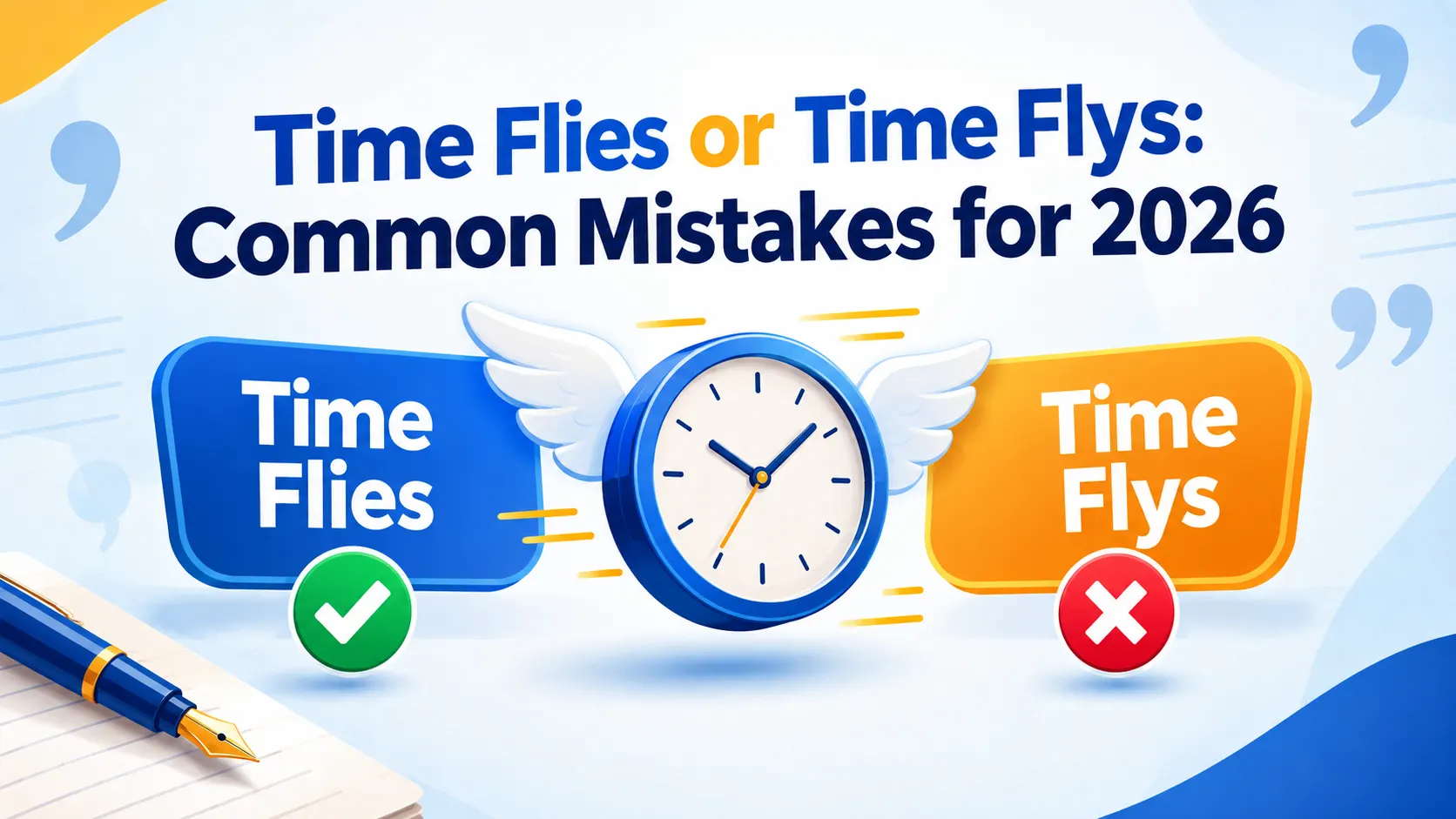
Time flies is the correct spelling in standard English; time flys is incorrect when you mean that time seems to pass quickly. The confusion comes from a small but important spelling rule: the verb fly changes to flies when it follows a singular third-person subject such as time. This is the same pattern seen in try → tries and carry → carries.
The phrase itself is an established English expression meaning that time passes surprisingly quickly. It can describe an enjoyable afternoon, a busy workday, a holiday, or simply the feeling that months and years have disappeared faster than expected. “Time flies when you’re having fun” is the familiar longer version, but time flies works perfectly well on its own.
If you have ever hesitated between flies and flys, the answer is straightforward—but the grammar behind it is worth understanding. This guide explains why flies is correct, when the phrase sounds natural, how fly changes with different subjects, why flys is such an easy mistake to make, and how to avoid similar spelling errors in your own writing.
Time Flies or Time Flys — Which Spelling Is Correct?
The correct expression is:
Time flies.
Not:
Time flys.
Flies is the third-person singular present-tense form of the verb fly. Oxford lists the present forms as I/you/we/they fly but he/she/it flies.
Because time is grammatically singular, it takes the singular verb form:
- Time flies.
- The day flies by.
- The year flies by.
- My vacation flies by.
By contrast, a plural subject takes fly:
- The days fly by.
- The years fly by.
- The weeks fly by.
So the issue is not a British-versus-American spelling difference. It is ordinary subject–verb agreement combined with an English spelling rule.
Quick answer at a glance
| Expression | Correct? | Explanation |
| Time flies | ✓ | Correct singular verb form |
| Time flys | ✗ | Incorrect spelling of the verb |
| Time fly | ✗ | Does not agree with singular time |
| Times fly | ✓* | Grammatically possible, but has a different meaning |
| The years fly by | ✓ | Plural subject takes fly |
*For example, Times fly when circumstances change would be grammatically possible, although it does not express the normal idiom time flies.
What Does “Time Flies” Mean?
Time flies means that time seems to pass very quickly.
Cambridge defines the expression as meaning that time passes surprisingly quickly, while Oxford gives the same core meaning and identifies time flies as a saying.
The expression is figurative. Time does not literally have wings and cannot physically fly. Instead, English uses the idea of rapid movement to describe how quickly a period seems to disappear.
Consider these situations:
- You start a two-hour movie, and suddenly the credits are rolling.
- You begin a new job and realize six months have passed.
- Your child starts school, and graduation seems to arrive unexpectedly soon.
- You take a short vacation and feel that it ended almost immediately.
In each case, you might say:
Time flies!
The phrase is especially natural when the speaker is surprised by how quickly a period has passed.
“Time Flies When You’re Having Fun” — What Does It Mean?
The longer expression “time flies when you’re having fun” suggests that enjoyable experiences can seem to pass particularly quickly.
For example:
We started playing at noon, and suddenly it was evening. Time flies when you’re having fun.
It does not mean that enjoyment literally accelerates time. It describes a subjective perception of elapsed time.
The shorter form can be used in exactly the same general situation:
We’ve already been here for three hours. Time flies!
Why Is “Time Flies” Correct but “Time Flys” Wrong?
The simplest explanation is grammatical:
Time + flies
Here, time is a singular third-person subject, so fly must appear in its third-person singular present form: flies. Oxford explicitly lists he/she/it flies as the present-tense form.
The spelling changes because fly ends in a consonant followed by y.
The basic spelling pattern
For many English verbs ending in consonant + y, the y changes to i before the ending -es:
- fly → flies
- try → tries
- cry → cries
- carry → carries
- study → studies
- hurry → hurries
That gives us:
Time flies.
Not:
Time flys.
The incorrect version comes from treating fly as though it behaved like a verb such as play.
When does a verb ending in Y simply take “-s”?
This is where the distinction becomes useful.
If a verb ends in vowel + y, the spelling normally keeps the y and adds -s:
- play → plays
- stay → stays
- enjoy → enjoys
- employ → employs
Compare:
| Base verb | Letter before Y | Third-person singular |
| fly | l — consonant | flies |
| try | r — consonant | tries |
| carry | r — consonant | carries |
| play | a — vowel | plays |
| enjoy | o — vowel | enjoys |
| stay | a — vowel | stays |
This is why flys looks plausible at first glance but does not follow the standard spelling pattern.
Understanding the Grammar of “Time Flies”
There are two separate ideas working together in time flies:
- Subject–verb agreement
- The spelling pattern for verbs ending in consonant + y
The subject is time.
The verb is flies.
Because time is singular, the verb must be the singular present form.
Think of the underlying sentence:
Time flies.
Now change the subject:
The days fly.
Nothing mysterious has happened. The verb changed because the subject changed from singular to plural.
Why is “time” singular?
Although time refers to an enormous abstract concept, grammar treats it as a singular uncountable noun in this construction.
We therefore say:
- Time flies.
- Time passes.
- Time moves quickly.
- Time seems short.
We do not normally say:
- Time fly.
- Time pass quickly.
- Time move quickly.
The same principle applies to other singular subjects:
The afternoon flies by.
My vacation flies by.
The semester flies by.
But:
The afternoons fly by.
Our vacations fly by.
The semesters fly by.
Time Flies vs Time Flys: A Clear Comparison
The difference is not one of meaning. Time flys is simply not the standard spelling of the intended expression.
| Feature | Time flies | Time flys |
| Standard English | Yes | No |
| Correct verb form | Yes | No |
| Subject | Singular time | Singular time |
| Meaning | Time seems to pass quickly | Intended meaning is usually the same, but spelling is incorrect |
| Suitable for formal writing | Yes | No |
| Suitable for casual writing | Yes | No |
| Correct idiom | Yes | No |
If you are writing an email, essay, article, caption, card, or professional message, use time flies.
How to Use “Time Flies” Naturally in a Sentence
The expression is flexible, but it is most natural when the speaker is reflecting on elapsed time.
Simple everyday examples
Time flies when you’re having fun.
I can’t believe it’s already Friday. Time flies.
We graduated ten years ago. How time flies!
The children have grown so much. Time flies.
My vacation is almost over already. Time flies.
More natural, context-rich examples
We spent the entire afternoon talking, and before we knew it, it was dinner time. Time flies when you’re with good friends.
I started this job last January, and now I’m already preparing for my first annual review. Time flies.
The baby was only six months old when we took that picture. Time flies!
Notice that the expression often appears after a realization or observation about elapsed time. That is part of what makes it sound natural.
“How time flies!”
How time flies! is a particularly natural exclamation.
For example:
How time flies! It seems like only yesterday that we moved here.
Here, how expresses surprise at the degree to which time appears to have passed quickly.
“Time Flies” vs “Time Flies By”
These expressions are closely related, but flies by puts slightly more emphasis on the process of passing.
Time flies.
Time flies by.
Both can mean that time seems to pass very quickly.
Cambridge gives examples such as My vacation seems to have flown by this year and The years fly by.
The addition of by often makes the movement metaphor more vivid:
The summer flew by.
The years have flown by.
The afternoon just flew by.
The spelling remains flies, never flys, when the subject is singular and the verb is in the present tense.
Time Flies in Different Tenses
One useful way to avoid confusion is to notice that flies is only one form of fly.
The verb changes depending on tense and grammatical structure.
| Tense/form | Example |
| Base form | Time can fly when you’re busy. |
| Present, singular | Time flies when you’re busy. |
| Present, plural | The days fly by. |
| Past | Time flew by. |
| Present perfect | Time has flown by. |
| Continuous | Time is flying by. |
| Infinitive | It seems to fly by. |
This explains another common mistake: flies, flew, flown, and flying are different forms of the same verb.
Oxford lists flew as the past tense and flown as the past participle.
For example:
Last summer, time flew by.
The past few months have flown by.
Time is flying by.
You should not substitute flys for any of these forms.
Common Mistakes With “Time Flies”
1. Writing “Time Flys”
Incorrect:
Time flys when you’re having fun.
Correct:
Time flies when you’re having fun.
This is the central spelling mistake addressed by this article.
2. Writing “Time Fly”
Incorrect:
Time fly so quickly.
Correct:
Time flies so quickly.
Fly is the base form, but a singular present-tense subject requires flies.
3. Confusing “Flies” With “Flys”
English has many verbs where adding -s is straightforward:
play → plays
work → works
walk → walks
That pattern can lead writers to produce flys. But fly belongs to the consonant + y pattern, so the spelling changes to flies.
4. Confusing “Flies” With the Plural Noun
Flies can also be the plural of the noun fly, meaning insects. Cambridge lists flies as the plural noun form of fly.
Compare:
The flies are annoying.
Here, flies is a noun.
Time flies quickly.
Here, flies is a verb.
The pronunciation is the same, but the grammatical role is different.
Why People Get Confused About “Time Flies”
The mistake is understandable because several English rules intersect in one short phrase.
First, learners often remember a general rule that says:
“For he, she, and it, add -s.”
That rule is useful, but incomplete. Some verbs require spelling changes.
Second, the base verb fly remains visually recognizable inside flies, but the spelling changes enough to make the transformation less obvious.
Third, other familiar verbs ending in y behave differently:
play → plays
enjoy → enjoys
This creates a reasonable-looking analogy:
fly → flys
Unfortunately, the analogy is wrong because fly ends in consonant + y, while play ends in vowel + y.
The better way to remember the rule
Don’t memorize time flies as an isolated phrase.
Learn the pattern:
consonant + y → ies
Then you can apply it to:
- fly → flies
- try → tries
- cry → cries
- reply → replies
- identify → identifies
That is more useful than memorizing one spelling mistake.
Is “Time Flies” British or American English?
Time flies is standard in both British and American English.
There is no meaningful US-versus-UK spelling split in this expression. Oxford’s American English dictionary also gives he/she/it flies, and Cambridge likewise treats time flies as a standard English expression.
So if you are wondering whether Americans should write time flys while British writers use time flies, the answer is no.
Both varieties use:
Time flies.
Regional differences can matter for many English words, but this is not one of those cases.
Is “Time Flies” Correct in Formal Writing?
Yes.
There is nothing grammatically incorrect or inherently informal about time flies. The expression can appear in ordinary conversation, personal writing, professional communication, and other contexts.
However, tone and precision still matter.
In a reflective article:
Time flies when you’re building a career.
sounds natural.
In a highly technical report where the exact duration matters:
The project period lasted six months.
may be more precise.
The distinction is not about correctness. It is about purpose.
Choose “time flies” when:
- You are expressing personal reflection.
- You want natural, conversational English.
- You are emphasizing how quickly a period seemed to pass.
- The exact duration is already understood.
Choose a literal alternative when:
- Exact timing matters.
- You need objective wording.
- The document is highly technical.
- You are reporting measured duration rather than perception.
Style tip: Don’t replace an established idiom merely because you assume formal writing must avoid idioms. Consider the audience and purpose first.
“Time Flies” vs Similar Expressions
Several expressions describe the rapid passage of time, but they are not always interchangeable.
| Expression | Main idea | Typical use |
| Time flies | Time seems to pass very quickly | General reflection |
| Time flies by | Time passes quickly | Stronger sense of movement |
| Time goes by quickly | Time passes quickly | More literal |
| Time passes quickly | Time moves from one point to another rapidly | Neutral/formal |
| The days fly by | Days seem to disappear quickly | Specific period |
| Before I knew it | Something happened sooner than expected | Narrative/conversation |
For example:
Time flies when you’re enjoying yourself.
The weekend went by quickly.
Before I knew it, Monday had arrived.
These expressions overlap, but their tone and structure differ.
When “Time Flies” Does Not Mean the Same Thing as “Time Moves Fast”
Time flies normally describes how quickly time seems to pass.
That element of perception matters.
Compare:
Time flies when you’re having fun.
with:
The clock moves quickly.
The first expresses a human impression of elapsed time. The second sounds much more literal and unusual unless there is a specific physical or metaphorical context.
Cambridge specifically defines fly in its time-related sense as to seem to pass quickly, which captures this distinction.
So when someone says:
Time flies!
they are usually not making a scientific claim about the speed of time. They are commenting on their experience of its passage.
Why “Time Flies When You’re Having Fun” Is So Common
The expression has become familiar because it captures a recognizable experience in very few words.
Imagine two situations.
Situation A: You spend two hours waiting in a boring airport.
You may feel:
That was a long two hours.
Situation B: You spend two hours talking with close friends.
You may say:
Time flies when you’re having fun.
The clock measures the same amount of time, but the experience of that period can feel very different.
This is why the phrase works so well in everyday English. It communicates both elapsed time and subjective experience.
Easy Ways to Remember “Flies,” Not “Flys”
If you regularly make this mistake, use a short pattern rather than relying on visual memory.
Memory trick: Fly + ies
Think:
FLY → FLIES
The Y changes to I before -es.
Then connect it with similar verbs:
TRY → TRIES
CRY → CRIES
FLY → FLIES
Another useful contrast is:
PLAY → PLAYS
FLY → FLIES
Why?
Because play has a vowel before y, while fly has a consonant before y.
A quick self-check
When you write flys, stop and ask:
“Is the letter before Y a vowel or a consonant?”
In fly, the letter before y is l, a consonant.
That points you toward:
flies
Quick Practice: Flies or Fly?
Try these before checking the answers.
- Time ___ when you’re having fun.
- The years ___ by so quickly.
- She ___ home every weekend.
- The afternoon ___ by when we’re busy.
- Birds ___ south for the winter.
- My vacation ___ by every year.
- The days ___ past when we’re traveling.
- He ___ to London every month.
Answers
- flies
- fly
- flies
- flies
- fly
- flies
- fly
- flies
The key is the subject.
Time flies.
The years fly.
She flies.
Birds fly.
Once you focus on the subject instead of simply remembering the phrase, the pattern becomes much easier to apply.
A Practical Editing Checklist for “Time Flies”
Before publishing a sentence containing time flies, run through this quick check:
- Is “time” the subject?
- Is the sentence in the present tense?
- Is “fly” functioning as the verb?
- Is the subject singular?
- Have you changed y to i and added -es?
- Does the sentence mean that time seems to pass quickly?
- Would “time flies by” or “time goes by quickly” express your meaning more naturally?
If all the answers line up, time flies is the form you want.
Expert tip: Learning the underlying spelling rule is more valuable than memorizing one correct phrase. The same rule will help you with tries, cries, carries, replies, and many other verbs.
Conclusion
The difference between time flies and time flys comes down to a small spelling rule with a wider lesson for English learners. Time is singular, so the present-tense verb is flies, not fly or flys. The same consonant + y → ies pattern appears in words such as tries, cries, and carries. One final actionable tip: when you are unsure, identify the subject before changing the verb. That habit will solve many subject–verb and spelling problems at once. A common mistake to avoid is assuming every verb ending in y simply takes -s. Learn the pattern, and time flies becomes easy to get right.
Frequently Asked Questions
Q1. Is “time flies” grammatically correct?
Yes. Time flies is grammatically correct because time is a singular subject and flies is the third-person singular present form of fly. Dictionaries also recognize time flies as an established expression meaning that time seems to pass very quickly.
Q2. Is “time flys” ever correct?
Not when you mean the standard expression time flies. Flys is not the standard third-person singular present form of fly. The correct form is flies, following the spelling pattern used with verbs ending in consonant + y.
Q3. Why does “fly” become “flies”?
When a verb ends in consonant + y, the y commonly changes to i before the third-person singular ending -es. Thus, fly becomes flies, just as try becomes tries and carry becomes carries.
Q4. Can I say “time flies by”?
Yes. Time flies by is completely natural and emphasizes the rapid passage of time. You can also say the years fly by, the weekend flew by, or the months have flown by. The verb form changes with tense and subject, but flys is not used.
Q5. Is “time flies” suitable for formal writing?
Yes, although context determines whether it is the best stylistic choice. Time flies is standard English, but a formal report discussing measured duration may be clearer with wording such as the six-month period passed quickly. The choice depends on precision, audience, and tone.
