
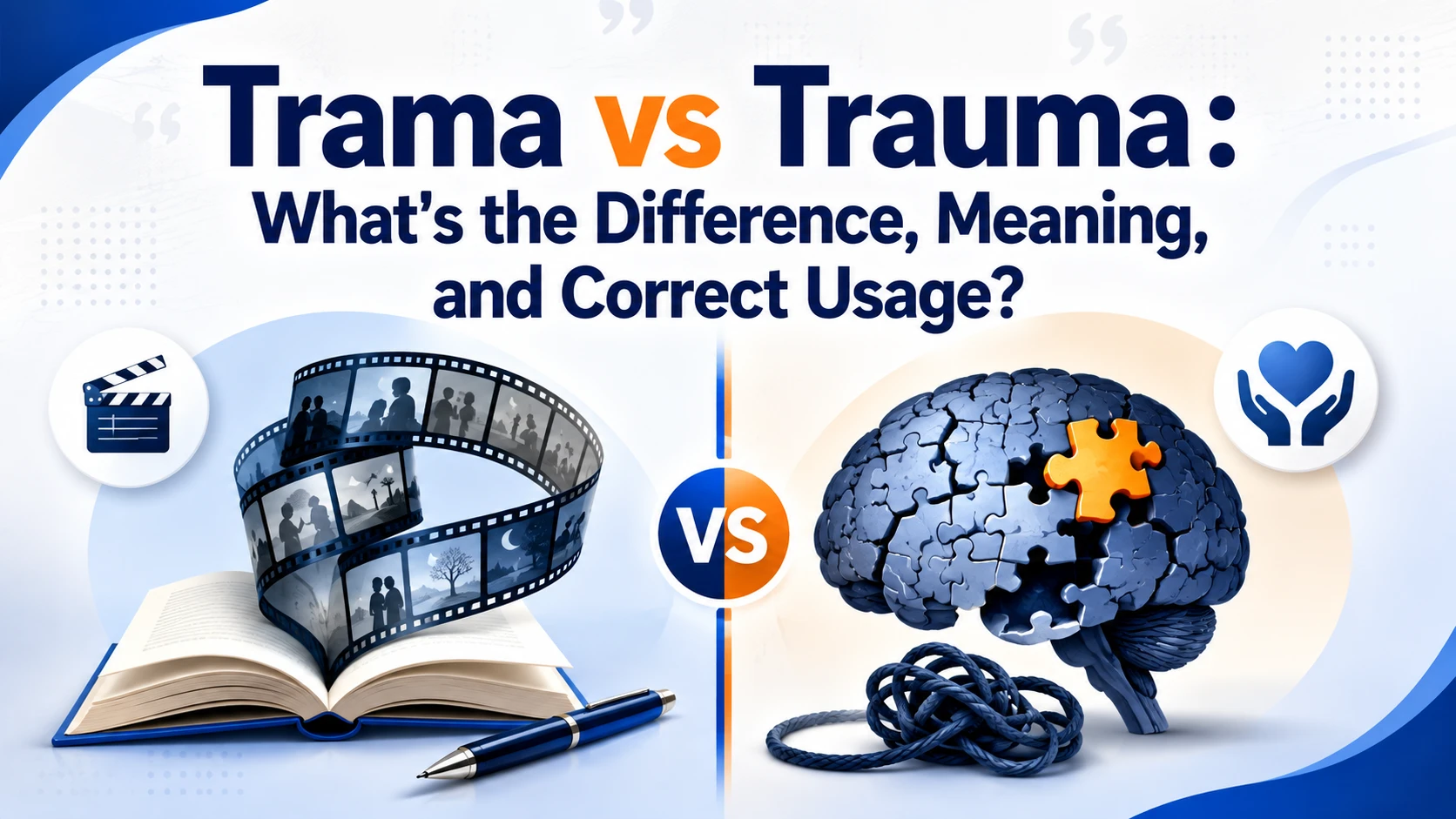
Trama vs Trauma is a common spelling question, especially among English learners and multilingual writers. At first glance, the two words differ by only one letter, yet they have completely different meanings. In English, trauma refers to a serious physical injury or a deeply distressing emotional experience. Trama, on the other hand, is generally not an English word. It appears in other languages, such as Spanish and Italian, where it often means plot, storyline, or, in textile terminology, the weft of woven fabric. Knowing which word belongs in which context helps you communicate accurately.
The confusion usually happens because people type quickly, mishear the pronunciation, or translate directly from another language. Someone discussing psychological trauma might accidentally omit the letter “u”, while a bilingual writer may use trama because it is correct in Spanish or Italian. These small mistakes can change the meaning of a sentence and reduce the credibility of academic papers, professional emails, healthcare documents, and online content. Learning the difference is therefore more than a spelling lesson—it’s a matter of writing with precision.
This guide explains everything you need to know about trama vs trauma. You’ll discover the correct meaning of each word, learn when trama is appropriate outside English, understand why people confuse the two terms, and see practical examples from everyday writing. You’ll also find comparison tables, memory techniques, and expert tips that make the distinction easy to remember, ensuring you use the right word with confidence in every situation.
Trama vs Trauma: The Quick Answer
If you’re writing in English, the answer is straightforward:
- ✅ Trauma is the correct English word when referring to a physical injury, psychological distress, or emotional harm.
- ✅ Trama is correct only in specific non-English contexts, such as Spanish, Italian, or textile terminology.
- ❌ Do not replace trauma with trama in English writing.
Which Spelling Is Correct in English?
In standard English, trauma is the accepted spelling.
Examples:
- She experienced emotional trauma after the accident.
- The hospital specializes in treating severe trauma cases.
- Childhood trauma can influence adult behavior.
Writing trama instead of trauma in these sentences creates a spelling error because the words are not interchangeable in English.
When Is “Trama” Correct?
Although trama is incorrect in most English contexts, it is a legitimate word in several other languages and technical fields.
For example:
- In Spanish, trama often means plot or storyline.
- In Italian, it can also refer to a plot or the weft of fabric.
- In textile weaving, trama refers to the horizontal threads (weft) woven through the warp.
The correct word depends entirely on the language and subject you’re discussing.
Quick Comparison Table
| Feature | Trauma | Trama |
| Standard English word | ✅ Yes | ❌ Usually No |
| Meaning in English | Physical or emotional injury | Not used with this meaning |
| Used in psychology | ✅ Yes | ❌ No |
| Used in medicine | ✅ Yes | ❌ No |
| Used in Spanish | ❌ Different meaning | ✅ Plot or storyline |
| Used in textiles | ❌ No | ✅ Weft of woven fabric |
Quick Tip
If you’re discussing health, emotions, medicine, or mental well-being, the correct word is almost always trauma.
What Does “Trauma” Mean?
The word trauma has both medical and psychological meanings. Although the contexts differ, the core idea is the same: an event or injury that causes significant harm or lasting effects.
Depending on the situation, trauma may affect the body, the mind, or both.
Definition of Trauma
In English, trauma refers to:
- A serious physical injury.
- A deeply distressing emotional experience.
- The lasting psychological effects of a shocking event.
The exact meaning depends on the context.
Examples:
- The patient suffered chest trauma after the collision.
- Losing a loved one unexpectedly may cause emotional trauma.
- Early-life trauma sometimes affects relationships later in life.
Medical Meaning of Trauma
In medicine, trauma describes injuries caused by external force rather than illness.
Examples include:
- Broken bones after a fall.
- Head injuries from a traffic accident.
- Burns.
- Sports injuries.
- Penetrating wounds.
Healthcare professionals often use terms such as:
- Trauma patient
- Trauma center
- Trauma surgeon
- Traumatic injury
These phrases specifically relate to emergency medical care.
Psychological Meaning of Trauma
In psychology, trauma refers to the emotional response to an overwhelming or frightening experience.
Examples may include:
- Serious accidents.
- Natural disasters.
- Abuse or neglect.
- Military combat.
- Violent crime.
- Witnessing tragic events.
Not everyone responds to difficult experiences in the same way. An event that is traumatic for one person may not affect another person in exactly the same manner. Factors such as age, previous experiences, support systems, and resilience all influence how someone processes trauma.
Everyday Uses of “Trauma”
Outside medical settings, people often use trauma more broadly to describe experiences that have had a lasting emotional impact.
Examples:
- The financial crisis created significant stress and emotional trauma for many families.
- Moving away unexpectedly was surprisingly traumatic for the child.
- She sought professional help to work through past trauma.
However, it’s best to avoid using trauma to describe minor inconveniences, as doing so can minimize the seriousness of genuine traumatic experiences.
Expert Insight
In healthcare and psychology, trauma has a specific clinical meaning. In everyday conversation, the word is used more broadly, but it should still be reserved for experiences involving significant physical or emotional harm.
What Does “Trama” Mean?
Unlike trauma, trama is not a standard English word with a medical or psychological meaning. Instead, it belongs primarily to other languages and specialized fields.
Understanding these meanings helps multilingual writers avoid accidental mistranslations.
“Trama” in Spanish
In Spanish, trama most commonly means:
- Plot
- Storyline
- Narrative structure
Examples:
- La trama de la película fue emocionante.
- La novela tiene una trama compleja.
English translation:
- The movie’s plot was exciting.
- The novel has a complex storyline.
Notice that trama here has nothing to do with emotional injury or medical trauma.
“Trama” in Italian
Italian speakers also use trama to refer to:
- The plot of a book.
- The storyline of a film.
- The structure of a narrative.
Example:
- La trama del romanzo è coinvolgente.
Translation:
- The novel’s plot is engaging.
Again, the meaning relates to storytelling rather than health or psychology.
“Trama” in Textile Terminology
In textile manufacturing, trama refers to the weft—the horizontal threads woven across the vertical warp threads to create fabric.
This technical meaning appears in:
- Textile engineering
- Fabric production
- Weaving manuals
- Fashion manufacturing
Unless you’re discussing weaving or translating textile documents, you’re unlikely to encounter this usage in everyday English.
Why “Trama” Is Usually Incorrect in English
Many spelling mistakes occur because writers unknowingly substitute trama for trauma.
Common reasons include:
- Forgetting to type the letter u.
- Direct translation from Spanish or Italian.
- Autocorrect or typing errors.
- Confusing similar-looking words.
If you’re writing about:
- mental health,
- medicine,
- emotional experiences,
- physical injuries,
always use trauma, not trama.
Why People Confuse Trama and Trauma
Because trama and trauma differ by only one letter, they’re easy to mix up. The confusion is especially common among English learners, bilingual writers, and anyone typing quickly. However, the two words belong to different languages and carry different meanings. Understanding the reasons behind the mistake can help you avoid it permanently.
Missing the Letter “U” While Typing
The simplest explanation is a typing error.
When writing quickly, it’s easy to omit the “u”, turning trauma into trama. This happens frequently in emails, text messages, online forums, and social media posts.
Example:
- ❌ The accident caused severe trama.
- ✅ The accident caused severe trauma.
Proofreading before publishing or sending important documents is one of the easiest ways to catch this mistake.
Similar Pronunciation in Fast Speech
In casual conversation, some speakers pronounce trauma so quickly that the “u” sound becomes less noticeable. As a result, listeners may assume the word is spelled trama.
This is a reminder that English spelling doesn’t always match pronunciation. When you’re unsure, check the dictionary or think about the word’s meaning rather than relying solely on how it sounds.
Influence of Spanish and Italian
Multilingual speakers often confuse the words because trama is a legitimate word in other languages.
For example:
- In Spanish, trama means plot or storyline.
- In Italian, trama has a similar meaning.
- In textile terminology, trama refers to the weft of woven fabric.
When writing in English, however, trauma is the correct choice whenever you’re referring to physical injuries or emotional distress.
Autocorrect and OCR Errors
Technology can sometimes contribute to the confusion.
Common causes include:
- Optical Character Recognition (OCR) misreading scanned text.
- Autocorrect replacing unfamiliar words incorrectly.
- Voice-to-text software producing spelling errors.
- Copying translated text without reviewing it.
Although these tools save time, they shouldn’t replace careful proofreading.
Writing Tip
If you’re writing about health, psychology, medicine, or emotional well-being, double-check that you’ve written trauma, not trama.
How to Use “Trauma” Correctly in English
The word trauma appears in many areas of English, including medicine, psychology, education, journalism, and everyday conversation. The context determines its exact meaning, but the spelling never changes.
Medical Examples
In healthcare, trauma refers to injuries caused by an external force rather than disease.
Examples:
- The patient was transported to a trauma center after the crash.
- Doctors treated multiple traumatic injuries following the accident.
- The emergency department specializes in severe trauma cases.
These examples focus on physical injuries requiring medical care.
Mental Health Examples
Mental health professionals use trauma to describe the emotional or psychological effects of distressing experiences.
Examples:
- Childhood trauma may affect relationships later in life.
- Therapy helped him process past trauma.
- The counselor specializes in trauma-informed care.
These examples highlight emotional recovery rather than physical injury.
Everyday Conversation Examples
Outside professional settings, trauma is often used to describe deeply upsetting experiences.
Examples:
- Losing her home was a traumatic experience.
- The community is recovering from the trauma caused by the disaster.
- He still remembers the emotional trauma of that event.
While the word is common in everyday speech, it should be reserved for genuinely serious situations.
Professional and Academic Writing Examples
You’ll frequently encounter trauma in research papers, news reports, and educational materials.
Examples:
- Researchers examined the long-term effects of childhood trauma.
- Hospitals continue improving trauma care for emergency patients.
- The article discusses psychological trauma after natural disasters.
Using the correct spelling is essential in academic and professional writing because it reflects attention to detail and accuracy.
When “Trama” Is the Right Word
Although trama is usually incorrect in English, it has legitimate uses in specific languages and technical fields.
Knowing these exceptions prevents overcorrecting words that are actually appropriate.
Discussing Books, Movies, or TV Shows in Spanish
If you’re writing in Spanish or quoting Spanish sources, trama refers to the plot or storyline of a creative work.
Examples:
- La trama de la novela es emocionante.
- La trama de la película mantiene al público interesado.
In English, these would be translated as plot or storyline, not trauma.
Referring to Textile Weaving
In textile terminology, trama means the weft, which consists of the horizontal threads woven through the vertical warp threads.
This specialized meaning appears in:
- Textile manufacturing
- Fabric design
- Weaving manuals
- Fashion production
Outside these industries, most English speakers rarely encounter this usage.
Using Foreign-Language Quotations
Sometimes you should preserve the original word trama when quoting or translating another language.
Example:
A literary review discussing a Spanish novel may intentionally retain trama to preserve the author’s wording or cultural context.
In these cases, changing trama to trauma would alter the intended meaning.
Common Collocations With “Trauma”
Certain words frequently appear alongside trauma. Learning these collocations helps you write naturally and understand how native speakers use the term.
Emotional Trauma
This phrase describes psychological harm resulting from distressing experiences.
Example:
- She sought counseling to recover from emotional trauma.
Physical Trauma
This collocation refers to bodily injuries caused by accidents or violence.
Example:
- The patient suffered severe physical trauma in the collision.
Childhood Trauma
This expression refers to distressing experiences during childhood that may have long-term effects.
Example:
- Researchers continue studying the impact of childhood trauma on adult health.
Traumatic Injury
This term is common in emergency medicine and describes an injury caused by external force.
Example:
- The surgeon specializes in treating traumatic injuries.
Trauma Recovery
This phrase refers to the process of healing after physical or emotional trauma.
Example:
- Support groups play an important role in trauma recovery.
Trauma-Informed Care
Trauma-informed care is an approach used in healthcare, education, and social services that recognizes how traumatic experiences can affect people’s behavior and well-being. It emphasizes safety, empathy, and appropriate support.
Example:
- Many healthcare organizations now provide trauma-informed care to improve patient outcomes.
Expert Tip
Learning common collocations is one of the fastest ways to sound more natural in English. Instead of memorizing trauma alone, practice complete phrases like emotional trauma, physical trauma, and trauma recovery.
Common Mistakes to Avoid
Although trauma is a familiar English word, writers still misuse it in certain situations. Most errors involve confusing it with trama, translating directly from another language, or using the word too broadly. Avoiding these mistakes will make your writing more accurate and professional.
Using “Trama” Instead of “Trauma” in English
The most common mistake is replacing trauma with trama.
❌ Incorrect:
- She experienced emotional trama after the accident.
- The doctor treated severe head trama.
✅ Correct:
- She experienced emotional trauma after the accident.
- The doctor treated severe head trauma.
Whenever you’re writing in English about health, psychology, or injuries, use trauma.
Assuming Both Words Mean the Same Thing
Because the words look similar, some people believe they’re interchangeable.
They are not.
- Trauma = physical or psychological injury (English)
- Trama = plot, storyline, or weft (Spanish, Italian, and textile terminology)
Choosing the wrong word completely changes the meaning of your sentence.
Misusing “Trauma” for Minor Inconveniences
In everyday conversation, people sometimes describe ordinary disappointments as trauma.
Examples:
- “My phone battery died. It was trauma.”
- “Waiting in line was traumatic.”
While these statements may be intended humorously, using trauma for trivial situations can minimize the seriousness of genuine physical injuries and psychological distress. Reserve the term for experiences involving significant harm or lasting emotional impact.
Translating Directly From Another Language
Bilingual writers occasionally translate trama directly into English without considering the context.
For example:
Spanish:
- La trama de la novela fue excelente.
Correct English translation:
- The plot of the novel was excellent.
Incorrect English translation:
- The trauma of the novel was excellent.
Always translate the meaning, not just the spelling.
Expert Tip
If you’re translating content, ask yourself whether the sentence refers to a story, fabric, or an injury. The answer will usually tell you whether the correct word is plot, trama, or trauma.
Memory Tricks to Remember the Difference
A simple memory device is often more effective than memorizing dictionary definitions. These tricks can help you distinguish trama from trauma at a glance.
The “U” Stands for Upsetting Experience
Focus on the extra letter.
TraUma
Think of U as standing for Upsetting or Unpleasant experience.
If the sentence involves emotional pain, mental health, or physical injury, remember that it needs the U.
Associate “Trama” With a Story Plot
Whenever you see trama, think of literature.
In Spanish and Italian, trama usually means:
- Plot
- Storyline
- Narrative
If someone is discussing a novel or movie in another language, trama is likely the correct word.
One-Sentence Mnemonic
Try this simple reminder:
“TraUma hurts you. Trama tells a story.”
Because the two words belong to different contexts, this sentence makes the distinction easy to recall.
Practice Sentences
Test your understanding with these short exercises.
Choose the Correct Word
Select the correct option.
- The firefighter received treatment for severe (trama / trauma).
- The Spanish teacher explained the novel’s (trama / trauma).
- Childhood (trama / trauma) can affect emotional development.
- The movie’s (trama / trauma) kept everyone interested.
Fill in the Blanks
Complete each sentence.
- The hospital opened a new __________ center.
- The detective admired the complex __________ of the mystery novel.
- Therapy helped her recover from emotional __________.
- The fabric’s __________ was carefully woven by hand.
Correct the Mistakes
Rewrite these sentences correctly.
- The accident caused serious trauma.
- The trauma of the English report focused on mental health.
- The Spanish novel had an exciting trauma.
- Doctors specialize in emergency trauma care.
Answer Key
Choose the Correct Word
- Trauma
- Trama
- Trauma
- Trama
Fill in the Blanks
- Trauma
- Trama
- Trauma
- Trama
Correct the Mistakes
- The accident caused serious trauma.
- The report focused on mental health trauma.
- The Spanish novel had an exciting trama (or plot in English).
- Doctors specialize in emergency trauma care.
Practicing with both words in different contexts helps reinforce their meanings and reduces the likelihood of future mistakes.
Similar Word Pairs People Commonly Confuse
Trama vs trauma is just one example of similar-looking words that often cause confusion. Learning other commonly mixed-up pairs can strengthen your spelling and vocabulary.
Affect vs Effect
- Affect is usually a verb meaning to influence.
- Effect is usually a noun meaning a result.
Examples:
- The weather affected our plans.
- The new policy had a positive effect.
Breath vs Breathe
- Breath is a noun.
- Breathe is a verb.
Examples:
- Take a deep breath.
- Remember to breathe slowly.
Stationary vs Stationery
These words sound the same but have different meanings.
- Stationary means not moving.
- Stationery refers to writing materials such as paper and envelopes.
Examples:
- The train remained stationary.
- I bought new stationery for work.
Principal vs Principle
Another frequently confused pair.
- Principal can mean main or the head of a school.
- Principle means a rule, belief, or fundamental truth.
Examples:
- The principal welcomed the students.
- Honesty is an important principle.
Learning Tip
Comparing commonly confused word pairs trains you to look beyond spelling similarities and focus on meaning, context, and usage. This habit improves both your writing accuracy and your overall command of English.
Conclusion
Understanding Trama vs Trauma becomes simple once you focus on meaning and context rather than spelling alone. Trauma is the correct English word for physical injuries, emotional distress, and psychological conditions, while trama belongs mainly to Spanish, Italian, and textile terminology. Recognizing this distinction helps you write more accurately, avoid translation errors, and communicate with confidence. One final actionable tip: Before using either word, ask yourself whether you’re discussing an injury or a story plot. That quick check will prevent most mistakes.
A common mistake to avoid: Never assume trama is an alternative English spelling of trauma. In standard English, it isn’t. By remembering these differences and practicing with real examples, you’ll use both terms correctly whenever the situation calls for them.
FAQs
Q1. Is trama an English word?
No. Trama is generally not an English word. It is used in languages such as Spanish and Italian, where it usually means plot, storyline, or weft in textiles. In English, use trauma when referring to physical or emotional injury.
Q2. Why do people confuse trama and trauma?
The confusion usually happens because the words look and sound similar. It can also result from typing errors, multilingual translation, or assuming that trama is simply an alternative English spelling of trauma, which it is not.
Q3. Can trama ever be correct in English writing?
Yes, but only in specific contexts. If you’re referring to a Spanish or Italian title, quoting foreign text, or discussing textile terminology, trama is appropriate. Otherwise, English writing should use the correct English equivalent, such as plot or trauma, depending on the context.
Q4. How can I quickly tell which word to use?
Ask yourself what the sentence is about. If it involves an injury, distress, medicine, or psychology, use trauma. If it refers to a story plot in another language or the weft of woven fabric, trama is the correct choice.
Q5. What is the easiest way to remember the difference?
Remember this simple rule: Trauma has the letter “U” for “Upsetting” experiences, while trama is linked to plots and textiles in other languages. If you’re writing in English about health or emotions, trauma is almost always the correct spelling.
