
Oversight vs. oversite can be confusing because the two words look and sound almost identical, yet they have different meanings. Oversight is the standard word used for supervision, monitoring, or responsibility, and it can also mean an accidental mistake or omission. Oversite, by contrast, is a specialized construction term used for a prepared layer or surface beneath a building floor in certain construction contexts. Choosing the wrong spelling can change the meaning of a sentence, particularly in business reports, technical documents, and construction specifications.
The most important distinction is the subject you are discussing. A manager may provide oversight of a project, while a contractor may refer to an oversite layer when describing building work. These words are not interchangeable, even though their pronunciation is similar. There is also a small complication: oversight has two meanings that may seem opposite. It can describe careful supervision, but it can also describe something that someone accidentally failed to notice.
Understanding oversight vs. oversite is easier when you connect each spelling with its context. This guide explains the meanings, grammatical uses, construction terminology, common mistakes, and practical examples of both words. You will also learn how to distinguish supervision from an unintended omission, choose the right word in professional writing, and remember the spelling without relying on pronunciation alone.
Quick Answer: Oversight vs. Oversite
Oversight is the correct word when you mean supervision, monitoring, review, or an accidental omission. Oversite is a specialized construction term referring to a prepared layer or surface beneath a floor in some building contexts. It is not a general alternative to oversight.
| Word | Meaning | Typical context | Example |
| Oversight | Supervision or monitoring | Business, government, healthcare, education | The committee provides oversight of the project. |
| Oversight | An accidental omission or failure to notice something | Everyday and professional communication | Forgetting the attachment was an oversight. |
| Oversite | A prepared layer or surface beneath a building floor in certain construction terminology | Building and construction | The specification describes the oversite concrete layer. |
Correct: The board provides financial oversight.
Incorrect for this meaning: The board provides financial oversite.
Correct in a construction context: The contractor prepared the oversite before the next stage of floor construction.
The rule is simple: use oversight for supervision or an unintended omission, and use oversite only when the specialized construction meaning is intended.
What Does Oversight Mean?
Oversight is a noun with two established meanings. It can describe the act of supervising or monitoring an activity, system, or organization. It can also describe an accidental failure to notice something, remember something, or include a necessary detail.
The intended meaning depends on the sentence.
For example:
- The committee provides oversight of the department.
Here, oversight means supervision. - Leaving the date off the form was an oversight.
Here, oversight means an accidental omission.
These meanings may initially seem contradictory. In the first sentence, someone is watching or reviewing a process. In the second, someone has failed to notice or include something. Both uses are standard English.
Oversight Meaning: Supervision and Monitoring
When oversight means supervision, it refers to the responsibility to watch over an activity, review decisions, monitor performance, or ensure that appropriate standards are followed.
It often appears in professional, institutional, and administrative contexts. A board may oversee a company’s operations, a government agency may monitor a regulated industry, and a committee may review how a project is managed.
Examples include:
- The board provides oversight of the company’s finances.
- Government oversight helps ensure that agencies follow applicable rules.
- The project requires careful oversight from senior management.
- The committee is responsible for oversight of the research program.
- Independent oversight can help identify weaknesses in a process.
In these examples, oversight does not necessarily mean that someone performs every task personally. It often describes a broader responsibility for monitoring, reviewing, or holding others accountable.
Oversight Meaning: An Accidental Mistake or Omission
Oversight can also mean an unintentional failure to notice, remember, or include something. This meaning is common in workplace conversations, emails, reports, and explanations of errors.
For example:
- Leaving your name off the document was an oversight.
- The missing attachment was an oversight on my part.
- The editor’s oversight allowed a small typo to remain in the final draft.
- We missed the deadline because of an administrative oversight.
- The report contained an oversight that we corrected before publication.
This use generally suggests that something was missed unintentionally. It does not automatically mean that the person was careless or deliberately ignored a responsibility.
Consider the difference between these two sentences:
Supervision: The manager provides oversight of the hiring process.
Omission: The manager’s failure to include the final document was an oversight.
The first describes a responsibility; the second identifies a missed detail.
Why Does Oversight Have Two Different Meanings?
The two meanings of oversight can be surprising because supervision and missing something appear to be opposites. However, the meanings are both established in English, and context usually makes the intended sense clear.
A sentence about a committee, manager, regulator, or review process usually uses oversight to mean supervision. A sentence about a forgotten attachment, omitted detail, missed step, or accidental error usually uses it to mean an omission.
Compare these examples:
| Sentence | Meaning of oversight | Clue |
| The agency provides oversight of the program. | Supervision | The agency monitors a program. |
| The missing signature was an oversight. | Accidental omission | A required detail was missed. |
| The board strengthened its oversight procedures. | Monitoring and review | Procedures support accountability. |
| Leaving the client off the email was an oversight. | Unintended mistake | Someone was accidentally excluded. |
You do not need a special rule to decide which meaning applies. Look at the surrounding words and ask whether the sentence describes watching over something or failing to notice something.
What Does Oversite Mean?

Oversite is a specialized construction term. In some building terminology, particularly in British construction usage, it refers to a prepared layer or surface beneath a floor, often involving concrete laid over prepared ground or a sub-base.
The precise construction and materials depend on the building design and specification. The term should not be treated as a universal name for every foundation, floor base, or concrete slab.
For example:
- The construction specification refers to an oversite concrete layer.
- The contractor completed the oversite preparation before the next stage of the floor installation.
- The builder checked the prepared oversite before continuing with the work.
These examples use oversite in a technical building context. In everyday writing, however, it is much more likely that a person who types oversite intends to write oversight.
Is Oversite a Real Word?
Yes. Oversite is a real but specialized term, rather than simply a universally incorrect spelling. Its use is associated with particular construction terminology, so its appropriateness depends on the subject and the terminology used in the relevant plans or specifications.
It is not the correct spelling when you mean supervision or an accidental omission.
For instance:
❌ Incorrect: The company improved its financial oversite.
✅ Correct: The company improved its financial oversight.
Why: The sentence concerns financial monitoring, not building construction.
However, in a construction document, oversite may be appropriate if it is the term specified for the prepared layer or surface being described. When working with technical plans, follow the terminology defined by the project’s specifications and relevant building standards.
Oversight vs. Oversite: Key Differences
Although the spellings differ by one letter, the words serve different purposes.
| Feature | Oversight | Oversite |
| Part of speech | Noun | Noun |
| Main meaning | Supervision, monitoring, or an accidental omission | A specialized construction layer or prepared surface |
| Common contexts | Business, administration, government, healthcare, education, everyday English | Construction and building terminology |
| Used for a forgotten detail? | Yes | No |
| Used for management supervision? | Yes | No |
| Used in construction specifications? | Yes, when discussing supervision or review | Yes, when the specific construction term applies |
| General-purpose spelling | Yes | No |
| Pronunciation | Commonly /ˈoʊvərsaɪt/ in American English | Often pronounced the same or very similarly, depending on the speaker |
The key is not to assume that one spelling is always correct and the other always wrong. Both forms have legitimate uses, but their meanings are different. The mistake occurs when oversite is used in place of oversight in a sentence about monitoring, management, or an unintended omission.
Why Do People Confuse Oversight and Oversite?
The main reason is pronunciation. In many English accents, oversight and oversite sound the same or nearly the same. When people write from memory, they may choose the wrong spelling because they rely on the sound rather than the meaning.
The words also share most of their letters. The difference between sight and site is small visually, and both are familiar English words.
Consider these examples:
- Sight: The view from the window was beautiful.
- Site: The team visited the construction site.
- Oversight: The manager reviewed the process.
- Oversite: The builder prepared the specified layer beneath the floor.
The words sight and site are homophones in standard pronunciation: they sound alike but have different meanings and spellings. The confusion between oversight and oversite follows the same pattern.
Typing quickly, autocorrect, and incomplete proofreading can contribute to the error. Spellcheck may identify an unfamiliar word, but a specialized term or a word accepted by the software may not always trigger a warning. The best solution is to check the intended meaning before selecting the spelling.
How to Use Oversight Correctly in Professional Writing

Because oversight has two meanings, the sentence should provide enough context for readers to understand which one you intend. The word is common in business reports, governance documents, formal emails, academic writing, and administrative communication.
Oversight in Business and Corporate Governance
In business, oversight commonly describes the responsibility to monitor an organization’s activities, decisions, risks, or performance. A board, committee, manager, or designated team may have oversight responsibilities.
Examples:
- The board provides oversight of the company’s long-term strategy.
- Senior management strengthened oversight of the procurement process.
- The audit committee reviews financial reporting and internal controls.
- The project requires regular oversight to ensure that milestones are met.
The word is useful because it can describe supervision without implying that the person or group performs every operational task.
For example, a board may have oversight of a department while the department’s employees carry out daily work.
Financial Oversight
Financial oversight refers to monitoring financial activities, records, budgets, spending, or reporting. It may involve reviewing financial information, checking internal controls, and ensuring that appropriate procedures are followed.
| Area | Example of financial oversight |
| Budgeting | Reviewing spending against the approved budget |
| Accounting | Checking that financial records are complete |
| Payroll | Monitoring payroll procedures and discrepancies |
| Procurement | Reviewing purchases and approval processes |
| Financial reporting | Checking reports before they are finalized |
Example sentence:
“The finance committee provides oversight of the annual budget.”
Here, oversight means supervision and review. It does not mean that the committee accidentally missed something.
Oversight in Legal and Regulatory Contexts
In legal and regulatory writing, oversight often refers to supervision or review by an authorized body. The exact responsibilities depend on the institution, law, agreement, or regulatory framework involved.
Examples include:
- regulatory oversight
- judicial oversight
- legislative oversight
- compliance oversight
- independent oversight
Example sentences:
- The regulator increased oversight of the industry.
- The committee conducts oversight of the agency’s activities.
- The organization reviewed its compliance procedures under external oversight.
Use the word precisely. Oversight does not automatically mean enforcement, approval, or legal authority to intervene. It refers broadly to monitoring or supervisory responsibility, while the specific powers depend on the context.
Oversight in Healthcare
Healthcare organizations use oversight when discussing the monitoring of services, procedures, safety standards, research, and administration.
Examples:
- The committee provides oversight of the clinical research program.
- Hospital management strengthened oversight of medication procedures.
- The review examined the oversight of patient safety practices.
In these sentences, oversight describes monitoring and responsibility. It does not necessarily mean that a single person directly supervises every clinical decision.
The same word may also describe an accidental omission in a healthcare setting:
“The missing entry in the patient’s record was an oversight.”
Here, the sentence identifies a missed detail rather than a supervisory function. As always, context determines the meaning.
Oversight in Education
In education, oversight can refer to monitoring educational standards, school administration, curriculum processes, or institutional policies.
Examples:
- The school board provides oversight of district policies.
- The committee is responsible for oversight of the assessment process.
- The review identified an oversight in the publication of the examination schedule.
The first two examples describe supervision or review. The last describes an omission.
This distinction matters in reports and official communications because the reader needs to know whether the word refers to a responsibility or a mistake.
How to Use Oversite Correctly in Construction
Use oversite only when the subject genuinely concerns the construction term. Its meaning is narrower than that of oversight, and its use depends on the terminology adopted in the relevant building context.
In some construction usage, an oversite layer is a prepared layer or surface beneath a floor, often involving concrete. It may be discussed as part of ground preparation and floor construction.
Example:
“The contractor completed the specified oversite layer before proceeding with the next stage of the floor installation.”
This sentence is appropriate when oversite is the term used in the project’s construction documents.
Oversite vs. Oversight in Construction Documents
Construction documents may discuss both words, but they refer to different things.
| Construction sentence | Correct word | Reason |
| The engineer reviewed the contractor’s work. | Oversight, if describing supervisory review | The sentence concerns monitoring. |
| The specification describes the prepared layer beneath the floor. | Oversite, if that is the specified technical term | The sentence concerns a construction element. |
| The missing measurement was an accidental omission. | Oversight | The sentence describes a missed detail. |
| The project manager maintains oversight of the construction schedule. | Oversight | The project manager monitors the project. |
Do not replace technical terminology with a general-purpose word merely because the spellings are similar. Likewise, do not use a construction term when you mean supervision or an error.
If you are unsure whether oversite is the correct term for a particular building component, check the project’s specification, technical glossary, or relevant local construction guidance. Construction terminology can vary by region and by the specific building system.
Common Oversight vs. Oversite Mistakes
The most frequent error is using oversite in a sentence that clearly requires oversight. The following examples show how to identify and correct the problem.
| Incorrect or unsuitable sentence | Correct sentence | Explanation |
| The board provides financial oversite. | The board provides financial oversight. | Financial monitoring is oversight. |
| The manager apologized for the oversite. | The manager apologized for the oversight. | The sentence describes an accidental mistake. |
| The agency increased regulatory oversite. | The agency increased regulatory oversight. | Regulatory supervision is oversight. |
| Leaving out the attachment was an oversite. | Leaving out the attachment was an oversight. | An unintended omission is an oversight. |
| The committee maintains oversight of the project. | The committee maintains oversight of the project. | The original is already correct. |
| The plans specify an oversite layer beneath the floor. | The plans specify an oversite layer beneath the floor. | This may be correct in the relevant construction terminology. |
Mistakes With the Two Meanings of Oversight
Writers sometimes use oversight without making its intended meaning clear. The word itself is correct, but the surrounding sentence may need more detail.
For example:
Potentially unclear: “The oversight was completed last week.”
This sentence does not explain whether the writer means a supervisory review or an omission. If the intended meaning is supervision, a clearer version would be:
“The supervisory review was completed last week.”
If the intended meaning is an error, write:
“The omission was identified last week.”
You do not always need to replace oversight. In most sentences, context will make the meaning clear. However, when precision matters, choose a more specific expression if the original wording could confuse readers.
Oversight, Supervision, Monitoring, and Omission: Choosing the Right Word
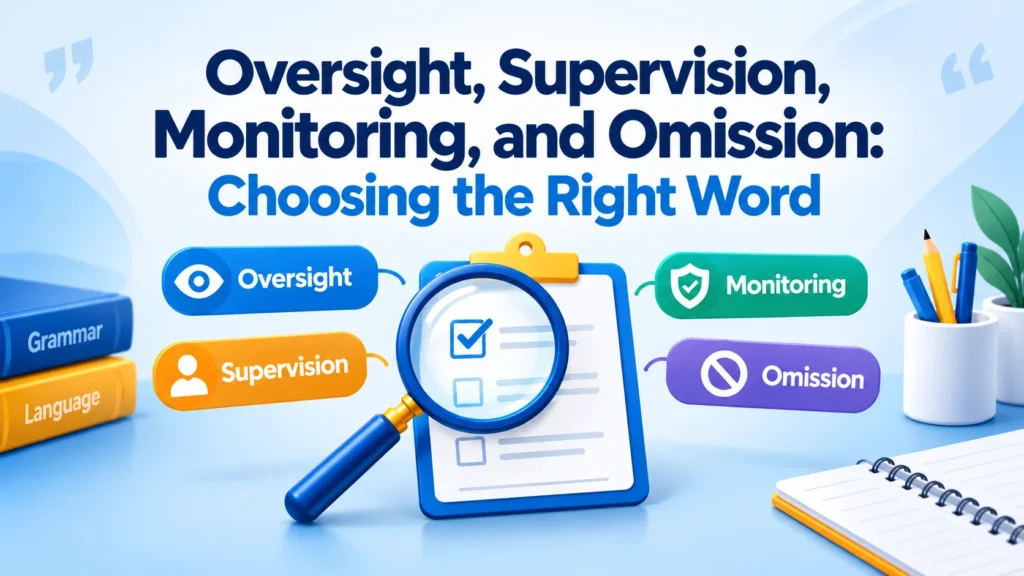
Several words overlap with the meanings of oversight, but they are not interchangeable in every context.
| Word | Main meaning | Example |
| Oversight | Supervision or an accidental omission | The board provides oversight of the project. |
| Supervision | Directing or overseeing someone’s work or an activity | The trainees worked under close supervision. |
| Monitoring | Observing or checking something over time | The team monitors system performance. |
| Management | Organizing and directing resources or activities | She is responsible for project management. |
| Review | Examining something to evaluate it | The committee completed its review. |
| Omission | Something left out or not included | The omission of the date caused confusion. |
| Error | A mistake or incorrect result | The calculation contained an error. |
Choose supervision when you want to emphasize directing work, monitoring when you mean observing something over time, and review when you mean examining something. Use omission when you specifically mean that something was left out.
Oversight is useful when the sentence refers to broader supervisory responsibility or to an unintended failure to notice something. If readers might confuse the two meanings, a more specific term can improve clarity.
Easy Ways to Remember Oversight vs. Oversite
A useful memory trick should help you recall both the spelling and the meaning.
Connect Oversight With Sight
The word oversight contains sight. Connect it with the idea of keeping something in sight while monitoring it.
For example:
“The committee keeps the project in sight through regular oversight.”
This is a memory aid, not a literal definition of the word. Oversight can involve reviewing information and accountability, not simply watching something visually.
Remember that oversight also means an accidental omission:
- Supervision: The manager provides oversight.
- Omission: Forgetting the attachment was an oversight.
Connect Oversite With a Construction Site
The spelling oversite contains site, which can remind you of a building or construction site. When the context involves a specialized prepared layer beneath a floor, oversite may be the appropriate term.
This connection helps separate the words:
- Oversight: supervision or an accidental omission.
- Oversite: a specialized construction term.
Do not use this memory trick to assume that every sentence mentioning a construction site requires oversite. A construction project can also require oversight by a manager, engineer, regulator, or committee.
A Quick Decision Checklist
Before choosing a spelling, ask yourself:
- Am I describing supervision, monitoring, or review? Use oversight.
- Am I describing an accidental omission or something that was missed? Use oversight.
- Am I describing a specific prepared layer or surface in construction terminology? Oversite may be appropriate.
- Is the sentence about a general business, administrative, or everyday situation? The intended word is usually oversight.
- Does a technical document define a particular construction term? Follow the terminology used in the specification.
These questions resolve most cases without needing to rely on pronunciation.
Conclusion
The difference between oversight vs. oversite depends on meaning, not pronunciation. Oversight is the standard word for supervision, monitoring, or an accidental omission, while oversite is a specialized term used in certain construction contexts for a prepared layer or surface beneath a building floor. One final actionable tip: before choosing the spelling, identify what the sentence describes—a supervisory responsibility, a missed detail, or a construction element. That simple check will usually reveal the correct word. A common mistake to avoid is treating oversite as universally incorrect or using it as a substitute for oversight in business writing. Both forms can have legitimate uses, but they are not interchangeable. When technical terminology is involved, follow the project’s specifications; in ordinary communication, choose the word that expresses your intended meaning clearly.
FAQs
Q1. What does oversight mean?
Oversight has two main meanings: supervision or monitoring, and an accidental omission or failure to notice something. For example, a committee may provide oversight of a project, while forgetting to attach a document may be described as an oversight. The surrounding sentence determines the intended meaning.
Q2. What does oversite mean in construction?
In certain construction terminology, particularly British usage, oversite refers to a prepared layer or surface beneath a building floor, often involving concrete. Its exact meaning depends on the construction context and specifications. It is not the standard word for supervision or an accidental mistake.
Q3. Are oversight and oversite pronounced the same way?
They are pronounced the same or very similarly in many English accents. This similarity can make the spellings confusing, particularly when writing quickly. The best way to distinguish them is to focus on meaning: oversight concerns supervision or omission, while oversite is a specialized construction term.
Q4. Is oversite a misspelling of oversight?
Not always. Oversite can be a legitimate technical term in construction, but it is generally incorrect when used to mean supervision, monitoring, or an accidental omission. In ordinary business, academic, and administrative writing, choose oversight unless the construction meaning is specifically intended.
Q5. How can I remember the difference between oversight and oversite?
Connect oversight with sight and the idea of keeping something under review. Connect oversite with a construction site and its specialized terminology. Remember that oversight can also mean a missed detail, as in “Leaving out the attachment was an oversight.”
