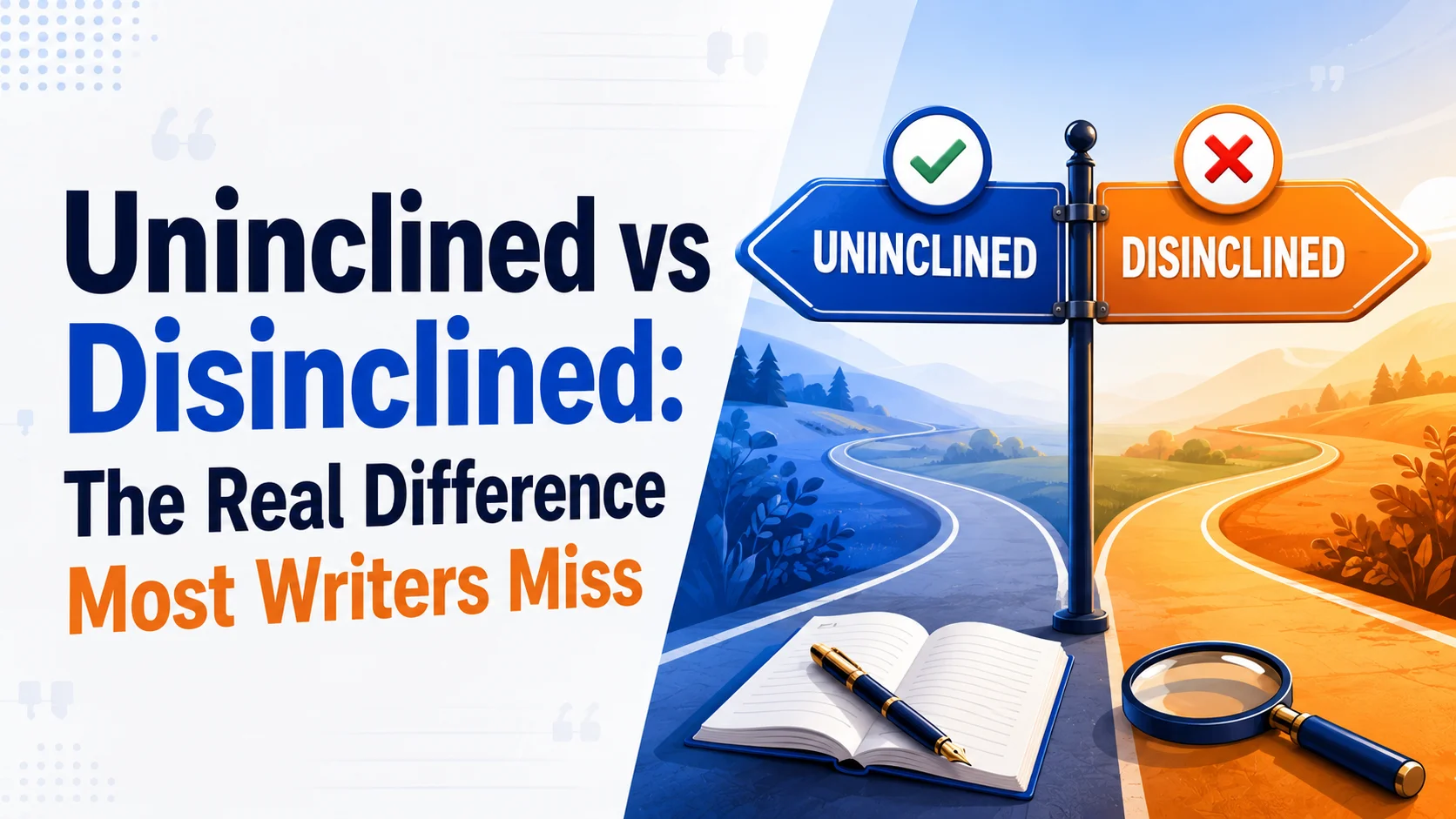
Uninclined vs disinclined is a common source of confusion for writers who want to express a lack of interest, willingness, or desire without changing the tone of a sentence. Both words describe someone who does not feel inclined to do something, but they can carry slightly different shades of meaning depending on context. Uninclined often emphasizes the absence of an inclination, while disinclined can more readily suggest reluctance or an unwilling attitude. The distinction is subtle rather than absolute, which is why even confident English users sometimes struggle to choose between them.
Understanding these words matters when precision is important. A sentence in a business email, academic paper, professional report, or everyday conversation can sound more hesitant, neutral, or decisive depending on the adjective you choose. For example, saying that a manager is uninclined to approve a proposal describes a lack of inclination, whereas saying the manager is disinclined to approve it may place greater emphasis on reluctance. Neither sentence necessarily means that the manager has rejected the proposal outright. The surrounding context determines how readers interpret the message.
In this guide, you will learn the definitions, grammatical patterns, practical differences, and correct usage of both words. You will also see how they compare with reluctant, unwilling, and averse, along with examples from workplace communication, academic writing, and everyday English. Rather than memorizing an oversimplified rule, you will learn how to identify the meaning you want to communicate and select the word that expresses it most naturally. By the end, you should be able to distinguish between these near-synonyms confidently and avoid common word-choice mistakes.
Uninclined vs Disinclined: What Is the Difference?
The main difference between uninclined and disinclined lies in their emphasis, not in a strict separation of meaning. Both describe a lack of inclination toward an action, decision, or activity.
Uninclined can emphasize that someone does not naturally feel motivated or disposed to do something. Disinclined can more readily communicate reluctance or a lack of willingness in a particular situation. However, these tendencies overlap, and either word can be appropriate in many of the same sentences.
Consider these examples:
- I am uninclined to discuss the matter further.
- I am disinclined to discuss the matter further.
Both sentences communicate that the speaker does not wish to continue the discussion. The second may sound slightly more reluctant or resistant, but the difference is not guaranteed. A reader could reasonably interpret both sentences in almost exactly the same way.
Uninclined vs Disinclined: Quick Comparison Table
| Feature | Uninclined | Disinclined |
| Basic meaning | Not inclined or disposed to do something | Not inclined or willing to do something |
| Main emphasis | Absence of inclination or desire | Lack of willingness or reluctance |
| Typical tone | Neutral or descriptive | Often suggests reluctance |
| Common structure | Uninclined to + verb | Disinclined to + verb |
| Formality | Suitable for formal and neutral writing | Suitable for formal and neutral writing |
| Strength of refusal | Does not necessarily imply refusal | Does not necessarily imply refusal |
| Interchangeability | Often interchangeable with disinclined | Often interchangeable with uninclined |
| Example | She was uninclined to intervene. | She was disinclined to intervene. |
Important: Do not treat the difference in tone as an inflexible rule. Context, the subject’s circumstances, and the surrounding words can matter more than the adjective itself.
Are Uninclined and Disinclined Interchangeable?
Yes. They are near-synonyms and can often replace each other without substantially changing a sentence’s meaning.
For example:
- The committee was uninclined to reconsider its decision.
- The committee was disinclined to reconsider its decision.
Both sentences indicate that the committee was not inclined to reconsider its decision. The second may suggest a more noticeable reluctance, but the sentence alone does not prove that the committee felt more strongly.
Interchangeability becomes less straightforward when a writer wants to emphasize a specific attitude. If the intended meaning is hesitation, reluctant may be more precise. If the person has made a definite decision not to cooperate, unwilling may communicate that position more clearly.
The best approach is to select the word that fits the intended meaning rather than assuming that the two adjectives always have different levels of intensity.
What Does Uninclined Mean?
Uninclined is an adjective meaning not disposed, minded, or willing to do something. It describes an absence of inclination toward an action, choice, or activity.
Someone who is uninclined to attend a meeting, for example, does not feel particularly motivated or willing to attend. That person might be tired, uninterested, unconvinced, or simply unwilling to spend time on the meeting. The word itself does not explain the reason.
Uninclined Definition and Meaning
In plain English, uninclined means not feeling a desire or tendency to do something.
It can describe a temporary response to a particular situation or a more general disposition. For instance:
- She was uninclined to accept the invitation.
She did not feel inclined to attend the event. - He is generally uninclined to take unnecessary risks.
He tends not to favor unnecessary risks. - The editor was uninclined to approve the proposed changes.
The editor did not feel disposed to approve them.
Notice that none of these examples necessarily indicates anger, hostility, or a permanent refusal. The word describes the person’s inclination, not the complete reasoning behind it.
What Does Uninclined Suggest About Someone’s Attitude?
The word often presents an attitude in a measured, relatively neutral way. It can communicate that a person lacks interest or willingness without suggesting that they strongly oppose the action.
Imagine a colleague who is asked to join an optional weekend project. Saying that the colleague is uninclined to participate indicates a lack of willingness or interest. It does not tell us whether the colleague dislikes the project, has other commitments, or simply prefers to rest.
This makes uninclined useful when the writer wants to describe a position without making assumptions about someone’s emotions.
However, the word is not automatically softer than disinclined. A sentence such as The board was uninclined to approve any further funding can communicate a firm position when the surrounding circumstances support that interpretation.
How to Use Uninclined in a Sentence
The following examples demonstrate its use in different contexts.
Everyday English
- I’m uninclined to go out tonight.
- She was uninclined to join the conversation.
- He seemed uninclined to try the unfamiliar dish.
Professional writing
- The department was uninclined to change its established procedures.
- The client appeared uninclined to accept the revised terms.
- Management was uninclined to extend the deadline without a clear justification.
Academic and analytical writing
- The researcher was uninclined to draw conclusions from such a small sample.
- The author was uninclined to accept the explanation without further evidence.
In each example, the adjective describes a lack of inclination. The context explains what the person is considering and why the choice matters.
Common Sentence Structures With Uninclined
1. Uninclined to + Base Verb
This is a straightforward and widely useful construction.
Examples:
- She was uninclined to respond.
- They seemed uninclined to cooperate.
- I am uninclined to speculate.
The verb following to remains in its base form. Write uninclined to participate, not uninclined to participating.
2. Be, Seem, Appear, or Remain Uninclined
These verbs help describe a person’s attitude or how that attitude appears to others.
Examples:
- He remained uninclined to negotiate.
- The director appeared uninclined to reconsider the decision.
- They seemed uninclined to pursue the opportunity.
Choose the introductory verb carefully. Was uninclined presents the attitude directly, while appeared uninclined indicates that the writer is interpreting observable behavior rather than claiming certainty about someone’s thoughts.
3. Uninclined Toward or Towards + Noun
This construction can describe a general attitude or disposition.
Examples:
- She was uninclined toward confrontation.
- He was uninclined toward unnecessary experimentation.
Both toward and towards are standard English forms. Regional preferences differ, so consistency within a document is more important than choosing one universally correct form.
When Is Uninclined the Right Choice?
Consider uninclined when you want to describe a lack of desire, tendency, or disposition without unnecessarily emphasizing resistance.
It works particularly well when:
- You are describing a general preference.
- You want to explain someone’s attitude in a measured tone.
- You are writing a formal report or analytical discussion.
- You want to avoid claiming that a person has firmly refused.
For casual conversations, however, not interested, not keen, or not really in the mood may sound more natural.
What Does Disinclined Mean?
Disinclined is an adjective meaning not inclined or willing to do something. It frequently communicates reluctance, an unfavorable disposition, or a lack of desire to take a particular action.
For example, someone who is disinclined to accept a job offer may have reservations about the salary, responsibilities, working conditions, or opportunity itself. The word conveys the lack of willingness, but it does not identify the reason.
Disinclined Definition and Meaning
In simple terms, disinclined means not wanting or not feeling willing to do something.
Examples include:
- She was disinclined to reveal the details.
She was reluctant to share the information. - The manager seemed disinclined to approve the expense.
The manager appeared unwilling or reluctant to approve it. - He was disinclined to argue over a minor disagreement.
He did not feel willing to argue about it.
The word is particularly useful when describing someone’s response to a request, proposal, decision, or action.
Does Disinclined Mean Reluctant or Unwilling?
It can overlap with both words, but neither is an exact substitute in every context.
Reluctant commonly emphasizes hesitation, reservation, or resistance. Unwilling can communicate a more direct lack of willingness. Disinclined falls within this general semantic area, often expressing that a person does not feel disposed to act.
Compare:
- She was disinclined to sign the contract.
She did not feel willing to sign it. - She was reluctant to sign the contract.
She hesitated or had reservations about signing it. - She was unwilling to sign the contract.
She was not prepared to sign it.
These sentences can describe the same situation, but they do not emphasize precisely the same thing. The final example may sound more decisive, particularly when the surrounding context shows that the person has made a firm choice.
How to Use Disinclined in a Sentence
In everyday situations
- I’m disinclined to get involved in their disagreement.
- She was disinclined to stay out late.
- He felt disinclined to cook after a long day.
In professional communication
- The supplier was disinclined to renegotiate the original agreement.
- The director appeared disinclined to authorize additional spending.
- The employee was disinclined to accept the transfer without further information.
In academic writing
- The researcher was disinclined to interpret the correlation as proof of causation.
- The author was disinclined to endorse the theory without stronger evidence.
These examples show how the word can express hesitation or unwillingness without necessarily communicating a final refusal.
Common Sentence Structures With Disinclined
1. Disinclined to + Base Verb
Examples:
- He was disinclined to participate.
- They were disinclined to negotiate.
- I am disinclined to make assumptions.
This is the most useful pattern for describing reluctance to perform an action.
2. Be, Seem, Appear, or Remain Disinclined
Examples:
- The committee remained disinclined to change the policy.
- The client appeared disinclined to continue negotiations.
- She seemed disinclined to answer the question.
As with uninclined, the introductory verb can indicate whether the attitude is stated directly or inferred from behavior.
3. Disinclined Toward or Towards + Noun
Examples:
- He was disinclined toward confrontation.
- The organization was disinclined toward unnecessary risk.
Use this structure when discussing a disposition toward a subject or type of behavior. If you are describing a specific action, the infinitive construction is often more direct.
When Is Disinclined Most Appropriate?
Choose disinclined when you want to express a lack of willingness or reluctance, especially in a measured or formal context.
It can be effective in:
- Professional discussions about decisions and proposals.
- Explanations of why someone does not wish to act.
- Formal descriptions of reservations or resistance.
- Analytical writing where the writer wants to avoid overstating a position.
It is less suitable when a plain expression would communicate the message more clearly. For example, The customer was disinclined to pay may be appropriate in a formal report, but The customer did not want to pay may be more direct for a general audience.
Uninclined vs Disinclined: How Context Changes the Meaning
The most useful way to understand these words is to examine the situation rather than treating them as two fixed levels of unwillingness.
Lack of Inclination vs Reluctance
A lack of inclination means that a person does not feel drawn toward an action. Reluctance suggests that the person is hesitant or unwilling to proceed.
In practice, these ideas frequently overlap.
Consider an employee who is asked to present an unfinished report:
- The employee was uninclined to present the report.
The employee did not feel disposed to present it. - The employee was disinclined to present the report.
The employee did not feel willing to present it and may have had reservations.
The second sentence can sound more explicitly reluctant, but the difference depends on context. If the report contains serious errors, both sentences might describe a reasonable response to the same problem.
How Tone Changes When You Switch the Word
Word choice influences how a reader interprets a person’s attitude, even when the basic meaning remains similar.
| Situation | With uninclined | With disinclined |
| Declining an invitation | She was uninclined to attend. | She was disinclined to attend. |
| Avoiding a dispute | He was uninclined to argue. | He was disinclined to argue. |
| Rejecting a proposal | The board was uninclined to proceed. | The board was disinclined to proceed. |
| Withholding an opinion | I am uninclined to comment. | I am disinclined to comment. |
In each pair, both versions are grammatically acceptable. The second may foreground reluctance more clearly, but it is not necessarily stronger, more negative, or more final.
When Does Replacing One Word Change the Meaning?
A substitution can affect the tone without changing the basic message. The larger change often occurs when either adjective is replaced by a word with a more specific meaning.
For instance:
- He was uninclined to help. — He did not feel inclined to help.
- He was reluctant to help. — He hesitated or had reservations about helping.
- He was unwilling to help. — He was not prepared to help.
If the character’s hesitation is important to the story, reluctant may be more informative. If the person has firmly refused, unwilling may be clearer.
Expert tip: Do not choose a word solely because it sounds more sophisticated. Choose it because it communicates the intended attitude accurately.
Uninclined vs Disinclined vs Reluctant vs Unwilling
These four adjectives describe related attitudes, but each can direct attention toward a different aspect of a person’s response.
How the Four Words Differ
| Word | Main emphasis | Example |
| Uninclined | Lack of inclination or disposition | She was uninclined to intervene. |
| Disinclined | Lack of inclination or willingness | She was disinclined to intervene. |
| Reluctant | Hesitation, reservation, or resistance | She was reluctant to intervene. |
| Unwilling | Lack of willingness, potentially a firm position | She was unwilling to intervene. |
Uninclined vs Reluctant
Uninclined can describe someone who simply has no desire to do something. Reluctant often highlights hesitation, reservation, or resistance.
For example, a student who is uninclined to join an optional club may have little interest in it. A student who is reluctant to join might want to participate but feel nervous about meeting new people.
This is a useful distinction when writing about motivation, decision-making, or character development. Still, context can make the two words interchangeable.
Disinclined vs Unwilling
Disinclined can express reluctance without suggesting a definite refusal. Unwilling can sound more direct, particularly when someone has made a clear decision.
Compare:
- The tenant was disinclined to renew the lease.
The tenant did not feel inclined to renew it. - The tenant was unwilling to renew the lease.
The tenant was not prepared to renew it.
If the tenant is still considering the options, disinclined may suit the situation. If the tenant has made a firm decision, unwilling may communicate that position more clearly.
Disinclined vs Averse
Averse generally emphasizes opposition, dislike, or a strong unfavorable attitude toward something.
For example:
- She was disinclined to take the assignment.
She did not feel willing to accept it. - She was averse to taking unnecessary risks.
She had an unfavorable attitude toward unnecessary risk-taking.
The grammar differs as well. Writers commonly use disinclined to + verb and averse to + noun or gerund.
Correct examples:
- He was disinclined to participate.
- He was averse to participating.
Incorrect in standard usage:
- He was averse to participate.
When choosing between these words, consider whether you want to describe a lack of willingness in a particular situation or a broader opposition to something.
Grammar Rules: How to Use Uninclined and Disinclined Correctly
Both adjectives follow similar grammatical patterns. Understanding these patterns helps prevent awkward sentences and makes formal writing more precise.
Should You Write Uninclined To or Uninclined Toward?
Both constructions are possible, but they serve different purposes.
Use uninclined to + base verb when referring to an action:
- She was uninclined to negotiate.
- I am uninclined to interfere.
Use uninclined toward or towards + noun when describing a general attitude:
- He was uninclined toward confrontation.
- They were uninclined towards further changes.
The choice depends on what follows the adjective. If the next element is an action, the infinitive construction is generally straightforward. If it is a noun describing an attitude or tendency, a prepositional phrase may be suitable.
Should You Write Disinclined To or Disinclined Toward?
The same principle applies to disinclined.
- The manager was disinclined to intervene.
- The manager was disinclined toward confrontation.
The first describes a particular action the manager did not feel willing to take. The second describes a broader disposition.
For most practical writing, disinclined to do something is a reliable construction when discussing a specific decision or action.
Can These Words Describe Groups and Organizations?
Yes. Although uninclined and disinclined most directly describe attitudes associated with people, they can also describe groups, committees, companies, and other organizations.
Examples:
- The committee was disinclined to reopen the investigation.
- The company was uninclined to change its pricing structure.
These sentences use the organization as a shorthand for the position taken by its members or decision-makers. In formal reporting, however, make sure the statement is supported by what the organization actually said or did. Do not present an interpretation of a group’s attitude as a confirmed fact.
Can You Use Uninclined and Disinclined in Negative Sentences?
Yes, but negative constructions can make a sentence harder to interpret.
Consider:
She was not disinclined to help.
This means that she was not reluctant or unwilling to help. Depending on the context, it may suggest that she was reasonably willing, but it does not necessarily indicate enthusiasm.
A clearer alternative might be:
- She was willing to help.
- She was open to helping.
- She did not object to helping.
Choose the direct version when the intended meaning is straightforward. Negative constructions can be useful for understatement, but they should not obscure an important decision.
Are Uninclined and Disinclined Formal Words?
Both are suitable for formal, professional, and analytical writing. They can also appear in ordinary conversation, although they may sound more formal than simpler alternatives.
Compare:
- Formal: I am disinclined to attend the meeting.
- Neutral: I am reluctant to attend the meeting.
- Conversational: I don’t really want to attend the meeting.
The formal option is not automatically better. In an email to a colleague, the conversational sentence may sound more natural. In a report describing a person’s response to a proposal, disinclined may fit the register more comfortably.
Real-World Examples of Uninclined vs Disinclined
In Workplace and Business Communication
Professional writing often requires a careful distinction between someone’s lack of interest and an actual refusal.
Example 1
The director was uninclined to revise the policy without additional evidence.
This describes the director’s lack of inclination to revise the policy under the existing circumstances.
Example 2
The supplier was disinclined to renegotiate the original agreement.
This suggests that the supplier was reluctant or unwilling to renegotiate.
In both cases, the wording leaves room for the possibility that new information or changed circumstances could affect the decision.
Practical recommendation: If the person has already made a definite decision, describe that decision directly. For example, The supplier declined to renegotiate the agreement is clearer than either adjective when the refusal is confirmed.
In Academic and Analytical Writing
Academic writers frequently need to communicate caution without overstating their conclusions.
Examples:
- The researcher was uninclined to draw conclusions from a limited sample.
- The author was disinclined to endorse the theory without additional evidence.
Both sentences indicate a lack of willingness to proceed without sufficient support.
However, an academic writer should distinguish between an attitude and a methodological requirement. If a conclusion cannot be justified by the available evidence, it is more precise to explain that the evidence is insufficient than to describe the researcher as uninclined to draw a conclusion.
In Everyday Conversations
These adjectives can describe personal preferences, although they may sound formal in casual speech.
Examples:
- I’m uninclined to go out tonight.
- I’m disinclined to get involved in their disagreement.
More conversational alternatives include:
- I don’t really feel like going out tonight.
- I’d rather not get involved in their disagreement.
The best option depends on the audience and the purpose of the conversation. A formal expression can be useful when you want to sound measured, but plain English is often more natural among friends.
In Persuasive and Professional Writing
A writer’s word choice can influence whether a statement sounds neutral, hesitant, or decisive.
Compare:
- The client was disinclined to accept the proposal.
- The client rejected the proposal.
The first sentence describes an attitude or lack of willingness. The second states an outcome. They are not interchangeable if the client has not formally rejected the proposal.
Similarly, The committee was uninclined to proceed does not necessarily mean that the committee voted against proceeding. It may simply describe the committee’s apparent disposition.
Best practice: Separate what someone appears to feel from what they have actually decided. This improves accuracy and prevents readers from mistaking reluctance for a confirmed refusal.
Before-and-After Editing Examples
| Less precise wording | Clearer alternative | Why it works |
| She was not disinclined to participate. | She was willing to participate. | Removes an unnecessary negative construction. |
| He was disinclined and refused to consider the offer. | He refused to consider the offer. | States the confirmed action directly. |
| The researcher was uninclined because the evidence was bad. | The researcher was reluctant to accept the conclusion because the evidence was insufficient. | Explains the actual reason more clearly. |
| The manager was disinclined toward to approve the change. | The manager was disinclined to approve the change. | Corrects the grammatical construction. |
The common principle is simple: use an adjective to describe an attitude, and use a direct verb when you need to report a definite action.
Synonyms of Uninclined and Disinclined
Synonyms can make writing more varied, but choosing one requires attention to meaning. Words that appear similar in a thesaurus do not always communicate the same attitude.
Uninclined Synonyms
| Synonym | Meaning or emphasis | Example |
| Not inclined | Direct expression of a lack of inclination | She was not inclined to argue. |
| Reluctant | Hesitant or resistant | He was reluctant to agree. |
| Unwilling | Not prepared or willing | They were unwilling to compromise. |
| Uninterested | Lacking interest | She was uninterested in the offer. |
| Unmotivated | Lacking motivation | He felt unmotivated to begin. |
| Not disposed | Not naturally inclined or favorably minded | She was not disposed to intervene. |
These alternatives are not exact substitutes in every sentence. For example, a person can be interested in a project but unwilling to participate because of time constraints. In that situation, uninterested would misrepresent the person’s attitude.
Disinclined Synonyms
Useful alternatives include:
- Reluctant: emphasizes hesitation or reservations.
- Unwilling: emphasizes a lack of willingness.
- Not inclined: offers a neutral, straightforward expression.
- Hesitant: highlights uncertainty or delay before acting.
- Averse: emphasizes opposition or an unfavorable attitude.
- Resistant: suggests opposition to an action, demand, or change.
Consider the sentence The employee was disinclined to accept the transfer. If the employee is worried about moving, reluctant may fit. If the employee has decided not to accept it, unwilling may be clearer.
Words That Are Similar but Not Exact Synonyms
Indifferent means that someone is not particularly interested or concerned. It does not necessarily imply unwillingness.
Apathetic suggests a lack of interest, enthusiasm, or emotional engagement.
Hesitant describes uncertainty or reluctance that may delay action.
Resistant often implies opposition to a proposed action or change.
Uninterested specifically emphasizes a lack of interest, which is different from lacking the willingness to act.
Choosing the correct synonym requires identifying the actual issue. Is the person uninterested, uncertain, opposed, or simply unwilling? Once that distinction is clear, the appropriate word usually becomes easier to identify.
Common Mistakes Writers Make With Uninclined and Disinclined
Treating the Words as Completely Different in Meaning
The two words overlap considerably. It is misleading to claim that uninclined always describes mild indifference while disinclined always describes strong reluctance.
How to avoid the mistake: Explain the difference as a tendency in emphasis, and acknowledge that both words can describe the same situation.
Assuming Disinclined Always Means a Stronger Refusal
The prefix dis- does not establish a universal scale of unwillingness. A person’s attitude depends on the sentence and its context.
For example, She was disinclined to answer does not prove that she refused to answer. It describes a lack of willingness, not necessarily the final outcome.
How to avoid the mistake: Use refused, declined, or rejected when the action is confirmed and that is what you mean.
Confusing Lack of Interest With Lack of Willingness
Someone may be interested in an activity but unable to participate. Another person may have the time and ability but no desire to take part.
These are different situations. Uninterested focuses on interest; uninclined and disinclined focus on inclination or willingness.
How to avoid the mistake: Identify the person’s actual reason before selecting a synonym.
Using Formal Vocabulary Where Plain English Works Better
A formal word can make a simple sentence unnecessarily difficult to read.
Instead of The team was disinclined to proceed, you might write The team did not want to proceed if the context calls for direct, accessible language.
How to avoid the mistake: Consider the audience, document type, and importance of the nuance. Formality should serve clarity rather than replace it.
Using the Wrong Verb Form or Preposition
The standard pattern is disinclined to participate, not disinclined to participating. When a noun or gerund follows a preposition, use a construction appropriate to that preposition, such as disinclined toward confrontation or averse to participating.
How to avoid the mistake: Check what follows the adjective. Use the infinitive construction for a specific action, and choose a suitable prepositional phrase for a noun or general disposition.
How to Remember the Difference Between Uninclined and Disinclined
A useful memory technique should help you choose a word without creating an inaccurate rule.
Use the Inclination Test
Ask yourself: Am I describing an absence of inclination, or do I want to emphasize reluctance?
- If the focus is simply a lack of inclination, uninclined may work.
- If the focus is reluctance or unwillingness, disinclined may work.
This test helps identify emphasis, but it does not guarantee that only one word is correct.
Use the Context Test
Think about the situation before selecting the adjective.
If a person generally avoids unnecessary risks, uninclined toward risk-taking may describe a disposition. If the person is reluctant to sign a particular contract, disinclined to sign may be suitable.
The distinction depends on what the sentence needs to communicate, not on a universal difference in strength.
Use the Plain-English Substitution Test
Replace the adjective with a simpler expression and check whether the meaning remains intact.
For example:
- She was uninclined to comment. → She did not feel inclined to comment.
- He was disinclined to cooperate. → He was reluctant to cooperate.
If reluctant changes the meaning too much, consider not inclined or not willing. If the sentence describes a definite refusal, a direct verb may be more accurate than any of these adjectives.
Practice Exercises: Uninclined or Disinclined?
Choose the word that best fits each sentence. Remember that some sentences allow both answers, depending on the intended emphasis.
Fill in the Blanks
- The researcher was ______ to draw conclusions before reviewing all the evidence.
- After a long day at work, I felt ______ to cook an elaborate dinner.
- The committee appeared ______ to approve the proposal without further discussion.
- He was generally ______ toward unnecessary confrontation.
- The client was ______ to renegotiate the agreement.
- She was ______ to share personal information with people she barely knew.
Answers and Explanations
- Uninclined or disinclined — Both can describe the researcher’s lack of willingness to draw conclusions. The choice depends on the intended emphasis.
- Uninclined or disinclined — Either works. In everyday conversation, not in the mood to cook would sound more natural.
- Disinclined — A suitable choice when emphasizing the committee’s reluctance, although uninclined is also possible.
- Uninclined — A natural option for describing a general disposition toward confrontation. Disinclined can also work.
- Disinclined — Appropriate when describing the client’s reluctance to renegotiate. If the client has formally refused, declined to renegotiate is more precise.
- Disinclined or uninclined — Both are possible. Reluctant to share is another natural option if the focus is hesitation or reservation.
Choose the Most Precise Word
1. A person has made a firm decision not to sign a contract. Which word best expresses the position?
- A. Uninterested
- B. Unwilling
- C. Unmotivated
Answer: B. Unwilling. It most directly communicates the lack of willingness, although the full context may call for an even more precise expression, such as refused to sign.
2. A student wants to join a group but feels nervous about meeting unfamiliar people. Which word is most suitable?
- A. Reluctant
- B. Indifferent
- C. Apathetic
Answer: A. Reluctant. The word captures hesitation or reservations rather than a lack of interest.
3. A person simply does not feel inclined to participate in an optional event. Which words could work?
- A. Uninclined
- B. Disinclined
- C. Both
Answer: C. Both. The words overlap, and either can communicate a lack of inclination. The surrounding context determines whether one better fits the intended tone.
Conclusion
The difference between uninclined vs disinclined is subtle, and understanding that subtlety is more useful than memorizing a rigid rule. Both adjectives describe a lack of inclination or willingness, while disinclined can place greater emphasis on reluctance in certain contexts. Neither word necessarily means a firm refusal, and both can be appropriate in the same sentence. The most effective choice depends on the attitude you want to express, the audience you are addressing, and the degree of precision your writing requires. One final actionable tip: Before choosing either word, replace it mentally with not inclined, reluctant, or unwilling. Select the alternative that preserves your intended meaning. A common mistake to avoid is assuming that disinclined always expresses stronger opposition than uninclined.
Frequently Asked Questions
Q1. Is Uninclined a Correct English Word?
Yes. Uninclined is a valid English adjective meaning not disposed or inclined to do something. It is used in sentences such as She was uninclined to participate. Although it may sound formal in casual conversation, it is appropriate in standard written English.
Q2. Is Disinclined More Negative Than Uninclined?
Not necessarily. Disinclined can suggest reluctance more readily, but it does not automatically express a stronger or more negative attitude. Both words can describe the same situation. If the degree of unwillingness matters, explain it through context or use a more precise word.
Q3. What Is the Difference Between Disinclined and Reluctant?
Disinclined describes a lack of inclination or willingness, while reluctant often emphasizes hesitation or reservations. The words overlap in many contexts. For example, someone may be disinclined or reluctant to accept an offer, but reluctant can make the hesitation more prominent.
Q4. Can I Use Uninclined and Disinclined in Formal Writing?
Yes. Both words are suitable for professional reports, academic discussions, and formal correspondence. They are especially useful when describing attitudes without claiming that a decision is final. However, if clarity is more important than formality, expressions such as not willing, reluctant, or declined may communicate the message more effectively.
Q5. What Is the Best Synonym for Uninclined or Disinclined?
The best synonym depends on the intended meaning. Use not inclined for a neutral expression, reluctant for hesitation, unwilling for a lack of willingness, and uninterested for a lack of interest. These words are related but not interchangeable in every situation, so check the meaning of the full sentence.
