
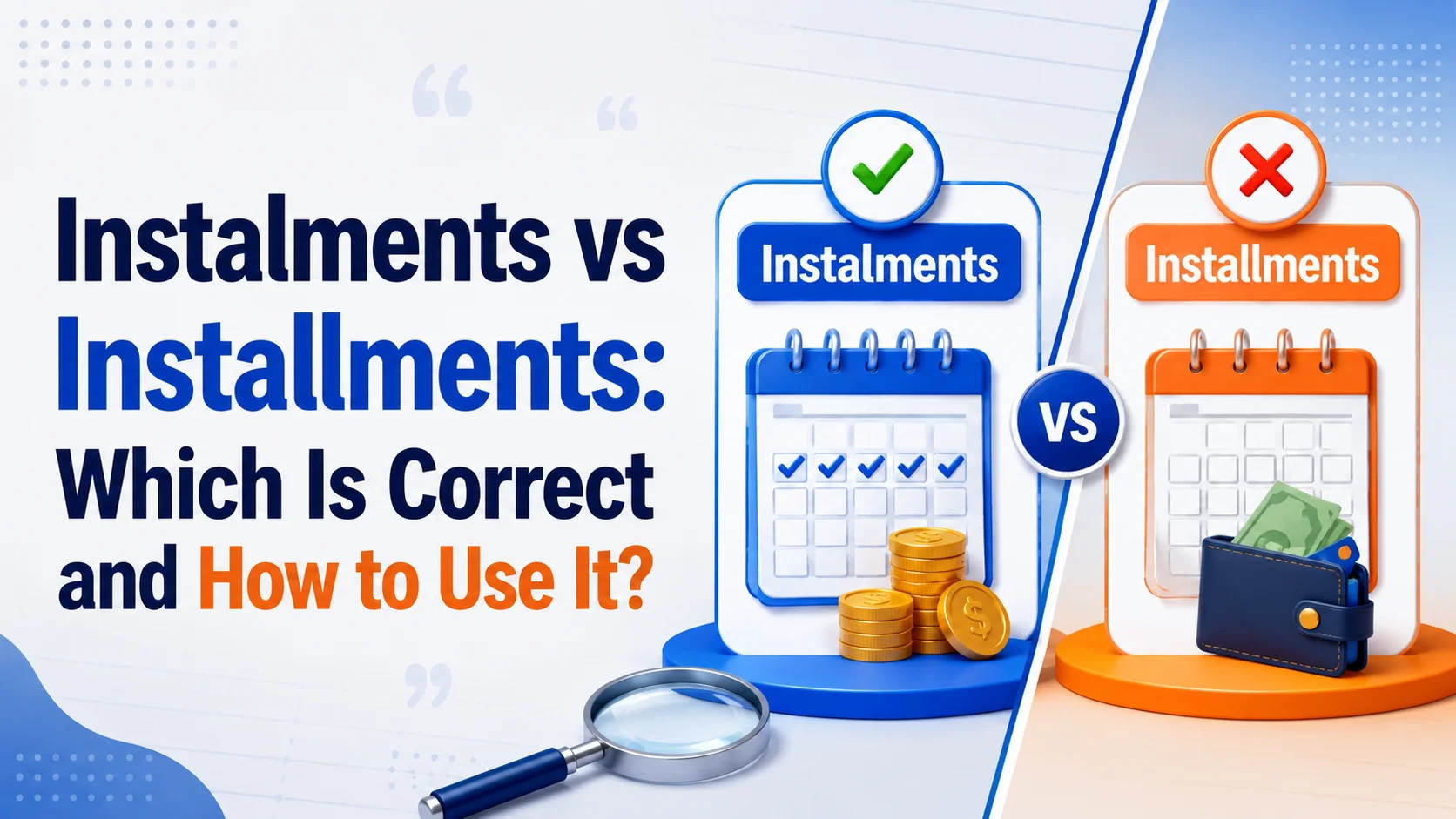
Instalments vs installments is a common spelling question, especially when writing about payments, loans, tuition fees, or purchases. The good news is that both spellings are correct. The main difference is regional: “instalments” is the standard spelling in British English, while “installments” is standard in American English. Both words have the same meaning, so neither is universally wrong. The spelling you choose depends on your intended audience and the English convention you follow. Understanding this small difference can help you write more confidently in emails, financial documents, academic assignments, and website content without worrying unnecessarily about spelling corrections.
Although the difference comes down to one letter, choosing the appropriate form matters in professional writing. A British company may use instalment plan in its customer agreements, while an American business will generally write installment plan. Neither expression changes the payment arrangement itself. The same distinction applies when discussing a portion of a book, television series, or film franchise. Problems usually arise when writers mix British and American spelling conventions in the same document or assume that one version is a spelling mistake. Consistency, audience expectations, and editorial guidelines are more important than treating either spelling as universally correct.
In this guide, you will learn the meanings of instalment and installment, the difference between their singular and plural forms, and how to use them in real sentences. You will also discover why the spellings differ, how they appear in financial and nonfinancial contexts, and which version is appropriate for business writing, school assignments, and international websites. Practical examples and comparison tables will make the distinction easy to remember. By the end, you will know which spelling to choose, when exceptions may apply, and how to avoid common mistakes without overthinking a straightforward English spelling variation.
Instalments vs Installments: The Quick Answer
Both instalments and installments are correct English spellings. The choice depends primarily on whether you are following British or American English.
- Instalments: The standard British English plural spelling.
- Installments: The standard American English plural spelling.
Both refer to portions of a larger amount paid or delivered at separate times. They can also describe individual parts of a book, film series, or another work released in stages.
Examples:
- British English: The customer will pay the balance in four monthly instalments.
- American English: The customer will pay the balance in four monthly installments.
Both sentences communicate exactly the same information. The difference is spelling, not meaning or grammar.
Instalments vs Installments: Key Differences
The following table shows how the two forms compare.
| Feature | Instalments | Installments |
| Standard spelling | British English | American English |
| Singular form | Instalment | Installment |
| Plural form | Instalments | Installments |
| Main meaning | A portion of a larger payment or series | A portion of a larger payment or series |
| Financial example | Pay in monthly instalments | Pay in monthly installments |
| Literary example | The final instalment of a novel | The final installment of a novel |
| General correctness | Correct in British English | Correct in American English |
The easiest way to remember the distinction is to focus on the single “l” in the British spelling and the double “l” in the American spelling.
One important point: regional spelling preferences are conventions, not absolute rules governing every writer or publication. A company may follow its own style guide, and an international publication may adopt a particular spelling for consistency.
What Do Instalment and Installment Mean?
An instalment or installment is one part of a larger amount or series that is divided into separate portions. The exact meaning depends on the context.
Instalment Meaning in British English
In British English, instalment commonly refers to a portion of money paid at an agreed time or one part of something released in a sequence.
For example, someone buying a car might agree to pay a deposit followed by several monthly instalments. Rather than paying the entire amount immediately, the buyer follows an agreed schedule.
The word is also used outside finance. A chapter or section of a serialized novel, for instance, may be described as an instalment.
Examples:
- The first instalment of the loan is due next month.
- Students can pay their fees in three instalments.
- The next instalment of the detective novel will be published in December.
Installment Meaning in American English
In American English, installment carries the same meanings. It can describe a scheduled portion of a debt, a purchase price, or a work released in separate parts.
American businesses frequently use expressions such as installment payments, installment loans, and installment plans.
Examples:
- Your first installment is due on November 1.
- The company offers an installment plan for eligible customers.
- The newest installment in the film series arrives next summer.
There is no meaningful difference between the British and American definitions. The spelling changes, but the underlying concept remains the same.
Can Instalment or Installment Refer to a Story?
Yes. Both words can refer to one part of a larger creative work released in stages.
A novelist might publish a story chapter by chapter, while a film studio might release several connected movies over a number of years. Each individual part may be called an instalment or installment.
For example:
- British English: The latest instalment of the series ends with a surprising discovery.
- American English: The latest installment of the series ends with a surprising discovery.
This meaning is useful to recognize because the word is not restricted to banking or payments.
What Is the Difference Between an Instalment and a Payment?
The words are related, but they are not interchangeable in every situation.
A payment is a broad term for money transferred to settle an obligation or purchase. An instalment is usually one portion of a larger amount paid according to an arrangement.
Suppose a laptop costs £900. A buyer who pays the full amount immediately makes a payment. If the buyer instead pays £150 each month for six months, each scheduled £150 amount is an instalment.
The distinction matters when describing agreements. Saying that a customer has made a payment does not necessarily mean the customer is following an instalment plan.
Why Does British English Use Instalment but American English Use Installment?
The difference reflects the development of regional spelling conventions in English. British and American English share most vocabulary, but they do not always preserve the same written forms.
The British Spelling: Instalment
Instalment is the conventional British English spelling. It appears in writing about loans, purchases, tuition fees, contracts, and serialized works.
British spelling often differs from American spelling in familiar word pairs, including colour/color and centre/center. However, not every British-American difference follows the same pattern, so writers should check individual words instead of assuming a universal rule.
For British-oriented writing, use instalment in the singular and instalments in the plural.
The American Spelling: Installment
Installment is the standard American English form. The double “l” is part of the established spelling, not an indication of a different pronunciation or meaning.
American writers use this spelling in both everyday and formal contexts. It is appropriate for customer agreements, financial explanations, educational material, and general publishing intended for American readers.
Use installment for the singular and installments for the plural.
Is Either Spelling Incorrect?
Neither spelling is inherently incorrect. The appropriate choice depends on the English variety and any applicable editorial requirements.
A British publication may flag installment because it expects British spelling. An American spellchecker may flag instalment because its dictionary is configured for US English. These corrections reflect language settings rather than proof that the alternative form is invalid.
Practical rule: Choose the spelling that matches your audience, then use it consistently throughout the document.
Instalment vs Installment: Singular, Plural, and Possessive Forms
Knowing the regional difference is only part of using these words correctly. You must also choose the appropriate singular, plural, and possessive forms.
Singular Forms: Instalment vs Installment
Use the singular when referring to one portion of a larger amount or one part of a series.
- British English: The first instalment is due on Friday.
- American English: The first installment is due on Friday.
Both nouns are countable, so they can follow a number or an appropriate article.
Examples include:
- an instalment
- one instalment
- an installment
- one installment
The article an is correct because the word begins with a vowel sound.
Plural Forms: Instalments vs Installments
To form the plural, add -s to the relevant singular form.
| Singular | Plural | English convention |
| Instalment | Instalments | British |
| Installment | Installments | American |
Examples:
- The fee must be paid in two instalments.
- The fee must be paid in two installments.
- All instalments must arrive before the deadline.
- All installments must arrive before the deadline.
Do not add an apostrophe to form an ordinary plural. Instalment’s and installment’s are not standard plural forms.
Instalment’s, Instalments’, Installment’s, and Installments’
An apostrophe is appropriate when you need to show possession or a related grammatical relationship.
- Instalment’s: The singular possessive. The instalment’s due date has changed.
- Instalments’: The plural possessive. The instalments’ payment dates are listed below.
- Installment’s: The American singular possessive. The installment’s amount is fixed.
- Installments’: The American plural possessive. The installments’ schedule is available online.
In ordinary writing, you can often avoid an awkward possessive construction by rephrasing the sentence.
For example, instead of the instalment’s due date, write the due date for the instalment. Both are understandable, but the second may read more naturally in a formal payment schedule.
How to Use Instalments and Installments in Different Contexts
The right spelling depends on your English convention, but the context determines whether the word itself is appropriate.
Instalment Payments for Loans and Credit
A loan may require borrowers to repay the amount owed through a series of scheduled instalments. Each instalment may include some principal, interest, or both, depending on the loan terms.
Example: The borrower must make twelve monthly instalments under the agreement.
Before using the term in a financial document, check the actual repayment arrangement. Not every recurring charge is necessarily an instalment of a debt. Monthly subscriptions, for example, may be recurring payments for continued service rather than portions of a fixed purchase price.
Installment Payments for Cars and Consumer Purchases
In the United States, installment commonly appears in descriptions of car financing, furniture purchases, appliances, and other consumer transactions.
Example: The customer selected a twelve-month installment plan for the appliance.
The term describes how the amount is divided, but it does not tell the reader whether the plan includes interest, service fees, or penalties. Those details must be explained separately.
When comparing purchase options, look beyond the installment amount. A lower monthly payment can result from a longer repayment period and may not mean a lower overall cost.
Instalments or Installments in Education and Tuition
Educational institutions may allow students to pay tuition or other fees in scheduled portions.
British English: The university allows eligible students to pay their tuition fees in instalments.
American English: The college allows eligible students to pay their tuition in installments.
The institution’s actual policy determines the number of payments, due dates, and any administrative charges. Avoid suggesting that an instalment option is automatically available to every student.
Instalments or Installments in Business Contracts
In business writing, the word may describe payments scheduled under a contract or service agreement.
For example:
The client will pay the project fee in three instalments, with each payment due after an agreed milestone.
This sentence uses British spelling. An American version would use installments.
The payment clause should also make clear:
- The amount of each instalment.
- The date or condition triggering payment.
- The method of payment.
- Any applicable late-payment provisions.
Important: Correct spelling does not guarantee that a payment clause is legally complete. Contracts should accurately express the parties’ agreement and meet any relevant legal requirements.
Instalment or Installment in Books, Films, and Series
The word can also describe a creative work that forms part of a sequence.
Examples include:
- The final instalment of the fantasy novel will be released next year.
- The third installment in the movie franchise introduces a new character.
- Readers can access each instalment of the serialized story online.
In these examples, the word describes a portion of a larger creative project rather than a payment. The same regional spelling distinction applies.
Instalments vs Installments in British, American, and Other Varieties of English
English spelling conventions vary by region, but national labels do not resolve every editorial question. The following table provides a practical starting point.
| Audience or context | Recommended approach |
| United Kingdom | Generally use instalment and instalments. |
| United States | Generally use installment and installments. |
| Canada | Check the publisher’s or organization’s preferred spelling. |
| Australia | Generally use instalment and instalments. |
| New Zealand | Generally use instalment and instalments. |
| International website | Choose a consistent English variety based on the intended audience. |
| Quoted material | Usually preserve the source’s original spelling. |
United Kingdom
Instalment is the conventional British spelling. Writers commonly use it in financial documents, everyday communication, and discussions of books or television series.
For UK-facing content, use the British form unless a client, publisher, or official title requires another spelling.
United States
Installment is the standard American form. It is appropriate for US-facing websites, financial explanations, educational material, and professional correspondence.
American readers will generally expect the double-“l” spelling in ordinary prose.
Canada
Canadian English draws on multiple spelling traditions. Although some words have strong regional preferences, it is unwise to assume that every word follows one consistent British or American pattern.
If you are preparing a Canadian organization’s documents, follow its established editorial policy or consult a reputable Canadian dictionary.
Australia and New Zealand
British-oriented spelling conventions generally favor instalment and instalments in Australian and New Zealand English.
For formal publications, check local editorial guidance rather than relying solely on assumptions about regional spelling.
International and Global English
An international website may serve readers from countries that use different English conventions. The most practical approach is to select one primary variety for the main content.
If the website uses British English, write instalments consistently. If it targets American readers, use installments. You do not need to insert both spellings into every paragraph to demonstrate that you recognize the alternative.
Exceptions may apply to direct quotations, official names, and reproduced documents where changing the original spelling would reduce accuracy.
Common Mistakes to Avoid When Using Instalments and Installments
Assuming One Spelling Is Always Wrong
The biggest mistake is treating the British spelling as a misspelling in every context or assuming the American form is universally preferred.
Correction: Check the intended English variety before changing a spelling. A form flagged by a spellchecker may still be correct in another regional convention.
Mixing British and American Spellings in One Document
Consider this sentence:
The customer will pay two instalments, followed by four additional installments.
The meaning is understandable, but the spelling is inconsistent if the writer intends to use one English variety throughout.
British version: The customer will pay two instalments, followed by four additional instalments.
American version: The customer will pay two installments, followed by four additional installments.
Consistency makes a document easier to edit and gives it a more professional appearance.
Writing the Plural With an Apostrophe
The ordinary plural forms are instalments and installments, not instalment’s and installment’s.
An apostrophe is needed only for a possessive construction or another appropriate grammatical use.
Incorrect: The customer paid three installment’s.
Correct: The customer paid three installments.
Confusing an Instalment With the Entire Debt
An instalment usually represents one portion of a larger amount. It should not be used when you mean the full outstanding balance unless the context genuinely supports that meaning.
Suppose a person owes £1,200 and agrees to repay £200 each month for six months. Each £200 amount is an instalment; £1,200 is the original amount owed before accounting for repayments or other adjustments.
Assuming Every Instalment Plan Is Interest-Free
The word instalment does not mean that a purchase is free of interest or additional charges.
Some arrangements may be interest-free, while others include interest, fees, or penalties. The terms of the agreement determine the total cost.
Before recommending or describing a payment plan, check whether the quoted amount includes all applicable charges.
Changing the Spelling Without Considering the Audience
A writer may encounter installment in an American source and use it in a British article without noticing the shift. The reverse can happen in US-facing content.
Choose the appropriate form during editing and use your spellcheck settings to catch inconsistencies. Do not automatically replace every regional variant without considering quotations, names, and house style.
Instalments vs Installments: Correct and Incorrect Sentence Examples
These examples show how spelling, grammar, and context work together.
British English Examples
- The remaining balance must be paid in three instalments.
- Students can pay their tuition fees in monthly instalments.
- The first instalment is due at the end of October.
- The latest instalment of the novel will be published next week.
- The contract lists the dates of all future instalments.
American English Examples
- The remaining balance must be paid in three installments.
- Students can pay their tuition in monthly installments.
- The first installment is due at the end of October.
- The latest installment of the novel will be published next week.
- The contract lists the dates of all future installments.
Before-and-After Corrections
| Sentence | Assessment | Explanation |
| The buyer will pay four instalments. | Correct in British English | The plural matches the British convention. |
| The buyer will pay four installments. | Correct in American English | The plural matches the American convention. |
| The buyer will pay four installment’s. | Incorrect | The apostrophe is unnecessary for an ordinary plural. |
| The buyer will pay two instalments and two installments. | Usually inconsistent | Choose one spelling convention unless the context justifies the difference. |
| The next installment of the series is available. | Correct in American English | The word refers to a part of a series. |
A sentence can be grammatically correct but inconsistent with a document’s chosen spelling convention. That distinction is especially important when editing long reports or website articles.
Which Spelling Should You Use in Your Writing?
For School and University Assignments
Follow the spelling convention specified by your teacher, institution, or required style guide. If the assignment uses British English, choose instalment. If it requires American English, choose installment.
Do not assume that every institution follows the spelling convention of the country where it is located. Course materials and publication guidelines may establish their own requirements.
For Business Emails and Professional Documents
Use the spelling established by your organization and appropriate for the recipient. Consistency is particularly useful in contracts, invoices, payment reminders, and customer-facing documents.
For example, if your company uses British English in its templates, retain instalment in the subject line, email body, and attached payment schedule.
For Websites and SEO Content
Choose the spelling that matches your target audience and the site’s editorial policy.
- Use instalments for British-oriented content.
- Use installments for American-oriented content.
- Maintain the selected spelling in headings, body text, tables, and examples.
- Address the alternative spelling naturally when it helps readers resolve their confusion.
Search optimization does not require repeating both versions unnaturally. A clear explanation of the difference is more useful than inserting both variants into every heading.
For International Audiences
If readers come from several English-speaking regions, select a consistent primary variety for the main content. You can explain regional alternatives where relevant.
Preserve the spelling in quotations and official titles when changing it would misrepresent the source. This is a sensible exception to an otherwise consistent editorial policy.
What Do Dictionaries Say About Instalment and Installment?
Reputable dictionaries distinguish between regional spelling conventions. British dictionaries commonly list instalment, while American dictionaries generally use installment as the main spelling.
When checking a dictionary, pay attention to the usage label rather than looking only at the headword.
British Dictionary Usage
British English references can help confirm the spelling instalment and show how it is used in financial or general contexts.
American Dictionary Usage
American English references can confirm installment as the standard US form and provide examples of its use.
How to Interpret Dictionary Labels
Labels such as British English, US English, and chiefly British tell you about a word’s regional distribution. They do not necessarily mean that every alternative is wrong.
For professional editing, consult a reputable dictionary and your organization’s style guide together. The dictionary helps establish accepted usage, while the style guide tells you which convention to apply in a particular publication.
How to Remember the Difference Between Instalments and Installments
Use a Regional Spelling Reminder
Remember this simple association:
- British English: instalment, instalments.
- American English: installment, installments.
The distinction is the additional “l” in the American spelling.
Check the Singular Before Writing the Plural
Start with the singular form, then add s:
- Instalment → instalments.
- Installment → installments.
This reduces the risk of accidentally switching conventions halfway through a document.
Check Your Spellchecker Settings
If your word processor repeatedly flags a spelling, check whether the document is configured for British or American English.
A spellchecker is useful, but its suggestions depend on its dictionary and language settings. Review any correction in context instead of assuming that the software always identifies the only acceptable spelling.
Conclusion
The difference between instalments vs installments is straightforward once you understand regional English conventions. Both spellings are correct, both have the same meaning, and neither should be treated as universally wrong. British English generally uses instalment and instalments, while American English prefers installment and installments. The distinction applies whether you are discussing loan repayments, tuition fees, consumer purchases, or the next part of a creative series. One final actionable tip: Before publishing an article or sending a formal document, identify your intended audience and check that your spelling follows the appropriate convention. A consistent approach makes your writing easier to read and edit. A common mistake to avoid is changing a regional spelling simply because a spellchecker flags it. Correct writing is not about forcing every English variety into one pattern; it is about choosing the appropriate form and using it accurately. When your spelling, meaning, and context work together, even small language decisions become much easier.
Frequently Asked Questions
Q1. Is “instalments” British or American English?
Instalments is the standard British English plural spelling of instalment. It is used for scheduled portions of payments and for individual parts of a series. American English generally uses installments. The appropriate form depends on your audience and the spelling convention you are following.
Q2. Is “installments” correct in English?
Yes, installments is correct and is the standard American English plural form. It has the same meaning as instalments, including scheduled payments and parts of a serialized work. It may be flagged in software configured for British English, but that does not make it universally incorrect.
Q3. Is it “instalment plan” or “installment plan”?
Both expressions are correct. Instalment plan is conventional in British English, while installment plan is standard in American English. When writing for a particular company or audience, follow its preferred spelling. Also check the plan’s actual terms before describing its interest, fees, or repayment schedule.
Q4. Can instalments refer to books, films, and television series?
Yes. Both instalment and installment can describe one part of a larger creative work released in stages. British writers generally use instalment, while American writers prefer installment. For example, the final instalment of a novel and the final installment of a film series express the same basic idea.
Q5. How can I avoid mixing instalments and installments in a long article?
Choose British or American English before editing, then use your word processor’s language settings to help identify inconsistencies. Search the document for both spellings during proofreading. Check quotations and official titles separately, because preserving their original wording may justify an exception to your usual spelling convention.
