
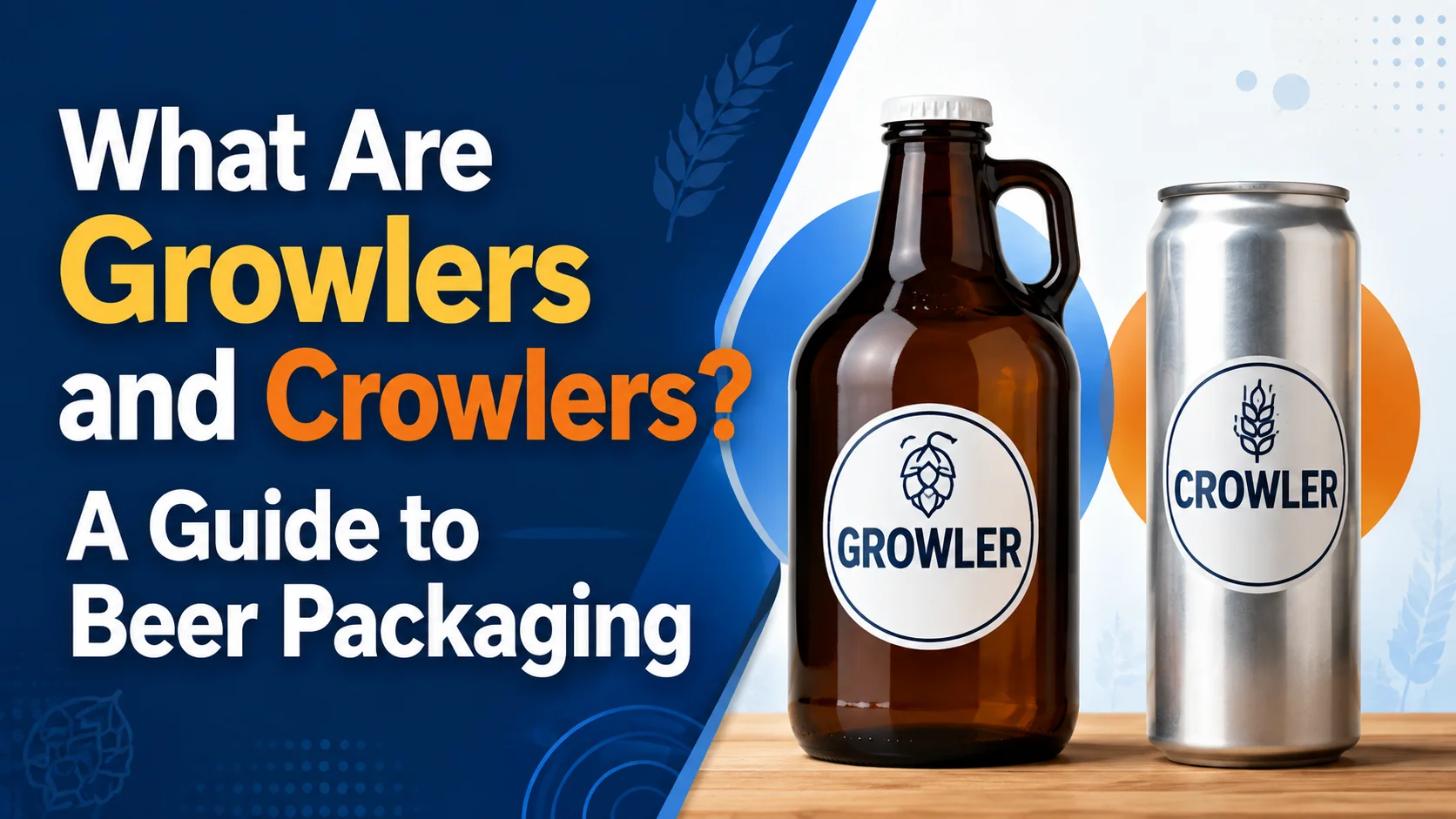
Growlers and crowlers are two familiar formats in the world of draft-beverage packaging, but they represent very different approaches to taking a beverage beyond the taproom. A growler is typically a reusable vessel, while a crowler is a metal can filled and mechanically sealed for transport. The distinction sounds simple, yet the packaging choices affect portability, reuse, light exposure, oxygen management, cleaning requirements, and waste.
Understanding these containers is useful even if you are simply curious about how modern beverage packaging works. Why does one format use a reusable bottle while another uses a disposable can? Why are some growlers made from stainless steel rather than glass? And why does a crowler require specialized sealing equipment? The answers involve a mixture of materials science, packaging engineering, sanitation, and consumer convenience.
This guide breaks down the terminology without assuming prior knowledge. We’ll look at what growlers and crowlers are, how they developed, how their construction differs, why breweries use them, and what their respective advantages and limitations are. We’ll also examine common misconceptions and the broader packaging lessons these formats reveal.
What Is a Growler?
A growler is a reusable container traditionally associated with draft beverages. Historically, growlers were relatively simple vessels used to transport beer from a place serving it to another location. Modern versions are much more standardized and can be made from several materials.
The most recognizable growlers are glass jugs with a handle and a relatively wide opening. However, today’s market also includes stainless-steel and ceramic growlers, each offering different physical characteristics.
The important point is that “growler” describes the format and intended use, not one specific material.
Where Did the Name “Growler” Come From?
The history of the term is less certain than the modern container itself. Several explanations have been proposed for the word’s origin, but there is no universally accepted single story.
The broader history is clearer: before modern cans and bottles became dominant, people commonly transported draft beer in whatever suitable containers were available. The growler evolved from that practical tradition into a recognizable reusable beverage vessel.
Modern growlers therefore combine an old idea—taking draft beer home—with modern manufacturing and sealing technology.
What Does a Growler Look Like?
A traditional growler usually has:
- A sturdy body designed to hold liquid
- A handle or grip
- A relatively narrow neck
- A removable closure
- A capacity commonly associated with larger take-home formats
Glass remains popular because it is inexpensive, easy to manufacture, and visually familiar.
Stainless steel offers a different experience. It is durable, opaque, and resistant to breakage, making it particularly attractive for reusable beverage containers.
Ceramic versions tend to be heavier and more decorative, but they can have strong insulation and aesthetic appeal.
Why Are Growlers Reusable?
The defining environmental and practical characteristic of a growler is its potential for repeated use.
Instead of manufacturing a new primary container every time, the same vessel can theoretically be cleaned, inspected, refilled, and used again.
That creates an important distinction between reusability and automatic sustainability. A reusable container only provides a meaningful reuse advantage when it is actually reused enough times to justify the additional material, manufacturing, transportation, and cleaning involved.
Key point: “Reusable” describes a container’s design. It does not automatically prove that the container has the lowest environmental impact in every situation.
What Is a Crowler?
A crowler is a metal beverage can that is filled from a draft system and then sealed using a can-seaming machine.
The word itself combines the concepts of “can” and “growler.” Unlike a conventional reusable growler, the crowler is designed around the familiar structure of a single-use aluminum can.
This creates a useful middle ground between draft service and packaged beverage formats. A beverage can be dispensed from a draft system and then transferred into a factory-style sealed can format.
Why Is a Crowler Different From an Ordinary Can?
A conventional packaged can is generally filled and sealed during commercial production using equipment designed for high-volume manufacturing.
A crowler is filled at the point of sale or service and then sealed with a specialized can seamer.
The important engineering feature is the seam. The machine mechanically joins the can body and lid to create a closed package.
That means the crowler isn’t simply an open can with a snap-on cover. Its lid becomes part of a mechanically formed closure.
What Is a Crowler Made From?
Most crowlers use aluminum, the same broad material family used for many conventional beverage cans.
Aluminum is useful for beverage packaging because it is:
- Lightweight
- Relatively durable
- Opaque to light
- Easily recyclable where recycling systems accept it
- Suitable for high-speed industrial manufacturing
- Capable of being formed into precise can-and-lid assemblies
The material also provides a significant portability advantage compared with glass.
Growler vs. Crowler: What’s the Difference?
The simplest distinction is straightforward:
A growler is generally a reusable vessel; a crowler is a can that is filled and mechanically sealed.
But several smaller differences matter.
| Feature | Growler | Crowler |
| Basic format | Reusable beverage vessel | Sealed metal can |
| Common material | Glass, stainless steel, ceramic | Aluminum |
| Reusable design | Yes | Generally designed as single-use packaging |
| Breakage risk | Depends on material | Low compared with glass |
| Weight | Can be relatively heavy | Relatively lightweight |
| Light exposure | Depends on material | Very low |
| Cleaning required | Yes | No consumer washing between fills |
| Closure | Cap, stopper, or swing-top | Mechanically seamed lid |
| Environmental consideration | Reuse potential | Material recycling potential |
| Convenience | Requires maintenance | Convenient disposal/recycling after use |
Neither format is universally “better.” They solve slightly different packaging problems.
How Do Growlers and Crowlers Handle Light?
Light is an important consideration in beverage packaging because some compounds can react with ultraviolet or visible light and contribute to undesirable changes in certain beverages.
This is one reason packaging color matters.
Clear glass provides visibility but offers little protection from light. Brown glass provides substantially greater protection. An opaque stainless-steel vessel blocks light entirely, while aluminum cans provide excellent light exclusion.
That gives crowlers and stainless-steel growlers an inherent advantage when light protection is the packaging priority.
However, packaging is only one factor. Storage conditions, time, temperature, closure integrity, and the properties of the beverage itself also influence quality.
Why Does Oxygen Matter in Beverage Packaging?
Oxygen management is one of the most important concepts in modern beverage packaging.
Once oxygen enters a beverage package, it can participate in chemical reactions that alter aroma, flavor, color, and overall quality. The sensitivity varies considerably by beverage and formulation.
That is why professional packaging systems try to minimize unnecessary oxygen exposure.
Growlers and Oxygen
A reusable growler has a closure that can be opened and closed. Its performance therefore depends heavily on the vessel design and closure.
Once opened, the container has substantially different conditions from a sealed package.
Crowlers and Oxygen
A properly formed can seam creates a closed package. The goal of professional filling and sealing is to produce a package with an effective closure while limiting unnecessary oxygen exposure during filling.
This illustrates an important packaging principle:
The container alone does not determine shelf quality. The filling process, closure, storage environment, and beverage formulation all matter.
Why Do Breweries Use Growlers and Crowlers?
From a packaging perspective, both formats solve a simple commercial problem: how can a draft beverage be offered beyond the dispensing location?
A draft system is designed for dispensing, not necessarily for long-distance distribution.
Growlers and crowlers bridge that gap.
They allow a business to offer a beverage in a container without requiring the entire production operation to resemble a large-scale packaged-beverage facility.
Benefits of Growler-Style Packaging
Growlers can provide:
- A reusable format
- Strong visual connection with draft service
- Multiple material options
- A large-container format
- Reduced dependence on new containers when reused repeatedly
Their biggest drawback is that reuse creates responsibilities. The vessel needs to remain clean, intact, and suitable for filling.
Benefits of Crowlers
Crowlers offer:
- Lightweight packaging
- Low breakage risk
- Strong light protection
- Familiar can construction
- No consumer cleaning between uses
- Convenient recycling potential where infrastructure exists
Their primary trade-off is that they are generally not intended to become permanent household containers.
Growler Materials Compared
Different materials change the practical characteristics of a reusable container.
| Material | Main Advantages | Main Limitations | Best Packaging Characteristic |
| Glass | Familiar, inexpensive, visually appealing | Heavy and breakable | Transparency |
| Stainless steel | Durable, opaque, reusable | More expensive | Durability and light protection |
| Ceramic | Decorative, distinctive | Heavy and fragile | Appearance and insulation |
| Aluminum crowler | Lightweight, opaque, recyclable where accepted | Generally single-use | Portability and light protection |
There isn’t one universally superior material. The appropriate choice depends on what the container needs to accomplish.
Glass Growlers: Strengths and Weaknesses
Glass has a long history in beverage packaging because it is chemically stable, relatively easy to clean, and visually appealing.
Its transparency can also be useful when consumers want to see the contents.
The weakness is physical. Glass is heavy and breakable, especially compared with aluminum.
Another consideration is light. A transparent vessel provides minimal protection from exposure unless it is stored somewhere dark.
Stainless-Steel Growlers: Why Are They Popular?
Stainless steel changes the equation considerably.
A steel growler is:
- Durable
- Opaque
- Resistant to breakage
- Suitable for repeated use
- Relatively easy to transport compared with a glass equivalent
Its main disadvantage is cost. Stainless steel manufacturing is more resource-intensive than simply purchasing an inexpensive glass vessel.
The environmental advantage becomes more compelling when the container is used repeatedly over a long period.
Ceramic Growlers: A Traditional Alternative
- Ceramic growlers are less common as everyday containers, but they remain interesting from a design perspective.
- Ceramic offers a distinctive appearance and can provide useful thermal characteristics because of its mass.
The trade-offs are obvious: ceramic is heavy and vulnerable to impact.
For many consumers, the appeal is less about convenience and more about craftsmanship, tradition, or presentation.
Are Growlers More Environmentally Friendly Than Crowlers?
This question sounds as though it should have a simple answer. It doesn’t.
A growler’s environmental advantage comes primarily from reuse. A crowler’s advantage comes partly from the properties and recycling potential of aluminum.
To compare them properly, you would need to consider:
- Manufacturing impacts
- Container weight
- Transportation distance
- Number of times a reusable container is reused
- Washing requirements
- Water and energy used for cleaning
- Recycling rates
- Local waste infrastructure
- Distribution patterns
A growler used dozens of times is fundamentally different from a growler purchased once and abandoned in a cupboard.
Likewise, an aluminum container entering an effective recycling stream is different from one ending up in landfill.
Expert perspective: Environmental comparisons should evaluate the complete life cycle rather than assuming “reusable” automatically beats “recyclable.”
How Does Can-Seaming Work?
Crowlers depend on a manufacturing principle called double seaming.
A can body and lid are designed with precisely shaped edges. A seaming machine manipulates those edges so they interlock mechanically.
The result is a continuous closure around the circumference of the can.
The process must be precise. A poor seam can compromise package integrity.
This is why crowler packaging isn’t simply a matter of attaching a lid. The equipment creates a carefully engineered mechanical joint.
Why Seam Quality Matters
A properly formed seam helps provide:
- Package integrity
- Resistance to leakage
- Protection from external contamination
- A reliable closure during handling
Commercial beverage packaging therefore treats seam inspection as an important quality-control consideration.
Common Growler and Crowler Misconceptions
“A Growler Is Just a Big Beer Bottle”
Not exactly.
A growler is primarily defined by its role as a reusable draft-beverage container, rather than simply its shape.
Its closure, material, filling method, and intended reuse all distinguish it from an ordinary bottle.
“A Crowler Is a Reusable Can”
Usually, no.
The crowler resembles a conventional beverage can because that is essentially what its packaging format is based on. Its primary advantage is sealed convenience, not repeated reuse.
“Reusable Always Means More Sustainable”
Not necessarily.
Reuse can reduce the need for new packaging, but cleaning and transportation have environmental costs. The number of successful reuse cycles matters.
“All Growlers Are Glass”
Glass is traditional, but modern growlers also come in stainless steel, ceramic, and other specialized formats.
“A Sealed Can Is Immune to Quality Changes”
No package completely eliminates change over time.
A sealed container can protect contents from many external influences, but temperature, chemical reactions, package integrity, and storage duration still matter.
A Practical Packaging Decision Matrix
If you’re comparing the formats strictly from a packaging-design perspective, this framework helps:
| Priority | Growler | Crowler |
| Repeated reuse | Excellent | Low |
| Lightweight transport | Moderate | Excellent |
| Breakage resistance | Depends on material | Excellent |
| Light protection | Depends on material | Excellent |
| Minimal consumer maintenance | Low | Excellent |
| Long-term household reuse | Excellent | Low |
| Familiar can format | No | Yes |
| Decorative presentation | Strong with some designs | Moderate |
| Recycling potential | Depends on material | Strong where aluminum recycling exists |
The best choice therefore depends on the specific priority, not on a universal ranking.
Packaging Lessons Beginners Often Miss
One of the easiest mistakes is to focus entirely on the container while ignoring the system around it.
Professional packaging decisions consider the entire chain:
- Container material
- Filling equipment
- Closure design
- Oxygen management
- Light protection
- Temperature exposure
- Transportation
- Cleaning or recycling
- End-of-life handling
A beautifully designed container can still perform poorly if the closure is unreliable or the package is mishandled.
Likewise, a simple aluminum can can be remarkably effective because its packaging system has been refined through decades of engineering.
Growlers and Crowlers Compared With Bottles and Cans
Growlers and crowlers sit between draft service and conventional packaged beverages.
| Packaging Format | Reusable | Lightweight | Light Protection | Typical Manufacturing Context |
| Glass bottle | Usually no | No | Depends on glass color | Commercial packaging |
| Aluminum can | No | Yes | Excellent | Commercial packaging |
| Glass growler | Yes | No | Limited if clear | Draft take-home |
| Steel growler | Yes | Moderate | Excellent | Draft take-home |
| Crowler | Generally no | Yes | Excellent | Draft-to-can packaging |
The crowler is particularly interesting because it uses a conventional industrial packaging format in a smaller, point-of-service setting.
Conclusion
Understanding growlers and crowlers reveals that beverage packaging is about far more than choosing between a bottle and a can. A growler emphasizes reuse, durability, and traditional draft-service culture, while a crowler applies modern can technology to a point-of-service packaging model. Each has genuine advantages and meaningful trade-offs.
The most useful way to compare them is to look beyond the container itself. Material, closure design, light exposure, oxygen management, transportation, cleaning, reuse, and end-of-life recycling all influence the overall packaging system. One final actionable tip: when evaluating any beverage package, ask what problem its design is solving rather than assuming one format is automatically superior. A common mistake to avoid is treating “reusable” or “recyclable” as the complete environmental story. Good packaging is a system, not simply a container.
Frequently Asked Questions
Q1. Why is a growler called a growler?
The precise origin of the term is uncertain, although several historical explanations have been proposed. The word became associated with containers used to transport draft beer. Today, growler generally refers to a reusable vessel intended for draft-beverage transport.
Q2. Why are crowlers made from aluminum?
Aluminum is lightweight, opaque, formable, and widely used for beverage cans. It can also be mechanically seamed into a reliable closure. Those properties make it well suited to a draft-to-can packaging format where portability and light protection are important.
Q3. Can a crowler be reused as a beverage container?
Technically, the empty metal can may have other household uses, but it isn’t designed as a reusable pressure-rated beverage vessel. Once opened, its original factory-style closure cannot simply be restored to the same specification.
Q4. Why do some growlers use stainless steel instead of glass?
Stainless steel offers greater resistance to breakage and excellent light protection while remaining suitable for repeated use. Its disadvantages include higher manufacturing cost and, depending on the design, greater initial expense than a basic glass growler.
Q5. Is a growler or crowler more environmentally friendly?
There is no universal winner. A growler benefits from repeated reuse, while an aluminum crowler benefits from lightweight construction and recycling potential. The answer depends on reuse frequency, transportation, cleaning, manufacturing, and local recycling infrastructure.
