
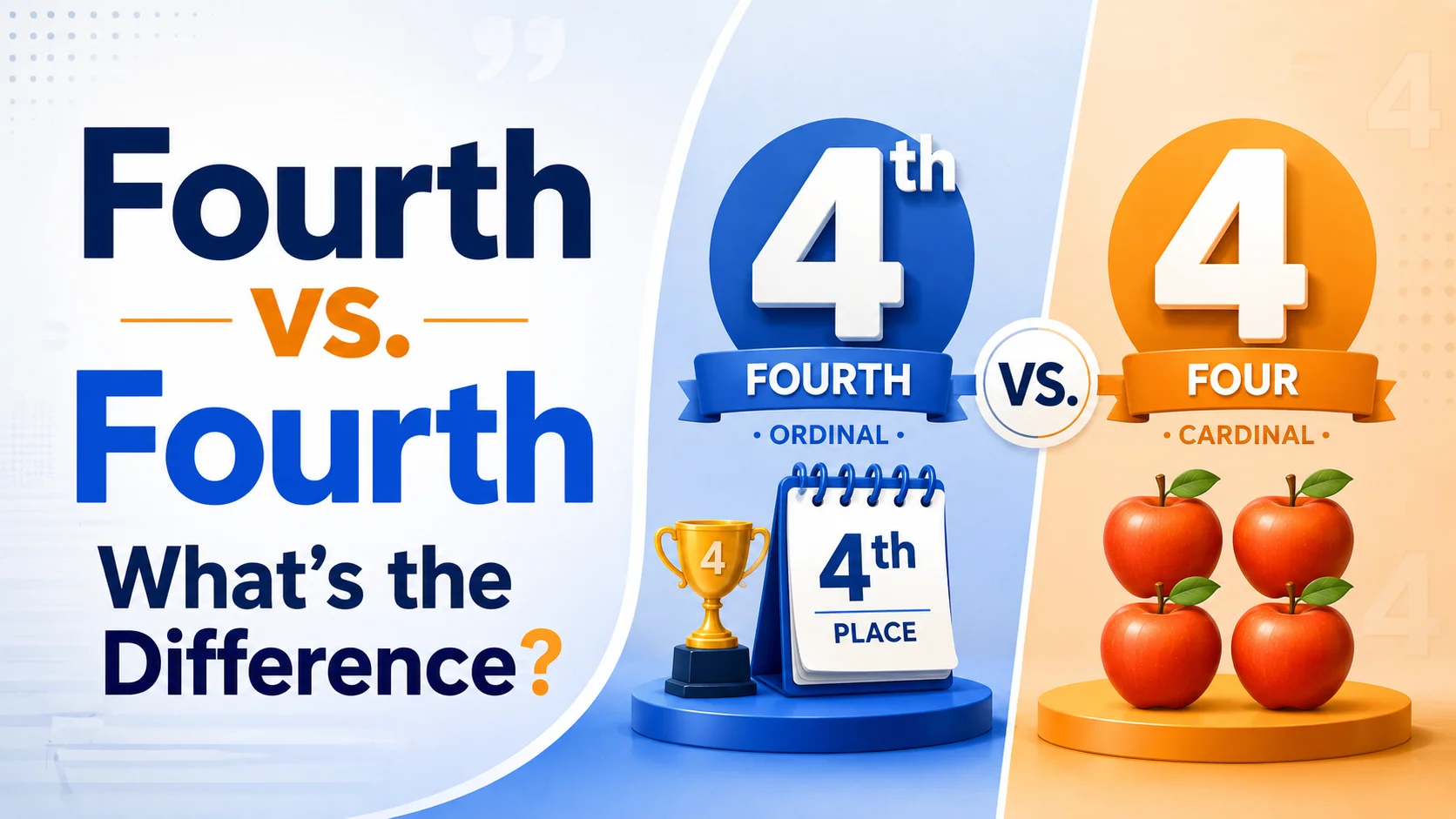
Fourth vs. fourth is a classic English spelling confusion because the two words are pronounced alike in many varieties of English, yet they do completely different jobs. Fourth generally refers to moving or progressing onward, while fourth identifies position number four in a sequence. The difference becomes much easier once you connect each spelling with its meaning: forth relates to going forward, whereas fourth contains the word four because it represents the fourth position.
The confusion usually appears when people hear a sentence before they see it written. Someone might say, “She finished fourth,” or “They marched forth,” and the pronunciation alone may not reveal which spelling belongs on the page. That matters in school assignments, professional writing, dates, rankings, instructions, and everyday messages. Choosing the wrong word can change the meaning entirely, even though the mistake may be almost impossible to notice when speaking.
This guide explains fourth and fourth from the ground up. You will learn their meanings, grammatical roles, pronunciation, common expressions, differences from four, and the situations in which each word sounds natural. You will also see practical examples and simple memory techniques so that you can confidently choose between forth vs. fourth whenever the two words appear to sound the same.
Fourth vs. Fourth at a Glance
The quickest distinction is straightforward:
- Forth means forward, onward, outward, or into view, depending on the context.
- Fourth means number four in a sequence or position.
- Four is the cardinal number; fourth is its ordinal form.
- Forth is chiefly an adverb in modern English.
- Fourth is primarily an ordinal number but can also function as a noun in certain contexts.
| Word | Basic meaning | Typical grammatical role | Example |
| Forth | Forward, onward, outward | Adverb | The explorers moved forth. |
| Fourth | Number four in a sequence | Ordinal number | She finished fourth. |
| Four | The number 4 | Cardinal number | Four students arrived. |
The easiest way to remember the difference
Think of fourth as:
four + th = fourth
If you are talking about the fourth item, fourth person, fourth day, fourth floor, or fourth place, use fourth.
For forth, think of forward or onward:
forth → forward/onward
So:
- We moved forth. → We moved forward.
- She came fourth. → She came in position number four.
Quick rule: If the idea is movement or progress, consider forth. If the idea is position number four, use fourth.
What Does “Forth” Mean?
Forth is mainly an adverb. Its central idea is movement forward, onward, outward, or away from a point, although the exact sense depends on the expression in which it appears.
The word is more formal or literary in some standalone uses than it is in ordinary conversation. However, it remains very common in established expressions such as back and forth, and so forth, set forth, and put forth.
Forth means “forward” or “onward”
One common use of forth describes movement ahead.
For example:
- The soldiers marched forth.
- She stepped forth to accept the award.
- The travelers went forth into the wilderness.
- We must move forth with the plan.
In many modern contexts, forward or ahead would sound more natural in everyday speech. Forth can give the sentence a formal, literary, dramatic, or ceremonial tone.
Compare:
The team moved forward with the project.
This sounds ordinary and professional.
The team moved forth with the project.
This is grammatically possible in contexts where forth means onward, but it sounds more elevated and is not usually the first choice in casual modern English.
That distinction is useful: knowing what a word can mean does not necessarily tell you when it is the most natural word to choose.
Forth can mean “out” or “into view”
Forth can also describe something emerging or being brought outward.
Examples include:
- The flowers put forth new leaves.
- The evidence gradually came forth.
- The machine brought forth an unexpected result.
- She stepped forth from the crowd.
This sense appears particularly often in phrasal verbs and formal expressions.
For example, bring forth can mean to produce, cause, or make something appear:
The new policy brought forth several questions.
Here, forth does not simply mean “forward.” The phrase conveys the idea of something being produced or brought into view.
“And so forth” means “and so on”
One of the most familiar uses of forth is the expression and so forth.
It means that a list or series continues with similar items.
For example:
We packed clothes, books, toiletries, snacks, and so forth.
The phrase is essentially equivalent to and so on.
It is important not to interpret the forth in this expression literally as movement. And so forth is a fixed expression meaning that there are additional similar examples.
“Back and forth” means repeatedly in two directions
Another extremely common expression is back and forth.
It describes repeated movement from one direction or place to another and back again. It can also describe repeated communication, disagreement, or exchange.
Examples:
- The boat moved back and forth across the lake.
- They passed the ball back and forth.
- We exchanged emails back and forth all afternoon.
- The two sides argued back and forth about the proposal.
This is one reason why it remains highly recognizable in contemporary English even though some standalone uses sound formal.
Common expressions with “forth”
| Expression | Meaning | Example |
| go forth | Go forward or set out | They went forth to begin their journey. |
| come forth | Appear, emerge, or come forward | A witness finally came forth. |
| bring forth | Produce or cause | The discussion brought forth new ideas. |
| put forth | Present, offer, or exert | She put forth a convincing argument. |
| set forth | Present formally or begin a journey | The report sets forth the main requirements. |
| back and forth | Repeatedly in two directions | The children ran back and forth. |
| and so forth | And so on | We discussed costs, schedules, materials, and so forth. |
| from that day forth | From that time onward | From that day forth, everything changed. |
These expressions are worth learning as complete phrases rather than trying to replace forth mechanically with forward every time.
What Does “Fourth” Mean?
Fourth is the ordinal form associated with the number four. While four tells us how many things there are, fourth tells us where something stands in a sequence.
Consider:
- I bought four books.
- I read the fourth book first.
The first sentence tells us the quantity. The second identifies a position.
Fourth means “number four in order”
Examples include:
- She finished fourth in the race.
- This is my fourth attempt.
- He lives on the fourth floor.
- Read the fourth paragraph.
- Today is the fourth day of the course.
In each sentence, the fourth identifies a position or sequence.
Fourth before a noun
Fourth commonly appears before a noun:
- the fourth chapter
- the fourth student
- the fourth week
- the fourth question
- the fourth attempt
- the fourth stage
This is one of the easiest patterns to recognize.
If you can replace the word with “number four in the sequence,” fourth is probably correct.
For example:
Please read the fourth chapter.
The chapter is number four in the book.
Fourth can stand alone
You do not always need a noun after the fourth.
For example:
She finished fourth.
The omitted noun is understood: she finished in fourth place.
Likewise:
Which runner came fourth?
The context makes the meaning clear.
This is why fourth can function independently as an ordinal expression rather than always behaving like an ordinary adjective.
Fourth can mean one of four equal parts
There is another useful meaning of a fourth: one of four equal parts of something.
For example:
A fourth of the students were absent.
Or:
She ate a fourth of the cake.
In many contexts, especially in British English, quarter is a very natural alternative:
A quarter of the cake remained.
The meaning is essentially the same when the whole has been divided into four equal parts.
Fourth vs. Fourth: The Key Differences
The words differ in meaning, grammatical function, spelling, and typical context, even though pronunciation can make them difficult to distinguish when heard.
| Feature | Forth | Fourth |
| Core meaning | Forward, onward, outward | Position number four |
| Main grammatical role | Adverb | Ordinal number |
| Connected idea | Movement/progression | Sequence/order |
| Related word | Forward | Four |
| Common expressions | Back and forth, and so forth | Fourth place, fourth floor |
| Example | They marched forth. | They finished fourth. |
| Can refer to number 4? | No | Yes, as an ordinal |
| Can describe movement? | Yes | No |
Meaning is the biggest difference
The safest distinction is semantic.
Ask yourself:
Am I describing where something is going, or where something ranks?
If it is movement or progression:
The group went forth.
If it is position:
The group finished fourth.
The pronunciation may be similar, but the underlying meanings are unrelated.
Their grammatical roles are different
Forth generally functions as an adverb:
The travelers moved forth.
It modifies the movement expressed by moved.
Fourth, by contrast, is an ordinal number:
She finished fourth.
It identifies her position in the sequence.
It can also appear before a noun:
the fourth student
or function as a noun in contexts such as:
a fourth of the total
Understanding the grammatical role can help when spelling by ear is difficult.
Fourth vs. Fourth Pronunciation: Why Are They So Easy to Confuse?
The pronunciation is a major source of the spelling problem. Cambridge gives forth and fourth the same basic UK pronunciation, /fɔːθ/, and the same basic US pronunciation, /fɔːrθ/. This means that in many standard varieties of English, they are homophones—words with different meanings and spellings that sound alike.
The spelling therefore cannot reliably be determined from sound alone.
Compare these spoken sentences:
They moved forth.
They finished fourth.
A listener may hear virtually the same final word. The surrounding meaning tells you which spelling is intended.
Why context matters more than pronunciation
English contains many homophones:
- there / their / they’re
- right / write
- pair / pear
- sea / see
- forth / fourth
With these pairs, hearing the word is not enough. Writing requires you to identify the intended meaning.
For forth and fourth, the easiest contextual clues are:
- movement/progression → forth
- number four/sequence → fourth
How to Use “Forth” Correctly in a Sentence
The best way to master forth is to learn its natural patterns instead of forcing it into sentences where forward, ahead, or out would sound more ordinary.
Use “forth” for onward movement
Examples:
The explorers ventured forth before sunrise.
She stepped forth when her name was called.
The soldiers marched forth.
These sentences have a somewhat formal or literary flavor.
Use “forth” in established expressions
Some combinations are much more natural than others:
- back and forth
- and so forth
- set forth
- put forth
- bring forth
- come forth
These expressions should be treated as established English constructions.
For example:
The committee set forth several recommendations.
Here, set forth means to present or state something clearly and formally.
Be careful with standalone “forth”
A common mistake among learners is assuming that because forth can mean forward, it can replace forward everywhere.
It cannot.
For instance, in ordinary conversation:
Please move forward.
is much more natural than:
Please move forth.
The second version may sound ceremonial, poetic, or deliberately formal.
Expert tip: A dictionary definition tells you what a word can mean; natural usage tells you where native speakers actually prefer to use it.
How to Use “Fourth” Correctly in a Sentence
Use fourth whenever you are identifying position 4 in a sequence.
Use “fourth” for rankings
Examples:
Maya finished fourth in the competition.
Our team came fourth overall.
He was the fourth person to cross the finish line.
The key idea is order.
Use “fourth” for numbered stages or items
Examples:
We are now entering the fourth stage of the process.
Turn to the fourth page.
This is the fourth question on the test.
The fourth chapter explains the main theory.
Whenever the underlying sequence is 1st, 2nd, 3rd, 4th, the written word is fourth.
Use “fourth” for dates
Examples:
Her birthday is on the fourth of December.
The event begins on December fourth.
The meeting is scheduled for the fourth.
The exact date format varies by English variety and style, but the ordinal number remains fourth.
Use “fourth” for fractions
Examples:
One fourth of the budget was spent.
A fourth of the class chose the second option.
Divide the pizza into fourths.
In mathematical or everyday contexts, one-quarter or a quarter may often be more idiomatic, but fourth is perfectly meaningful.
Forth vs. Fourth Examples Side by Side
Seeing the words together makes the distinction easier to remember.
| Situation | Correct word | Example |
| Moving onward | forth | The travelers went forth. |
| Ranking position 4 | fourth | She finished fourth. |
| Repeated two-way movement | forth | The door swung back and forth. |
| Sequence position 4 | fourth | Read the fourth paragraph. |
| From a particular time onward | forth | From that day forth, he changed his routine. |
| One of four equal parts | fourth | A fourth of the cake remained. |
| Presenting something formally | forth | The report sets forth the rules. |
| Fourth item in a series | fourth | This is the fourth item. |
Movement vs. position
- The hikers marched forth.
- The hikers are moving onward.
- The hikers finished fourth in the race.
- Their position is number four.
Changing one word for the other would destroy the intended meaning.
Progress vs. sequence
The discussion moved forth.
This can work in a formal or literary context, although forward would usually sound more natural.
The discussion entered its fourth stage.
Here, fourth identifies the stage’s position in an ordered process.
Forth vs. Fourth vs. Four
A third word deserves attention because many mistakes come from confusing four, fourth, and forth rather than only forth and fourth.
Four is a cardinal number
Four tells you the quantity.
We need four chairs.
There are four chairs.
Fourth is an ordinal number
Fourth tells you the position.
We need the fourth chair.
The chair is number four in an identifiable sequence or arrangement.
Forth relates to movement or continuation
Forth has nothing to do with the numerical value four.
The horse moved forth.
The horse moved onward.
A useful comparison is:
| Word | Question it answers | Example |
| Four | How many? | I have four books. |
| Fourth | Which position? | I read the fourth book. |
| Forth | In what direction/progression? | The story moves forth. |
This three-way distinction solves a surprisingly large number of spelling errors.
Common Mistakes With Fourth and Fourth
Mistake 1: Using “fourth” for forward movement
Incorrect:
The soldiers marched fourth.
Correct:
The soldiers marched forth.
The soldiers are moving onward, not occupying position number four.
Mistake 2: Using “forth” for position number four
Incorrect:
She finished fourth in the race.
Correct:
She finished fourth in the race.
The sentence identifies her ranking, so fourth is required.
Mistake 3: Confusing “four” with “fourth”
Incorrect:
He lives on the fourth floor.
Correct:
He lives on the fourth floor.
The floor has a position in a sequence.
Mistake 4: Assuming similar pronunciation means interchangeable spelling
It does not.
Homophones can have entirely different meanings. The same sound does not make the words grammatical substitutes for one another.
Mistake 5: Replacing “forward” with “forth” everywhere
Although forth can mean forward or onward, forward is generally the more neutral modern choice for ordinary physical or figurative movement.
Use forth naturally in expressions and contexts where its formal or literary tone fits.
How to Remember Forth vs. Fourth
You do not need to memorize a complicated rule.
Remember “four” inside “fourth”
When you mean the ordinal number associated with 4, choose fourth.
- four
- fourth
- fourth place
- fourth chapter
- fourth floor
Associate “forth” with “forward”
When the meaning involves going onward, think:
forth → forward
Examples:
- go forth
- move forth
- set forth
- from that day forth
Use the context test
When you hesitate, ask:
Is this about movement or position?
- If it is about movement, progress, or going onward, choose forth.
- If it is about position number four, choose fourth.
- If it is simply about the quantity 4, choose four.
That gives you a three-word decision system:
Four = quantity
Fourth = position
Forth = onward
Fourth vs. Fourth in Different Contexts
Academic writing
Fourth is common when organizing material:
- fourth chapter
- fourth section
- fourth study
- fourth experiment
- fourth hypothesis
Forth may appear in formal expressions such as set forth:
The paper sets forth three possible explanations.
This is a useful distinction because academic writing often needs both words, but for entirely different reasons.
Professional and business writing
Business documents frequently use fourth for stages, periods, and rankings:
- fourth quarter
- fourth phase
- fourth meeting
- fourth report
Forth appears in formal constructions:
The policy sets forth the company’s requirements.
Here, sets forth means states or presents formally.
Everyday conversation
You are likely to hear fourth in:
- dates
- rankings
- floors
- attempts
- chapters
- stages
You are likely to encounter forth in fixed expressions:
- back and forth
- and so forth
- go forth
- put forth
Standalone forth is less common in casual conversation than forward.
Literary and historical writing
Older, ceremonial, or literary writing uses forth more freely:
They rode forth at dawn.
From that day forth, the kingdom changed.
That style can be effective when intentional. It may sound unnecessarily dramatic in an ordinary email or conversation.
Related Words That Cause Similar Confusion
Forward vs. forth
These words overlap in meaning, but they are not interchangeable in every sentence.
Forward is the broader and more neutral modern word:
Move forward.
Forth is more formal or literary in many standalone uses:
Go forth.
However, forth remains very natural inside expressions such as back and forth and so forth.
Fourth vs. four
The distinction is grammatical as well as numerical:
Four students arrived.
Quantity.
The fourth student arrived late.
Position.
A simple way to remember it is:
Cardinal numbers count. Ordinal numbers order.
Forth vs. further
These words can both relate to progress, but they do different jobs.
Further commonly means additional, to a greater extent, or at a more advanced point:
We need further information.
Forth generally conveys movement onward or outward:
The travelers went forth.
They should not be treated as synonyms simply because both can appear in contexts involving progress.
Fourth vs. foreword
Fourth refers to position number four.
A foreword is a short introductory section of a book, usually written by someone other than the main author.
The spelling is completely different, and so is the meaning.
A Quick Decision Guide
Use this checklist whenever you are unsure.
| Ask yourself… | If the answer is yes, use… |
| Am I talking about going onward? | forth |
| Does the word mean forward or outward? | forth |
| Is it part of “back and forth”? | forth |
| Is it part of “and so forth”? | forth |
| Am I describing position number 4? | fourth |
| Am I talking about the fourth item? | fourth |
| Is it the fourth day, floor, chapter, or attempt? | fourth |
| Am I talking about quantity 4? | four |
Test yourself
Choose forth, fourth, or four:
- The runners moved ___ toward the finish line.
- She came ___ in the competition.
- We bought ___ notebooks.
- The meeting is on the ___ of June.
- The children ran back and ___.
- This is my ___ attempt.
- The report sets ___ several recommendations.
Answers:
- forth
- fourth
- four
- fourth
- forth
- fourth
- forth
The key is not pronunciation. Look at what the sentence means.
Conclusion
The difference between fourth and fourth is simple once you stop relying on pronunciation. Forth is connected with moving forward, onward, or outward, and it appears naturally in expressions such as back and forth, and so forth, and set forth. Fourth, meanwhile, identifies position number four: the fourth chapter, fourth floor, fourth attempt, or fourth-place finisher. And remember that four itself simply expresses quantity. One final actionable tip: when you are unsure, replace the word mentally. If forward or onward makes sense, forth may be right. If number four in a sequence makes sense, choose fourth. A common mistake to avoid is treating the similar pronunciation as proof that the spellings are interchangeable. They are not. Once you connect fourth with four and forth with forward, this pair becomes much easier to handle accurately.
Frequently Asked Questions
Q1. What is the difference between fourth and fourth?
Fourth generally means forward, onward, or outward, while fourth means number four in a sequence. For example, “They marched forth” describes movement, whereas “She finished fourth” identifies a ranking. They can sound alike, so context determines the correct spelling.
Q2. Is “forth” a number?
No. Fourth is not a number. It is chiefly an adverb associated with movement, progression, or emergence. Fourth is the ordinal number connected with four. If you mean the position after third, use fourth, not forth.
Q3. Are fourth and fourth homophones?
In many varieties of English, yes. Forth and fourth have the same or essentially the same pronunciation, although accent differences can affect the exact sound. Because they are commonly homophones, their meanings and sentence context—not pronunciation—must determine which spelling you write.
Q4. Is “forth” still commonly used in modern English?
Yes, although some standalone uses sound formal or literary. It remains very common in established expressions such as back and forth, and so forth, set forth, and put forth. In ordinary conversation, forward is often preferred when simply describing movement.
Q5. Is “a fourth” the same as “a quarter”?
Usually, yes, when the whole is divided into four equal parts. “A fourth of the cake” and “a quarter of the cake” describe the same fraction. Quarter is often more idiomatic in everyday English, while fourth is also standard, particularly in mathematical or explanatory contexts.
