
Ally vs. Allie is a common spelling question because the two words can sound alike, yet they serve different purposes in English. Ally usually refers to a person, group, or country that supports another, and it can also function as a verb meaning to join or cooperate with someone. Allie, by contrast, is a personal name, often used independently or as a nickname for a longer name such as Allison or Alexandra. The correct choice depends on what you want to communicate: a relationship based on support or the identity of a particular person.
The confusion often appears in sentences where pronunciation alone cannot reveal the intended spelling. For example, “Maya is my strongest ally” describes Maya’s supportive role, while “Allie is my closest friend” uses Allie as a name. However, there is one important detail: Ally can also be a person’s name. If someone is named Ally, that spelling is correct for that person. The distinction is therefore not simply that Ally is never a name and Allie always is; meaning, capitalization, and a person’s chosen spelling all matter.
Understanding these differences helps you write more accurately in emails, school assignments, articles, workplace communication, and everyday messages. It also prevents confusion with related forms such as allies, ally’s, Allie’s, and alley. This guide explains the meanings and grammatical roles of both words, shows how to use them naturally, and clarifies the spelling and punctuation rules that commonly cause mistakes. You will also learn how to distinguish the words quickly without relying on pronunciation alone.
Quick Answer: What Is the Difference Between Ally and Allie?
Ally is a common word meaning a supporter or partner, and it can also be a verb meaning to join forces. Allie is commonly used as a personal name or nickname. However, Ally can also be a person’s name, so you should preserve the individual’s actual spelling.
- Ally: “The team found an ally in its new manager.”
- Allie: “Allie joined the team on Monday.”
- Ally as a name: “Ally joined the team on Monday.”
- Alley: “The delivery driver walked through the alley.”
Use ally for the common noun or verb, and use the spelling the person actually uses when writing a name.
What Does Ally Mean?
The word ally generally refers to someone or something connected to another through support, cooperation, or a shared interest. It is most often a noun, but it can also be a verb.
Ally as a noun
As a noun, ally means a supporter, associate, or partner. An ally may help another person through a difficult situation, work with an organization toward a common goal, or cooperate with a country on political or military matters.
Examples:
- “She became a reliable ally during the negotiations.”
- “The small business found an ally in a local supplier.”
- “The two countries have been allies for years.”
- “A good ally listens before offering advice.”
An ally does not have to be a close friend. The word describes a supportive relationship, which may be personal, professional, political, or strategic.
Ally as a verb
Ally can also mean to join, associate, or cooperate with another person, group, or organization. It is often used in formal writing, political reporting, and discussions of business strategy.
Examples:
- “The two organizations allied to improve access to education.”
- “Several countries allied against a common threat.”
- “The company allied itself with a trusted technology provider.”
The verb is commonly used in the forms ally, allies, allied, and allying. For example, “She allies herself with experienced researchers” uses the present-tense form, while “The groups allied last year” uses the past tense.
What is the origin of ally?
Ally entered English through Old French, with roots in Latin alligare, meaning to bind or connect. This history is consistent with the modern idea of people or groups joining together through a shared purpose.
The origin can help you remember the meaning, but it does not determine how every modern sentence should be written. Current context and grammatical function remain the best guides.
What Does Allie Mean?
Allie is commonly a personal name. It may be a given name in its own right or a familiar form of a longer name. Unlike the common noun ally, it does not ordinarily mean a supporter or partner.
Examples:
- “Allie called to confirm the appointment.”
- “I met Allie at the conference.”
- “Allie enjoys reading historical novels.”
- “We saved a seat for Allie.”
In each example, Allie identifies a particular person. The spelling should match that person’s name, whether it is used in a casual conversation, a formal email, or an official document.
Names that may use Allie as a nickname
Allie is sometimes used as a shortened form of several names. The connection depends on personal preference; not everyone with one of these longer names uses the same nickname.
| Longer name | Possible short form |
| Allison | Allie |
| Alison | Allie |
| Alexandra | Allie |
| Alicia | Allie |
| Alyssa | Allie |
These are possibilities, not fixed rules. A person named Allison might prefer Ally, Alli, or the full name, while someone named Allie may use it as their full given name.
Is Ally also a person’s name?
Yes. Ally is also used as a given name or nickname. This is an important exception to the simple rule that ally means a supporter and Allie means a person.
Consider these sentences:
- “My ally helped me prepare for the interview.” Here, ally is a common noun.
- “Ally helped me prepare for the interview.” Here, Ally may be a person’s name.
The surrounding sentence does not always settle the distinction by itself. If you are referring to someone whose name is Ally, use that spelling and capitalize it. Never change a person’s name to Allie merely because you expect that version to be more common.
Ally vs. Allie: Key Differences
The table below compares the common-word and name uses. Remember that the capitalization of Ally changes when it is a person’s name.
| Feature | Ally | Allie |
| Common meaning | A supporter or partner | Usually a personal name |
| Grammatical role | Noun or verb | Proper noun when used as a name |
| Common noun example | “She is a trusted ally.” | Not normally used as a common noun |
| Name example | “Ally is waiting outside.” | “Allie is waiting outside.” |
| Capitalization | Lowercase as a common noun; uppercase as a name or at the start of a sentence | Uppercase when used as a name |
| Related forms | Allies, allied, allying, ally’s | Allie’s; Allies may be a plural of the name in a suitable context |
| Best way to choose | Check whether it means support or is someone’s actual name | Check whether this is the person’s chosen spelling |
The main difference is the word’s function in context. Ally has an established meaning as a common noun and verb, while Allie is commonly a name. Both spellings can identify people.
How to Use Ally Correctly
Use ally when you mean a supporter or partner, or when the verb means to join forces. Its meaning can shift slightly with context, but the central idea is cooperation or support.
In personal relationships
An ally is someone who supports another person or stands alongside them in a particular situation. The word does not necessarily mean a best friend or someone who agrees with every decision.
Examples:
- “My sister was an ally when I changed careers.”
- “He found an ally in a colleague who understood the problem.”
- “Being an ally means listening as well as offering support.”
These examples describe a role rather than a name. If the supporter is named Ally, however, the same spelling can serve both purposes in different sentences.
In business and professional settings
Businesses and professionals may have allies who offer expertise, introductions, resources, or cooperation. An ally does not necessarily have to be a formal business partner.
Examples:
- “The startup gained an ally in an experienced investor.”
- “Our department needs allies in other teams.”
- “The two firms allied to develop a shared service.”
Choose ally when you are describing the supportive relationship. If you are writing about a colleague named Allie or Ally, capitalize the name and follow the person’s preferred spelling.
In politics and international relations
The word ally frequently describes a country or political group that cooperates with another. Such relationships may involve security, diplomacy, trade, or other shared interests.
Examples:
- “The country consulted its allies before making the announcement.”
- “The two parties allied to support the proposal.”
- “The treaty strengthened the relationship between the allies.”
In historical writing, Allies can also refer to a particular coalition. For example, the Allies commonly names the coalition of countries that fought against the Axis powers during World War II. The capital letter reflects the historical group being named, rather than a person’s name.
In social movements and advocacy
An ally may be someone who supports a group or cause, particularly when that person is helping address unfair treatment or exclusion. In this context, the word often describes actions as well as attitudes.
Examples:
- “A workplace ally speaks up when a colleague is treated unfairly.”
- “The organization encouraged community allies to participate.”
- “Being an ally requires listening to the people directly affected.”
The meaning is still based on support. The spelling does not change because the word appears in discussions of inclusion or advocacy.
How to Use Allie Correctly
Use Allie when that is the person’s actual name or preferred nickname. Treat it as a proper noun and capitalize it in ordinary sentences.
Capitalization rules for Allie
Names begin with capital letters, regardless of where they appear in a sentence.
Correct:
- “Allie will send the revised document.”
- “I spoke to Allie yesterday.”
- “We invited Allie and her family.”
Incorrect, when referring to a person named Allie:
- “allie will send the revised document.”
- “I spoke to allie yesterday.”
The rule applies to names such as Ally, Allie, Allison, and Alison. If ally appears as a common noun in the middle of a sentence, it normally stays lowercase: “She became an ally.”
Allie as a nickname
A nickname may be used in casual conversation, professional communication, or published writing if that is how the person identifies themselves. It is not necessary to replace every nickname with a longer legal or formal name.
For example:
- “Allie will lead the presentation.”
- “Allie Bennett submitted the report.”
- “The invitation was addressed to Allie.”
In formal documents, use the name the person has supplied or the form required by the document. Do not assume that Allie is short for Allison or Alexandra unless you have reason to know that.
The possessive form of Allie
To show that something belongs to Allie, add an apostrophe and s: Allie’s.
Examples:
- “Allie’s laptop is on the desk.”
- “We reviewed Allie’s proposal.”
- “Allie’s team won the competition.”
The apostrophe is not part of the name itself; it marks possession. In a sentence such as “Allie’s arriving soon,” the same spelling can also represent the contraction Allie is. The surrounding words tell you which meaning is intended.
Ally vs. Allie in Sentences
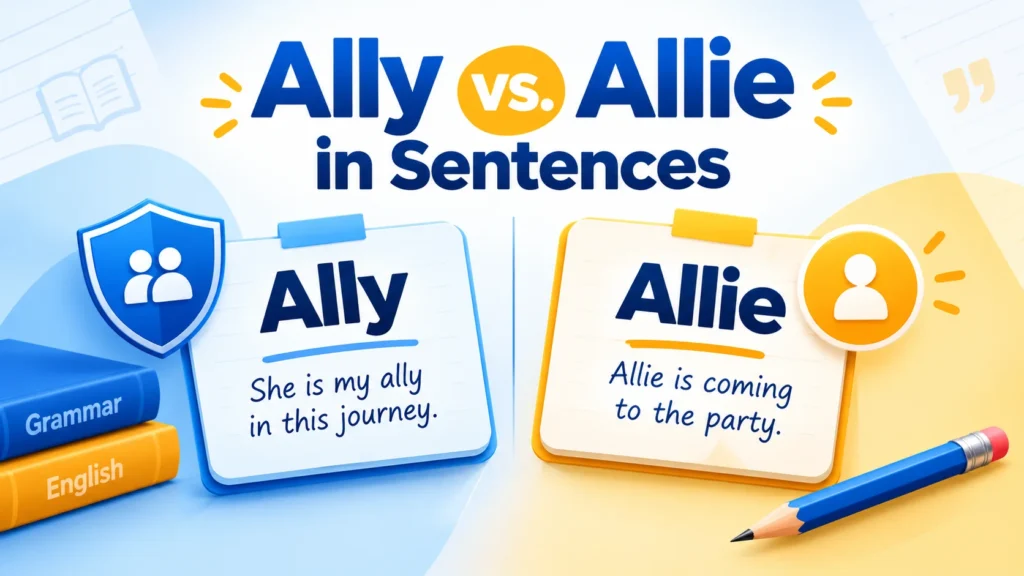
Comparing complete sentences is one of the quickest ways to see how the spellings work.
Examples using ally
- “A good ally offers support without taking over.”
- “The country consulted its allies before the summit.”
- “Our team found an ally in the new director.”
- “The two organizations allied to fund the project.”
- “She has allied herself with people who share her goals.”
- “The community needs allies who are willing to take action.”
- “The negotiator thanked each ally for their cooperation.”
- “The companies allied to develop a new product.”
In these examples, ally is a common noun or verb. It is lowercase unless it begins a sentence or forms part of a proper name.
Examples using Allie
- “Allie called before the meeting.”
- “I saved a place for Allie.”
- “Allie’s presentation begins at noon.”
- “Have you met Allie from the design team?”
- “Allie and her brother arrived early.”
- “The message was addressed to Allie.”
- “Allie’s notebook was left in the conference room.”
- “We asked Allie to review the final draft.”
Here, Allie identifies a person. If that person’s chosen spelling is Ally, use Ally instead.
Common Mistakes With Ally and Allie
Most errors happen when writers rely on how a word sounds rather than checking its meaning or the spelling of a person’s name.
| Mistake | Correct approach | Explanation |
| Writing “a trusted Allie” to mean a supporter | “a trusted ally” | Use the common noun ally for a supporter. |
| Changing a person’s name from Ally to Allie | Preserve the person’s actual name | Both spellings can be names. |
| Writing “allie called me” for a person named Allie | “Allie called me” | Proper names require capitalization. |
| Using “ally’s” for more than one supporter | “allies” | The plural of the common noun ally is allies. |
| Writing “Allie’s” when you mean several supporters | “allies” | An apostrophe does not make a regular plural. |
| Confusing ally with alley | Choose by meaning | An alley is a narrow passage or lane. |
Using Allie instead of ally
❌ Incorrect: “The country needed a strong Allie.”
✅ Correct: “The country needed a strong ally.”
Why: If the intended meaning is a supporting country, person, or group, use the common noun ally. Capitalizing Allie does not make it the correct spelling for that meaning.
Using ally instead of someone’s name
Suppose your colleague’s name is Allie.
❌ Incorrect: “I sent the report to my colleague, ally.”
✅ Correct: “I sent the report to my colleague, Allie.”
Why: Use the person’s actual name. However, if your colleague’s name is Ally, then Ally is correct. Do not apply a general spelling rule to override someone’s chosen name.
Confusing allies and Allie’s
These forms have different grammatical functions:
- allies: the plural of the common noun ally
- ally’s: the possessive form of the common noun ally, or a contraction of ally is or ally has in suitable sentences
- Allie’s: the possessive form of the name Allie, or a contraction of Allie is or Allie has
- Allies: potentially the plural of the name Ally, depending on context, or the capitalized name of a historical coalition
Examples:
- “The country relied on its allies.”
- “The ally’s advice proved useful.”
- “Allie’s coat is hanging by the door.”
- “Allie’s joining us later” means “Allie is joining us later.”
Apostrophes mark possession or certain contractions. They do not ordinarily create plural nouns.
Ally vs. Alley vs. Allie
Ally, alley, and Allie may sound alike in many varieties of English, but they do not mean the same thing. This comparison is useful because alley is another frequent spelling mistake.
| Word | Meaning | Example |
| ally | A supporter or partner; also a verb meaning to join forces | “She became a trusted ally.” |
| alley | A narrow passage, lane, or pathway | “The delivery van entered the alley.” |
| Allie | A personal name or nickname | “Allie entered the building.” |
| Ally | A personal name in some cases | “Ally entered the building.” |
To choose correctly, ask what the sentence is describing. A person who supports you may be an ally. A narrow passage is an alley. A person named Allie or Ally should be identified using their actual name.
Grammar Rules for Ally and Allie
Understanding the related word forms prevents mistakes that a simple definition cannot resolve.
Singular and plural forms
The common noun ally follows the usual spelling pattern for many consonant-plus-y nouns: change the y to ies to form the plural.
| Form | Example |
| Singular common noun: ally | “She is a dependable ally.” |
| Plural common noun: allies | “They are dependable allies.” |
| Base verb: ally | “The groups ally to share resources.” |
| Third-person singular verb: allies | “The organization allies itself with local partners.” |
| Past tense: allied | “The groups allied last year.” |
| Present participle: allying | “The companies are allying to develop a service.” |
The same spelling change can appear in the plural of the name Ally, but names follow the way they are actually written and used. When writing about multiple people named Ally, make sure the context makes the intended meaning clear.
Possessive forms
Use an apostrophe to show possession. The placement depends on whether the noun is singular or plural.
| Form | Possessive | Example |
| One common-noun ally | ally’s | “The ally’s support was valuable.” |
| Multiple common-noun allies | allies’ | “The allies’ agreement was renewed.” |
| A person named Allie | Allie’s | “Allie’s appointment is at ten.” |
| A person named Ally | Ally’s | “Ally’s appointment is at ten.” |
Do not confuse a possessive with a plural. “The allies’ plan” refers to a plan belonging to multiple allies, while “the allies” simply means more than one supporter.
Easy Ways to Remember the Difference
A memory trick is useful when it helps you make a decision without adding another rule to memorize.
Connect ally with alliance
The word ally is closely related in meaning to alliance. Both concern a relationship built around cooperation or a shared purpose.
Try this sentence: “An ally joins an alliance.” The connection reminds you to use ally when you mean a supporter or partner.
Connect Allie with a person’s name
Think of Allie as a name you might see on a birthday card, meeting invitation, or contact list. If you are addressing a particular person, check the spelling they use.
Remember that Ally can also be a name. The best memory trick is not to assume every person’s name must be spelled Allie.
Use this quick decision test
- Do you mean a supporter or partner? Use ally.
- Do you mean someone whose name is Allie? Use Allie.
- Is the person’s name Ally? Use Ally.
- Do you mean a narrow passage? Use alley.
- Are you showing possession or forming a plural? Check whether you need ally’s, allies, Allie’s, or another form.
This test handles most everyday cases and helps you avoid relying on sound alone.
Conclusion
Choosing between ally and Allie becomes straightforward when you focus on meaning and identity rather than sound. Use ally when you mean a supporter, partner, or someone joining forces with another person or group. Use Allie when that is the name or nickname of the person you are referring to, while remembering that Ally is also a valid personal name. One final actionable tip: when editing a sentence, ask whether the word describes a relationship or identifies a particular person. Then check the intended meaning and spelling before making a correction. A common mistake to avoid is assuming that every person’s name must be spelled Allie. Names vary, and the individual’s preferred spelling takes priority. That small check keeps your writing clear, accurate, and respectful.
Frequently Asked Questions
Q1. Is Ally or Allie the correct spelling?
Both spellings are correct, but they are used differently. Ally is a common noun meaning a supporter or partner and can also be a verb. Allie is commonly a personal name. Since Ally can also be a name, check the person’s actual spelling.
Q2. Can Ally be a girl’s name?
Yes. Ally is used as a given name or nickname, just as Allie is. Some people use Ally as a short form of Allison or Alexandra, while others use Allie or a different spelling. When referring to a specific person, use the spelling that person prefers.
Q3. Is Allie always capitalized?
When Allie is used as a person’s name, it is capitalized because names are proper nouns. If a word appears at the beginning of a sentence, it is capitalized for that reason too. The common noun ally normally remains lowercase within a sentence.
Q4. What is the plural of ally?
The plural of the common noun ally is allies. For example, “The organization has several allies.” This spelling changes the final y to ies. Do not write ally’s to mean more than one supporter; the apostrophe usually marks possession or a contraction.
Q5. What is the difference between ally, Allie, and alley?
Ally means a supporter or partner, while Allie is commonly a personal name. Alley means a narrow passage or lane. Ally can also be a person’s name, so context and the individual’s chosen spelling matter when identifying someone.
