
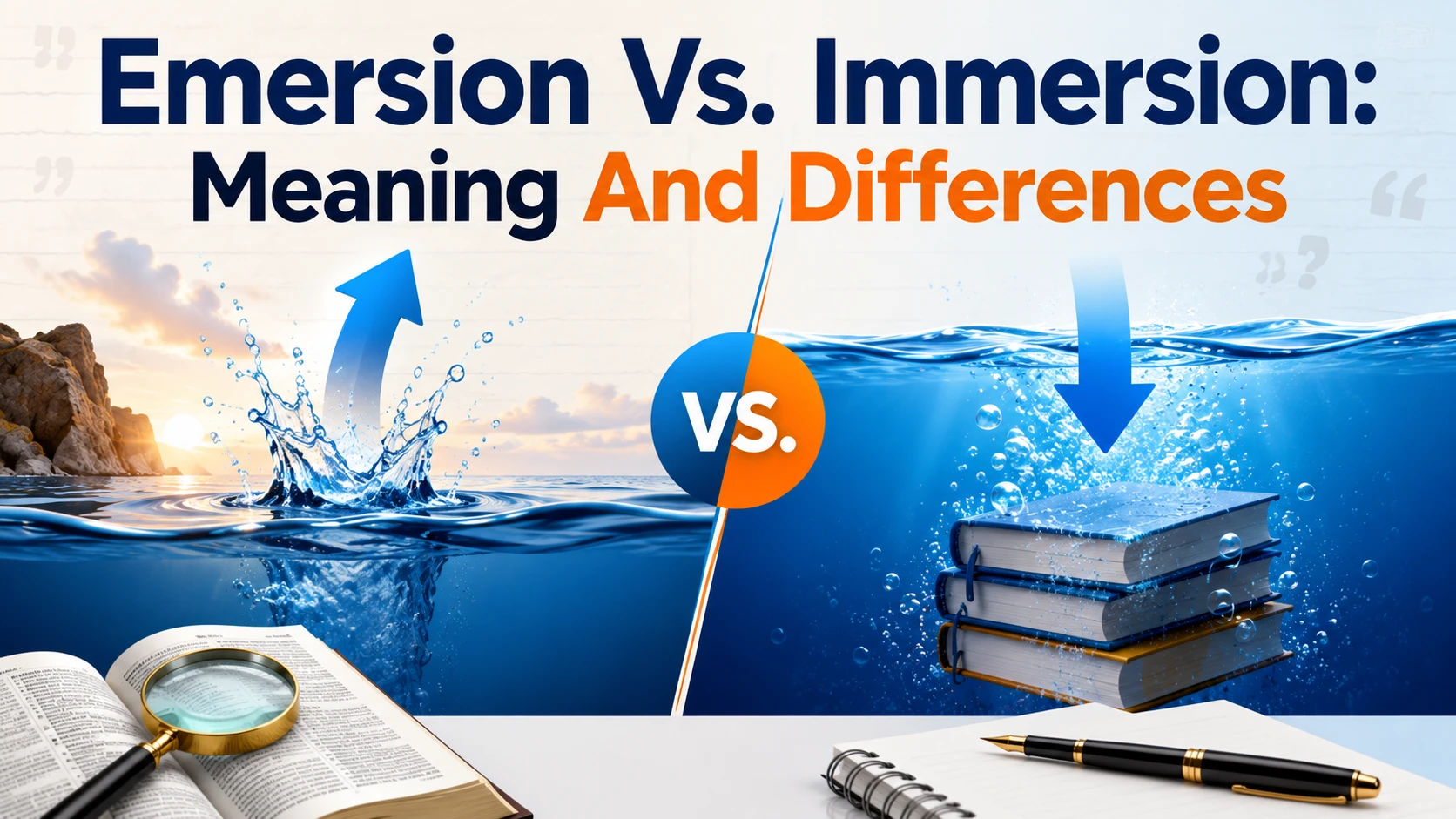
Emersion vs. immersion can confuse English learners because the two words look and sound similar, yet they describe different types of movement and position. Emersion refers to coming out, rising, or emerging from a submerged or hidden state. Immersion, on the other hand, means entering, being placed in, or becoming completely surrounded by a substance, especially water. Understanding this difference helps you choose the correct word in academic writing, professional communication, and everyday English.
The easiest way to remember the distinction is to picture a swimmer. When the swimmer moves upward from underwater and reaches the surface, the action represents emersion. When the swimmer enters the water or remains fully surrounded by it, the situation represents immersion. While emersion often focuses on movement outward or upward, immersion focuses on entering, being within, or being completely covered by something. The words may appear in scientific, natural, technical, and specialized contexts, but their core meanings remain distinct.
Learning how to use emersion and immersion correctly can improve your vocabulary, sentence accuracy, and communication clarity. This guide explains their meanings, pronunciation, usage, related terms, and common mistakes through simple definitions and practical examples. By understanding the context behind each word, you can avoid confusing similar spellings and write with greater confidence and precision.
Why People Confuse Emersion and Immersion
English has a habit of creating linguistic twins that look almost identical. Emersion and immersion belong in that category.
At first glance, the words feel interchangeable because:
- they share similar spellings
- they sound close in pronunciation
- they describe forms of movement
- they come from related root words
However, familiarity plays the biggest role in the confusion.
Most people encounter “immersion” constantly:
- immersive games
- language immersion
- immersive technology
- immersive experiences
- immersion learning
Meanwhile, “emersion” appears mostly in:
- marine biology
- astronomy
- environmental science
- technical writing
Since immersion dominates everyday language, many readers assume emersion must be incorrect. That assumption creates mistakes in essays, blog posts, research papers, and online discussions.
The reality looks much simpler:
- both words are correct
- both have legitimate meanings
- they describe opposite directions
What Does Emersion Mean?
The word emersion refers to the act of emerging, rising out of, or becoming exposed after submersion or concealment.
In simple language:
Emersion means coming out of something.
The term appears most often in scientific or technical contexts.
Definition of Emersion
Emersion means:
The process of emerging from a liquid, covering, or hidden state.
The word commonly describes exposure after being submerged.
Examples include:
- coral becoming exposed during low tide
- seaweed emerging above water
- a moon reappearing after eclipse
The focus always points outward or upward.
Origin and Etymology of Emersion
Emersion comes from the Latin word:
emergere
Meaning:
- to rise out
- to emerge
- to bring forth
That Latin root also appears in related words such as:
- emerge
- emergence
- emergency
Each word involves appearance, exposure, or upward movement.
Language roots often work like breadcrumbs. Follow them carefully and meanings become easier to remember.
Emersion in Marine Biology
Marine biology frequently uses emersion because coastal ecosystems constantly shift between exposure and submersion.
During low tide:
- seaweed experiences emersion
- barnacles become exposed
- tidal organisms encounter air instead of water
These environmental changes affect:
- temperature
- oxygen exchange
- hydration
- survival rates
Some organisms tolerate emersion remarkably well. Others survive only short exposure periods.
Example
A mussel attached to rocks may remain:
- immersed during high tide
- emerged during low tide
That repetitive cycle shapes entire coastal ecosystems.
Emersion in Astronomy
Astronomy uses emersion differently.
In this field, emersion describes:
The reappearance of a celestial body after eclipse or occultation.
For example:
- a moon emerging from behind a planet
- a star becoming visible again
Astronomers often pair:
- immersion = disappearance
- emersion = reappearance
The terminology sounds technical yet surprisingly elegant.
Emersion in Environmental Science
Environmental scientists study emersion because exposure creates physical stress for aquatic organisms.
Extended emersion may cause:
- dehydration
- overheating
- reduced oxygen access
- habitat instability
Coastal species evolved fascinating survival strategies to handle these conditions.
For example:
- barnacles seal moisture inside shells
- crabs burrow into wet sand
- mangroves tolerate alternating water levels
Nature improvises like a jazz musician under pressure.
What Does Immersion Mean?
Unlike emersion, the word immersion appears everywhere in modern English.
Immersion refers to:
Deep involvement, engagement, or submersion into something.
The meaning can be:
- physical
- emotional
- educational
- technological
- psychological
The core idea always involves entering deeply into an experience or environment.
Definition of Immersion
Immersion means:
The act of becoming fully involved or submerged.
Examples include:
- language immersion
- virtual reality immersion
- cultural immersion
- water immersion
The word emphasizes depth and involvement.
Origin and Etymology of Immersion
Immersion comes from the Latin word:
immergere
Meaning:
- to plunge into
- to dip into
- to submerge
That root still shapes modern usage clearly.
Whenever you immerse yourself in something, you enter it deeply.
Language Immersion
Language immersion remains one of the most effective learning methods available.
Instead of memorizing endless vocabulary lists, learners surround themselves with:
- native speakers
- daily conversations
- television
- books
- real-life communication
For example, a student learning Spanish in Mexico experiences immersion through:
- restaurants
- public transportation
- social interaction
- local culture
The brain adapts quickly because the language becomes necessary for everyday life.
That’s why immersion programs often produce faster fluency than traditional classroom memorization alone.
Immersion in Gaming and Virtual Reality
Gaming companies chase immersion aggressively because engagement drives success.
An immersive experience:
- captures attention deeply
- creates emotional investment
- feels believable
- reduces outside distractions
Developers use:
- realistic sound
- detailed graphics
- interactive storytelling
- responsive environments
to strengthen immersion.
Games like The Legend of Zelda: Breath of the Wild became hugely successful partly because players felt absorbed inside the world itself.
That sensation defines immersion perfectly.
Immersion in Education
Educational immersion focuses on active participation instead of passive observation.
Examples include:
- science simulations
- language labs
- role-playing exercises
- hands-on workshops
Students generally retain information better when they engage directly with the material.
Reading about swimming teaches theory. Jumping into the pool teaches survival.
That difference explains why immersive learning often works so well.
Cultural Immersion
Travel becomes far more meaningful through cultural immersion.
Tourists observe from a distance. Immersed travelers participate directly.
Cultural immersion may involve:
- staying with local families
- speaking the local language
- attending community events
- trying regional food
These experiences create deeper understanding and stronger personal connection.
Emersion vs Immersion: The Main Difference
The easiest way to understand these words involves direction.
| Feature | Emersion | Immersion |
| Meaning | Coming out | Going into |
| Direction | Outward or upward | Inward or downward |
| Common Usage | Scientific writing | Everyday language |
| Popularity | Less common | Extremely common |
| Example | “Seaweed experienced emersion.” | “Language immersion improved fluency.” |
One word exists. The other enters.
That directional contrast controls every correct usage.
How To Use Emersion Correctly
Emersion works best in scientific or technical contexts involving exposure or emergence.
Correct Examples of Emersion
- “The coral experienced an emersion during low tide.”
- “Researchers measured emersion stress in shellfish.”
- “Lunar emersion occurred after the eclipse.”
Each sentence involves something emerging or becoming exposed.
Incorrect Examples of Emersion
Incorrect:
- “The movie created a complete emersion.”
- “Language emersion improved fluency.”
Correct:
- “The movie created complete immersion.”
- “Language immersion improved fluency.”
Entertainment and educational contexts almost always require immersion instead.
How To Use Immersion Correctly
Immersion appears in both literal and metaphorical situations.
Correct Examples of Immersion
- “Meditation requires mental immersion.”
- “The students benefited from language immersion.”
- “Virtual reality increases immersion dramatically.”
- “Cultural immersion improved communication skills.”
The word consistently suggests deep involvement or submersion.
Incorrect Examples of Immersion
Incorrect:
- “Low tide caused coral immersion above water.”
Correct:
- “Low tide caused coral emersion above water.”
The direction matters enormously.
Emersion vs Immersion in Science
Scientific writing relies heavily on precision. Switching these words accidentally changes the meaning completely.
Emersion in Marine Biology
Marine organisms often alternate between:
- immersion underwater
- emersion above water
Examples include:
- oysters
- seaweed
- barnacles
- coral reefs
Long exposure periods may increase dehydration risk and environmental stress.
Emersion in Astronomy
Astronomers use emersion when celestial bodies become visible again after eclipse or occultation.
Example:
A moon emerging from behind a planet.
The opposite event often involves immersion or disappearance.
Space terminology sounds surprisingly dramatic sometimes.
Immersion in Physics and Chemistry
Immersion appears frequently in:
- immersion cooling systems
- optical immersion
- laboratory submersion methods
These techniques improve:
- efficiency
- temperature control
- measurement precision
Pronunciation Differences Between Emersion and Immersion
The pronunciation difference feels subtle.
Emersion Pronunciation
ih-MER-zhən
Immersion Pronunciation
ih-MER-shən
Casual speech often blurs these sounds together. That overlap explains many spelling mistakes online.
Your ears hear similarity while your brain guesses the spelling afterward.
Sometimes the brain guesses wrong.
Common Mistakes People Make
Even strong writers occasionally confuse these terms.
Using Emersion Instead of Immersion
Incorrect:
“The VR game created total emersion.”
Correct:
“The VR game created total immersion.”
Immersion belongs in entertainment and engagement contexts.
Misspelling Immersion as “Emmersion”
This mistake appears constantly online.
Correct spellings:
- emersion
- immersion
Incorrect:
- emmersion
Adding extra letters only creates grammatical chaos.
Assuming Both Words Mean the Same Thing
They don’t.
These words describe opposite directional ideas:
- immersion = entering
- emersion = emerging
That distinction becomes extremely important in scientific and academic writing.
Easy Tricks To Remember Emersion vs Immersion
Memory tricks simplify confusing vocabulary quickly.
Think “E” for Exit
Emersion starts with E:
- Exit
- Emerge
- Exposure
All suggest outward movement.
Think “I” for Into
Immersion starts with I:
- Into
- Inside
- Involvement
All suggest inward movement.
Visualize a Diver
Picture a diver:
- diving underwater = immersion
- surfacing above water = emersion
That image usually locks the meanings into memory immediately.
Related Words and Similar Terms
Several related words create additional confusion.
| Word | Meaning |
| emerge | come out |
| immerse | go deeply into |
| emergence | appearance |
| immersive | deeply engaging |
| submersion | complete covering |
Recognizing word roots makes unfamiliar vocabulary easier to understand.
Real-World Examples of Emersion and Immersion
Practical examples make the meanings easier to remember.
Ocean Examples
- “Seaweed experienced emersion during low tide.”
- “Fish remained in full immersion underwater.”
Education Examples
- “Language immersion accelerated fluency.”
- “Cultural immersion improved confidence abroad.”
Gaming Examples
- “Detailed graphics increased immersion.”
- “Virtual reality creates stronger immersion than traditional screens.”
Meditation Examples
Deep meditation often creates mental immersion where outside distractions fade almost completely.
Attention narrows like a spotlight in a dark room.
Quick Comparison Cheat Sheet
| Situation | Correct Word |
| Emerging above water | Emersion |
| Deep language learning | Immersion |
| Tidal exposure | Emersion |
| VR gaming experience | Immersion |
| Astronomical reappearance | Emersion |
| Deep focus or engagement | Immersion |
Fast answer. Zero confusion.
Conclusion
In simple terms, emersion and immersion are opposite concepts that often confuse English learners because they look and sound very similar. Emersion is about coming out, rising, or emerging from something like water, sea, or even a situation, while immersion means going inside, submerging, or being fully placed into water or another environment. Understanding this difference helps improve vocabulary, grammar usage, and communication clarity in both academic writing and everyday English. When learners correctly use these words, their sentence structure becomes more professional, and their meaning becomes much more accurate in real communication.
FAQs
Q1. What is the meaning of emersion in simple English?
Emersion means the act of coming out, rising, or emerging from water, sea, or any situation, showing movement from inside to outside.
Q2. What does immersion mean in everyday usage?
Immersion means going inside or being fully submerged in water, liquid, or an environment, such as during baptism or deep focus activities.
Q3. What is the main difference between emersion and immersion?
The main difference is that emersion means coming out or rising up, while immersion means going inward or being fully submerged.
Q4. Why do English learners confuse emersion and immersion?
English learners confuse them because both words have similar spelling, sound, and structure, but they represent opposite meanings in usage.
Q5. How can learning emersion vs immersion improve communication skills?
Learning emersion vs immersion improves communication skills by helping you choose the correct word, avoid mistakes, and make your writing more clear, accurate, and professional.
