
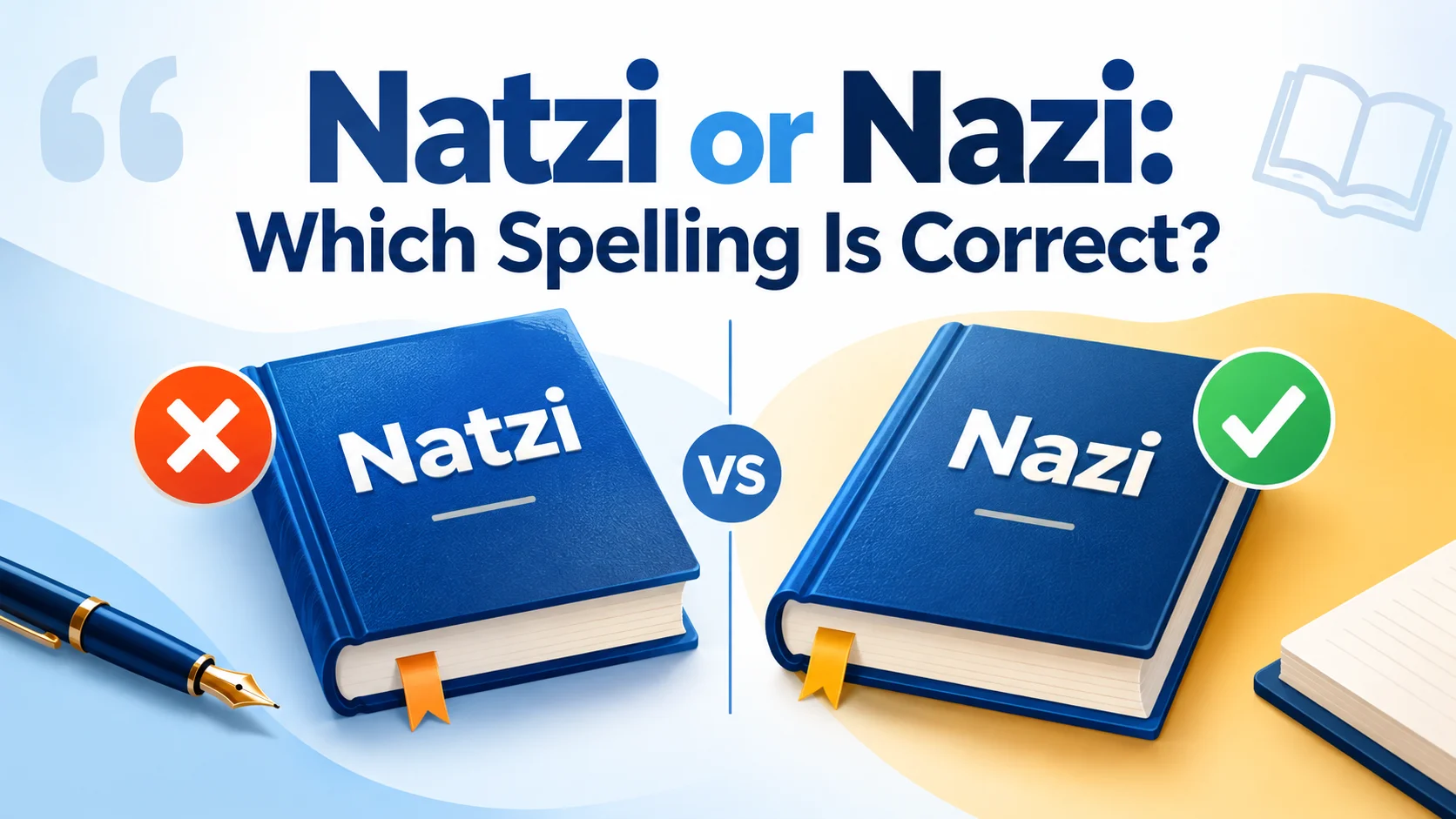
Nazi is the correct spelling, while Natzi is a misspelling in standard English. The difference is only one letter, but using the accepted form matters when writing about history, politics, education, or the Second World War. The word Nazi refers to a member or supporter of the National Socialist movement associated with Adolf Hitler and can also describe people, institutions, policies, or events connected with that movement. Because the term is closely linked to dictatorship, antisemitism, and the Holocaust, spelling it correctly is more than a minor proofreading detail. It helps readers recognize the historical subject immediately and understand the intended meaning without confusion.
Many people search for Natzi or Nazi after hearing the word spoken, seeing it in an online discussion, or trying to remember its spelling. The additional t may look reasonable to someone unfamiliar with the word, but it does not belong in the standard English form. You will find Nazi in established expressions such as Nazi Germany, Nazi Party, and Nazi regime. The related noun Nazism refers to the ideology associated with the movement. Learning these forms together makes spelling easier and helps writers distinguish between an individual, a political ideology, and a historical government.
In this guide, you will learn which spelling is correct, why Natzi is incorrect, what Nazi means, and how to use the word in a sentence. You will also find pronunciation guidance, capitalization and pluralization rules, comparisons with related terms, common mistakes, and practical proofreading advice. Whether you are preparing a school assignment, writing a history article, editing website content, or simply checking a word, this explanation will help you choose the right form. The aim is not only to remember four letters but also to use an important historical term accurately, respectfully, and in the right context.
Quick Answer: Is It Natzi or Nazi?
The correct spelling is Nazi. The spelling Natzi is generally an error and should not be used as an alternative in standard English writing.
| Word or phrase | Correct? | Meaning or use |
| Nazi | Yes | A person associated with the Nazi movement; also an adjective describing something connected with it |
| Natzi | No, in standard usage | A common misspelling of Nazi |
| Nazis | Yes | The plural form of Nazi |
| Nazi’s | Sometimes | The singular possessive form, as in “the Nazi’s uniform” |
| Nazis’ | Sometimes | The plural possessive form, as in “the Nazis’ policies” |
| Nazism | Yes | The ideology associated with the Nazi movement |
| Neo-Nazi | Yes | A person or movement that revives or promotes Nazi ideology in a later period |
| Anti-Nazi | Yes | Opposed to the Nazi movement or its ideology |
Easy rule to remember: Nazi has four letters: N-A-Z-I. Do not insert a t between the a and the z.
What Does Nazi Mean?
The word Nazi is the common English term for a member or supporter of the National Socialist German Workers’ Party, the political party led by Adolf Hitler. The party gained power in Germany in 1933 and established a dictatorship. It promoted extreme nationalism, racial hierarchy, antisemitism, political repression, and territorial expansion.
The Nazi regime and its collaborators were responsible for the Holocaust, the systematic murder of six million European Jews. They also persecuted and murdered millions of other people, including Roma and Sinti people, disabled people, Polish civilians, Soviet prisoners of war, political opponents, and others targeted by the regime.
The word can be used as a noun or an adjective, depending on the sentence.
Nazi as a Noun
As a noun, Nazi refers to a person associated with the Nazi movement.
Examples:
- The historian interviewed a former Nazi as part of the research.
- The museum documents the experiences of people who resisted the Nazis.
- The investigation examined the activities of a Nazi organization.
In these sentences, the word identifies a person or group of people.
Nazi as an Adjective
As an adjective, Nazi describes something connected with the party, ideology, government, or historical period.
Examples:
- The students studied Nazi Germany in their history class.
- Researchers examined Nazi propaganda from the 1930s.
- The archive contains documents produced under the Nazi regime.
- The exhibition explores Nazi persecution during the Second World War.
The spelling does not change when the word functions as an adjective. It remains Nazi.
Why Context Matters
The term carries substantial historical weight. In an academic or journalistic article, it should identify a genuine historical connection or a clearly explained ideological relationship.
For example, describing a government as the Nazi regime is appropriate when discussing Hitler’s government. Calling an ordinary disagreement “Nazi behavior” without explaining what is meant can create confusion and trivialize the historical meaning.
For reliable historical background, the United States Holocaust Memorial Museum’s provides detailed information about Nazi ideology, persecution, and the Holocaust.
Why Is Nazi Correct Instead of Natzi?
Nazi is the established English spelling. The alternative Natzi adds a letter that does not belong in the standard word.
The term developed from the German political movement known as the National Socialist German Workers’ Party, whose German name was Nationalsozialistische Deutsche Arbeiterpartei. The shortened term Nazi became the familiar label for a member of that party and, more broadly, for things associated with its ideology and rule.
The spelling Natzi is not a recognized standard variant of the word. If you see it in an article, social media post, or student assignment, it is usually a typing mistake or a spelling error.
The Difference Between Nazi and Natzi
The difference is easy to see when the two spellings are placed side by side:
- Nazi: N-A-Z-I
- Natzi: N-A-T-Z-I
The incorrect version contains an extra t. That letter does not make the spelling more accurate or indicate a separate historical group.
| Comparison point | Nazi | Natzi |
| Letter count | Four | Five |
| Standard English spelling | Yes | No |
| Used in historical writing | Yes | Only when reproducing an error or discussing the misspelling itself |
| Suitable for formal essays | Yes, when contextually accurate | No |
| Example | Nazi Germany | Natzi Germany — incorrect |
Why Do People Add the Extra T?
There are several possible reasons:
- Writing from memory: A person may remember the sound but not the exact spelling.
- Misreading the word: Someone who encounters the word quickly may incorrectly remember an extra letter.
- Copying an online mistake: Misspellings can spread when people repeat them without checking a reliable source.
- Uncertainty about pronunciation: A writer may add a letter because they assume it represents a sound they hear.
None of these reasons makes Natzi correct. The most reliable solution is to learn the spelling visually and verify unfamiliar historical terms in a trusted dictionary or reference source.
How to Pronounce Nazi
In English, Nazi is commonly pronounced approximately “NAHT-see” or “NAH-tsee”, with the main stress on the first syllable. The exact vowel sound can vary between accents and dictionary pronunciation systems.
Pronunciation can help explain why a person might be uncertain about the spelling, but it does not determine the accepted written form. The standard spelling remains Nazi, regardless of the speaker’s accent.
How to Remember the Pronunciation and Spelling
Try these practical techniques:
- Break the word into two syllables: Think of it as Na-zi.
- Remember the four letters: N-A-Z-I.
- Connect it to a familiar phrase: Recall Nazi Germany or Nazi Party.
- Read a reliable example: Seeing the word in a historical context reinforces the correct form.
A useful proofreading habit is to check both the spelling and the sentence’s meaning. A word can be spelled correctly but still be used inaccurately if it describes the wrong person, ideology, or historical period.
Nazi vs. Natzi: Which Word Should You Use?
When choosing between the two spellings, use Nazi in all ordinary English writing about the historical movement. Natzi should not be treated as a regional variation, an alternate spelling, or a separate term.
The following examples demonstrate how to correct the error in different types of writing.
| Incorrect sentence | Correct sentence | Why the correction matters |
| The Natzi Party ruled Germany. | The Nazi Party ruled Germany. | Uses the accepted historical term |
| Students studied Natzi Germany. | Students studied Nazi Germany. | Corrects the spelling of the historical period |
| The museum displayed Natzi propaganda. | The museum displayed Nazi propaganda. | Uses the standard spelling in an educational context |
| The Natzi regime persecuted its opponents. | The Nazi regime persecuted its opponents. | Avoids a spelling error in a serious historical claim |
| The article explains Natzi ideology. | The article explains Nazi ideology. | Uses the accepted form for the movement’s beliefs |
Which Form Is Appropriate in Formal Writing?
Use Nazi in:
- School and university assignments
- Historical essays and research papers
- News articles and educational websites
- Museum descriptions and documentary materials
- Books, reports, and academic discussions
If you are directly quoting a source that contains Natzi, do not silently change the quoted text if exact wording is important. Preserve the original spelling when necessary and follow the publication’s rules for indicating errors. Outside a direct quotation, correct the misspelling.
Related Words: Nazi, Nazis, Nazism, Neo-Nazi, and Anti-Nazi
The word Nazi appears in several related expressions. Understanding their differences helps you select the right term instead of using one word for every situation.
| Term | Definition | Example sentence |
| Nazi | A member or supporter of the historical Nazi movement; also an adjective | The historian examined Nazi records. |
| Nazis | The plural form of Nazi | The Nazis established a dictatorship in Germany. |
| Nazism | The ideology associated with the Nazi movement | The course examines the history of Nazism. |
| Neo-Nazi | A later person or movement that adopts or promotes Nazi ideology | The report investigated a neo-Nazi group. |
| Anti-Nazi | Opposed to the Nazi movement or its ideology | The archive preserves anti-Nazi resistance material. |
| Nazi Germany | Germany under Nazi rule, especially from 1933 to 1945 | Nazi Germany invaded Poland in 1939. |
| Nazi Party | The political party led by Adolf Hitler | The Nazi Party dismantled democratic institutions. |
Nazi vs. Nazism
Nazi usually refers to a person or describes something connected with the movement. Nazism refers to the ideology itself.
Consider these sentences:
- “The historian studied Nazism.” The subject is the ideology.
- “The historian interviewed a former Nazi.” The subject is a person.
- “The researchers examined Nazi policies.” The word describes policies associated with the regime.
Using the right term makes the meaning more precise. If you are discussing political beliefs, Nazism may be the appropriate word. If you are referring to a person or historical institution, Nazi may fit better.
Nazi vs. Neo-Nazi
A Nazi generally refers to someone associated with the original Nazi movement, especially in the historical context of Hitler’s Germany. A neo-Nazi belongs to a later movement that adopts or revives elements of Nazi ideology.
The prefix neo- means “new” or “revived.” It signals a later manifestation rather than simply describing the original party.
Example: “The researchers investigated the use of Nazi symbols by a modern neo-Nazi group.”
The two terms are related, but they are not interchangeable in every historical context. Use neo-Nazi when the later movement is specifically what you mean.
Nazi vs. Anti-Nazi
The prefix anti- means “against” or “opposed to.” Therefore, anti-Nazi describes opposition to the Nazi movement or its ideology.
Example: “The exhibition documents anti-Nazi resistance in occupied Europe.”
This term is particularly useful when discussing resistance groups, activists, political opponents, or individuals who challenged Nazi rule. The spelling of the base word remains Nazi; the prefix changes the meaning.
Capitalization Rules for Nazi
In standard English, Nazi is capitalized. The same convention is used in related words such as Nazism, neo-Nazi, and anti-Nazi.
Examples:
- Correct: The Nazi Party came to power in Germany in 1933.
- Correct: Historians continue to study Nazi persecution.
- Correct: The book examines the history of Nazism.
- Incorrect: The nazi regime controlled the government.
Capitalization does not change depending on whether Nazi is used as a noun or an adjective. In both cases, use the capital N.
Should Nazi Be Capitalized in the Middle of a Sentence?
Yes. The word retains its conventional capitalization even when it appears in the middle of a sentence.
Correct: “The museum’s new exhibition explores the effects of Nazi rule.”
Incorrect: “The museum’s new exhibition explores the effects of nazi rule.”
When editing a long article, use the find function in your word processor to locate instances of nazi written with a lowercase letter. Review each instance and correct it when it refers to the historical movement.
How Should You Write Nazi-Related Compounds?
Common forms include:
- Nazi Germany
- Nazi Party
- Nazi regime
- Nazi propaganda
- Nazism
- neo-Nazi
- anti-Nazi
Follow your chosen style guide for punctuation and hyphenation in specialized contexts, but do not change the standard spelling to Natzi. Consistency throughout a document helps readers and makes editorial review easier.
Common Spelling and Grammar Mistakes
Knowing the correct spelling is only the first step. Writers should also avoid mistakes involving plurals, possessives, related words, and historical context.
Mistake 1: Adding a T
Incorrect: “The Natzi government controlled Germany.”
Correct: “The Nazi government controlled Germany.”
The extra t is the central spelling error addressed in this article. If the word appears several times, check the entire document rather than correcting only the first occurrence.
Mistake 2: Using an Apostrophe to Form the Plural
Incorrect: “The Nazi’s ruled Germany.”
Correct: “The Nazis ruled Germany.”
An apostrophe is not needed to form the ordinary plural. Use Nazis when referring to multiple people.
Mistake 3: Confusing Plural and Possessive Forms
The forms Nazis, Nazi’s, and Nazis’ have different grammatical functions.
- Nazis: plural — “The Nazis imposed discriminatory laws.”
- Nazi’s: singular possessive — “The Nazi’s role was discussed in the report.”
- Nazis’: plural possessive — “The Nazis’ policies caused widespread persecution.”
Use the form that matches the sentence’s meaning. In most historical descriptions of a group, the plain plural Nazis is the required form.
Mistake 4: Using Nazi and Nazism Interchangeably
Incorrect: “She researched Nazi for her university paper.”
Clearer: “She researched Nazism for her university paper.”
The corrected sentence refers to the ideology. If the paper is about individual members of the movement, Nazi may be appropriate instead. The best word depends on what the writer is actually describing.
Mistake 5: Using the Term as a Casual Insult
Some speakers use Nazi informally to describe someone they consider unusually strict or controlling. In historical, educational, and professional writing, this usage can obscure the term’s specific meaning and trivialize the persecution and genocide associated with the Nazi regime.
If you mean that someone is inflexible, demanding, or excessively particular, choose a more precise description. Reserve Nazi for contexts where the historical or ideological connection is genuinely relevant.
Mistake 6: Trusting Every Online Spelling
An incorrect form can appear in comments, posts, or copied material many times without becoming standard. When accuracy matters, verify the spelling using a reputable dictionary and confirm historical claims with an established reference institution.
For historical topics, reliable sources are particularly important because a spelling error can appear alongside other inaccuracies. Correct terminology helps, but it should be accompanied by sound research.
Best Practices for Writing About Nazi History
Writing about the Nazi movement requires more than spelling accuracy. It also requires careful use of historical terminology and dependable sources.
Choose the Most Precise Term
Ask yourself what you are describing:
- A person associated with the historical movement: Nazi
- The ideology: Nazism
- Germany under the regime: Nazi Germany
- A later movement that revives the ideology: neo-Nazi
- Opposition to the ideology: anti-Nazi
This simple decision prevents vague or misleading sentences.
Verify Historical Claims
When writing about the Nazi Party, the Holocaust, or the Second World War, consult authoritative sources such as the United States Holocaust Memorial Museum, established archives, and scholarly historical works.
Avoid relying on an unsourced social media post for dates, definitions, or claims about victims and events. If a detail is disputed or complex, explain the uncertainty rather than presenting a guess as fact.
Keep the Tone Appropriate
Use clear, factual language. Do not exaggerate claims for dramatic effect or reduce historical events to casual comparisons. In educational writing, precise descriptions of the ideology, government, policies, and victims help readers understand the subject more responsibly.
Proofread for Spelling and Meaning
Before publishing, use this short checklist:
- Every ordinary reference uses Nazi, not Natzi.
- The word is capitalized consistently.
- Plurals and possessives are correct.
- Nazi, Nazism, neo-Nazi, and anti-Nazi are used accurately.
- Historical statements are supported by reliable sources.
- The tone suits the seriousness of the subject.
These checks are useful for students, teachers, researchers, bloggers, and editors alike.
Conclusion
When deciding between Natzi or Nazi, the answer is straightforward: Nazi is the correct spelling, and Natzi is a misspelling in standard English. Remember the four-letter form, capitalize it consistently, and use related words such as Nazism, neo-Nazi, and anti-Nazi only when their meanings fit the context. These habits make writing clearer, but historical accuracy also depends on choosing reliable sources and describing events carefully. One final actionable tip: search your draft for “Natzi” before publishing and correct any accidental occurrences. A common mistake to avoid is assuming a spelling becomes legitimate simply because it appears repeatedly online. When writing about history, precise language is essential: it helps readers understand the subject and respects the seriousness of the events being discussed.
Frequently Asked Questions
Q1. Is Natzi ever a correct spelling in English?
Natzi is not the standard English spelling of the historical term. The accepted form is Nazi. If Natzi appears in an online article or assignment, it is usually a typographical error. You may reproduce it when discussing a source’s exact wording, but use Nazi in your own ordinary writing.
Q2. Why do people spell Nazi as Natzi?
People may add a t because they are recalling the word from memory, misreading it, or copying an earlier error. Pronunciation can also contribute to uncertainty. However, the additional letter does not create an accepted alternative. Remember the four-letter spelling: N-A-Z-I.
Q3. Is Nazi a noun or an adjective?
Nazi can be both. As a noun, it refers to a person associated with the Nazi movement. As an adjective, it describes something connected with the movement or regime, as in Nazi Germany or Nazi propaganda. The spelling and capitalization remain the same in both grammatical uses.
Q4. What is the plural of Nazi?
The plural is Nazis, formed by adding s without an apostrophe. For example: “The Nazis ruled Germany from 1933 to 1945.” Use Nazi’s for a singular possessive and Nazis’ for a plural possessive. The correct form depends on whether you mean multiple people or ownership.
Q5. What is the difference between Nazi and neo-Nazi?
A Nazi generally refers to someone associated with the original Nazi movement, particularly in Hitler’s Germany. A neo-Nazi is a person or group that adopts or promotes Nazi ideology in a later period. The prefix neo- indicates a later revival or adaptation of the ideology.
