
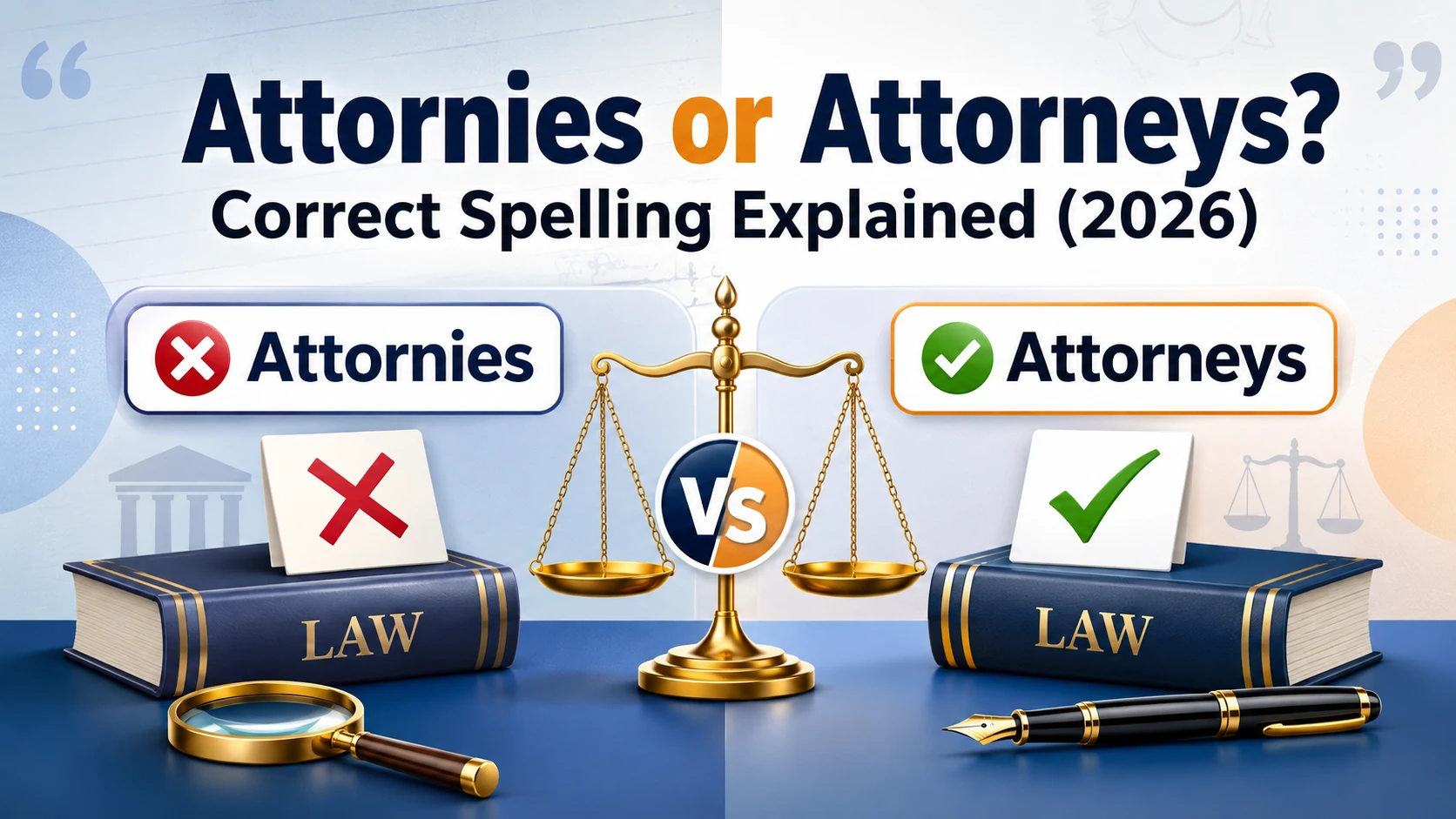
Attornies or attorneys is a common spelling question, but the correct plural form is attorneys. If you are talking about more than one attorney, write attorneys, not attornies. The reason is simple once you look at the final letters of the singular noun: attorney ends in a vowel + y, so standard English forms its plural by adding -s. You get attorney → attorneys, just as you get boy → boys and key → keys. The spelling attornies incorrectly applies a different pluralization pattern.
The confusion usually comes from a useful English spelling rule that is easy to overapply. Words ending in consonant + y commonly change y to ies: city → cities, company → companies, and party → parties. But that isn’t what happens with attorney. The letter immediately before the final y is e, which is a vowel. Therefore, the y stays and the plural ending -s is added. Understanding that distinction is more useful than memorizing attorneys as an isolated spelling.
There is another reason this question deserves more than a one-word answer. Legal writing frequently requires you to distinguish attorney, attorneys, attorney’s, and attorneys’. These forms look nearly identical, but they perform different grammatical jobs. This guide explains the plural rule, shows how attorneys works in real sentences, compares attorney and lawyer, and gives you a practical way to catch attornies before it reaches a professional document. By the end, the spelling should feel automatic rather than something you have to guess.
Attornies or Attorneys: Which Spelling Is Correct?
The correct spelling is attorneys.
Attorney → attorneys
Attornies is not the standard plural spelling of attorney in contemporary English.
The mistake happens because many English nouns ending in -y form their plurals by changing y to i and adding -es. That pattern is real, but it depends on the letter immediately before the y.
Compare:
- attorney → attorneys ✅
- city → cities ✅
- company → companies ✅
- party → parties ✅
- key → keys ✅
- boy → boys ✅
The important difference is the letter before y.
In attorney, the ending is ey. Since e is a vowel, the noun takes ordinary plural -s.
Quick Answer: Attorneys Is Correct
If you’re writing about more than one legal professional, use:
The attorneys reviewed the agreement.
Not:
The attornies reviewed the agreement. ❌
The spelling rule can be reduced to one practical question:
What letter comes immediately before the final y?
If it is a vowel, the plural generally keeps the y and adds s.
If it is a consonant, the noun will often change y → ies.
Why “Attornies” Looks Correct at First
Attornies looks plausible because English has many familiar plurals ending in -ies.
You probably already know:
- story → stories
- country → countries
- family → families
- activity → activities
- university → universities
That visual pattern can become a trap. A writer sees attorney, notices the final y, and automatically reaches for -ies.
The problem is that the rule isn’t:
“Words ending in Y become IES.”
The more accurate practical rule is:
Words ending in consonant + Y usually change Y to IES, while words ending in vowel + Y usually add S.
That small distinction explains why attorney → attorneys is correct.
What Does “Attorney” Mean?
Before looking at its plural, it helps to understand what the noun actually means.
In American English, attorney is a formal term for a lawyer, particularly one who can act for a client in court. Oxford also notes a broader meaning in which an attorney is someone given authority to act for another person in business or legal matters.
For example:
- She hired an attorney to represent her in court.
- The attorney reviewed the contract.
- His attorney advised him not to sign the document.
The word is especially common in professional titles and legal contexts:
- defense attorney
- prosecuting attorney
- district attorney
- corporate attorney
- criminal attorney
- family law attorney
- tax attorney
- attorney general
Attorney as a Legal Professional
In ordinary American usage, an attorney is a person who practices law and may represent clients.
Oxford describes lawyer as the broader term and attorney as a more formal term used for a lawyer, particularly in North American English and professional titles.
So you might say:
The attorney represented the defendant.
Or:
The attorneys represented different parties in the case.
The plural simply tells the reader that more than one attorney is involved.
Attorney as a Person Acting for Someone Else
Attorney can also describe a person authorized to act on someone else’s behalf in business or legal matters.
This is the sense behind the expression power of attorney.
For example:
She was appointed as her father’s attorney when he could no longer manage his affairs.
That meaning is important because attorney isn’t limited to courtroom situations. Its precise meaning depends on context.
Attorney in Professional Titles
You may encounter attorney in titles such as:
- District Attorney
- Attorney General
- State’s Attorney
- Assistant District Attorney
- United States Attorney
These titles can have specific legal meanings that vary by jurisdiction.
For ordinary spelling purposes, however, the plural of the standalone noun attorney is still attorneys.
Why Is “Attornies” Incorrect?
The simplest explanation is grammatical.
Attorney ends in vowel + y, so you add -s.
Break the word down:
attorn + e + y
The letter directly before y is e.
Since e is a vowel:
attorney + s = attorneys
You don’t replace the y.
The Plural of Attorney Is Attorneys
Here is the transformation:
Singular: attorney
Plural: attorneys
Examples:
One attorney attended the meeting.
Three attorneys attended the meeting.
The noun changes only by adding s.
The same basic pattern appears in:
- boy → boys
- day → days
- key → keys
- journey → journeys
- employee → employees
The exact spelling of each word still needs to be learned, but the vowel + y pattern gives you a reliable guide.
The Key Letter Before the Y
Don’t focus only on the final y.
Look one letter to the left.
| Word | Letter before Y | Plural |
| attorney | e | attorneys |
| boy | o | boys |
| key | e | keys |
| city | t | cities |
| party | t | parties |
| company | n | companies |
This is the most useful diagnostic tool in the entire spelling question.
Don’t ask, “Does the word end in Y?” Ask, “What comes immediately before Y?”
That extra step prevents the most common mistake.
The Grammar Rule Behind Attorney → Attorneys
English plural spelling has several patterns. The one relevant to attorney is the distinction between vowel + y and consonant + y.
Consonant + Y Usually Becomes IES
When a regular count noun ends in a consonant followed by y, its plural commonly changes y to i and adds -es.
Examples:
- city → cities
- country → countries
- company → companies
- policy → policies
- family → families
- party → parties
Notice the final two letters:
- city
- company
- party
The letters before the y are consonants.
So:
city → cities
not citys.
Vowel + Y Usually Takes S
When a noun ends in a vowel followed by y, the normal plural formation is to add -s.
Examples include:
- attorney → attorneys
- boy → boys
- key → keys
- day → days
- journey → journeys
- employee → employees
- toy → toys
The y remains.
That’s exactly what happens with attorney.
The Shortcut: Look at the Letter Before Y
When you’re unsure about a word ending in y, use this quick test:
- Step 1: Find the final y.
- Step 2: Look at the letter immediately before it.
- Step 3: Decide whether it is a vowel or consonant.
- Step 4: Apply the usual plural pattern.
For attorney:
attorney
The letter before y is e.
Therefore:
attorney → attorneys
This is much more reliable than memorizing a long list of individual plurals.
Practical tip: The “vowel + y” rule is a strong general guide, but English has exceptions and irregular nouns. Use it as a spelling tool, not as a promise that every English noun behaves identically.
Attorney vs Attorneys: Singular and Plural Forms
The difference between attorney and attorneys is straightforward, but professional writers also need to distinguish their possessive forms.
| Form | Grammatical function | Example |
| attorney | Singular noun | The attorney called. |
| attorneys | Plural noun | The attorneys called. |
| attorney’s | Singular possessive | The attorney’s office is closed. |
| attorneys’ | Plural possessive | The attorneys’ offices are nearby. |
When to Use Attorney
Use attorney when you’re referring to one person.
The attorney reviewed the evidence.
The singular noun normally takes a singular verb:
The attorney is available.
Not:
The attorney are available. ❌
When to Use Attorneys
Use attorneys when you’re referring to two or more people.
The attorneys reviewed the evidence.
The plural noun takes a plural verb:
The attorneys are available.
This matters in professional writing because the number of people involved can affect the meaning of a sentence.
Compare:
The attorney filed the motion.
with:
The attorneys filed the motion.
The first describes one legal professional. The second describes multiple legal professionals.
Attorneys vs Attorney’s vs Attorneys’
These three forms are easy to mix up.
Attorney’s means something belongs to or is associated with one attorney:
The attorney’s brief was submitted yesterday.
Attorneys’ means something belongs to or is associated with multiple attorneys:
The attorneys’ briefs were submitted yesterday.
Attorneys simply means more than one attorney:
The attorneys submitted their briefs yesterday.
The apostrophe is not optional decoration. It changes the grammatical function of the word.
Attorneys in Real Sentences
Seeing the word in different environments makes the spelling easier to recognize.
Legal and Courtroom Writing
- The attorneys presented their arguments before the court.
- Both attorneys questioned the witness.
- The attorneys filed separate motions.
- Several attorneys appeared at the hearing.
- The attorneys agreed to discuss the matter privately.
The plural is especially common when describing opposing counsel, legal teams, or multiple parties.
Business and Professional Communication
- The company’s attorneys reviewed the proposed agreement.
- Our attorneys will contact you after reviewing the documents.
- The attorneys advised the board to postpone the decision.
- Several attorneys participated in the negotiation.
In these examples, attorneys is simply the plural noun. There’s no special legal plural rule.
Academic and Informational Writing
- The study examined how attorneys use digital evidence.
- Many attorneys specialize in employment law.
- The researchers interviewed attorneys from several firms.
Academic writers should pay particular attention to subject-verb agreement:
The attorneys were interviewed.
Not:
The attorneys was interviewed. ❌
Everyday Conversation
Legal terminology doesn’t disappear outside formal writing.
You might hear:
- I talked to two attorneys about the problem.
- Their attorneys handled the negotiations.
- The company has several attorneys on staff.
The word remains attorneys regardless of whether the sentence is formal or conversational.
Attorney vs Lawyer: Are They the Same?
This question often appears alongside searches for attorneys because people aren’t always sure whether the two words describe different professions.
In American English, attorney and lawyer are often used interchangeably in ordinary conversation. Oxford describes lawyer as a general term for someone qualified to advise people about law, prepare legal documents, and/or represent people in court. It describes attorney as a more formal term for a lawyer, especially in North American English and job titles.
What Is a Lawyer?
Lawyer is the broader everyday term.
For example:
She is a lawyer who specializes in employment law.
You can use lawyer when talking generally about someone qualified in the legal profession.
What Is an Attorney?
Attorney is especially common in American legal and professional contexts.
For example:
She is an attorney with a focus on employment law.
The two terms can describe the same person in ordinary American usage.
Why the Terms Are Often Used Interchangeably
Consider:
I need to speak with my lawyer.
and:
I need to speak with my attorney.
Both can naturally refer to the same legal professional.
The choice often depends on register and context. Attorney can sound more formal and is common in official titles, while lawyer is extremely common in everyday speech. Oxford makes this distinction explicitly in its American English guidance.
Attorney vs Lawyer: Quick Comparison
| Term | General meaning | Typical context |
| lawyer | General term for a qualified legal professional | Everyday and general writing |
| attorney | More formal term for a lawyer, especially in North American usage | Legal, professional, and official contexts |
| attorneys | Plural of attorney | Two or more attorneys |
The distinction can become more complicated in other English-speaking legal systems. For example, solicitor and barrister have specific roles in England and Wales. That is one reason writers shouldn’t assume that every legal title has exactly the same meaning across countries.
Common Mistakes With Attorney and Attorneys
Writing “Attornies” Instead of “Attorneys”
This is the central spelling error.
Incorrect:
The attornies met with the client.
Correct:
The attorneys met with the client.
The error comes from applying the consonant + y rule to a word that actually ends in vowel + y.
Applying the Y-to-IES Rule Automatically
A common shortcut is:
“Words ending in y change to ies.”
That rule is incomplete.
The better version is:
Consonant + y → usually ies.
Vowel + y → usually s.
This distinction is small but powerful.
Confusing Attorneys With Attorney’s
Compare:
The attorneys reviewed the file.
and:
The attorney’s file was missing.
The first means more than one attorney.
The second means the file belonging to one attorney.
Confusing Attorneys With Attorneys’
Compare:
The attorneys met with the client.
The attorneys’ offices were searched.
In the second sentence, the apostrophe after s marks plural possession.
A useful test is to ask:
Am I talking about the people, or something belonging to those people?
If you’re simply naming multiple legal professionals, use attorneys.
Using the Wrong Number in a Sentence
Watch the verb as well:
The attorney is preparing the documents.
The attorneys are preparing the documents.
The noun and verb need to agree in number.
Attorney Pluralization Compared With Similar Words
The best way to master this rule is to compare attorney with words that look similar but behave differently.
Words Ending in Vowel + Y
| Singular | Plural | Pattern |
| attorney | attorneys | vowel + y |
| boy | boys | vowel + y |
| key | keys | vowel + y |
| day | days | vowel + y |
| toy | toys | vowel + y |
| journey | journeys | vowel + y |
| employee | employees | vowel + y |
The final y stays.
Words Ending in Consonant + Y
| Singular | Plural | Pattern |
| city | cities | consonant + y |
| company | companies | consonant + y |
| party | parties | consonant + y |
| policy | policies | consonant + y |
| family | families | consonant + y |
| country | countries | consonant + y |
| activity | activities | consonant + y |
The y changes to i and -es is added.
Why This Comparison Matters
If you memorize only:
Y → IES
you will eventually write words such as attornies, keysies, or boysies.
The real skill is recognizing the letter pattern before y.
That’s the transferable lesson. Once you understand it, you can solve unfamiliar spelling problems instead of memorizing every plural individually.
Real-World Editing: How to Catch “Attornies” Quickly
Spelling mistakes become more costly when they appear in documents that represent a business, law firm, school, or professional organization.
Fortunately, this one is easy to catch.
The Three-Second Spelling Test
When you see attornies, pause.
Ask:
What is the singular form?
Answer:
attorney
Now look at the ending:
ey
Because the e is a vowel, the plural is:
attorneys
This method is faster than trying to remember whether the word “looks right.”
Search-and-Replace Proofreading
If you’re editing a long document, use your word processor’s search function to look for:
attornies
This is particularly useful for:
- legal articles
- law firm websites
- contracts
- reports
- academic papers
- newsletters
- business correspondence
If the search returns results, review each one and determine whether the writer intended the ordinary plural of attorney.
Why Spell Check Isn’t Enough
Spell-checking software is useful, but it shouldn’t replace grammatical understanding.
A document can contain correctly spelled words that are grammatically wrong in context.
For example:
The attorneys’ reviewed the contract.
The word attorneys is spelled correctly, but the apostrophe is unnecessary because the sentence isn’t expressing possession.
Human proofreading remains valuable because spelling, punctuation, meaning, and context overlap.
Professional Writing: Why the Correct Plural Matters
A spelling mistake in casual communication may be harmless. In professional communication, it can undermine confidence in the document.
Legal Documents
Legal writing often contains repeated references to:
- attorneys
- clients
- courts
- counsel
- parties
- witnesses
- judges
A recurring spelling error such as attornies can make an otherwise polished document look careless.
That doesn’t mean every typo has legal consequences. It means accuracy is part of professional presentation, particularly when the document represents a legal practice or professional organization.
Law Firm Websites
Law firms commonly describe teams of legal professionals:
Our attorneys have extensive experience in commercial litigation.
A page titled Our Attornies would contain an obvious spelling error in a highly visible professional setting.
The same applies to:
- attorney biographies
- practice-area pages
- team pages
- newsletters
- legal guides
- press releases
Emails and Business Communication
Suppose you’re writing:
I spoke with the attorneys handling the transaction.
That’s correct.
If you’re referring to one person:
I spoke with the attorney handling the transaction.
The choice isn’t about formality. It’s about number.
Practical Examples: Choosing the Correct Form
Example 1 — One Legal Professional
The attorney reviewed the contract before the meeting.
Use attorney because one person is being discussed.
Example 2 — Multiple Legal Professionals
The attorneys reviewed the contract before the meeting.
Use attorneys because more than one person is involved.
Example 3 — Singular Possession
The attorney’s office is on the second floor.
The office belongs to one attorney.
Example 4 — Plural Possession
The attorneys’ offices are on the second floor.
The offices belong to multiple attorneys.
Example 5 — Incorrect Plural
The attornies reviewed the contract. ❌
Correct it to:
The attorneys reviewed the contract. ✅
Example 6 — A Different Y Rule
The companies reviewed the contract.
Here, company → companies because the noun ends in consonant + y.
This is exactly the pattern that writers mistakenly transfer to attorney.
A Simple Memory Trick for Attorneys
Remember “EY → S”
The ending ey can help you remember that attorney keeps its y in the plural.
attorney → attorneys
Think of similar words:
- key → keys
- journey → journeys
- employee → employees
The point isn’t that every ey word follows one universal rule. The point is to remind yourself to look at the vowel before the y.
Don’t Memorize “Every Y Becomes IES”
That’s the mistake to avoid.
A better memory sentence is:
Check the letter before Y.
Then ask:
- Vowel? → usually add s
- Consonant? → usually change y to ies
This gives you a method you can reuse.
The One-Line Rule
Vowel + Y → add S; consonant + Y → usually change Y to IES.
Apply it to attorney:
attorney → attorneys
But wait—that visual result is wrong because the plural spelling is attorneys, not attorneys with any additional vowel manipulation. The actual operation is simply:
attorney + s → attorneys
The y stays exactly where it is.
This is worth emphasizing because the goal isn’t to mechanically manipulate letters. The goal is to recognize that no y-change is required.
Attornies vs Attorneys: Quick Decision Guide
| If you want to say… | Correct form | Why |
| One legal professional | attorney | Singular |
| Two or more legal professionals | attorneys | Plural |
| Something belonging to one attorney | attorney’s | Singular possessive |
| Something belonging to several attorneys | attorneys’ | Plural possessive |
| Incorrect plural | attornies | Wrong plural formation |
| More than one lawyer in American English | attorneys | Standard plural |
When you’re editing, this table gives you the quickest answer:
People → attorneys.
One person’s possession → attorney’s.
Several people’s possession → attorneys’.
Conclusion
The correct answer to attornies or attorneys is attorneys. When you’re talking about more than one attorney, simply add -s to the singular noun: attorney → attorneys. The reason is that attorney ends in vowel + y, so its final y remains unchanged. The commonly remembered rule that changes y to ies applies to words ending in consonant + y, such as city → cities and company → companies. There’s one more distinction worth keeping in mind. Attorneys means more than one attorney, attorney’s indicates possession by one attorney, and attorneys’ indicates possession by multiple attorneys. Once you separate those three forms, most related errors disappear. One final actionable tip: whenever you’re unsure about a plural ending in y, look at the letter immediately before the y rather than applying the rule automatically.
Frequently Asked Questions
Q1. Is “attornies” ever the correct plural of attorney?
No, attorneys is the standard plural form of attorney in contemporary English. Attornies results from incorrectly applying the consonant-plus-y plural pattern. Because attorney ends in vowel + y, the final y remains and the plural ending -s is added.
Q2. Why is the plural of attorney “attorneys” instead of “attornies”?
The spelling depends on the letter before the final y. In attorney, that letter is e, a vowel. Nouns ending in vowel + y generally form their regular plurals by adding -s, so attorney becomes attorneys rather than changing y to ies.
Q3. Is “attorneys’” different from “attorney’s”?
Yes. Attorney’s is singular possessive and refers to something belonging to one attorney: the attorney’s desk. Attorneys’ is plural possessive and refers to something belonging to multiple attorneys: the attorneys’ offices. Attorneys without an apostrophe is simply plural.
Q4. Is an attorney the same as a lawyer?
In American English, attorney and lawyer are often interchangeable in ordinary usage. Lawyer is the broader general term, while attorney is a more formal term commonly used in professional titles and legal contexts. Exact terminology can vary among legal systems and jurisdictions.
Q5. Does the same Y rule apply to every English word?
No. The vowel + y / consonant + y distinction is a useful rule for regular nouns, but English contains irregular plurals and exceptions. Use it as a practical spelling guide rather than an absolute law. When a word has an established irregular plural, that form must be learned separately.
