
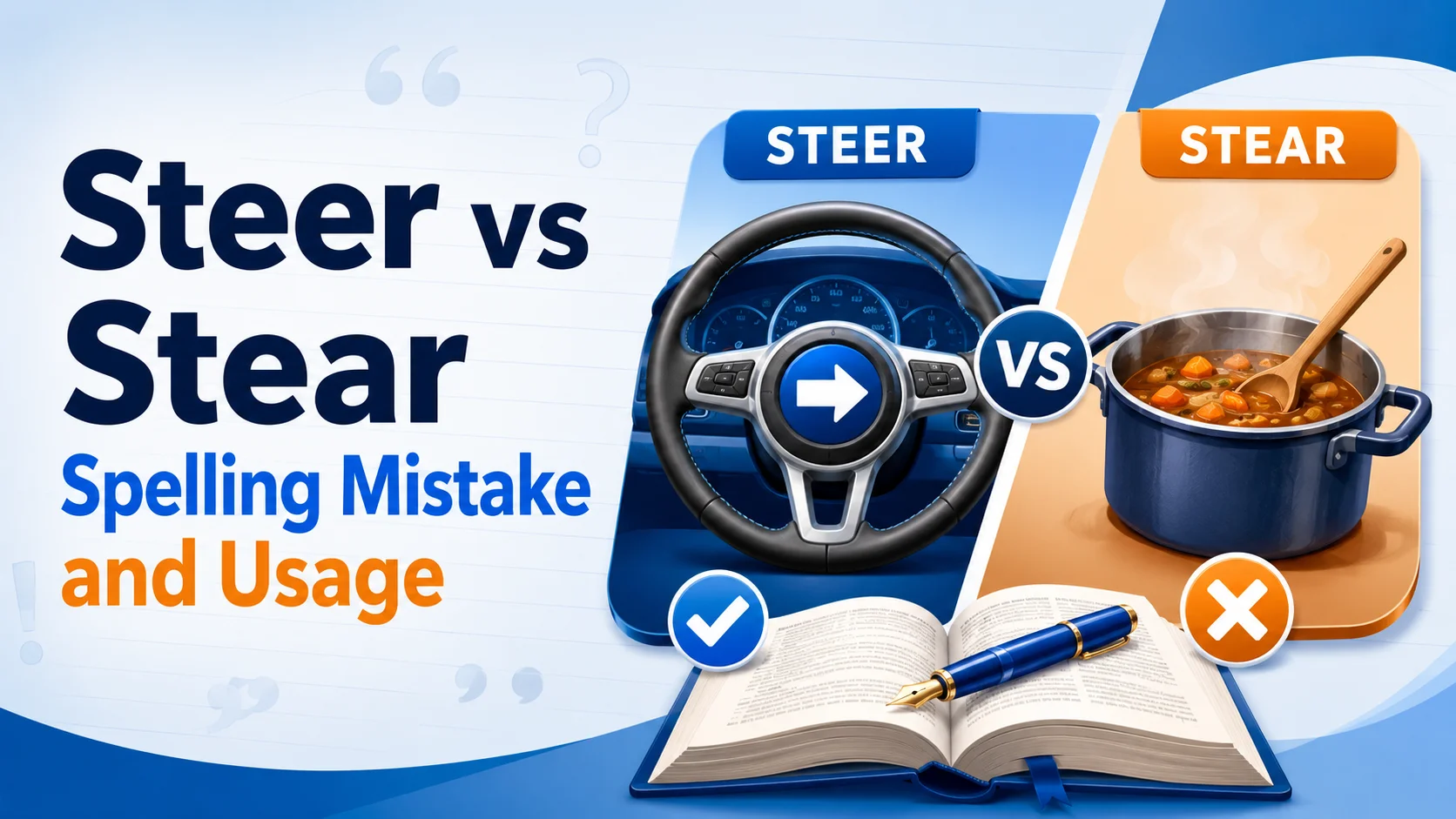
Steer vs stear can be confusing because the two spellings look almost identical and are easy to mix up when you’re writing quickly. If you mean to guide, direct, or control the course of something, the correct modern English spelling is steer. For example, you might steer a car around a pothole, steer a boat toward the harbor, or steer a conversation back to the main topic. The spelling stear is not the standard modern form of this verb. Major learner dictionaries such as Cambridge and Oxford list steer for these meanings, including its physical and figurative uses.
The confusion becomes more interesting when you look beyond ordinary modern usage. Stear isn’t simply a meaningless string of letters. Historical English sources record stear as an obsolete form of steer, while modern dictionaries also use stear- as a combining form in scientific vocabulary associated with stearic acid. Those facts matter because saying “stear has never been a word” is too absolute. For everyday writing, however, the practical rule remains straightforward: write steer when you mean guide or direct.
This guide explains steer vs stear from every angle that matters to a writer. You’ll learn what steer means as a verb and noun, how to use it with common prepositions, why stear sometimes appears, and how to form steered and steering correctly. You’ll also see the difference between steer and stir, learn useful expressions such as steer clear of, and work through examples that show how the word behaves in everyday, professional, and figurative English. By the end, you should be able to choose the right spelling without hesitation.
Steer vs Stear: Which Spelling Is Correct?
For normal contemporary English, steer is the spelling you want.
Use steer when you mean:
- To control the direction of a car, boat, bicycle, or other vehicle.
- To guide an animal or person.
- To direct a conversation, project, or situation.
- To influence the course of an event or decision.
- A young male bovine that has been castrated.
Examples:
- Please steer the car toward the right lane.
- She steered the boat away from the rocks.
- The moderator steered the discussion back to the original question.
- His advice steered me toward a better option.
- The rancher sold several steers at the auction.
By contrast, stear should not be substituted for steer in ordinary modern writing. If you write “Please stear the car,” most readers will interpret it as a spelling error.
The Correct Spelling Is “Steer”
The spelling steer contains ee:
S-T-E-E-R
That spelling applies across the ordinary forms of the word:
- steer
- steers
- steered
- steering
The double e doesn’t disappear when the word changes form.
Cambridge defines steer as controlling the direction of a vehicle and also as making someone or something move in a desired direction. Oxford similarly gives physical and figurative meanings, including influencing how a situation develops.
Why “Stear” Is Usually a Spelling Mistake
In an ordinary sentence, stear is generally a mistaken spelling of steer. The error is understandable because English spelling doesn’t always let you predict the vowel combination from pronunciation.
A writer might hear the word and mentally construct stear, especially if they are familiar with words such as bear, wear, and tear. But spelling by sound can be unreliable in English.
Compare:
- steer → guide or direct
- stear → not the standard modern spelling of that meaning
- stare → look fixedly
- stair → a step in a staircase
- stir → mix or agitate
The important point isn’t merely that steer “looks right.” It has a specific established spelling that should be retained in standard writing.
Quick rule: If you mean guide, direct, or control a course, use steer.
What Does Steer Mean?
Steer has more than one meaning, but its central idea is remarkably consistent: directing something along a particular course.
That idea can be literal or figurative.
Steer as a Verb
As a verb, steer can mean to control the direction in which something moves.
For example:
- He steered the car through the narrow street.
- She steered the bicycle around the obstacle.
- The captain steered the ship into the harbor.
The verb doesn’t necessarily mean complete control over every aspect of movement. It focuses on direction.
That’s why steer works especially well with vehicles and vessels. A driver controls where a car goes by steering it, while a captain changes a boat’s course by steering.
Steer as “Guide or Direct”
The word also works when nothing physical is moving.
Consider:
The editor steered the discussion toward the central issue.
No vehicle is involved. The editor is guiding the direction of the discussion.
This figurative meaning is common in professional English:
- steer a meeting
- steer a discussion
- steer a project
- steer a company
- steer negotiations
- steer someone toward a solution
- steer a conversation away from conflict
Oxford specifically recognizes steer for taking control of a situation and influencing how it develops.
Steer as a Noun
Steer is also a noun with a completely different subject-area meaning.
A steer is a male bovine that has been castrated, traditionally raised for meat. Merriam-Webster and Cambridge both record this livestock meaning.
For example:
- The rancher purchased a young steer.
- Several steers were being prepared for market.
This meaning has nothing to do with driving or directing.
There is also a less common British informal noun meaning a useful piece of advice or information:
Could you give me a steer on which course to take?
Oxford records this use as British informal English.
So steer can function as both a verb and a noun, with meanings determined by context.
How to Use Steer Correctly in a Sentence
One of the easiest ways to understand steer is to examine the structures that commonly follow it.
Steer for Physical Direction
When you are controlling movement, steer often appears with a noun and a directional phrase.
Examples:
- Steer the car to the left.
- She steered the boat toward the shore.
- He steered his bicycle around the fallen branch.
- The pilot steered the aircraft away from the storm.
The pattern is often:
steer + object + direction
For example:
She steered the truck toward the exit.
Here, truck is what she directs and toward the exit tells us where.
Steer for Guidance or Influence
The same structure can describe abstract direction.
- The teacher steered the conversation toward the evidence.
- The consultant steered the company toward a more practical strategy.
- Her questions steered him toward the answer.
Notice the subtle meaning. Steer doesn’t necessarily mean force.
If a manager steers a discussion toward a solution, the manager guides the discussion without literally controlling every statement made by everyone else.
That distinction makes steer particularly useful in professional writing.
Steer With Common Prepositions
Certain combinations occur naturally with steer.
| Expression | Meaning | Example |
| steer toward | guide in the direction of something | She steered the team toward a workable solution. |
| steer away from | guide away from something | The moderator steered the discussion away from personal attacks. |
| steer into | guide into a place or situation | He steered the boat into the harbor. |
| steer around | guide around an obstacle | She steered around the construction zone. |
| steer through | guide through a difficult route or situation | The CEO steered the company through a difficult year. |
| steer back to | return attention or direction to something | Let’s steer the conversation back to the main issue. |
Cambridge and Oxford both document several of these directional and figurative patterns.
Steer in Different Contexts: From Driving to Everyday Speech
The meaning of steer changes slightly depending on what you’re directing, but the underlying idea stays the same.
Steer a Car, Truck, or Bicycle
This is probably the most familiar use.
You need to steer carefully on this narrow road.
The driver isn’t simply moving the vehicle. They are controlling its direction.
More examples:
- She steered the car into the parking space.
- He steered around the pothole.
- The cyclist steered away from the pedestrian.
Steer a Boat
Steer is particularly natural with boats and ships.
- The captain steered the vessel toward the island.
- We steered away from the shallow water.
- The sailor carefully steered into the harbor.
A rudder is one mechanical means of steering a vessel. Merriam-Webster defines the verb in part as controlling a course and specifically notes guidance by mechanical means such as a rudder.
Steer a Horse or Animal
You can also steer an animal when you guide its movement.
She gently steered the horse toward the gate.
The word emphasizes direction rather than simply commanding the animal.
Steer a Conversation
This figurative use is extremely common.
The interviewer steered the conversation toward the candidate’s experience.
The interviewer isn’t physically moving anything. Instead, they are influencing what the conversation focuses on.
You can also steer a conversation:
- back to a topic
- toward a solution
- away from controversy
- into a new subject
Steer a Project, Team, or Organization
Professional writers often use steer because it conveys leadership without implying absolute control.
Examples:
- The project manager steered the team through several setbacks.
- The new director helped steer the organization toward long-term growth.
- Her leadership steered the project away from unnecessary complexity.
This is one reason the word appears frequently in business and formal writing. Cambridge’s Business English definition describes steer as making something or someone progress in a particular direction.
Steer vs Stear: Meaning and Spelling Difference
| Word | Standard modern use? | Meaning | Example |
| steer | Yes | Guide, direct, control; also a livestock noun | Steer the boat toward shore. |
| stear | No as the ordinary modern verb | Historical/obsolete form of steer; also appears in scientific combining forms | Stear is not the normal spelling for guide. |
| stir | Yes | Mix, move, disturb, or arouse | Stir the soup. |
The safest choice for ordinary writing is simple: use steer.
Is “Stear” Ever a Real Word?
This is where a little nuance matters.
If someone says “stear is never a word under any circumstances,” that statement goes too far.
Historical English sources record stear as an obsolete form of steer. Wiktionary, for example, identifies it as an obsolete English verb and gives a historical quotation from John Milton’s Paradise Lost.
Modern scientific vocabulary also contains stear- as a combining form related to stearic acid. Merriam-Webster lists stear- as a combining form used in words such as stearamide.
So there are three different situations:
- Modern everyday verb: use steer.
- Historical English: stear may occur as an obsolete form.
- Scientific compounds: stear- occurs as part of specialized terminology.
That distinction is important for accurate language advice.
When “Stear” Is Not the Right Choice
Suppose you’re writing any of these:
Please stear the car carefully.
She tried to stear the discussion toward the solution.
He learned how to stear a boat.
All three should use steer in contemporary standard English.
Correct:
- Please steer the car carefully.
- She tried to steer the discussion toward the solution.
- He learned how to steer a boat.
The existence of an obsolete spelling doesn’t make it appropriate for modern general-purpose writing.
Steer vs Stir vs Stear: Three Words That Cause Confusion
These words can look or sound close, but their meanings are different.
Steer vs Stir
Steer means to guide or direct.
Stir means to mix something, move something slightly, or provoke a feeling or reaction.
Compare:
- Steer the car into the driveway.
- Stir the sauce before serving.
And figuratively:
- She steered the discussion toward a solution.
- His comment stirred controversy.
A useful test is to ask:
Am I directing something, or am I agitating/mixing something?
If you’re directing it, choose steer.
If you’re mixing or provoking it, choose stir.
Steer vs Stear
The distinction is much simpler:
- steer = standard modern spelling
- stear = generally not the spelling you want in ordinary modern English
Don’t treat them as two interchangeable contemporary spellings.
Steer vs Similar-Looking Words
A few other words can create visual confusion:
| Word | Meaning | Example |
| steer | guide or direct | Steer the car carefully. |
| stare | look fixedly | Don’t stare at people. |
| stair | a step in a staircase | She climbed the stair. |
| star | celestial object or famous performer | The star was visible tonight. |
| stir | mix or agitate | Stir the coffee. |
The sentence’s meaning usually makes the correct word obvious once you slow down.
Steer Verb Forms: Steered, Steering, and Steers
Knowing the related forms helps prevent a second spelling mistake after you’ve learned steer.
| Form | Correct spelling | Example |
| Base form | steer | I steer the boat. |
| Third-person singular | steers | She steers carefully. |
| Past tense | steered | He steered the car home. |
| Past participle | steered | The boat was steered safely. |
| -ing form | steering | She is steering the vehicle. |
Oxford lists steer, steers, steered, and steering as the standard forms.
Present Tense: Steer and Steers
Use steer with I, you, we, and they:
- I steer the boat.
- They steer the vehicle carefully.
Use steers with he, she, and it:
- She steers the car confidently.
- The vessel steers well in calm water.
Past Tense: Steered
The past tense is steered, not stear-ed or steard.
- She steered the car around the obstacle.
- The captain steered the ship into port.
- He steered the discussion back to the original issue.
Cambridge identifies steered as the past simple and past participle of steer.
Present Participle: Steering
The -ing form is steering:
- She is steering the car.
- He is steering the project toward completion.
The double e remains before -ing.
Common Incorrect Forms
Watch for these errors:
- stear ❌
- steard ❌
- steare ❌
- steering → correct
- steered → correct
- steers → correct
A quick proofreading trick is to check the base word first. If the intended verb is steer, its ordinary forms begin from steer, not stear.
Common Mistakes With Steer and Stear
Writing “Stear” When You Mean “Steer”
This is the main spelling mistake.
Incorrect:
The driver had to stear around the truck.
Correct:
The driver had to steer around the truck.
Confusing Steer With Stir
Incorrect:
Please steer the soup before serving.
Correct:
Please stir the soup before serving.
The problem here isn’t spelling alone. It’s meaning.
Misspelling Steered
Incorrect:
The pilot steard the plane away from the storm.
Correct:
The pilot steered the plane away from the storm.
The correct past tense is steered.
Using “Steer” When “Control” Is Too Strong or Too Weak
This is a subtler issue.
Steer often suggests guidance or influence, while control can imply stronger authority.
Compare:
She steered the conversation toward the budget.
This suggests she influenced its direction.
She controlled the conversation.
This suggests a much stronger level of authority.
Choosing steer can therefore make professional writing more precise when you want to describe direction without absolute control.
Steer Synonyms: Choosing the Right Alternative
There isn’t one perfect synonym for steer in every context.
Synonyms for Physical Direction
Depending on the situation, you might use:
- guide
- direct
- navigate
- maneuver
- lead
- control
But each carries a slightly different emphasis.
Navigate focuses on finding or following a route.
Maneuver emphasizes skillful movement, often around obstacles.
Guide emphasizes helping something or someone move in the right direction.
Steer sits naturally between these ideas when the focus is on directing the course.
Synonyms for Figurative Guidance
For abstract situations, alternatives include:
- guide
- direct
- influence
- lead
- channel
- shape
For example:
The manager steered the discussion toward a compromise.
could become:
The manager guided the discussion toward a compromise.
Both work, but steered, emphasizes the idea of changing or maintaining the direction of the discussion.
Why Steer Isn’t Always Interchangeable With Control
Writers sometimes replace steer with control because the words seem similar.
That can change the tone.
Steer often suggests:
“I helped determine where this was going.”
Control can suggest:
“I had authority over what happened.”
That distinction is useful in business reports, leadership writing, journalism, and academic discussion.
Real-World Examples of Steer in American English
Everyday Examples
- Steer the car into the driveway.
- She steered her bike around the puddle.
- He learned to steer a boat before taking it offshore.
- The driver steered away from the debris.
- Keep both hands on the wheel while you steer.
Workplace Examples
- The project manager steered the team through a difficult transition.
- The chair steered the meeting toward a final decision.
- The director steered negotiations toward a compromise.
- The new strategy should steer the company toward sustainable growth.
Academic and Formal Examples
- The researcher steered the discussion toward the evidence.
- The author steers the argument toward a broader conclusion.
- The debate was carefully steered away from irrelevant issues.
Informal and Conversational Examples
- Let me steer you toward the cheaper option.
- The conversation somehow steered toward travel.
- I’d steer clear of that restaurant during rush hour.
The last example introduces one of the most useful expressions built around the word.
The Expression “Steer Clear Of”
Steer clear of means avoid someone or something, particularly because it may cause trouble, danger, or an unwanted situation.
Examples:
- Steer clear of that road during the storm.
- I’d steer clear of unreliable sellers.
- The team decided to steer clear of unnecessary controversy.
The expression has a useful metaphor behind it. Imagine a vehicle or ship changing course so it doesn’t collide with an obstacle. The figurative meaning developed naturally from that idea.
Oxford lists steer clear as an idiom meaning to avoid someone or something because it may cause problems.
Don’t write:
stear clear of
Use:
steer clear of
How to Remember the Spelling of Steer
The “EE” Memory Trick
A simple mnemonic is:
You use your eyes to see where you steer.
Both see and steer contain the familiar ee pattern.
So when you mean direction:
stEEr
This isn’t a universal spelling rule. It’s simply a memory device.
A Meaning Test
When you’re unsure, replace the word mentally with guide or direct.
If your sentence means:
“Guide the vehicle.”
then write:
Steer the vehicle.
If your sentence means:
“Mix the liquid.”
then you need:
Stir the liquid.
This meaning-based check is more reliable than guessing from pronunciation.
A Proofreading Check
When editing, search specifically for stear.
If your document is about driving, leadership, transportation, project management, or direction, inspect every occurrence. In most ordinary contexts, you’ll want steer instead.
Steer vs Stear: Quick Decision Guide
| If you mean… | Use | Example |
| Guide a vehicle | steer | Steer the car carefully. |
| Direct a boat | steer | Steer the boat toward shore. |
| Guide an animal | steer | She steered the horse toward the gate. |
| Direct a conversation | steer | He steered the discussion back to the issue. |
| Influence a decision | steer | Her advice steered me toward a better choice. |
| Guide a project | steer | She steered the project through several challenges. |
| Avoid something | steer clear of | Steer clear of that route. |
| Mix something | stir | Stir the sauce. |
| Look fixedly | stare | Don’t stare at the screen. |
| Historical form of steer | stear | Rare and obsolete, not normal modern usage. |
A Practical Proofreading Checklist
Before publishing or submitting your writing, ask:
- Do I mean guide or direct? → steer
- Am I talking about mixing or agitating something? → stir
- Did I accidentally type stear in an ordinary sentence?
- Is the past tense steered?
- Is the -ing form steering?
- Am I using steer toward, steer away from, or steer through correctly?
- Did I mean steer clear of rather than another phrase?
- If I used stear, is it genuinely part of a historical or specialized term?
For most everyday documents, this checklist takes only a few seconds and catches the error immediately.
Practice: Can You Choose Steer or Stear?
Fill-in-the-Blank Practice
Choose steer, steered, steering, or another appropriate word.
- The driver had to ______ around the fallen tree.
- She tried to ______ the discussion toward a practical solution.
- The captain ______ the boat into the harbor.
- He is ______ the vehicle through heavy traffic.
- The manager wants to ______ the project toward completion.
Answers
- steer
- steer
- steered
- steering
- steer
Correct-the-Mistake Exercise
Correct each sentence:
- Please stear the car to the left.
- The manager steard the conversation toward the budget.
- She is stearing the boat toward the dock.
Correct versions:
- Please steer the car to the left.
- The manager steered the conversation toward the budget.
- She is steering the boat toward the dock.
Context-Based Practice
Consider this sentence:
The coach steered the conversation away from blame.
Here, steer is figurative. The coach isn’t physically moving the conversation. Instead, the coach is influencing its direction.
Now compare:
The driver steered the car away from the barrier.
Here, steer is literal because the driver physically changes the vehicle’s direction.
The same verb works in both sentences because both involve the central idea of directing a course.
Conclusion
The practical answer to steer vs stear is straightforward: use steer in modern standard English when you mean to guide, direct, or control a course. You can steer a car, boat, bicycle, conversation, project, or organization. You can also use steer as a noun for a castrated male bovine, and British English has a separate informal noun meaning a useful piece of advice. Stear deserves a small footnote rather than a blanket dismissal. It exists historically as an obsolete form of steer, and stear- survives in scientific vocabulary related to stearic acid. But neither fact changes what you should type in an ordinary sentence. One final actionable tip: when you mean guide or direct, check for the ee in steer before submitting your writing. A common mistake to avoid: don’t let the existence of the historical spelling stear convince you that it is a normal modern alternative. In contemporary everyday English, steer is the spelling to choose.
Frequently Asked Questions
Q1. Is “stear” a correct spelling of “steer”?
Not for ordinary modern English when you mean guide, direct, or control movement. The standard spelling is steer. Historical sources do record stear as an obsolete form of steer, so calling it universally nonexistent would be inaccurate. For contemporary writing, choose steer.
Q2. Why do people spell steer as “stear”?
The mistake is likely encouraged by English spelling patterns and pronunciation. The sound of steer doesn’t automatically tell a writer whether to use ee or another vowel combination. Similar-looking words can make stear seem plausible, especially when someone is writing quickly or spelling from sound.
Q3. What is the past tense of steer?
The past tense and past participle are both steered. For example, “She steered the car around the obstacle.” The form steard is incorrect. The same double-e spelling remains visible in the correct forms steered and steering.
Q4. Is a steer the same thing as a bull?
Not exactly. A steer is a male bovine that has been castrated, while bull generally refers to an intact adult male bovine. The distinction matters mainly in agricultural and livestock contexts. Dictionaries such as Cambridge and Merriam-Webster record this specific noun meaning of steer.
Q5. Can “stear” ever appear correctly in English?
Yes, but this requires context. Stear is recorded as an obsolete historical form of steer, while stear- appears in specialized scientific compounds related to stearic acid. Neither use makes stear an acceptable everyday replacement for steer.
