
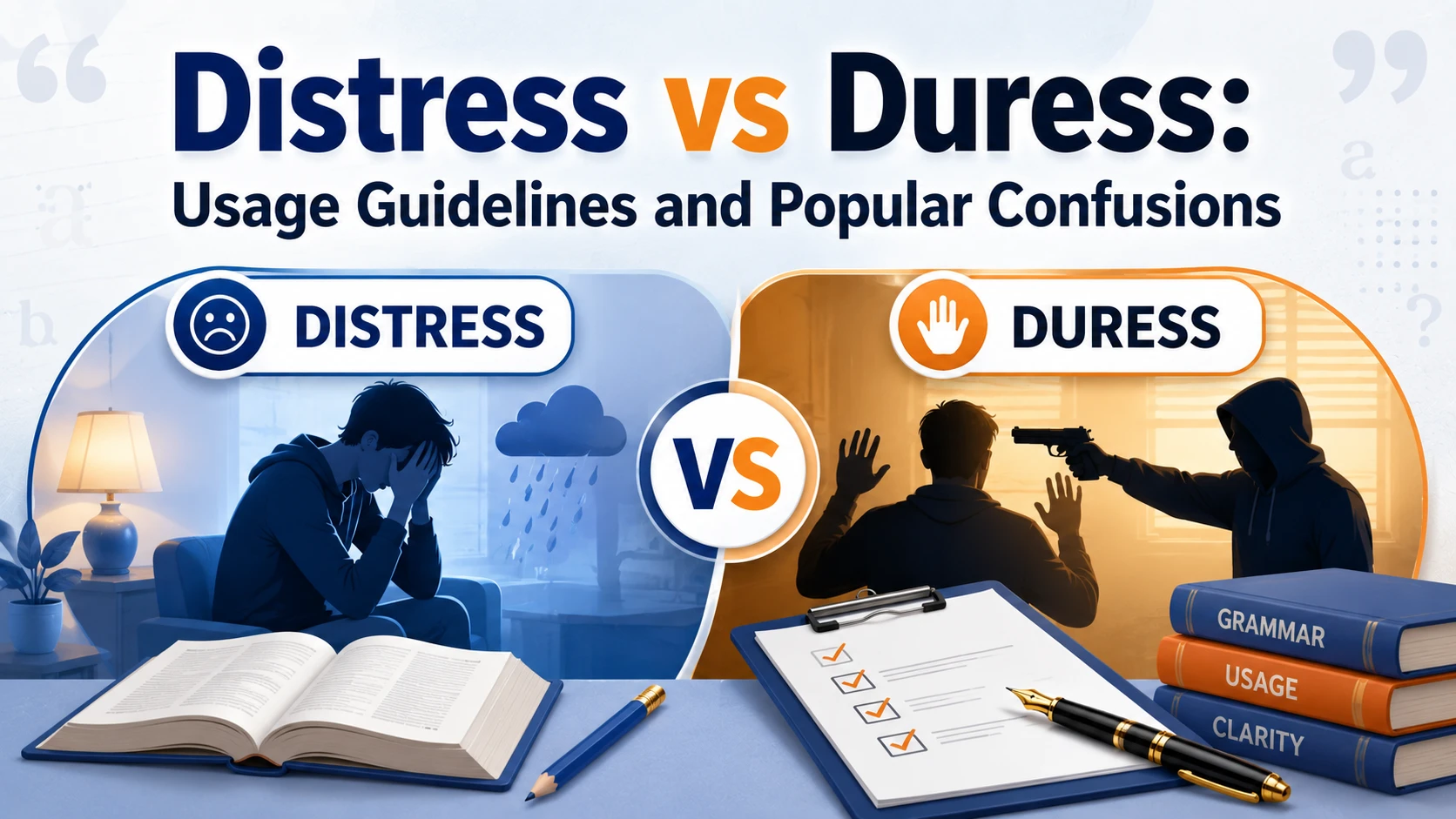
Distress vs duress is a confusing pair because both words describe difficult situations, pressure, or suffering. Yet they point to different things. Distress usually describes serious emotional, physical, or situational suffering, while duress refers to pressure or coercion that forces someone to act against their will. Cambridge defines distress in terms of extreme worry, sadness, pain, danger, or urgent need, whereas duress centers on threats used to force someone to do something.
The distinction becomes especially important when context changes the meaning. You might experience emotional distress after receiving devastating news, financial distress when you cannot meet your obligations, or physical distress during a medical emergency. By contrast, someone who signs a document because of threats may say they acted under duress. The two conditions can even occur together: coercion can put someone under duress and cause considerable distress. The key is identifying whether your sentence emphasizes suffering or coercion.
These words also behave differently grammatically and appear in different fixed expressions. You are likely to see in distress, emotional distress, and financial distress, while under duress is by far the most recognizable construction. This guide explains the distinction in plain English, examines legal and professional usage, compares distress with related words such as stress and pressure, and gives you practical examples so you can choose the right word confidently.
Distress vs Duress: What’s the Difference?
The quickest distinction is this:
Distress = serious suffering, pain, worry, hardship, or danger.
Duress = coercive pressure or threats that force someone to act.
| Word | Core meaning | Common contexts | Typical expression |
| distress | Severe suffering, worry, pain, hardship, or danger | Emotional, physical, financial, medical, general | in distress |
| duress | Coercion or threats that compel action | Legal, contractual, criminal, formal | under duress |
| stress | Pressure, demands, or strain | Work, school, relationships, everyday life | under stress |
| pressure | Influence or force toward an outcome | Everyday, professional, social, legal | under pressure |
Why These Words Are So Easy to Confuse
The words share several features. Both are nouns, both can describe unpleasant circumstances, and both can involve a person who feels constrained or overwhelmed.
But their focus is different.
If your sentence describes someone’s suffering, distress is usually the better choice:
The accident caused considerable distress for the family.
If your sentence describes someone being forced to act, duress is more precise:
He claimed that he signed the agreement under duress.
The first sentence tells us about suffering. The second tells us about coercion.
That distinction is more useful than trying to memorize two isolated dictionary definitions.
What Does Distress Mean?
Distress has a broad range of meanings, but its central idea is serious suffering or difficulty. Cambridge includes extreme worry, sadness, pain, danger, and urgent need among its meanings. It also recognizes distress as a verb meaning to make someone very upset or worried.
Unlike duress, distress does not require another person to be forcing you to do something.
You can experience distress because of:
- grief
- illness
- injury
- financial problems
- frightening news
- relationship problems
- dangerous circumstances
- physical pain
- overwhelming anxiety
Distress as Emotional or Mental Suffering
One of the most common uses is emotional distress.
The sudden loss caused the family tremendous emotional distress.
Here, distress describes the emotional suffering caused by an event.
You can also say:
- She was visibly distressed by the news.
- The argument caused him considerable distress.
- The children showed signs of distress.
The word does not tell us that someone was forced to do anything. It tells us that they were suffering emotionally.
In legal contexts, emotional distress can also have a more specialized meaning. Cornell’s Legal Information Institute describes emotional distress as mental suffering resulting from an event, condition, or pattern of events and notes that it can be relevant to certain tort claims.
Distress as Physical Suffering
Distress can also describe a person’s physical condition.
The patient showed signs of respiratory distress.
Here, the word isn’t describing sadness or worry. It refers to physical difficulty or compromised functioning.
Other examples include:
- The runner was in physical distress.
- The animal appeared to be in distress.
- The patient became visibly distressed.
This is one reason distress is much broader than duress.
Distress as Trouble or Danger
A person, animal, vehicle, or vessel can be in distress when it is in serious difficulty or danger and needs help. Cambridge gives examples involving boats and distress signals.
For example:
The boat sent a distress signal.
Rescuers found the hikers in distress.
The same basic concept applies: something is in a serious condition requiring attention or assistance.
Distress in Financial Contexts
One particularly important collocation is financial distress.
The company entered financial distress after losing its largest customer.
Here, distress means serious financial difficulty. Cambridge’s business dictionary specifically uses financial distress for situations involving financial failure or difficulty meeting debts or operating costs.
You can also encounter:
- financially distressed companies
- distressed borrowers
- distressed assets
- economic distress
None of these automatically involves duress.
Distress as a Verb
Distress can also function as a verb meaning to make someone very upset or worried.
The news distressed her.
It distressed him to see the family struggling.
This form is important because duress does not have an equivalent everyday verb meaning “to cause someone distress.”
What Does Duress Mean?
Duress means pressure or coercion that forces someone to do something they would not otherwise choose to do. Cambridge defines it as threats used to force a person to act.
The word is formal and is especially common in legal, contractual, and official contexts.
The most familiar construction is:
under duress
For example:
He signed the confession under duress.
The important element is not simply that he felt bad. The sentence says he was forced or coerced.
Duress as Coercion or Threat
Imagine someone tells another person:
“Sign this document or I will seriously harm you.”
If the person signs because of that threat, the situation can be described as involving duress.
The crucial feature is the loss of meaningful freedom caused by coercive pressure.
That is why this sentence works:
She claimed that she had acted under duress.
The phrase suggests that an external force or threat compelled her action.
Duress in Legal Contexts
In U.S. law, duress can have a more specific meaning than it has in ordinary English. Cornell’s Legal Information Institute describes it as unlawful threats or coercive behavior that causes another person to perform an act they otherwise would not perform. It notes that duress can arise in both criminal and contract law, although the legal requirements depend on the circumstances.
In contract law, duress can make a contract voidable under applicable law. In criminal law, duress can potentially function as an affirmative defense where the required elements are satisfied.
That legal specificity matters.
You should not assume that every unpleasant negotiation, deadline, threat, or difficult choice automatically qualifies as legal duress.
Duress in Everyday and Formal English
You don’t need to be discussing a lawsuit to use duress correctly.
For example:
He admitted that he had acted under duress.
The witness said the statement was made under duress.
She maintained that she had agreed only under duress.
The word sounds more formal than stress or pressure, so it is less common in casual conversation.
The Phrase “Under Duress”
Under duress is the expression most readers will immediately recognize.
Common combinations include:
- act under duress
- sign under duress
- agree under duress
- confess under duress
- testify under duress
- make a statement under duress
- enter an agreement under duress
The phrase tells readers that the person’s action was accompanied by coercive pressure.
Distress vs Duress: The Core Meaning Difference
A useful way to separate the words is to ask what your sentence is actually describing.
Distress Means Suffering
Use distress when the emphasis is on:
- emotional pain
- physical suffering
- anxiety
- grief
- hardship
- danger
- financial difficulty
- urgent need for assistance
For example:
The family experienced severe distress after the accident.
The family is suffering. Nobody has to be forcing them to do anything.
Duress Means Coercive Pressure
Use duress when the emphasis is on:
- threats
- coercion
- intimidation
- compulsion
- forced action
- lack of meaningful choice
For example:
The defendant claimed that he acted under duress.
The sentence focuses on why the person acted, not merely on how upset they were.
The Simplest Test: “Suffering or Forced Action?”
When you’re stuck between the two, ask:
Is the sentence mainly about suffering?
Use distress.
Is the sentence mainly about being forced to act?
Use duress.
This test solves most everyday cases.
Distress vs Duress in Different Contexts
The right word becomes easier to identify when you know the setting.
Emotional and Personal Contexts
Distress is usually natural when someone experiences emotional suffering.
The breakup caused her considerable distress.
The child appeared to be in distress.
Duress would require a different situation:
She agreed to the arrangement under duress.
Now the focus is on coercion rather than sadness.
Workplace and Professional Contexts
Work can create stress, and severe circumstances can produce distress.
The prolonged workload caused considerable distress.
But you should not automatically call a demanding workplace situation duress.
For duress, there must be some form of coercive pressure relevant to the situation.
He claimed that he signed the resignation letter under duress.
The second sentence makes a much stronger claim than simply saying:
He was under stress at work.
Financial and Business Contexts
The standard phrase is:
financial distress
For example:
The company is experiencing financial distress.
This means the business is experiencing serious financial difficulty.
However, economic duress is also a recognized legal concept. Cornell’s Wex describes economic duress as a contract-law situation involving improper or illegal conduct that creates fear of economic hardship and interferes with a party’s free choice.
That distinction is important: financial distress is a broad description of financial trouble, while economic duress is a specialized legal concept involving coercive conduct.
Legal and Contractual Contexts
This is where duress becomes particularly important.
The defendant claimed that the confession was obtained under duress.
The buyer alleged that the agreement was signed under duress.
Legal terminology requires care because whether conduct actually constitutes duress depends on applicable law and facts.
A writer should therefore distinguish:
He said he signed under duress.
from:
The contract was legally invalid because of duress.
The first reports an allegation. The second makes a legal conclusion.
Medical and Emergency Contexts
Distress is common in medical language:
- respiratory distress
- physical distress
- signs of distress
- patient in distress
For example:
The patient developed respiratory distress.
Duress would normally be inappropriate if you’re simply describing a physical medical condition.
How to Use Distress Correctly in a Sentence
Distress as a Noun
Common structures include:
- cause distress
- experience distress
- suffer distress
- show signs of distress
- be in distress
- emotional distress
- financial distress
Examples:
The decision caused considerable distress.
The animal was clearly in distress.
The company is facing financial distress.
Distress as a Verb
Use distress as a verb when something causes emotional upset or worry.
The news distressed her.
His condition distressed his parents.
It distressed me to see them arguing.
Notice the difference between the noun and verb:
The incident caused distress.
The incident distressed the family.
Both are correct, but their sentence structures differ.
Common Collocations With Distress
| Expression | Meaning | Example |
| emotional distress | Serious emotional suffering | The incident caused emotional distress. |
| financial distress | Serious financial difficulty | The business is in financial distress. |
| physical distress | Physical suffering or difficulty | The patient showed physical distress. |
| in distress | In serious difficulty, danger, or suffering | The vessel was in distress. |
| distress signal | A signal requesting urgent help | The crew sent a distress signal. |
| cause distress | Make someone suffer or worry | The announcement caused distress. |
How to Use Duress Correctly in a Sentence
The Most Common Construction: “Under Duress”
This is the safest and most recognizable structure.
He signed the agreement under duress.
She claimed that the confession was made under duress.
The witness said he had acted under duress.
Duress With Action Verbs
Because duress concerns compelled behavior, it frequently appears with verbs describing actions.
Act under duress
He said he acted under duress.
Sign under duress
She alleged that she signed the contract under duress.
Agree under duress
The employee claimed that he agreed under duress.
Confess under duress
The defense argued that the confession was made under duress.
The common thread is an action allegedly produced by coercion.
What Does Not Automatically Count as Duress?
Not every difficult situation is duress.
These situations might involve stress or pressure instead:
- having a tight deadline
- facing a difficult exam
- receiving criticism
- negotiating a difficult business deal
- worrying about money
- working long hours
- feeling nervous before a presentation
For example:
She was under pressure to finish the report.
That doesn’t automatically mean:
She was under duress.
The latter implies a much stronger form of coercion.
Distress vs Duress: Examples Side by Side
| Situation | Best word | Example |
| A person is deeply upset | distress | The news caused him great distress. |
| A company is struggling financially | distress | The company is in financial distress. |
| A patient is having physical difficulty | distress | The patient showed signs of respiratory distress. |
| A boat needs urgent help | distress | The vessel sent a distress signal. |
| Someone signs because of threats | duress | He signed the contract under duress. |
| Someone claims they were forced to confess | duress | She said the confession was made under duress. |
| Someone has a demanding workload | stress/pressure | He was under considerable pressure. |
Examples With Distress
- The family experienced emotional distress after the accident.
- The injured animal was clearly in distress.
- The company entered financial distress after months of declining revenue.
- The announcement caused considerable distress among employees.
- The aircraft sent a distress signal.
Each sentence describes suffering, difficulty, danger, or hardship.
Examples With Duress
- He claimed that he signed the document under duress.
- The witness said she had acted under duress.
- The defense argued that the statement was made under duress.
- She maintained that the agreement was not entered into voluntarily but under duress.
Each sentence centers on coercion or compelled action.
Common Mistakes With Distress and Duress
Mistake 1: Treating Duress as a Synonym for Stress
This is probably the most common conceptual error.
Incorrect in ordinary usage:
I was under duress because I had three deadlines.
Better:
I was under stress because I had three deadlines.
Or:
I was under considerable pressure because I had three deadlines.
Duress suggests something more coercive.
Mistake 2: Using Distress When Coercion Is the Point
Suppose someone threatens an employee and forces them to sign a document.
Saying:
The employee signed the document in distress.
could describe the employee’s emotional state, but it does not communicate the crucial idea of coercion.
If the intended meaning is that threats compelled the signature:
The employee claimed to have signed the document under duress.
That’s much more precise.
Mistake 3: Assuming Every Threat Automatically Creates Legal Duress
This is especially important in legal writing.
A person can experience fear, pressure, or even make a serious allegation without the circumstances necessarily satisfying a jurisdiction’s legal test for duress.
Cornell’s Wex notes that legal duress involves specific elements and that the requirements differ according to the legal context.
So don’t turn a general vocabulary explanation into a legal conclusion.
Mistake 4: Using Duress for Financial Difficulty
Incorrect:
The company is under financial duress because sales have fallen.
If you simply mean that the company is struggling financially, use:
The company is in financial distress.
If you’re discussing a specific legal claim involving coercive economic conduct, economic duress may be appropriate, but that is a specialized concept.
Mistake 5: Confusing “In Distress” With “Under Duress”
These phrases are not interchangeable.
In distress means someone or something is suffering, in danger, or in serious difficulty.
The hikers were in distress.
Under duress means someone is being subjected to coercive pressure.
The hikers said they acted under duress.
The first describes a condition. The second describes a cause of compelled action.
Distress, Duress, Stress, and Pressure: What’s the Difference?
These four words overlap, but they are not interchangeable.
Distress vs Stress
Stress can describe ordinary pressure or strain.
She was under stress because of the upcoming examination.
Distress generally indicates a more serious state of suffering or difficulty.
The traumatic event caused severe emotional distress.
Stress can be manageable or even temporary. Distress usually communicates a more serious negative state.
Distress vs Duress
This is the central comparison:
Distress describes suffering. Duress describes coercion.
You can be distressed without being coerced.
You can also be under duress and become distressed as a result.
Duress vs Pressure
Pressure is broad.
A manager might pressure an employee to finish a report. A friend might pressure you to attend an event. A salesperson might pressure a customer to buy something.
None of those situations automatically amounts to duress.
Duress is a stronger, more specialized concept involving coercive force or threats.
Quick Four-Way Comparison
| Term | Main idea | Example |
| stress | Mental or physical strain from demands | The workload caused stress. |
| distress | Serious suffering, worry, pain, or hardship | The accident caused distress. |
| pressure | Influence pushing someone toward an action | She felt pressure to agree. |
| duress | Coercive pressure compelling action | He signed under duress. |
When Distress and Duress Cannot Be Swapped
Some expressions strongly favor one word.
Financial Distress, Not Ordinary Financial Duress
If a business cannot meet its obligations, financial distress is the natural broad term.
The retailer is experiencing financial distress.
This describes the business’s condition.
Emotional Distress, Not Emotional Duress
If someone is suffering emotionally:
The experience caused emotional distress.
Emotional duress may occur in specialized contexts, but it isn’t the ordinary replacement for emotional distress. The words describe different concepts.
Contract Under Duress, Not Contract Under Distress
If someone alleges that threats or coercion forced them to enter an agreement:
The contract was signed under duress.
The key issue is voluntary consent under coercive circumstances.
Respiratory Distress, Not Respiratory Duress
A patient experiencing serious breathing difficulty may be described as having:
respiratory distress
The term describes a physical medical condition, not coercion.
How Context Changes the Meaning
Context often gives you the answer before you even think about the definitions.
Ask What Is Happening to the Person
If someone is:
- crying
- grieving
- suffering pain
- facing financial hardship
- in danger
- experiencing severe anxiety
think distress.
If someone is:
- threatened
- coerced
- intimidated
- compelled
- forced into an action
think duress.
Look for Signals of Coercion
Words that often point toward duress include:
- threat
- force
- intimidation
- coercion
- compelled
- forced
- against one’s will
- lack of free choice
For example:
He was compelled to sign the document under duress.
Look for Signals of Distress
Words that commonly accompany distress include:
- emotional
- physical
- financial
- severe
- considerable
- acute
- anxiety
- pain
- grief
- danger
For example:
The family experienced considerable emotional distress.
A Practical Decision Guide for Choosing Distress or Duress
Use this checklist when you’re editing.
| Ask yourself | If yes, consider |
| Is the sentence describing suffering or emotional pain? | distress |
| Is someone in danger and urgently needs help? | distress |
| Is the issue financial hardship? | financial distress |
| Is the sentence describing physical difficulty? | distress |
| Was someone forced to act by threats or coercion? | duress |
| Is the phrase “under ___” describing compelled action? | duress |
| Is the situation merely demanding or stressful? | stress/pressure |
The Three-Question Test
When you’re unsure, ask these questions in order:
Is someone suffering?
If yes, distress may be right.
Is someone being forced to act?
If yes, duress may be right.
Is it simply a demanding or difficult situation?
If so, stress, pressure, or another word may be more accurate.
This approach is better than choosing based on which word “sounds more serious.”
Advanced Usage: Why Duress Is More Specialized
Duress in Contract Law
Contract law treats voluntary agreement as an important concept. A claim of duress generally argues that improper coercion undermined the person’s ability to exercise free choice.
Cornell’s Wex explains that duress can make a contract voidable, although the exact legal standards depend on the circumstances and applicable law.
Consider:
She signed because she was worried about losing the deal.
That describes pressure.
Now consider:
She alleged that the other party threatened serious harm unless she signed.
That describes a potential coercive situation much closer to the ordinary and legal concept of duress.
Duress and Voluntary Consent
The word becomes especially important when an action appears voluntary on the surface but was allegedly produced through coercion.
Someone physically signing a contract doesn’t automatically prove that they entered it freely.
That is why legal discussions of duress focus on the circumstances surrounding the person’s decision.
Why Legal Context Requires Extra Care
In general writing, you can explain duress as coercive pressure.
In legal writing, however, you should be careful about declaring that a particular situation is legally duress.
A safer distinction is:
The employee claimed that she acted under duress.
rather than:
The employee legally acted under duress.
The first reports a claim. The second sounds like a legal determination.
Memory Tricks That Actually Work
Distress = Difficult Suffering
Think:
Distress = suffering.
If someone is deeply upset, physically struggling, financially troubled, or in danger, distress is often the right word.
Duress = Doing Something Under Pressure
Think:
Duress = coercion that drives an action.
The word is especially easy to remember through its most common phrase:
under duress
Remember the Fixed Expressions
These combinations make the distinction almost automatic:
- in distress
- emotional distress
- financial distress
- physical distress
- distress signal
- under duress
- act under duress
- sign under duress
A useful mnemonic is:
Distress is the suffering. Duress is the force.
Practice Exercises: Distress or Duress?
Choose distress, duress, or another word such as stress or pressure where appropriate.
Fill-in-the-Blank Exercise
1. The accident caused considerable emotional ________.
2. The defendant claimed that he signed the agreement under ________.
3. The company is experiencing serious financial ________.
4. The patient showed signs of respiratory ________.
5. She was under considerable ________ because the deadline was only one day away.
6. The witness claimed that the statement was made under ________.
Answers
- distress
- duress
- distress
- distress
- stress or pressure
- duress
The fifth sentence is deliberately different. A deadline can create intense pressure without necessarily involving coercion.
Choose the Better Word
A. The grieving family experienced severe duress.
B. The grieving family experienced severe distress.
Answer: B.
The sentence describes emotional suffering, not coercion.
A. He signed the contract under distress.
B. He signed the contract under duress.
Answer: B, if the intended meaning is that threats or coercion forced him to sign.
A. The company is in financial distress.
B. The company is in financial duress.
Answer: A for ordinary financial difficulty.
Economic duress can be appropriate in a specific legal context involving coercive economic conduct, but it does not simply mean “having financial problems.”
Context Challenge
Consider this sentence:
She agreed to the deal under pressure.
The word pressure deliberately leaves the situation open.
Now add:
The other party threatened to seriously harm her if she refused.
The context now points toward duress.
This demonstrates an important writing principle: word choice depends on the facts you want the reader to understand.
Conclusion
Distress vs duress becomes much easier once you stop treating the words as interchangeable synonyms. Distress describes serious suffering, worry, pain, hardship, danger, or difficulty. It works naturally in expressions such as emotional distress, financial distress, respiratory distress, and in distress. Duress, by contrast, focuses on coercive pressure that compels someone to act, especially in formal or legal contexts. Its most familiar construction is under duress. The two ideas can overlap, but they answer different questions. Distress asks, “What suffering is happening?” Duress asks, “What coercion is forcing this action?” Keep that distinction in mind and your word choice will become far more precise. One final actionable tip: check whether your sentence describes suffering or compelled action before choosing the word. A common mistake to avoid: don’t use duress simply because a situation is stressful. Stress is pressure; distress is suffering; duress is coercion. That three-way distinction will keep your writing accurate even in difficult contexts.
Frequently Asked Questions
Q1. What is the easiest way to remember distress vs duress?
The simplest rule is distress = suffering and duress = coercion. Use distress for serious emotional, physical, financial, or situational difficulty. Use duress when someone is forced or compelled to act through threats or coercive pressure.
Q2. Is being under stress the same as being under duress?
No. Stress describes pressure, strain, or demands and can occur in ordinary situations. Duress is much narrower and involves coercive pressure or threats that force someone to act. A demanding deadline may cause stress without constituting duress.
Q3. Can someone be both in distress and under duress?
Yes. The concepts can overlap. For example, someone threatened into signing a document may be under duress while also experiencing severe distress. One word describes the coercive circumstances, while the other describes the person’s suffering.
Q4. What does “signed under duress” mean?
Signed under duress means a person claims that coercive pressure, threats, or improper conduct caused them to sign something they would not otherwise have signed voluntarily. Whether that claim has a particular legal effect depends on the applicable law and circumstances.
Q5. Is “financial distress” the correct phrase?
Yes. Financial distress is the standard expression for serious financial difficulty, such as trouble meeting debts or operating costs. Economic duress is different: it refers to a specialized legal concept involving improper conduct that interferes with voluntary decision-making.
