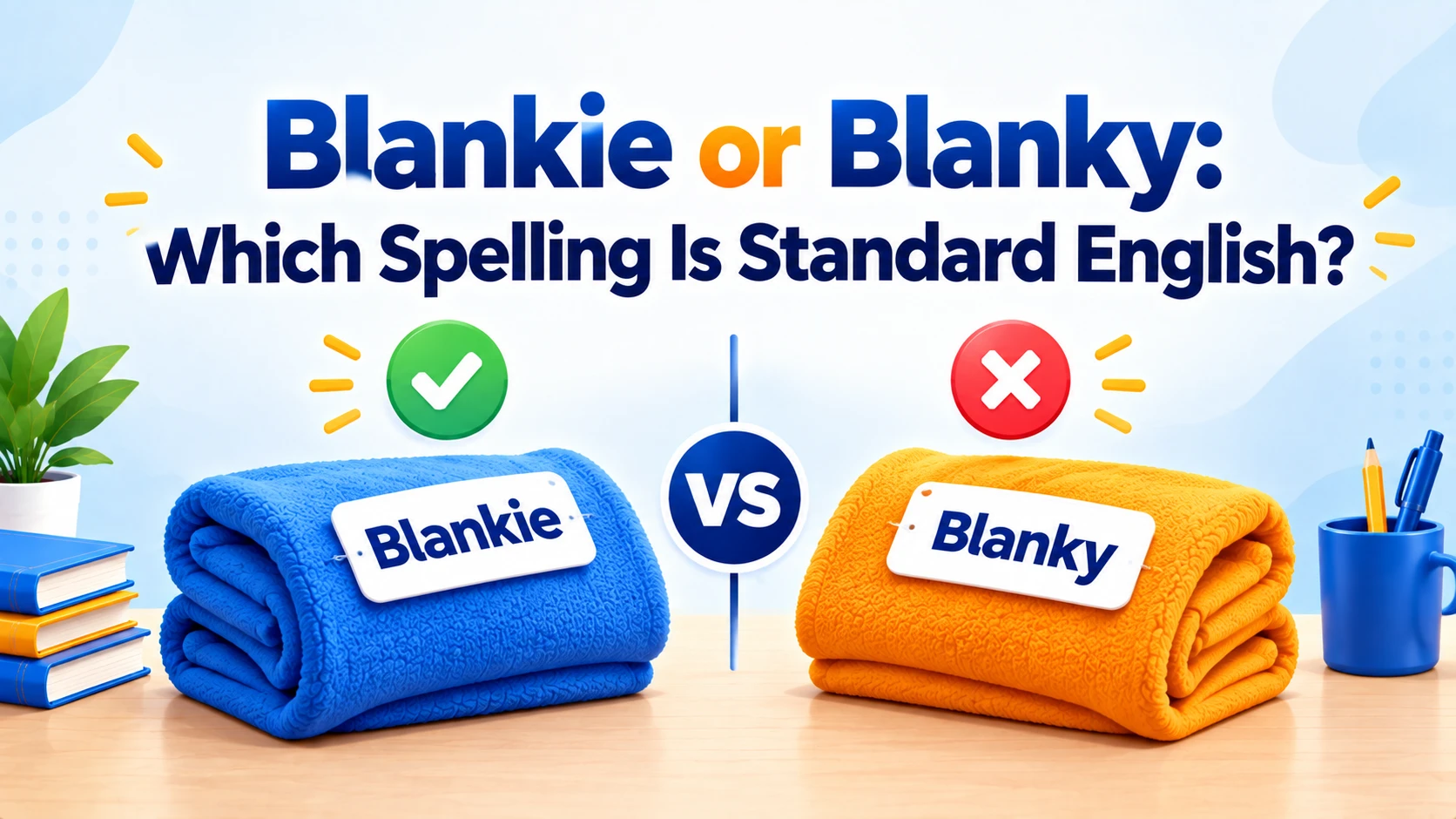
Blankie or blanky is a small spelling question, but the answer depends on what you mean by “standard.” Blankie is the safest established spelling when you mean an informal name for a child’s comfort blanket. Cambridge Dictionary lists blankie as an informal, mainly US noun and also records blankey as an alternative. That does not make every appearance of blanky a meaningless typo. Informal vocabulary can develop personal and family spellings, especially when words are learned through speech. The useful question, then, is not simply “Which one exists?” but which form should you choose in your context?
At first glance, blankie and blanky look interchangeable because they usually point to the same familiar object: a blanket, especially one a young child uses for comfort. The important distinction is one of usage, spelling preference, and register, rather than a reliable difference in meaning. Cambridge’s entry defines blankie as a blanket, particularly a small one or part of one that helps a young child feel safe and happy. In ordinary writing, blankie is therefore the stronger default. If you are writing dialogue, preserving a family’s preferred spelling, or quoting someone, however, the exact form may be worth keeping.
For formal writing, there is an even simpler solution: use blanket, comfort blanket, or security blanket when that wording fits your meaning. Blankie is a real English word, but it is explicitly labeled informal, so its dictionary status does not make it suitable for every situation. This article explains how blankie and blanky are used, why the spellings vary, what dictionary evidence tells us, how personal usage can affect the choice, and which form works best in everyday sentences. By the end, you should be able to make the spelling decision without relying on guesswork or rigid “right-versus-wrong” rules.
Blankie vs. Blanky: The Short Answer
If you need one spelling for general use, choose blankie.
Cambridge Dictionary lists blankie as an informal noun, mainly used in US English, and defines it as a blanket, especially a small blanket or piece of a blanket used by a young child for comfort. It also gives blankey as an alternative spelling.
The important qualification is that blankie is informal, not formal standard vocabulary in the same sense as blanket. So there are really two decisions:
- Are you asking for the established informal word? → Blankie
- Are you writing in a neutral or formal register? → Usually blanket, comfort blanket, or security blanket
What about blanky? You may encounter it in family writing, children’s language, informal conversation, usernames, stories, or other contexts where spelling is personal or deliberately informal. It should not automatically be treated as a catastrophic spelling mistake. However, if you are choosing a default spelling for edited English prose, blankie is the more defensible choice.
Quick rule: Use blankie when you deliberately want the informal affectionate term. Use blanket when you want neutral English. Treat blanky as a context-dependent informal spelling rather than the safest default.
Blankie, Blanky, and Blanket at a Glance
| Form | Basic meaning | Register | Best choice when… |
| blankie | A child’s or comfort blanket | Informal | You want the established affectionate term |
| blanky | Usually the same type of comfort blanket | Informal/personal | You are preserving a particular usage or voice |
| blankey | Variant spelling of blankie | Informal | You are reproducing that spelling intentionally |
| blanket | A covering used for warmth or comfort | Neutral | You need standard, general-purpose wording |
What Does “Blankie” Mean?
Blankie is an informal noun derived from blanket and used especially for a child’s familiar or comforting blanket.
Cambridge defines it as a blanket, particularly a small one or part of one that a young child uses to feel safe and happy. The dictionary labels it informal, mainly US and records blankey as an alternative form.
That definition is important because blankie is not simply another spelling of every possible meaning of blanket. In actual use, it tends to carry an affectionate, familiar, child-centered tone.
Consider the difference:
- “Please put the blanket on the bed.”
- “Please don’t forget the baby’s blankie.”
Both sentences can refer to a physical blanket. The second, however, suggests a particular familiar object with emotional importance.
Blankie as an Informal Noun
Calling a word informal does not mean the word is fake, incorrect, or unusable.
It means its register is associated with less formal situations. Cambridge explains informal as language suitable for settings such as interactions with friends and family rather than official occasions.
That distinction matters for grammar and spelling articles because readers often confuse these categories:
- Standard English does not mean “formal English only.”
- Informal English does not mean “incorrect English.”
- A word can be dictionary-listed and established while still being unsuitable for a formal report.
Blankie is a good example.
What Kind of Blanket Is a Blankie?
Depending on context, a blankie might be:
- a child’s favorite blanket;
- a small blanket carried around for comfort;
- a worn piece of a larger blanket;
- a familiar bedtime object;
- an item associated with a child’s sense of security.
The defining feature is often familiarity and emotional attachment, rather than a particular material, size, or manufacturing design.
What Does “Blanky” Mean?
Blanky is encountered as an informal spelling for the same general concept, particularly in personal or child-directed language.
The crucial point is that you should not create an artificial semantic rule such as:
“A blankie is one kind of blanket, while a blanky is a completely different kind.”
There is no reliable general distinction like that.
When people use blanky, they are normally communicating the same broad idea: an informal, affectionate name for a blanket, particularly one associated with a child.
The difference is primarily orthographic and stylistic, not conceptual.
Why Do People Write “Blanky”?
Several factors can produce the spelling:
- People often spell informal words according to how they hear them.
- The ending sounds like the familiar -y found in many English words.
- Families may establish their own spelling for a child’s favorite object.
- Children’s vocabulary is often transmitted orally before it is ever written.
- Authors may choose blanky deliberately to represent a character’s voice.
This is why it is better to distinguish preferred edited spelling from possible informal usage.
Is “Blanky” a Misspelling?
Not every occurrence should be corrected automatically.
If someone writes:
“Mia has slept with her blanky since she was a baby.”
an editor might prefer blankie for a general-audience article. But if Blanky is the established name of a particular child’s blanket, changing it may actually damage the intended meaning or voice.
Context matters.
Blankie vs. Blanky: Is There a Difference in Meaning?
For most practical purposes, no fixed difference in meaning separates blankie from blanky.
Both can be used to refer to a familiar or comforting blanket in informal language. The more meaningful distinction is how established each spelling is and what kind of writing you are producing.
The Difference Is Mainly in Usage
| Question | Blankie | Blanky |
| Can it refer to a comfort blanket? | Yes | Yes, in informal usage |
| Is it an established dictionary form? | Yes | Less securely established as the default |
| Is it formal? | No; informal | Informal |
| Is it child-friendly? | Yes | Yes |
| Is it the safest edited spelling? | Yes | Usually not the first choice |
| Can personal usage justify it? | Yes | Yes |
The distinction is especially important for editors. A good editor does not simply ask, “Have I seen this spelling before?” The better questions are:
- Is the form established?
- What register does it belong to?
- Is there a preferred dictionary form?
- Does the writer have a deliberate reason for using a variant?
- Would changing it alter the speaker’s voice?
Why “Blankie” Is the Safer Standard Spelling
The strongest reason to prefer blankie is not that it “looks more English.” It is that authoritative dictionary evidence directly supports it.
Cambridge Dictionary gives blankie its own entry and labels it informal, mainly US, while also recording blankey as an alternative. Its definition specifically connects the word with a blanket used by a young child for comfort.
That gives us something more reliable than a random spelling poll or search-engine result.
What Dictionary Evidence Tells Us
A dictionary entry can establish several useful facts:
- the form is recognized as English vocabulary;
- its grammatical category is identified;
- its meaning is documented;
- its register can be labeled;
- pronunciation can be supplied;
- regional information can be included;
- variant forms can be recorded.
For blankie, Cambridge provides all of this context rather than merely showing that people have typed the word online.
What Dictionary Evidence Does Not Tell Us
A dictionary entry does not mean a word belongs in every type of writing.
Compare:
- kid — established English, but less formal than child in some contexts.
- mom — standard vocabulary in its regional context, but not necessarily the preferred term in every variety of English.
- blankie — established vocabulary, but explicitly informal.
The useful distinction is therefore:
recognized word ≠ appropriate in every register
That is one of the most important lessons behind the blankie vs. blanky question.
Why Does “Blankie” End in “-ie”?
The spelling blankie makes sense as an affectionate formation based on blanket.
Merriam-Webster’s dictionary entry for blankie describes it as a child’s blanket and gives its etymology as blanket + -ie.
English frequently creates familiar or diminutive forms by changing the ending of a word.
Examples include:
- dog → doggie
- bird → birdie
- sweet → sweetie
- blanket → blankie
These examples do not create an absolute spelling rule. English has many irregularities. But they help explain why -ie feels natural in an affectionate word like blankie.
Why “-ie” and “-y” Both Feel Plausible
The final sound in blankie and blanky is essentially the same in ordinary use.
That means a person who knows the word primarily through speech has little reason to know which letters an editor or dictionary would prefer.
This is common with informal vocabulary. Pronunciation alone does not always determine conventional spelling.
That is precisely why an established dictionary form is useful when you are writing for a broad audience.
Is Blankie an American or British Spelling?
Cambridge labels blankie as mainly US.
That is useful information, but it should not be turned into an overly simple rule such as “Americans say blankie and British people say blanky.”
English usage is rarely that neat.
Regional vocabulary can overlap, and informal family language can cross national boundaries. A speaker’s choice may depend on family habits, childhood vocabulary, exposure to books, media, or the spelling used by a particular writer.
Blankie in American English
The American usage is particularly well supported by Cambridge’s regional label.
For American-facing informal content, blankie is therefore a strong choice when the affectionate term is appropriate.
What About British English?
The existence of a mainly-US label does not mean British readers cannot understand blankie, nor does it mean another spelling is automatically the British standard.
If your audience is British and you are writing formal prose, blanket is the safest neutral term.
If you are reproducing dialogue or discussing a person’s actual word choice, retain the form that best represents the source.
What About Canadian and Australian English?
The same principle applies.
Do not manufacture a regional spelling rule without evidence. For international English, the most reliable approach is:
- use blankie when you deliberately want the established informal form;
- use blanket when you need neutral wording;
- preserve another spelling when it is part of a person’s established voice.
Blankie, Blanky, Blankey, or Blanket?
Readers may encounter several forms, but they do not all have the same editorial status.
Blankie
Blankie is the best default for the informal term.
It is dictionary-listed, clearly defined, and explicitly labeled informal. Cambridge also identifies it as mainly US.
Blanky
Blanky can appear as an informal or personal spelling. It may be perfectly understandable and meaningful in context, but it is not the form I would select as the default spelling for a general English-language article.
Blankey
Blankey deserves separate mention because Cambridge explicitly records it as an alternative form of blankie.
That means an editor should not confuse it with an accidental random spelling.
Blanket
Blanket is the neutral choice.
If your sentence does not need the affectionate or child-directed tone, there is usually no reason to use blankie at all.
For example:
The airline provides each passenger with a blanket.
Not:
The airline provides each passenger with a blankie.
The second sentence sounds playful and changes the register unnecessarily.
When Should You Use “Blankie” Instead of “Blanket”?
Use blankie when the informal tone contributes something to the sentence.
Use Blankie for Child-Focused Situations
For example:
“Where’s your blankie?”
The word sounds natural because the setting is intimate and child-centered.
Other suitable contexts include:
- bedtime stories;
- parenting conversations;
- daycare communication;
- children’s fiction;
- family anecdotes;
- casual social media posts.
Use Blanket for Neutral Writing
Choose blanket when you are simply describing the physical object.
The child pulled the blanket over her shoulders.
There is nothing wrong with blankie in a suitable context, but blanket is more neutral.
Use Comfort Blanket When the Function Matters
Sometimes the best choice is comfort blanket.
This expression focuses on the blanket’s role as a source of comfort without sounding as child-directed as blankie.
For example:
The child became attached to a particular comfort blanket.
That can work especially well in informational prose.
Use Security Blanket When That Is the Intended Meaning
Security blanket emphasizes the object’s comforting or reassuring role.
It is broader and more descriptive than blankie. The two terms should not automatically be treated as perfect stylistic substitutes, because blankie can simply be a familiar name for the object.
Is “Blankie” Appropriate in Formal Writing?
Usually, no—not unless you have a specific reason to use the informal term.
This does not mean the word is incorrect. It means the register may not fit the document.
For example, in a research report, you might write:
The child carried a comfort blanket during the transition.
rather than:
The child carried his blankie during the transition.
But if the research is discussing the participant’s own language, quotation marks may make the informal term entirely appropriate:
The child repeatedly referred to the object as his “blankie.”
Here, replacing the word with blanket would remove evidence about the child’s actual vocabulary.
When Blankie Is Appropriate in Formal Prose
Use it when:
- quoting someone;
- discussing the word itself;
- analyzing children’s language;
- reproducing dialogue;
- discussing a literary character’s speech;
- preserving a personal name for an object.
The issue is therefore purpose, not grammatical legitimacy.
Common Mistakes With Blankie and Blanky
Mistake 1: Calling Blankie “Incorrect” Because It Sounds Childish
Childlike and incorrect are not synonyms.
Blankie is dictionary-listed and has an established meaning. Its label is informal, not “wrong.”
Mistake 2: Assuming Blanky Must Mean Something Different
The spelling does not establish a dependable semantic distinction.
If a family calls a particular blanket a blanky, the word can function perfectly well within that context.
Mistake 3: Treating Blankie as a Formal Synonym for Blanket
This ignores register.
A dictionary can recognize an informal word while still marking it as informal. That label gives writers important information about when to use it.
Mistake 4: “Correcting” a Personal Name
Suppose a child’s family has always called an object Blanky.
If a writer says:
“Blanky is still her favorite.”
changing it to Blankie may make the sentence less faithful to the family’s vocabulary.
Editorial consistency matters more than imposing a preferred spelling on a deliberately named object.
Mistake 5: Using a Cute Word When Neutral Language Is Needed
In a product description, instruction manual, academic paper, or professional report, blanket is usually clearer.
Good writing is not just about spelling words correctly. It is about selecting the word whose meaning and register fit the job.
Blankie in Singular, Plural, and Possessive Forms
Once you choose blankie, its ordinary grammatical forms follow normal English patterns.
Singular
The baby reached for her blankie.
Plural
The plural is normally blankies.
The daycare keeps several spare blankies.
The spelling changes from -ie to -ies, as happens with many nouns ending in -y/-ie-type forms.
Possessive
For a singular possessive:
The blankie’s corner was worn.
For a plural possessive:
The blankies’ colors were different.
These forms are useful because writers sometimes focus so heavily on the spelling question that they forget to consider how the word behaves inside a complete sentence.
Pronunciation of Blankie and Blanky
Cambridge gives blankie the pronunciation /ˈblæŋ.ki/ in both its UK and US entries.
The word has two syllables, with the main stress on the first.
In ordinary use, blankie and blanky are generally intended to sound alike when they represent the same informal noun. That similarity is one reason spelling confusion is unsurprising.
Does the Spelling Change the Pronunciation?
Not necessarily.
A person who writes blanky may pronounce it exactly as another person pronounces blankie. English spelling often offers multiple ways of representing similar sounds, particularly in informal vocabulary.
So pronunciation is not a reliable test for deciding which spelling an edited article should use.
Real Examples: Choosing the Natural Form
Context becomes much easier to understand when the examples are placed side by side.
| Situation | Natural wording | Why |
| Parent speaking to a child | “Where’s your blankie?” | Affectionate and informal |
| Children’s story | “Lily hugged her blankie.” | Fits child-focused narration |
| Family memory | “I still have my old blankie.” | Personal and nostalgic |
| Neutral description | “The child carried a blanket.” | Straightforward and neutral |
| Professional report | “The child used a comfort blanket.” | More formal/descriptive |
| Quoted family term | “She called it her Blanky.” | Preserves the chosen name |
The lesson is simple: the most appropriate word depends on the writing situation, not just the dictionary.
A Practical Decision Rule: Which Word Should You Write?
If you are staring at the sentence and still cannot decide, use this four-step test.
Do You Mean an Ordinary Blanket?
Use blanket.
He folded the blanket and put it away.
Do You Want an Affectionate Informal Term?
Use blankie.
She refuses to sleep without her blankie.
Is “Blanky” a Deliberate Personal or Character Spelling?
Keep blanky.
“Blanky comes everywhere with me,” the child said.
Do not “correct” a deliberate name simply because another spelling is more conventional.
Is the Writing Formal?
Choose blanket, comfort blanket, or another precise neutral expression.
The participant brought a comfort blanket to the appointment.
This decision process is more useful than memorizing a rigid rule that says one spelling is always right and the other is always wrong.
Is “Blankie” Appropriate for Adults?
Yes, although the tone changes with context.
An adult might use blankie affectionately when talking about a childhood object:
I still have my old blankie in a storage box.
Another adult might use it jokingly:
I need my blankie and a cup of tea after that meeting.
The word can therefore carry nostalgia, humor, affection, or deliberate childishness.
The object itself does not become linguistically inappropriate simply because an adult owns it. What changes is the social tone of the word.
Why Adults May Use the Word
Possible reasons include:
- nostalgia;
- family terminology;
- humor;
- affectionate storytelling;
- preserving a childhood name;
- deliberately playful language.
If the goal is factual or professional description, however, blanket remains the cleaner choice.
Blankie vs. Blanky: Myths Worth Clearing Up
Myth: “Only Blankie Is a Real Word.”
Too absolute.
Blankie is clearly established and dictionary-listed, but informal vocabulary can have variants and personal spellings.
Myth: “Blanky Is Always Wrong.”
Also too absolute.
A spelling may be less suitable as the default edited form without being meaningless in every context.
Myth: “Blankie Is a Formal Word Because It Is in the Dictionary.”
Dictionary recognition does not determine register.
Cambridge explicitly labels blankie informal.
Myth: “Blankie and Blanket Are Completely Interchangeable.”
Not stylistically.
They may refer to the same physical object, but blankie carries a much more affectionate and informal tone.
Myth: “There Is a Universal British Spelling and a Universal American Spelling.”
Regional labels are useful, but real-world language is more complicated than a two-column national rule. Cambridge’s mainly US label is evidence about blankie, not proof that every speaker elsewhere uses a different form.
Conclusion
Blankie is the best default when you need the established informal word for a child’s comfort blanket, while blanket remains the strongest neutral choice. Cambridge specifically identifies blankie as an informal, mainly US noun and records blankey as an alternative. Blanky can still make sense in personal, family, fictional, or quoted language, so treating it as automatically “wrong” goes further than the evidence supports. The real skill is matching spelling to register, audience, and purpose. One final actionable tip: if you are writing for a broad audience and simply need the affectionate term, choose blankie. A common mistake to avoid is assuming that dictionary recognition makes a word formal. Good English is not only about correctness; it is also about choosing the form that fits the situation.
Frequently Asked Questions
Q1. Is “blankie” or “blanky” the correct spelling?
Blankie is the safest established spelling when you mean the informal term for a child’s comfort blanket. Cambridge lists it as an informal, mainly US noun. Blanky can occur as a personal or informal variant, so context matters before labeling it simply incorrect.
Q2. Is “blankie” a real English word?
Yes. Blankie has a dictionary entry and is defined as an informal term for a blanket, especially one used by a young child for comfort. Cambridge also records blankey as an alternative spelling.
Q3. Is “blanky” a misspelling of “blankie”?
Not necessarily. Blanky can be used as an informal or personal spelling, particularly in family language or creative writing. However, if you are choosing a conventional spelling for edited general-audience prose, blankie is the stronger default.
Q4. Is “blankie” formal English?
No. Blankie is established English but informal English. For formal reports, professional documents, or neutral descriptions, blanket, comfort blanket, or security blanket will usually be more appropriate. The choice is about register, not whether the word exists.
Q5. What is the plural of “blankie”?
The normal plural is blankies. For example: “The daycare has several spare blankies.” The spelling changes in the plural rather than simply adding s, following the conventional plural pattern used with words ending in -ie.
