
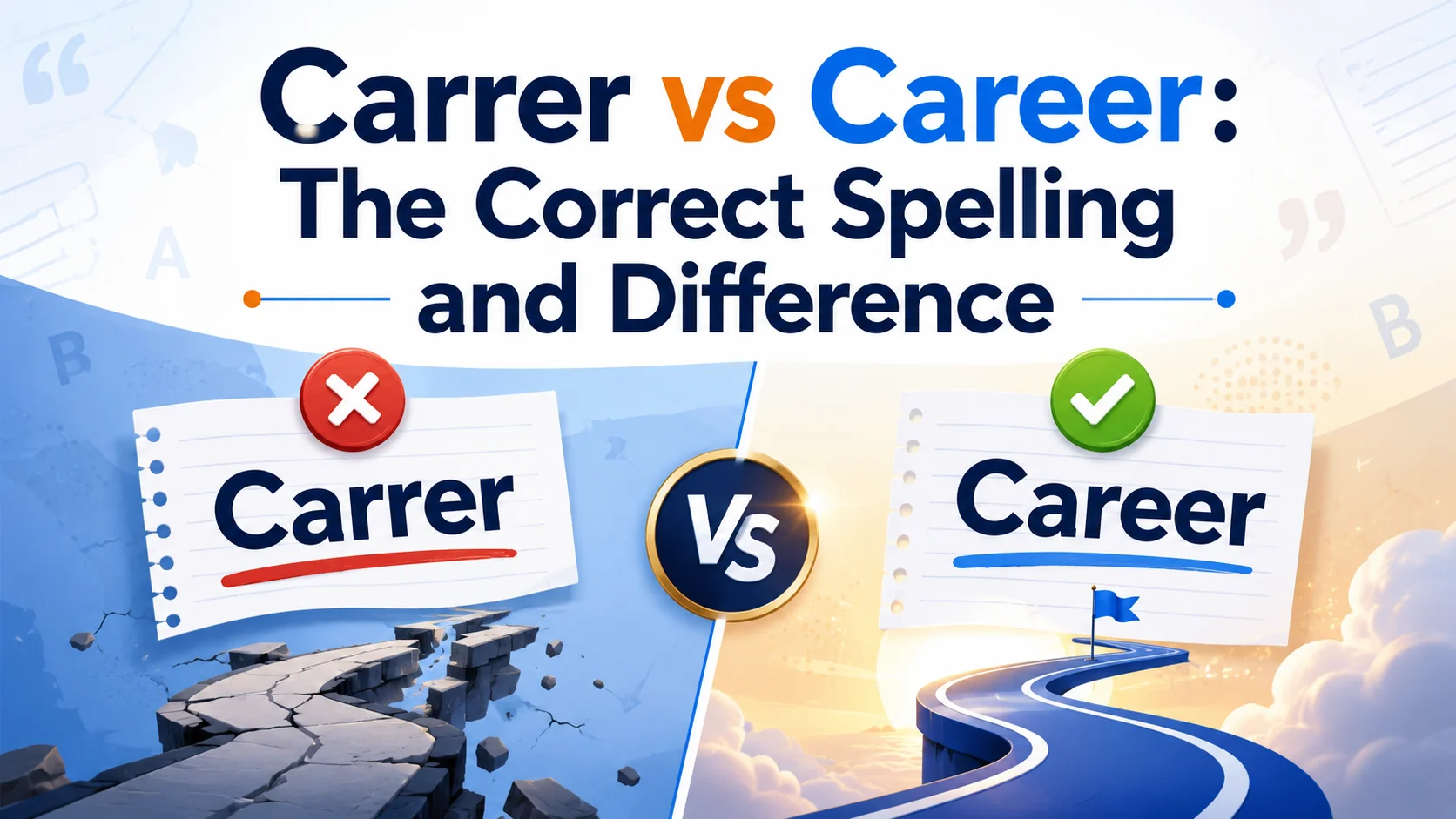
Carrer vs Career is a common spelling confusion, especially when people are writing about jobs, professions, education, or professional goals. The correct spelling is career, with the letters c-a-r-e-e-r. Carrer is generally an incorrect spelling when you mean a person’s profession or professional journey. The confusion is understandable because career has an unusual sequence of vowels, and its pronunciation does not make every letter obvious. In this guide, you’ll learn why career is correct, what career actually means, how it differs from carrier and job, and how to remember the spelling without second-guessing it.
Although the spelling looks simple once you know it, career causes several different problems for English learners and fast typists. Some people write carrer because they omit one of the two consecutive e’s, while others confuse it with the similarly spelled carrier. The word also appears in many professional expressions, including career path, career development, career goals, career change, and career opportunities. Understanding these expressions is more useful than memorizing a dictionary definition because it helps you recognize the correct spelling naturally when you encounter it.
There is also an important distinction between a career and a job. A job is usually a particular position or source of employment, while a career can describe the broader professional direction a person develops over many years. That difference matters when writing a resume, application, academic assignment, LinkedIn profile, or workplace document. This article covers correct spelling, meaning, pronunciation, common mistakes, related words, practical examples, and professional usage so you can use career confidently and avoid the carrer mistake in both everyday and formal English.
Carrer vs Career: Which Spelling Is Correct?
The correct spelling is career.
Correct: career
Incorrect: carrer
When you are referring to someone’s profession, occupation, or long-term professional journey, always use career.
For example:
- She wants to pursue a career in medicine.
- He changed his career after ten years in finance.
- Teaching has been a rewarding career for her.
- They are discussing their future career goals.
- His career began in a small local company.
The spelling carrer is not the standard spelling of the English noun career. In ordinary writing, seeing carrer usually means the writer intended to write career but made a spelling error.
Quick Spelling Reference
| Word | Status | Meaning | Example |
| Career | Correct | A profession or professional journey | She built a successful career in law. |
| Carrer | Incorrect for this meaning | Usually a misspelling of career | She wants a carrer in teaching. |
| Carrier | Correct word, different meaning | Someone or something that carries | The carrier delivered the package. |
The important point is that carrer and career are not two alternative spellings. There is no British-versus-American spelling distinction here. If the intended meaning is someone’s professional life, career is the standard spelling.
What Does “Career” Mean?
The noun career has a broader meaning than simply “job.” It can describe a person’s professional occupation, the progress they make within that occupation, or the period during which they work professionally in a particular field.
Career as a Profession or Occupation
In one common sense, a career is the professional field someone chooses or works in.
For example:
- She chose a career in nursing.
- He is considering a career in engineering.
- Maria began her career as a journalist.
- His career in finance lasted more than two decades.
Here, career identifies the professional field rather than one particular position.
A person might have several jobs while remaining in the same career. An accountant, for example, could work for three different companies without changing careers.
Career as a Long-Term Professional Journey
Career can also describe the progression of someone’s working life.
Consider this example:
Daniel started as a junior designer, became a creative director, and eventually opened his own design studio.
You could describe all of those stages as part of Daniel’s career.
This broader meaning includes things such as:
- education and training
- entry-level positions
- promotions
- changing employers
- developing specialist skills
- leadership responsibilities
- professional achievements
- career changes
- retirement or the end of a professional phase
That is why career is often more comprehensive than job.
Career as a Period of Professional Activity
The word can also refer to the period during which someone works professionally.
For example:
She had a long career in journalism.
This sentence does not identify one specific job. It refers to the overall professional period and achievements associated with journalism.
You may also see phrases such as:
- a successful career
- a distinguished career
- a long career
- a professional career
- a political career
- a military career
- an academic career
- an acting career
Why Is “Carrer” a Common Misspelling of “Career”?
There is nothing mysterious about the error. Career contains an unusual-looking vowel sequence: c-a-r-e-e-r. When people type quickly or rely on pronunciation, the spelling can be easy to reconstruct incorrectly.
The Repeated “E” in Career
The middle of the word is the part that causes the most trouble:
career
The word contains two e’s together:
car + ee + r
A person who remembers only the general shape of the word may accidentally reduce those two letters to one and produce:
carrer
That spelling looks plausible at a glance, which is one reason the mistake can survive casual proofreading.
Pronunciation Can Contribute to the Confusion
English spelling is not always a direct representation of pronunciation. Depending on accent and speaking speed, the vowels in career may not sound as clearly separated as a learner expects.
That creates a common trap: a writer remembers approximately how the word sounds rather than how it is spelled.
However, pronunciation does not make carrer an alternative spelling. The standard written form remains career.
Fast Typing Creates Another Opportunity for Error
Professional writing often happens quickly. Someone completing an application, writing an email, updating a profile, or filling out an online form may type hundreds of words without consciously checking every spelling.
A missing vowel can easily occur during that process.
The practical solution is not to obsess over every letter. Instead, become familiar with the correct visual pattern:
career = c-a-r-e-e-r
Once you repeatedly see and use the word correctly, the spelling becomes much easier to recognize.
Career vs Carrer: Side-by-Side Comparison
| Feature | Career | Carrer |
| Standard English spelling | Yes | No, when intended to mean career |
| Letters | C-A-R-E-E-R | C-A-R-R-E-R |
| Meaning | Profession or professional journey | Usually a spelling error |
| Used in resumes | Yes | No |
| Used in formal writing | Yes | No |
| Example | She wants a career in medicine. | She wants a carrer in medicine. |
Notice the important difference: career contains two consecutive e’s, while carrer changes that spelling pattern.
Correct Examples With “Career”
Here are several natural examples:
Everyday use:
My sister is thinking about a career in teaching.
Academic use:
Students often begin thinking about their career choices before graduation.
Professional use:
He has developed valuable skills throughout his career.
Business use:
The company offers several career opportunities for experienced professionals.
Career planning:
She created a five-year career plan after completing her degree.
Incorrect “Carrer” Examples
❌ He wants to start a carrer in medicine.
✅ He wants to start a career in medicine.
❌ She changed her carrer after moving abroad.
✅ She changed her career after moving abroad.
❌ His carrer has been very successful.
✅ His career has been very successful.
The correction is straightforward: replace carrer with career.
Career vs Carrier: Another Common Confusion
While carrer is generally a misspelling, carrier is a legitimate English word. It simply means something completely different.
What Does “Career” Mean?
Career refers to a profession, occupation, or professional journey.
She built a career in software development.
What Does “Carrier” Mean?
A carrier is generally a person, animal, organization, or object that carries something.
For example:
The package was handed to the delivery carrier.
The word also appears in specialized contexts. In biology and medicine, a carrier can refer to an individual who carries a particular genetic trait or infectious agent without necessarily showing the expected symptoms themselves.
Another familiar use is aircraft carrier, a large military ship designed to operate aircraft.
Career vs Carrier Comparison
| Word | Main meaning | Example |
| Career | Profession or professional journey | She began her career in education. |
| Carrier | Someone or something that carries | The carrier delivered the shipment. |
| Carrier | A person or organism carrying a biological trait or agent | A person can be a carrier of a genetic variant. |
| Carrier | Large ship used to operate military aircraft | The aircraft carrier entered the harbor. |
A useful memory rule is simple:
Career is about what you do professionally. Carrier is about carrying something.
Is “Career” Different in British and American English?
No. Career is the standard spelling in both British and American English.
You may encounter many genuine spelling differences between British and American English, such as:
- colour / color
- organise / organize
- centre / center
- travelling / traveling
But career is not one of those variable spellings.
| Variety | Correct spelling |
| British English | career |
| American English | career |
| Canadian English | career |
| Australian English | career |
So if you’re writing a British CV, an American resume, or professional English for an international audience, career remains the correct form.
How Do You Pronounce “Career”?
Pronunciation varies somewhat across English accents, which can contribute to spelling uncertainty.
In many varieties of English, the word has two broad syllabic parts, with the stress pattern commonly heard as something like:
career → kuh-REER
The exact vowel quality can change according to accent.
Why “Career” May Sound Different From How It Looks
English has many words whose spelling cannot be predicted perfectly from pronunciation. Career is a good example because the written ee does not necessarily sound as clearly separated from the surrounding vowels as a learner might expect.
This creates an important lesson for English learners:
Do not rely entirely on pronunciation to reconstruct spelling.
When a word repeatedly causes spelling problems, seeing it in context is often more useful than trying to spell it entirely from sound.
Does Pronunciation Make “Carrer” Acceptable?
No.
Different accents may pronounce career differently, but the standard written form remains career.
If you hear someone pronounce the word in a way that makes the spelling less obvious, remember the written pattern:
career — two e’s before the final r
Career vs Job: Are They the Same Thing?
Not exactly.
A job is usually a particular position or role that someone performs for an employer or organization. A career is broader and can include many jobs over time.
What Is a Job?
A job is a specific employment arrangement.
For example:
Priya works as a marketing manager at a software company.
That position is her job.
If she leaves the company and becomes a marketing director somewhere else, she has changed jobs.
What Is a Career?
Her broader professional development in marketing can be described as her career.
She might have:
- Started as a marketing assistant.
- Become a marketing coordinator.
- Worked as a marketing manager.
- Moved into marketing leadership.
- Eventually become a consultant.
Those individual positions are jobs. The overall professional journey is her career.
Career vs Job Comparison Table
| Career | Job |
| Broad professional journey | Specific position or role |
| Can include many jobs | Usually refers to one employment position |
| Often develops over years | Can be short-term or long-term |
| Includes progression and experience | Focuses on current or particular employment |
| Example: career in marketing | Example: marketing manager at Company X |
Can One Job Be Part of a Career?
Absolutely.
In fact, this is one of the easiest ways to understand the distinction.
Job = one role.
Career = the larger professional journey.
Someone may leave a job because of salary, location, management, or working conditions without abandoning the career itself.
Career, Work, Employment, Profession, and Occupation: What’s the Difference?
These words overlap, but they are not interchangeable in every sentence.
| Term | What it usually emphasizes | Example |
| Career | Long-term professional journey | She had a career in medicine. |
| Job | Specific paid role | He found a new job. |
| Work | Activity performed, often broadly | I have a lot of work today. |
| Employment | State or arrangement of being employed | Her employment began in June. |
| Profession | Specialized occupation or field | Teaching is her profession. |
| Occupation | What someone does for work | His occupation is engineering. |
Career vs Work
Work is the broadest of these terms. It can refer to tasks, employment, effort, or professional activity.
You can say:
I have a lot of work to finish.
But you would not normally replace work with career:
❌ I have a lot of career to finish.
The concepts are different.
Career vs Employment
Employment focuses on the relationship or condition of being employed.
Her employment with the company ended in July.
Career focuses more on the person’s professional direction and development.
Career vs Profession
A profession is usually a particular occupational field.
Medicine is his profession.
A career can describe the professional life someone builds within that field.
He spent forty years building a career in medicine.
Career vs Occupation
An occupation identifies what someone does for a living.
A career often says more about the person’s professional trajectory, experience, and development.
Common Career-Related Phrases You Should Spell Correctly
Learning career as part of common phrases makes the correct spelling easier to remember.
Career Path
A career path is the direction or sequence of professional roles a person follows.
She is planning a career path in cybersecurity.
Career Development
Career development involves acquiring knowledge, skills, experience, and opportunities that support professional growth.
The company provides training for employee career development.
Career Goals
Career goals are professional objectives a person wants to achieve.
His career goal is to become a senior architect.
Career Change
A career change occurs when someone moves into a substantially different professional field.
After working in finance for eight years, she decided to make a career change.
Career Opportunities
Career opportunities are potential professional roles, pathways, or advancement possibilities.
The program creates career opportunities for recent graduates.
Career Growth
Career growth can include gaining responsibility, improving skills, earning promotions, or moving into more advanced work.
She is looking for a company that offers career growth.
Career Counseling
Career counseling helps people evaluate professional interests, skills, qualifications, and possible career directions.
He spoke with a career counselor before choosing a degree program.
Common Misspellings and Mistakes Related to “Career”
The most obvious mistake is carrer, but understanding the reason behind it can prevent related errors.
Carrer vs Career
This is a spelling error involving the middle letters.
❌ carrer
✅ career
Remember the double e:
car + ee + r
Career vs Carrier
These are both real-looking words, but their meanings are different.
- career = professional life
- carrier = something or someone that carries
Confusing them can change the meaning of a sentence completely.
Confusing Career With Similar-Sounding Words
Pronunciation should not be used as the only guide to spelling. If a word sounds unfamiliar, check its written form rather than inventing a spelling based on what you hear.
Using Career When Job Is More Precise
This is not a spelling mistake, but it is a usage issue.
Compare:
I applied for a new job.
with:
I am planning a new career.
The first concerns a particular employment opportunity. The second suggests a broader professional direction.
How to Remember the Correct Spelling of Career
You do not need a complicated mnemonic.
Break It Into a Visual Pattern
Think:
CAR + EE + R
The important part is the middle:
EE
That gives you:
C-A-R-E-E-R
Remember the Double “E”
A simple memory trick is:
Your career needs two E’s.
It is not a linguistic rule; it is simply a convenient spelling aid.
Use Career in Familiar Phrases
Instead of memorizing the isolated word, remember combinations you are likely to use:
- career path
- career goals
- career change
- career development
- career opportunities
- career growth
- career advice
Seeing the same spelling repeatedly in meaningful phrases strengthens recognition.
The Quickest Spelling Test
When you’re unsure, ask:
Am I talking about someone’s professional life?
If yes, the word is:
career
Then visually check for the two consecutive e’s.
How to Use “Career” Correctly in a Sentence
The word works naturally in many grammatical constructions.
Everyday Examples
She is thinking about her future career.
My brother wants a career in technology.
He has had a successful career.
Academic Examples
Students often explore different career options before graduation.
The course provides skills that can support a career in research.
Workplace Examples
The company offers several opportunities for career development.
She left the position to pursue a different career direction.
Resume and Job-Application Examples
I am seeking a career opportunity that allows me to use my analytical skills.
My career experience includes project management and business development.
A useful distinction here is that career experience can summarize a person’s broader professional background, while a resume usually lists specific jobs, responsibilities, and achievements.
Formal Writing Examples
His academic career has focused on environmental policy.
Her professional career spans education, research, and public administration.
When Spelling “Career” Correctly Matters Most
A typo in an informal message is usually minor. In professional communication, however, proofreading becomes more important.
Resumes and CVs
A resume is a document designed to present your qualifications professionally. A repeated spelling error such as carrer can make the document look insufficiently reviewed.
That does not mean one typo determines whether someone gets hired. Hiring decisions involve qualifications, experience, relevance, communication, and many other factors.
The practical lesson is simpler:
If a document represents your professional abilities, proofread it carefully.
Cover Letters and Job Applications
Job applications often contain repeated uses of words such as:
- career
- experience
- qualifications
- skills
- professional
- development
- opportunities
Because these words appear frequently, learning their correct spelling pays off across many documents.
LinkedIn and Professional Profiles
A professional profile is often read quickly. Correct spelling makes the information easier to scan and helps the profile appear polished.
Academic and Professional Communication
Students, researchers, employees, managers, and applicants may all use career regularly. Knowing the correct spelling prevents an unnecessary error from appearing in otherwise strong writing.
A Practical Career-Spelling Checklist
Before submitting an important professional document, spend a few seconds checking the following:
- Career is spelled with two consecutive e’s.
- Do not replace career with carrer.
- Do not confuse career with carrier.
- Use job when referring to a specific position.
- Use career when discussing a broader professional journey.
- Check headings, profile sections, and form fields as well as paragraphs.
- Read the final version once after spell-checking.
Expert tip: Spell-check tools are useful, but they should support proofreading rather than replace it. A document can contain correctly spelled words and still use the wrong word for the intended meaning.
Quick Practice: Career or Carrer?
Test yourself before looking at the answers.
Fill in the Blank
- She wants to build a ______ in medicine.
- His ______ began shortly after university.
- They discussed several ______ opportunities.
- She decided to make a ______ change.
- He is satisfied with the direction of his ______.
Choose the Correct Spelling
6. Which sentence is correct?
A. She wants a carrer in teaching.
B. She wants a career in teaching.
C. He wants a carrier in teaching.
7. Which word means a professional journey?
A. Carrier
B. Carrer
C. Career
8. Which sentence uses carrier correctly?
A. She began a carrier in law.
B. The delivery carrier brought the package.
C. He changed his carrier last year.
Correct the Professional Writing Mistakes
9. “I am interested in developing a long-term carrer in marketing.”
10. “My carrer goals include becoming a project manager.”
Answers
- career
- career
- career
- career
- career
- B
- C
- B
- “I am interested in developing a long-term career in marketing.”
- “My career goals include becoming a project manager.”
The pattern is consistent: when you mean a profession or professional journey, choose career.
Conclusion
When the intended meaning is a profession, occupation, or long-term professional journey, the correct word is career, not carrer. The easiest way to remember it is to focus on the double e in the middle: c-a-r-e-e-r. It is also worth keeping career separate from carrier, which is a completely different word, and from job, which normally describes a specific position rather than an entire professional path. These distinctions become especially useful in resumes, applications, academic writing, and workplace communication. One final actionable tip: whenever you’re unsure, write career once slowly and check the two e’s. A common mistake to avoid is relying solely on pronunciation to determine spelling. In professional English, accurate word choice and spelling work together to make your writing clear, credible, and polished.
Frequently Asked Questions
Q1. Is “carrer” a correct English word?
Carrer is not the standard spelling when you mean a profession or professional journey. In that context, use career. If you see carrer in a resume, application, or ordinary sentence about employment, it is almost certainly a misspelling of career.
Q2. How do you spell career correctly?
The correct spelling is C-A-R-E-E-R. The easiest detail to remember is the two consecutive e’s in the middle. Think of the word visually as car + ee + r. This helps prevent the common error of replacing career with carrer.
Q3. Why do people spell career as “carrer”?
The mistake usually comes from the word’s unusual vowel sequence, pronunciation, or fast typing. Because the two e’s are not always obvious when the word is spoken, writers may accidentally omit one. Regular exposure to career in professional phrases makes the spelling easier to remember.
Q4. What is the difference between career and carrier?
Career refers to someone’s profession or professional journey, while carrier generally refers to someone or something that carries something. Carrier also has specialized meanings in biology, medicine, and transportation. The two words are spelled differently and should not be substituted for each other.
Q5. Is career spelled differently in British and American English?
No. Career is spelled the same way in British and American English. Although the two varieties have several genuine spelling differences, career is not one of them. Whether you’re writing a British CV or an American resume, career is the standard form.
