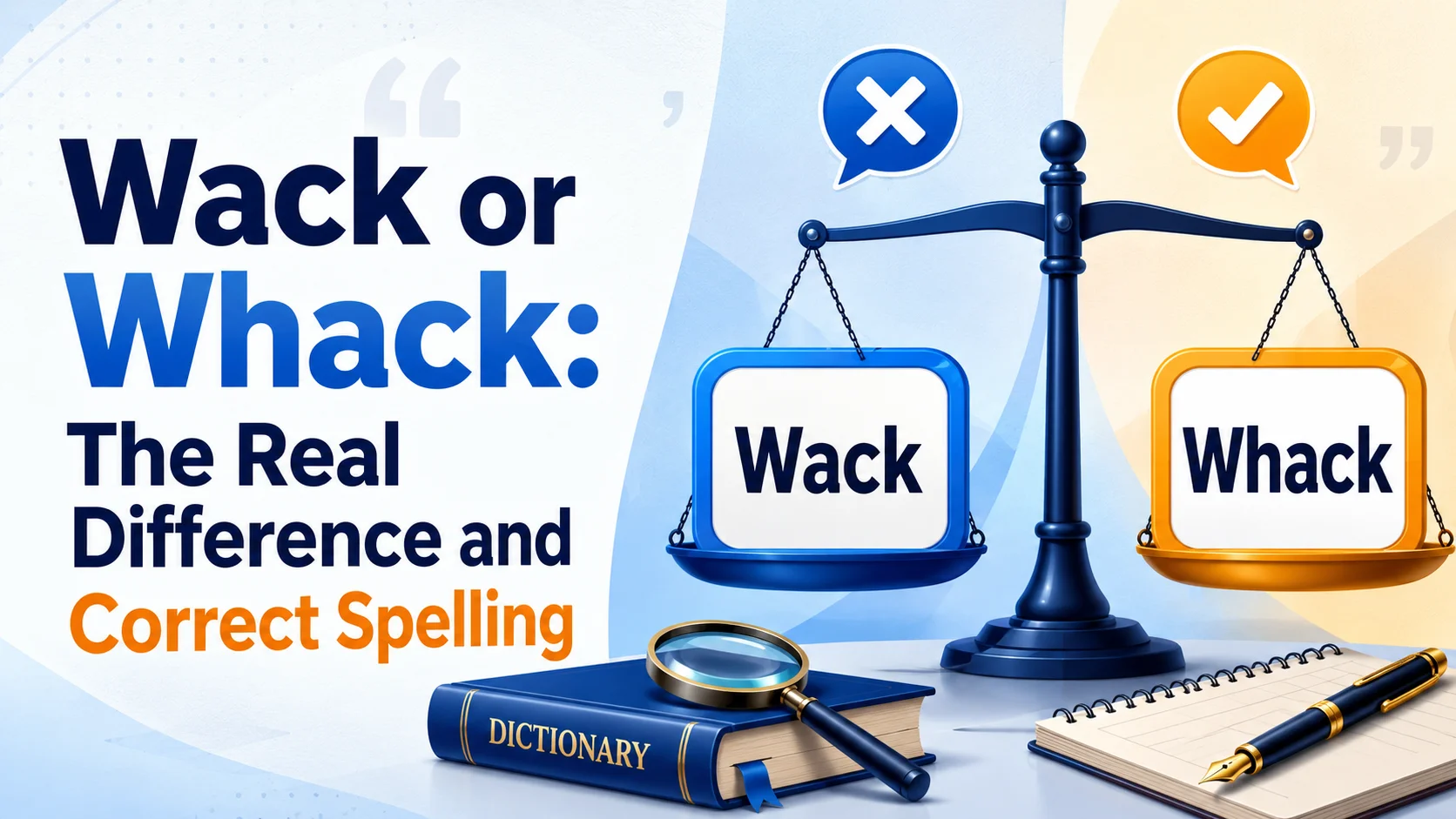
Wack or whack can be confusing because the two words are usually pronounced the same, yet they do not normally mean the same thing. If you are trying to describe hitting something, a blow, or something that is not working properly, the established spelling is whack. If you see wack in casual speech, music, social media, or slang, it can have a different meaning: something may be described as bad, lame, weak, strange, or uncool. That makes this more than a simple spelling question. The right choice depends on what you mean, where you are writing, and how formal the context is.
The confusion becomes easier to understand once you separate pronunciation from meaning. In many modern varieties of English, wack and whack sound alike or very nearly alike, so listening to the word will not necessarily tell you which spelling belongs on the page. Context does the real work. Whack is an established English word with literal and figurative uses, including the familiar expression out of whack. Wack, meanwhile, belongs primarily to informal slang, where it can express a negative judgment about something.
This guide goes beyond simply saying that one spelling is “right” and the other is “wrong.” You will learn what whack means, how wack is used, why the two forms are confused, when each is appropriate, how their histories differ, and which expressions require whack. You will also see practical examples, comparison tables, common mistakes, and a short decision guide. By the end, you should be able to choose the right form based on meaning rather than pronunciation or guesswork.
Wack or Whack: Which Word Is Correct?
The answer depends on the meaning you intend.
Whack is the standard English spelling for the word associated with hitting, striking, a blow, and several established expressions.
Wack is also found in English, but it is primarily an informal slang form used to describe something as bad, lame, weak, strange, disappointing, or uncool.
So it would be inaccurate to say that wack is always a misspelling of whack. In some sentences, wack is deliberately being used as slang.
| Word | Typical use | Main meaning | Example |
| Whack | Standard English | Hit, strike, blow, attempt, or established idiom | He gave the box a whack. |
| Wack | Informal slang | Bad, lame, weak, strange, or uncool | That excuse is wack. |
The key is context.
If someone physically hits a drum, you need whack.
If someone says a movie is terrible using slang, wack may be intentional.
A quick rule
Use whack when you mean hit, strike, blow, attempt, or “out of whack.”
Use wack when you deliberately mean the informal slang sense of bad, lame, weak, or uncool.
What Does “Whack” Mean?
Whack has several related meanings, which is one reason the word appears in more contexts than many learners initially expect.
Whack as a Verb
As a verb, whack means to hit or strike something, usually with considerable force.
For example:
He whacked the ball over the fence.
She accidentally whacked her hand against the table.
The carpenter whacked the peg into place.
The word is generally more vivid and informal than simply saying hit. It suggests a noticeable, forceful action.
Compare:
- He tapped the door. → light contact
- He hit the door. → neutral
- He whacked the door. → suggests a harder, more forceful strike
That difference matters when choosing vocabulary. Whack is useful when the writer wants the action to feel energetic or forceful.
Whack as a Noun
As a noun, whack can mean a blow or strike.
He gave the table a whack.
One whack was enough to loosen the stuck part.
The construction give something a whack is particularly common in informal English.
It does not necessarily mean an aggressive attack. The exact force depends on the context.
Whack as an Attempt
In the expression take a whack at something, whack has moved away from its literal physical meaning.
It means to try or attempt something.
I’ll take a whack at fixing the computer.
She took a whack at solving the puzzle.
This is an informal expression. In a formal report, attempt or try would usually be more appropriate.
Compare:
Informal: I’ll take a whack at it.
Neutral: I’ll try it.
Formal: I will attempt to resolve the issue.
The underlying idea is that someone is metaphorically taking a “swing” at a task.
What Does “Wack” Mean in English Slang?
Wack has a different role from whack. In informal slang, it can describe something that is bad, disappointing, lame, weak, strange, or uncool.
For example:
That movie was wack.
His excuse sounds wack.
The new design looks wack.
The exact meaning changes slightly with context. One speaker might use wack to mean “poor quality,” while another might mean “ridiculous” or “uncool.”
That flexibility is typical of slang.
Wack as “Bad” or “Lame”
If someone says:
That game was wack.
They are not talking about physical hitting. They are expressing a negative opinion about the game.
A more formal writer might instead choose:
- disappointing
- poor
- ineffective
- unimpressive
- unreasonable
- inappropriate
The best replacement depends on what the writer actually means.
Wack as a Casual Evaluation
Slang often works as a compact expression of attitude.
Consider:
“That rule is wack.”
This may communicate more than simply “That rule is bad.” It can also convey the speaker’s personal reaction that the rule is unreasonable, ridiculous, or unfair.
That expressive quality explains why slang can remain useful even when a more neutral synonym exists.
Is “Wack” Formal English?
Generally, wack is informal.
That does not make every use incorrect. It means the word carries a particular register.
Use it naturally in contexts such as:
- casual conversation
- informal messages
- dialogue
- social media
- creative writing
- discussions where slang is intentionally part of the voice
Be more cautious in:
- academic essays
- business reports
- formal applications
- legal writing
- technical documentation
- professional correspondence
In those settings, choose a precise standard-English alternative unless the slang itself is relevant to the subject.
Writing tip: A word can be legitimate English and still be the wrong choice for a particular audience.
Wack vs Whack: The Real Difference
The central distinction is semantic rather than simply orthographic.
| Feature | Whack | Wack |
| Status | Established English word | Informal/slang word |
| Common meaning | Hit, strike, blow | Bad, lame, weak, strange, uncool |
| Physical action | Yes | No in the usual slang sense |
| Noun use | Yes | Not normally in the same sense |
| Verb use | Yes | Slang usage varies |
| Formal writing | Generally acceptable when appropriate | Usually avoid |
| Common expression | out of whack | No equivalent standard idiom |
| Example | Give it a whack. | That song is wack. |
When “Whack” Is the Right Choice
Choose whack when the context involves:
- physically hitting something
- a forceful blow
- taking a try at something
- something being out of proper condition or alignment
- established expressions containing whack
Examples:
The machine is out of whack.
He gave the stuck drawer a whack.
I’ll take a whack at the problem.
When “Wack” Is the Right Choice
Choose wack when you’re intentionally using informal slang to describe something negatively.
Examples:
That excuse is wack.
The ending was totally wack.
They thought the new rules were wack.
If the writing is formal, however, a more precise adjective is usually better.
When Neither Word Is the Best Choice
Sometimes the question is not really “wack or whack?” The better question is what exact idea are you trying to communicate?
Suppose someone writes:
The results were wack.
That sentence is understandable in casual speech, but it is vague. A professional report might need:
The results were inconsistent.
Or:
The results were unreliable.
Or:
The results were unexpected.
Good writing is not about choosing the most complicated word. It is about choosing the most accurate word for the situation.
Is “Wack” a Real Word?
Yes, wack is used as an informal slang word, so treating every occurrence as a simple spelling mistake is too simplistic.
The important distinction is between lexical existence and formal appropriateness.
Many slang terms become recognizable parts of everyday English without becoming appropriate in every setting. Their presence in casual communication does not mean they should automatically appear in formal prose.
For example, a writer might intentionally use:
“That idea is wack.”
inside dialogue to make a character sound casual.
Changing it to:
“That idea is unreasonable.”
would alter the character’s voice.
Why Context Matters
Imagine an article about the history of slang. In that context, wack may be the exact word the writer needs.
Now imagine a scientific report describing an experimental result. Calling the result “wack” would be too vague and informal.
The word itself has not suddenly become incorrect. The context has changed.
Is “Whack” Correct Standard English?
Yes.
Whack is an established English word and has been used in both literal and figurative ways.
Its common meanings include:
- to hit or strike
- a blow or strike
- an attempt in informal expressions
- something being out of order in the phrase out of whack
The word can therefore appear in ordinary English without requiring a slang-heavy context.
However, some expressions containing whack are themselves informal.
For example:
I’ll take a whack at it.
is perfectly understandable English, but a formal document would more likely say:
I will attempt it.
This distinction is useful because standard word and formal expression are not always identical concepts.
Why Do People Confuse Wack and Whack?
The biggest problem is that the two forms are pronounced alike or very similarly for many speakers.
The Silent “H” Creates Uncertainty
The h in whack does not normally give modern speakers a separate audible sound.
As a result, someone hearing the word may have no way to know whether the speaker means:
- whack, the standard word associated with hitting, or
- wack, the slang word.
That is why spelling must be determined from meaning and context.
Slang Makes the Confusion More Common
People encounter slang in places where spelling rules are less formal:
- music
- entertainment
- social media
- text messages
- online comments
- casual conversations
Repeated exposure to wack can make the spelling feel just as familiar as whack.
Fast Typing Can Remove the H
There is also a simpler explanation: people sometimes omit letters when typing quickly.
Someone intending to write:
whack
may accidentally type:
wack
If the surrounding sentence is about hitting something, that is simply a spelling mistake.
The same written form can therefore arise for two completely different reasons: intentional slang or accidental omission.
How Do You Pronounce “Wack” and “Whack”?
For many English speakers, wack and whack are pronounced the same or nearly the same.
That is one reason the distinction is primarily a spelling-and-meaning problem.
You cannot reliably decide between them simply by hearing the word.
Consider:
“That was wack.”
The pronunciation alone does not tell you whether the speaker means the slang adjective.
Likewise:
“He gave it a whack.”
The surrounding words reveal the intended meaning.
Why Pronunciation Does Not Solve the Spelling Question
English contains many words whose spelling cannot be predicted perfectly from sound.
In this case, the listener needs context.
If the sentence describes a physical action, whack is the likely choice.
If the sentence expresses an informal judgment that something is poor or uncool, wack may be intended.
This is an important spelling principle for English learners:
When two forms sound alike, meaning often determines spelling.
Where Did “Whack” Come From?
The history of whack is associated with the idea of a blow or striking action. Like several vivid English words describing sounds or physical actions, its history has been influenced by the close relationship between language and physical experience.
Over time, the word developed beyond the literal action.
The modern language now allows whack to appear in several related contexts:
- striking something
- describing a blow
- attempting something
- describing something as being out of proper condition
That expansion is a good example of how ordinary English words develop literal and figurative meanings over time.
How Whack Developed Multiple Uses
The physical meaning provides the foundation.
From there, English speakers developed figurative expressions based on the idea of taking a swing or making an impact.
That helps explain:
take a whack at it
The phrase does not require anyone to hit anything. It uses the image of taking a swing as a metaphor for making an attempt.
Where Did “Wack” Come From?
Wack developed as an informal slang form rather than simply functioning as an ordinary spelling variant of whack.
Its modern use is strongly associated with informal American English and popular culture, particularly contexts in which speakers evaluate something negatively.
The spelling therefore became associated with a different semantic role.
That distinction matters. If a slang term happens to resemble a standard word, that does not mean the two forms are automatically interchangeable.
Why “Wack” Became More Familiar
Informal vocabulary spreads through communities and popular culture. A slang expression can move from relatively limited group usage into wider everyday recognition.
Music, entertainment, youth culture, online communication, and social media can all accelerate that process.
But increased familiarity does not necessarily make a slang word suitable for formal writing.
Common Expressions With “Whack”
Some expressions are especially useful because they make the correct spelling easy to identify.
Out of Whack
Out of whack means that something is not functioning properly, not properly balanced, or not in the expected condition.
Examples:
My sleep schedule is completely out of whack.
The machine’s settings are out of whack.
The budget is out of whack.
The expression is figurative. Nothing necessarily needs to be physically struck.
This is an important phrase to memorize because out of whack is the established spelling.
Take a Whack at Something
Take a whack at something means to attempt or try something.
I’ll take a whack at fixing the printer.
She took a whack at the difficult question.
It is conversational and informal.
In more formal writing:
I’ll attempt to fix the printer.
would be more appropriate.
Give Something a Whack
This expression usually means hit something.
He gave the stuck lid a whack.
The exact amount of force depends on the context, but the image is generally stronger than a gentle tap.
A Whack at Something
A whack at something can also describe an attempt.
He had another whack at solving the puzzle.
This is less formal than simply saying attempt or try.
How to Use “Wack” in a Sentence
Because wack is slang, sentence examples should reflect informal contexts.
Casual Conversation
That restaurant was wack.
His explanation was pretty wack.
The whole situation is wack.
These examples express a negative personal reaction.
Informal Online Writing
You may see wack in posts, comments, messages, and casual discussions.
For example:
“That update is wack.”
The spelling can be intentional because the writer is deliberately using slang.
Dialogue and Character Voice
Wack can be especially useful in fiction when the writer wants a character to sound informal.
“Nah, that plan is wack,” Marcus said.
Replacing wack with unreasonable would change the voice and personality of the character.
When Not to Use “Wack”
Avoid it when the context requires formal, precise language unless you’re discussing the slang itself.
Instead of:
The company’s policy is wack.
a professional report might say:
The company’s policy is inefficient.
Or:
The policy is unclear and difficult to implement.
The replacement should reflect the exact criticism.
How to Use “Whack” in a Sentence
Literal Physical Action
He whacked the ball with the bat.
The branch whacked against the window in the wind.
A Blow
She gave the stuck button a whack.
The box took a hard whack during transport.
Figurative Attempt
I’ll take a whack at the calculation.
He took another whack at repairing the old bicycle.
Out of Whack
The timing seems to be out of whack.
Her routine was completely out of whack after the trip.
These examples show why whack cannot be reduced to a single definition. It is a flexible word with several established uses.
Wack vs Whack in Real-Life Situations
The easiest way to choose between them is to imagine the situation before choosing the spelling.
| Situation | Correct choice | Example |
| Someone hits a drum | whack | He gave the drum a whack. |
| Someone hits a ball | whack | She whacked the ball across the field. |
| Something is malfunctioning | whack | The settings are out of whack. |
| Someone attempts a difficult task | whack | I’ll take a whack at it. |
| Someone calls a movie terrible using slang | wack | That movie was wack. |
| Someone calls an outfit uncool | wack | He thought the outfit looked wack. |
| A formal report describes poor results | Neither necessarily | Use precise wording such as “unreliable” or “inconsistent.” |
This approach is more reliable than memorizing a rule such as “whack is right and wack is wrong.”
Common Mistakes With Wack and Whack
Treating “Wack” as Always Wrong
This is the biggest oversimplification.
If someone writes:
That song is wack.
they may be intentionally using slang.
Correcting it to whack would actually change the intended word.
Treating “Wack” and “Whack” as Interchangeable
They are not interchangeable when their distinct meanings matter.
Compare:
He gave the door a whack.
with:
He said the door was wack.
The first describes a physical action. The second expresses a negative evaluation.
Using “Wack” in Formal Writing
Even when the slang is understandable, it may not communicate enough precision in formal writing.
- If you mean poor quality, say that.
- If you mean unreliable, say that.
- If you mean unreasonable, say that.
Strong professional writing identifies the actual problem instead of relying on vague slang.
Assuming Pronunciation Determines Spelling
Because the words can sound alike, pronunciation alone cannot solve the problem.
Ask what the sentence means first.
Confusing “Out of Whack” With “Out of Wack”
When you mean not functioning properly, not balanced, or not in proper order, the established idiom is:
out of whack
Not:
❌ out of wack
For example:
My sleep schedule is out of whack.
The numbers are out of whack.
Something is out of whack with the system.
A Simple Memory Trick for Wack vs Whack
A memory trick should make the distinction easier without pretending to be a linguistic rule.
Think “Whack” for a Hit
Associate whack with a physical strike.
whack = hit
That connection covers the most important standard meaning.
Think “Wack” for Slang
Associate wack with the informal reaction:
wack = bad, lame, or uncool
Again, this is a memory aid rather than a complete definition.
Let Context Decide
Use this two-step test:
Step 1: Is the sentence about hitting, striking, a blow, attempting something, or being out of proper order?
→ Choose whack.
Step 2: Is the word being used as informal slang to criticize something?
→ Wack may be the intended form.
If the writing is formal and you mean something like bad or poor, choose a more precise standard adjective.
Wack vs Whack: Quick Decision Guide
| If you mean… | Use… |
| To hit or strike | whack |
| A physical blow | whack |
| To attempt something informally | whack |
| Something not working properly | whack in “out of whack” |
| Something bad or lame in slang | wack |
| Something poor in a formal report | Use a precise adjective |
| Informal character dialogue | wack may be appropriate |
The decision becomes straightforward once you focus on meaning and register.
Practice Quiz: Wack or Whack?
Choose the Correct Word
1. He gave the stubborn lid a ___.
A. wack
B. whack
2. The entire schedule is out of ___.
A. wack
B. whack
3. “That movie was ___,” she said.
A. wack
B. whack
4. I’ll take a ___ at solving the problem.
A. wack
B. whack
5. The character described the new rules as ___.
A. wack
B. whack
6. Which sentence uses the standard word for a physical strike?
A. He gave the table a wack.
B. He gave the table a whack.
Correct the Mistakes
7. “My computer settings are out of wack.”
8. “I’ll take a wack at fixing the problem.”
9. “That new song is whack,” he said, using slang to mean it was terrible.
Answers
- B — whack
- B — whack
- A — wack
- B — whack
- A — wack
- B — whack
- My computer settings are out of whack.
- I’ll take a whack at fixing the problem.
- In this sentence, wack is appropriate if the intended meaning is the slang sense “terrible” or “uncool.”
The important lesson is that the answer depends on meaning, not simply on which spelling looks more familiar.
Conclusion
The real difference between wack and whack is not simply an extra letter. The words occupy different places in English. Whack is the established standard form for hitting, a blow, an informal attempt, and expressions such as out of whack. Wack belongs mainly to informal slang, where it can describe something as bad, lame, weak, strange, or uncool. One final actionable tip: before choosing the spelling, identify what the sentence actually means and whether the situation is formal or casual. A common mistake to avoid is treating wack as automatically wrong or assuming that pronunciation determines spelling. When the context is clear, the choice becomes much easier. Good word choice is ultimately about matching meaning, tone, and audience—not merely selecting the spelling that looks familiar.
Frequently Asked Questions
Q1. Is “wack” a correct spelling?
Wack is an established informal slang word, so it is not accurate to call every use a spelling mistake. It can mean something is bad, lame, weak, strange, or uncool. However, it is not the standard spelling of whack when the intended meaning is to hit or strike.
Q2. Is “whack” the standard spelling?
Yes. Whack is the established English spelling for meanings involving hitting, striking, a blow, or an attempt in expressions such as “take a whack at it.” It is also required in the common idiom out of whack, meaning something is not functioning or arranged properly.
Q3. What does “out of whack” mean?
Out of whack means something is not working, balanced, organized, or functioning as expected. It can describe schedules, machines, systems, routines, finances, or physical alignment. The phrase is idiomatic, so its meaning is broader than simply saying that something has been physically struck.
Q4. Does “wack” mean the same thing as “whack”?
No. In contemporary slang, wack commonly expresses a negative judgment, such as bad, lame, weak, or uncool. Whack, by contrast, has standard meanings involving hitting, a blow, attempts, and expressions such as “out of whack.” Context separates them.
Q5. Are “wack” and “whack” pronounced the same?
For many English speakers, the two forms are pronounced the same or very similarly. That explains why the spelling can be confusing. Since pronunciation often cannot distinguish them, writers need to determine the intended form from meaning, context, and register rather than sound alone.
