
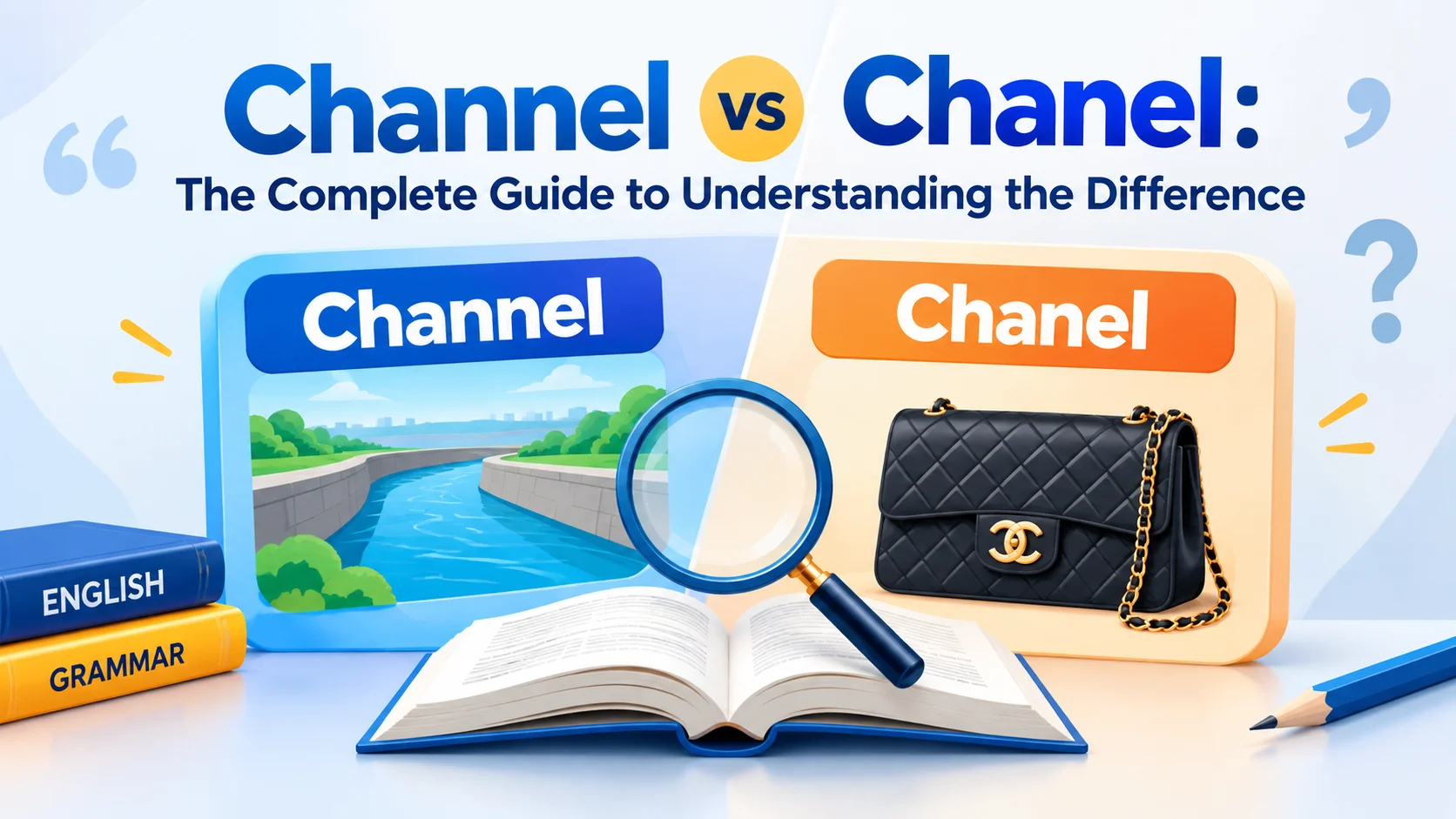
Channel vs Chanel is an easy pair to mix up because the words look almost identical and are both familiar in everyday English. But they do very different jobs. Channel is an ordinary English word that can describe a waterway, communication method, television station, digital platform, or a way of directing something. Chanel, by contrast, is a proper name, most commonly associated with the French fashion and beauty house founded by Gabrielle “Coco” Chanel.
The difference is only one letter, but that letter matters. Channel has two n’s and normally appears in lowercase when used as a common noun, while Chanel has one n and is capitalized when referring to the name or brand. For English learners, writers, marketers, and anyone working with fashion or digital media, recognizing that distinction prevents surprisingly common spelling mistakes.
This guide explains channel vs Chanel meaning, spelling, pronunciation, capitalization, grammar, and real-world usage. You will see how channel works across communication, television, marketing, technology, and physical geography, while Chanel is used as a proper name. By the end, you will have a simple way to choose the right word without relying on guesswork.
Channel vs Chanel: What’s the Difference?
The simplest distinction is this:
Channel is a common English word. Chanel is a proper name.
Channel has several related meanings, but the central idea is often a path, route, or means through which something moves or is communicated. A river can have a channel, a television service can be called a channel, and a company can communicate with customers through different channels. Cambridge Dictionary lists broadcasting, physical passages, communication, electrical uses, and other meanings for channel.
Chanel, on the other hand, refers to a name, particularly the fashion and beauty house associated with Gabrielle Chanel. The company identifies Gabrielle Chanel as its founder and traces its early business history to her hat boutique in Paris in 1910.
| Feature | Channel | Chanel |
| Type | Common English word | Proper name |
| Typical meaning | Path, medium, route, or means of communication | Name associated with Gabrielle Chanel and the luxury house |
| Spelling | channel | Chanel |
| Number of n’s | Two | One |
| Capitalization | Usually lowercase | Capitalized as a proper name |
| Common contexts | TV, YouTube, communication, marketing, water, technology | Fashion, fragrance, cosmetics, Gabrielle Chanel |
| Example | “Which channel is showing the match?” | “She bought a Chanel fragrance.” |
A useful rule is:
If you mean a medium, route, pathway, or means of communication, use channel. If you mean the name Chanel, use Chanel.
What Does “Channel” Mean?
Channel is a versatile English word. Its different meanings may seem unrelated at first, but they share an underlying idea: something provides a route through which something else travels, flows, or is directed.
That could be water, information, a television signal, electricity, products, or even someone’s attention.
Channel as a Physical Passage or Path
One of the oldest and most literal uses of channel refers to a passage through which water or another liquid flows.
For example:
- The river changed its channel after the flood.
- Farmers built irrigation channels to move water across the fields.
- The boat entered a narrow shipping channel.
A channel can also refer to a navigable part of a body of water. Cambridge Dictionary includes a passage for water or liquids and a deeper or wider route through water that ships can use.
This physical meaning helps explain some of the word’s broader uses. A communication channel, for example, can be understood metaphorically as a route through which information travels.
Channel as a Means of Communication
In communication, a channel is a method or route used to exchange information.
Consider these examples:
- Email is one communication channel.
- The company opened a new customer-support channel.
- The two governments maintained diplomatic channels.
- Employees can report concerns through official channels.
The word is particularly common in formal and professional writing. Cambridge defines this sense as a way of communicating with people or getting something done.
The important point is that channel does not necessarily mean a physical object. It can describe an abstract route for communication or action.
Channel in Television and Broadcasting
In television and radio, a channel can refer to a station or broadcasting service.
Examples include:
- “Turn to another channel.”
- “The news is on Channel 4.”
- “Which channel is broadcasting the game?”
- “The sports channel has a new program tonight.”
This is one reason channel is so familiar to English speakers. The word has been part of broadcasting vocabulary for decades.
It can also have a more technical meaning involving frequencies used to transmit broadcast signals.
Channel on YouTube and Other Digital Platforms
Today, channel is also strongly associated with online media.
A YouTube channel is the public space associated with a creator, organization, or other account for publishing videos.
For example:
“I subscribed to her YouTube channel.”
The word works naturally with other digital platforms and services too, depending on how the platform defines its publishing or communication structure.
This is an important modern use because someone searching for “my channel” or “our channel” may be talking about a digital presence rather than television.
Channel in Marketing and Business
In business, a marketing channel is a route through which a company reaches customers or makes products and services available.
Examples include:
- social media
- retail stores
- websites
- distributors
- sales representatives
- online marketplaces
A business might say:
“We are testing a new sales channel.”
Here, channel means a route through which the company reaches or serves customers.
Cambridge’s Business English definition specifically describes a channel as a way products or services are made available to customers.
Channel as a Verb
Channel can also function as a verb.
As a verb, it can mean to direct something toward a particular place, purpose, or activity.
Examples:
- She channeled her frustration into productive work.
- The organization channeled its resources into research.
- The company channeled more funding into customer support.
Cambridge defines this verbal sense as directing something into a particular place or situation.
This is another useful clue: channel is an active English vocabulary word with several grammatical functions. Chanel does not serve as its replacement.
Channel in Science, Technology, and Electronics
In technical contexts, channel can describe a route through which a signal travels.
For example:
- an audio channel
- a communication channel
- a data channel
- an electrical channel
Cambridge gives channel an electrical meaning involving a circuit through which a signal can travel.
So if you encounter channel in technical writing, don’t assume it refers to television or social media. The surrounding subject determines its precise meaning.
What Does “Chanel” Mean?
Unlike channel, Chanel is primarily a proper name.
In contemporary English, the word is most strongly associated with Gabrielle “Coco” Chanel and the fashion and beauty house that bears her name.
Gabrielle Chanel opened her first independent millinery shop in Paris in 1910, and her business later developed into a couture house. CHANEL’s own historical material identifies 1915 as the year she opened her couture house.
Chanel as a Proper Name
Because Chanel is a name, it behaves differently from channel.
Compare:
- The channel is busy today.
- Chanel released a new collection.
The first sentence uses a common noun. The second uses a proper name.
That difference explains the capitalization:
channel → ordinary noun
Chanel → proper name
Coco Chanel and the Origin of the Name
Gabrielle Chanel, widely known as Coco Chanel, became a major figure in twentieth-century fashion.
CHANEL’s own biography describes her as the founder of the House and highlights her influence on clothing, perfume, jewelry, and the broader vocabulary of modern fashion.
Her name therefore appears in contexts such as:
- fashion history
- couture
- fragrance
- beauty
- accessories
- luxury branding
If the subject is Gabrielle Chanel herself, Chanel is the correct spelling.
Chanel as a Fashion and Beauty Brand
Modern references to Chanel can involve far more than clothing.
Depending on the context, someone may be discussing:
- Chanel fashion
- Chanel handbags
- Chanel fragrance
- Chanel makeup
- Chanel skincare
- Chanel jewelry
- Chanel watches
For example:
“She wore a Chanel jacket.”
Here, Chanel identifies the brand associated with the item.
Why “Chanel” Is Capitalized
The capital letter is not decorative. It signals that Chanel is being used as a proper name.
Compare:
The television channel changed its schedule.
with:
The Chanel boutique opened a new location.
The lowercase/uppercase distinction gives the reader an immediate grammatical clue.
Channel vs Chanel: Spelling Difference
The spelling difference is extremely small:
CHANNEL
CHANEL
The key difference is the second n.
Why “Channel” Has Two N’s
The standard English spelling is:
c-h-a-n-n-e-l
That double n belongs to the established spelling of the English word channel.
If you’re referring to a television station, communication route, waterway, YouTube account, or marketing route, you need channel.
Why “Chanel” Has One N
The spelling Chanel belongs to the proper name.
It is not a shortened spelling of channel. The two words simply happen to look similar.
That distinction matters when proofreading. Removing one n from channel does not create an alternative spelling of the same word; it produces Chanel, a different name.
The One-Letter Difference That Changes the Meaning
This is a classic example of why English spelling deserves attention.
| If you write… | The reader may understand… |
| channel | A path, medium, route, station, or means of communication |
| Chanel | A proper name, especially the fashion/beauty brand |
A sentence such as:
“I watched the Chanel last night.”
is likely to make the reader stop because the expected word in a television context is channel.
Likewise:
“She bought a channel handbag.”
is incorrect if the intended reference is the fashion brand Chanel.
Channel vs Chanel Pronunciation
Spelling is not the only source of confusion. The words also sound sufficiently similar to create mistakes in conversation.
How to Pronounce “Channel”
Cambridge gives channel the pronunciation /ˈtʃæn.əl/ in both British and American English.
A simple approximation is:
CHAN-uhl
The first syllable is stressed.
For example:
“Which channel is the movie on?”
How to Pronounce “Chanel”
Cambridge gives the English pronunciation of Chanel as /ʃəˈnel/ in both UK and US entries.
A simple approximation is:
shuh-NELL
The second syllable receives the main stress.
That makes an important difference:
- channel → CHAN-uhl
- Chanel → shuh-NELL
Are Channel and Chanel Pronounced the Same?
No. Their standard English pronunciations are different.
The opening sounds are particularly useful:
- channel begins with the ch sound /tʃ/
- Chanel begins with the sh sound /ʃ/
The stress pattern also differs. Cambridge lists channel with initial stress and Chanel with final stress.
That said, unfamiliar brand names can be pronounced differently by individual speakers, particularly when speakers are influenced by another language or have only encountered the word in writing.
Tip: If you are unsure whether someone means the media term or the fashion name, listen for the context rather than relying on sound alone.
Channel vs Chanel: Grammar and Capitalization
The grammatical distinction is straightforward once you identify what the word represents.
When “channel” Is Lowercase
Use lowercase channel when it is functioning as an ordinary common noun.
Examples:
- a television channel
- a YouTube channel
- a communication channel
- a marketing channel
- a shipping channel
- an audio channel
For example:
“Our company uses several communication channels.”
There is no reason to capitalize channel simply because it appears in a professional context.
When “Chanel” Is Capitalized
Use Chanel when referring to the proper name.
Examples:
- Chanel
- Coco Chanel
- Chanel fragrance
- Chanel fashion
- Chanel boutique
The capital C tells the reader that the word is being used as a name.
Can “Chanel” Be Used Like an Ordinary English Word?
Not in the way channel can.
You cannot normally substitute Chanel for channel in sentences such as:
“Please contact us through the appropriate Chanel.”
The intended word is channel.
Likewise, Chanel is not the verb used when you mean “direct” something:
“She channeled her energy into writing.”
Not:
“She Chaneled her energy into writing.”
The latter does not represent standard English usage.
Channel vs Chanel in Sentences
Seeing the words in context is often more useful than memorizing definitions.
Examples Using “Channel”
Television:
“We switched to another channel during the commercial break.”
YouTube:
“Her cooking channel has grown quickly.”
Communication:
“Email remains an important communication channel for the company.”
Marketing:
“The business is testing a new sales channel.”
Physical geography:
“The boats moved carefully through the narrow channel.”
Verb:
“He channeled his experience into a new project.”
Each example uses the ordinary English word channel.
Examples Using “Chanel”
Brand:
“She purchased a Chanel handbag.”
Fragrance:
“Chanel N°5 was created in 1921.”
Fashion:
“The exhibition included references to Gabrielle Chanel’s designs.”
Person:
“Gabrielle Chanel founded the fashion house associated with her name.”
Side-by-Side Examples
| Incorrect or confusing use | Correct version | Reason |
| “I changed the Chanel on TV.” | “I changed the channel on TV.” | TV uses channel. |
| “She subscribed to my Chanel.” | “She subscribed to my channel.” | A YouTube presence is a channel. |
| “He bought a channel perfume.” | “He bought a Chanel perfume.” | The brand is Chanel. |
| “She wore a channel jacket.” | “She wore a Chanel jacket.” | The brand name is Chanel. |
| “Use another Chanel of communication.” | “Use another channel of communication.” | Communication uses channels. |
Common Channel vs Chanel Mistakes
Writing “Chanel” When You Mean a TV or YouTube Channel
This is probably the most obvious context error.
If you’re talking about a television station or creator account, write:
“The news channel…”
“My YouTube channel…”
not:
“The news Chanel…”
“My YouTube Chanel…”
The correct word has two n’s.
Writing “Channel” When Referring to the Fashion Brand
The opposite mistake happens when someone remembers the sound but not the spelling:
“She bought a Channel bag.”
For the brand, the correct form is:
“She bought a Chanel bag.”
Forgetting the Capital Letter in “Chanel”
In ordinary prose, the brand name should retain its proper-name capitalization:
Chanel, not chanel.
This is especially important in professional writing, product descriptions, articles, and editorial content.
Treating the Two Words as Interchangeable
They are not interchangeable.
You cannot decide between them based simply on which spelling “looks right.” Instead, ask:
What am I talking about?
If the answer is a route, medium, station, pathway, or means of communication, choose channel.
If the answer is the name Chanel, choose Chanel.
Autocorrect and Fast-Typing Errors
Because the words differ by only one letter, typing quickly can produce accidental substitutions.
A useful proofreading technique is to check the semantic context, not just the spelling.
If the sentence contains words such as:
- YouTube
- television
- communication
- marketing
- signal
- water
- river
then channel is probably intended.
If it contains:
- perfume
- handbag
- fashion
- couture
- Coco
- fragrance
- cosmetics
then Chanel is likely the intended name.
This is not a rigid grammar rule; it is a practical proofreading shortcut.
Why Do People Confuse Channel and Chanel?
The confusion is understandable because the visual difference is tiny.
1. They Share Most of Their Letters
Both words begin with chan- and contain the same general sequence of letters. When someone types quickly, the additional n in channel is easy to overlook.
2. Both Are Familiar Words or Names
Channel appears constantly in everyday English, especially in television, social media, business, and communication.
Chanel is also highly recognizable because of the fashion and beauty brand.
3. Sound Can Interfere With Spelling
People sometimes remember a word from conversation before they have seen it written. If the pronunciation is unfamiliar, spelling from memory can lead to errors.
4. English Learners May Associate Spelling With Sound
English contains many spelling patterns that cannot be predicted perfectly from pronunciation. In this case, the best strategy is not to invent a spelling rule but to associate each spelling with its meaning.
5. Context Changes Quickly
A single conversation might move from digital media to fashion:
“I found a new YouTube channel about Chanel handbags.”
Both words appear naturally in the same sentence. Their meanings are completely different even though their spellings are similar.
How to Remember Channel vs Chanel
Remember “Channel” as a Path or Medium
Think of channel as something that carries or directs something.
A channel can carry:
- water
- information
- television signals
- audio
- products
- communication
That broad idea connects many of its apparently different meanings.
Remember “Chanel” as a Name
Think:
Chanel = name
The capital C can serve as an additional reminder.
If you’re discussing Coco Chanel, fashion, perfume, or the luxury brand, you almost certainly need Chanel.
A Simple Spelling Test
Ask yourself:
Am I talking about a route or a name?
If it’s a route, medium, or pathway, choose channel.
If it’s a name or brand, choose Chanel.
Quick memory trick:
Channel has an extra N because it is the longer English word. Chanel is the shorter proper name.
Channel vs Chanel in Different Contexts
When you’re editing a sentence, context can resolve the spelling almost instantly.
| Context | Correct word | Example |
| YouTube | channel | “Subscribe to my channel.” |
| Television | channel | “Which channel is showing it?” |
| Radio | channel | “Tune into the correct channel.” |
| Communication | channel | “Email is a useful communication channel.” |
| Marketing | channel | “Social media is a marketing channel.” |
| Waterway | channel | “The river channel became narrower.” |
| Electronics | channel | “The device has two audio channels.” |
| Fashion brand | Chanel | “She wore Chanel.” |
| Fragrance | Chanel | “He bought Chanel N°5.” |
| Cosmetics | Chanel | “The product is from Chanel.” |
| Gabrielle Chanel | Chanel | “Gabrielle Chanel founded the House.” |
This table reveals the key principle: the correct spelling follows the meaning, not the sound alone.
Channel vs Chanel: Related Words You Should Not Confuse
Channel vs Channelling/Channeling
If you’re learning the channel family of words, you may encounter channeling and channelling.
The spelling varies by variety of English:
- channeling is common in American English
- channelling is common in British English
These forms come from the verb channel.
For example:
“The project is channeling resources into research.”
or:
“The project is channelling resources into research.”
That variation is a genuine spelling difference between varieties of English. It should not be confused with Chanel, which is a proper name.
Chanel vs Other Brand Names
A brand name does not automatically follow the spelling conventions of ordinary vocabulary.
That’s why it’s useful to treat Chanel as a name rather than asking whether it should follow the spelling pattern of channel.
When writing about a company, product, or person, preserve the established name rather than “correcting” it into a familiar English word.
A Practical Editing Checklist
Before publishing an article, email, product description, or social media post, run through this quick check:
- Does the sentence describe a route or medium? → Use channel.
- Does it describe television or radio? → Usually channel.
- Does it refer to YouTube? → channel.
- Does it refer to communication? → channel.
- Does it refer to marketing or distribution? → channel.
- Does it refer to a waterway? → channel.
- Does it refer to Coco Chanel or the fashion house? → Chanel.
- Does it refer to the fragrance or fashion brand? → Chanel.
- Is the word being used as a proper name? → Capitalize Chanel.
The best proofreading question is simply:
What does this word mean in this sentence?
That question is more reliable than trying to remember which spelling “looks familiar.”
Conclusion
Channel vs Chanel becomes much easier once you stop treating the pair as a spelling puzzle and look at the meaning of the sentence. Channel is the ordinary English word for a path, medium, route, broadcasting service, communication method, or means of directing something. Chanel is a proper name, most notably associated with Gabrielle Chanel and the fashion and beauty house she founded. One final actionable tip: when proofreading, identify the subject before checking the spelling. If you’re talking about YouTube, television, communication, marketing, water, or signals, you almost certainly need channel. If you’re discussing the fashion house, fragrance, cosmetics, or Gabrielle Chanel, use Chanel. A common mistake to avoid is choosing the word based only on how it sounds. Check the meaning first, then the spelling. One extra n can completely change what your sentence is referring to.
Frequently Asked Questions
Q1. Is “Chanel” the correct spelling of “channel”?
No. Channel is the correct spelling when you mean a communication route, television station, YouTube account, waterway, or similar concept. Chanel is a proper name, most commonly associated with Gabrielle Chanel and the fashion and beauty house.
Q2. How many N’s are in channel?
Channel has two consecutive n’s: c-h-a-n-n-e-l. Chanel has only one: c-h-a-n-e-l. Remembering the extra n is useful when distinguishing the ordinary English word from the proper name.
Q3. Is Chanel pronounced like channel?
No. Standard English pronunciations differ. Cambridge gives channel as /ˈtʃæn.əl/ and Chanel as /ʃəˈnel/. The words therefore differ in both their initial sound and stress pattern.
Q4. Should I capitalize the word channel?
Usually, no. Channel is normally lowercase when it is an ordinary noun, such as “television channel” or “communication channel.” Capitalization may occur when Channel forms part of a specific official name or title, depending on the naming convention.
Q5. Why is Chanel spelled differently from channel?
They are different words with different histories and functions. Channel is an English common noun with meanings involving paths, routes, communication, broadcasting, and direction. Chanel is a proper name associated with Gabrielle Chanel and the House of CHANEL.
