
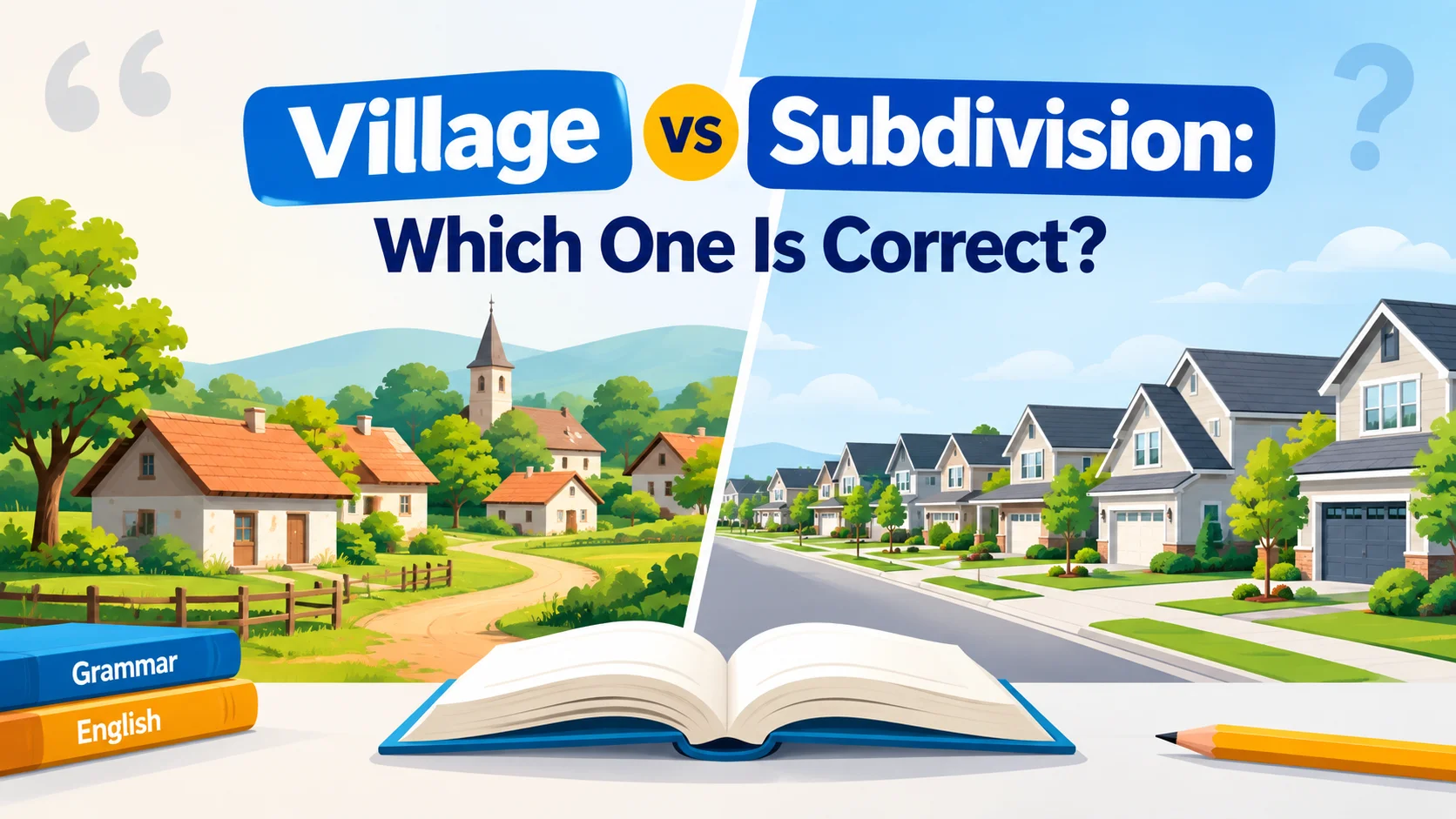
Village vs subdivision can be confusing because both words can describe places where people live, but they do not mean the same thing. A village generally refers to a settlement or community, while a subdivision usually refers to land that has been divided into separate parcels or a residential development created from that division. The important distinction is not simply about size or appearance. It is about what you are describing: the community itself, the settlement’s identity, or the way land has been divided and developed. Once that distinction is clear, choosing the right word becomes much easier.
The confusion becomes greater because everyday speech, real estate, and local government may use these terms differently. A place may be marketed as a village, function socially as a neighborhood, and legally form part of a subdivision. In another location, “village” may have a formal administrative meaning. That means there is no universal rule saying every village must look a certain way or every subdivision must have a particular population. Context and local terminology matter, especially when the word appears in property documents, addresses, planning information, or real-estate listings.
This guide explains village vs subdivision meaning, the difference between the two, how each develops, how they relate to neighborhoods and towns, and when the terms can overlap. You will also see practical sentence examples, real-estate situations, common mistakes, and a simple decision method for choosing the appropriate term. If you are wondering whether a particular place should be called a village or a subdivision, the answer starts with one question: Are you describing a community or a division of land?
Village vs Subdivision: The Quick Answer
Neither village nor subdivision is universally “the correct” word. They describe different concepts.
A village is generally a settlement or community, often smaller than a town or city. The exact definition varies by country and, in some cases, by local law.
A subdivision is generally connected to dividing land into separate lots or parcels, often for residential, commercial, or other development. In everyday real-estate language, it can also refer to the resulting development.
Here is the simplest distinction:
Village = a settlement or community.
Subdivision = land divided into lots or a development created from that division.
| Feature | Village | Subdivision |
| Main idea | Settlement or community | Division/development of land |
| Focus | People, place, and community | Lots, parcels, planning, and development |
| Can be historic? | Yes | Not necessarily |
| Can be planned? | Sometimes | Commonly |
| Can be residential? | Yes | Yes |
| Can exist in an urban area? | Yes | Yes |
| Legal definition | Varies by jurisdiction | Often connected to land-use regulations |
| Real-estate relevance | Describes a community/place | Describes property development or land division |
The two terms can describe the same general area from different perspectives, but they should not automatically be treated as synonyms.
What Does “Village” Mean?
Village Meaning in Everyday English
In ordinary English, a village is a relatively small settlement or community. The word often brings to mind a place where people live in a connected community with homes, roads, local businesses, and shared services.
Traditionally, villages were associated with rural areas and agriculture. A village might have developed around a church, market, crossroads, river, farm area, or other local center.
For example:
“She grew up in a small village surrounded by farmland.”
Here, village describes the settlement and community, not the legal arrangement of individual properties.
The word can also be used more broadly:
“The village has grown considerably over the past twenty years.”
That sentence focuses on the place as a community whose population and built environment have changed.
What Makes a Place a Village?
There is no single worldwide checklist that every village must satisfy. However, villages often share several characteristics:
- A relatively small settlement
- A recognizable local community
- Residential buildings
- Local roads and public spaces
- Shops, schools, religious buildings, or other services
- A distinct geographic or social identity
- A history of settlement or community development
Not every village has all of these features.
A modern village may have substantial infrastructure, internet access, modern housing, schools, businesses, and public transportation. Conversely, a small settlement may have very few services and still be described as a village.
Does “Village” Have a Legal Definition?
This is where writers need to be careful.
Village is not defined identically everywhere. Some countries or jurisdictions use the term as a formal administrative classification. Others use it mainly as a geographic or social description.
That means a sentence such as:
“A village must have fewer than 5,000 residents.”
should not be presented as a universal rule.
Population thresholds, administrative powers, boundaries, and official classifications can differ significantly from one place to another.
If you are writing about a specific location, use the local government’s terminology rather than assuming that a general dictionary definition determines its legal status.
Village Does Not Always Mean Rural
The traditional image of a village is rural, but modern development can complicate that picture.
A historic village may eventually become surrounded by:
- suburbs
- highways
- commercial districts
- apartment buildings
- expanding cities
The community may still be known as a village because of its history or official name.
Therefore, rural and village are not perfect synonyms.
A village can become increasingly urban while retaining its identity as a village.
What Does “Subdivision” Mean?
Subdivision Meaning in Real Estate and Land Use
In real estate and land-use planning, a subdivision generally involves dividing a larger parcel of land into smaller lots or parcels.
For example, imagine someone owns a large piece of undeveloped land. Instead of keeping it as one parcel, the land is divided into 80 individual residential lots. Roads and utilities may also be planned as part of the development.
That process and the resulting development may be described as a subdivision, depending on the jurisdiction and context.
The word therefore has a fundamentally different focus from village.
Village describes a settlement or community. Subdivision describes land division and development.
How a Residential Subdivision Is Created
The exact process varies according to local planning and property laws, but a typical residential subdivision may involve several stages:
- A developer acquires or controls a larger parcel.
- The land is surveyed.
- Proposed lots are designed.
- Roads and access points are planned.
- Utilities and drainage may be considered.
- Required planning or regulatory approvals are obtained.
- The land is divided into individual parcels.
- Homes or other buildings are developed on those lots.
The important point is that a subdivision has a land-planning dimension that is not required by the everyday meaning of village.
Subdivision Does Not Always Mean a Housing Development
In everyday conversation, people often associate subdivision with a neighborhood of newly built houses.
That is common, but the underlying concept is broader: subdivision involves dividing land into separate parcels.
Depending on local regulations and the situation, subdivision may relate to:
- residential lots
- commercial parcels
- industrial land
- mixed-use development
- agricultural parcels
- other forms of planned land division
So a subdivision should not automatically be defined as “a neighborhood of houses.”
What You Might See in a Subdivision
A residential subdivision may contain:
- Individual property lots
- Houses or planned building sites
- Internal roads
- Sidewalks
- Drainage infrastructure
- Utility networks
- Parks or shared spaces
- Community facilities
- Homeowners’ association arrangements
However, none of these features alone makes something a subdivision.
The defining idea is the organization and division of land into separate parcels or lots.
Village vs Subdivision: The Core Difference
The easiest way to understand the distinction is to change the question you are asking.
If your question is:
“What kind of community is this?”
Village may be the appropriate term.
If your question is:
“How was this land divided and developed?”
Subdivision may be the appropriate term.
A Village Is Primarily a Community or Settlement
A village describes a place where people live as a community.
Its identity may come from:
- history
- geography
- culture
- local institutions
- residents
- traditions
- administrative status
The way individual property boundaries were created may be secondary to the meaning of the word.
A Subdivision Is Primarily About Land Division and Development
A subdivision focuses on property structure and development.
The relevant questions are often:
- How many lots were created?
- Where are the property boundaries?
- How are roads arranged?
- What development rules apply?
- How are utilities provided?
- What approvals were required?
This is why the term appears frequently in planning, surveying, property, construction, and real-estate contexts.
Why They Are Not Synonyms
Calling a community a village does not necessarily tell you how its land was divided.
Calling a development a subdivision does not necessarily tell you anything about its historical or social identity.
A single area can therefore be described differently depending on the question being answered.
For example:
“The village has a population of about 2,000.”
This describes the community.
“The subdivision contains 150 residential lots.”
This describes the property development.
Both statements could potentially concern nearby or overlapping areas without being contradictory.
Village vs Subdivision: Detailed Comparison
| Category | Village | Subdivision |
| Primary concept | Community or settlement | Land division/development |
| Main perspective | Geographic/social | Property/planning |
| Historical development | Often gradual, but not always | Often associated with planned development |
| Land division | Not defining | Central to the concept |
| Community identity | Usually important | May develop later |
| Legal status | Depends on jurisdiction | Depends on local land-use rules |
| Housing | May be varied and developed over generations | Often planned around individual lots |
| Roads | May have evolved over time | Often incorporated into development planning |
| Real-estate documents | May identify location | May identify development or parcel structure |
| Name | May be geographic, historical, or official | May be official, descriptive, or commercial |
| Rural or urban | Either | Either |
| Neighborhood relationship | Can contain neighborhoods | Can function as a neighborhood |
How Villages and Subdivisions Are Created
How Villages Typically Develop
Historically, villages often formed gradually.
A settlement might grow around:
- agricultural activity
- a water source
- a road intersection
- a religious institution
- a market
- a transportation route
- local industry
Over time, homes and businesses could develop around the original settlement.
Not every village follows this pattern, but it explains why village often carries a stronger sense of community history than subdivision.
How Subdivisions Typically Develop
Subdivisions are more closely associated with deliberate land planning.
A developer or landowner may begin with one large tract and create a planned arrangement of smaller parcels.
The resulting community may have a very organized layout, with:
- standardized lots
- planned streets
- utility corridors
- building restrictions
- common amenities
That does not mean every subdivision looks modern or identical. Older subdivisions can change significantly over time.
Planned Village vs Planned Subdivision
The word village can also appear in modern planned developments.
A developer might create a community designed around:
- walkability
- a central gathering space
- shops
- smaller streets
- clustered housing
- shared amenities
Such a development may intentionally feel like a traditional village.
That does not automatically make it a legally recognized village.
The appearance or marketing of a place and its formal classification are separate questions.
Village vs Neighborhood vs Subdivision
These three terms are often mixed together, but they answer different questions.
What Is a Neighborhood?
A neighborhood is generally an area where people live that has some geographic or social identity.
It does not necessarily need to have formal legal boundaries.
People might identify a neighborhood because of:
- location
- streets
- schools
- community identity
- historical development
- local usage
A neighborhood can exist inside a city, town, village, or subdivision.
Village vs Neighborhood
A village is generally understood as a settlement or community, while a neighborhood is an area within or associated with a larger settlement.
For example:
“The village has three neighborhoods.”
That sentence is perfectly possible.
The village is the broader community; the neighborhoods are smaller areas within it.
Neighborhood vs Subdivision
A subdivision can function as a neighborhood, but the concepts are not identical.
For example, residents might say:
“I live in the Oak Ridge neighborhood.”
Property records might identify the same area as:
“Oak Ridge Subdivision.”
The first describes community identity. The second describes property/development structure.
Village vs Town vs Subdivision
A town and a village are generally settlement concepts, although their legal definitions differ across jurisdictions.
A subdivision, by contrast, is primarily a land-use or property concept.
This is why comparing village and subdivision purely by population can be misleading. A subdivision does not become a village simply because it contains enough houses.
Can a Subdivision Be Called a Village?
Yes, but context matters.
A subdivision might be given a name containing the word Village, such as “Greenfield Village” or “Oak Village.” That does not necessarily mean the development has the legal status of a village.
When the Terms Can Overlap
There are several situations where both concepts may appear naturally.
A subdivision may:
- be located within a village
- be located near a village
- become known informally as a community
- use “Village” as part of its name
- be designed around village-style architecture
- develop a strong local identity
In those cases, the words describe different aspects of the place.
When They Should Not Be Treated as the Same
Be especially precise when discussing:
- property deeds
- land surveys
- planning applications
- zoning
- parcel boundaries
- government records
- development approvals
In these contexts, a property’s formal legal classification matters more than what residents or developers casually call it.
A development’s name does not necessarily determine its legal status.
Why Real Estate Makes the Difference More Confusing
Real estate is one of the biggest reasons people encounter village and subdivision in overlapping contexts.
Developers Use “Village” as a Development Name
Words such as village, park, gardens, heights, and estates are often used in names for residential developments.
A name can communicate an intended atmosphere without describing a legal category.
For example:
“Sunrise Village”
could simply be the name of a residential development.
The name alone does not tell you whether local authorities legally classify it as a village.
“Subdivision” Can Sound More Technical
Subdivision is a technical-sounding word because it frequently appears in planning and property contexts.
A real-estate listing might say:
“Located in a quiet subdivision.”
That tells the reader something about the property’s development context.
It does not necessarily tell them whether the surrounding area is rural, urban, historic, or socially close-knit.
Official Name vs Legal Classification
This distinction is particularly important:
Name: What people or developers call a place.
Classification: How a government, planning authority, or property record officially identifies it.
These can sometimes be different.
If accuracy matters, don’t infer legal status from a marketing name.
How to Use “Village” and “Subdivision” Correctly
When to Use “Village”
Choose village when you are describing:
- A settlement
- A small community
- A geographic place
- A traditional settlement
- A recognized village
- A community commonly known by that term
Examples:
“The village has a small market near the main road.”
“They moved to a coastal village.”
“The historic village attracts visitors every year.”
When to Use “Subdivision”
Choose subdivision when you are describing:
- Divided land
- Residential lots
- A planned property development
- Land-use planning
- Parcel arrangements
- A development recorded or described as a subdivision
Examples:
“The developer submitted plans for a new subdivision.”
“The subdivision contains 85 residential lots.”
“The house is located in a recently developed subdivision.”
Examples That Show the Difference
| Sentence | Correct term | Why |
| “They moved to a small ___ surrounded by farmland.” | village | The sentence describes a settlement. |
| “The developer created 100 lots in the new ___.” | subdivision | The focus is land division. |
| “The ___ has a historic market square.” | village | The focus is community/place identity. |
| “The property is located in the Oak Ridge ___.” | subdivision | The development is being identified. |
| “The ___ grew around an old railway station.” | village | The sentence describes settlement development. |
| “The survey shows the boundaries of each lot in the ___.” | subdivision | The focus is parcels and land records. |
Common Mistakes When Comparing Village and Subdivision
Mistake: Assuming “Village” Always Means Rural
A village can be rural, suburban, or surrounded by urban development.
Better approach: Look at the actual geographic and administrative context.
Mistake: Assuming Every Subdivision Is a Neighborhood
A subdivision may function as a neighborhood, but neighborhood is a broader social and geographic term.
Better approach: Use subdivision when the land-development aspect matters.
Mistake: Treating “Village” as a Universal Legal Category
Different jurisdictions can define settlements differently.
Better approach: When discussing official status, consult the terminology used by the relevant local authority.
Mistake: Assuming a Name Reveals Legal Status
A place called “Village” may simply have “Village” in its name.
Better approach: Separate branding or common usage from formal classification.
Mistake: Choosing the Word Based Only on Size
People sometimes assume:
small = village
large = subdivision
That is not a reliable distinction.
A subdivision can be small or enormous, while a village can vary considerably in population and physical size.
The concepts are fundamentally different rather than simply different points on a size scale.
When the Difference Gets Blurry
A Historic Village Surrounded by a City
Urban expansion can transform the setting around a village.
A once-rural settlement might eventually be surrounded by:
- shopping centers
- apartment complexes
- major roads
- office buildings
- suburban housing
It can still retain the name and identity of a village.
A Modern Development Designed to Feel Like a Village
Some planned communities deliberately use village-like features:
- central public spaces
- pedestrian paths
- small-scale storefronts
- clustered buildings
- traditional architectural styles
This creates a village-like environment, but appearance alone does not establish legal status.
A Subdivision That Becomes a Recognized Community
A subdivision may initially be nothing more than a planned property development.
Over time, residents can create:
- community organizations
- social traditions
- local events
- shared identity
- informal boundaries
At that point, the area may function socially as a community or neighborhood even though its property classification remains a subdivision.
This is why social identity and legal land classification should not be confused.
Village vs Subdivision in Real Estate
What Buyers Should Look For
If you are evaluating a property, don’t rely solely on whether the listing describes the area as a village, community, or subdivision.
Look for:
- The legal property description
- Lot or parcel information
- Survey documents
- Zoning information
- Planning records
- Development restrictions
- Homeowners’ association documents, if applicable
- Local government terminology
The exact documents and terminology will depend on the jurisdiction.
Why the Distinction Matters in Property Documents
In casual conversation, saying “I live in the village” may be perfectly clear.
A legal document requires much greater precision.
Property records need to identify land through recognized descriptions, parcel numbers, lot numbers, boundaries, or other official identifiers.
That is why a real-estate professional may use subdivision in one sentence and village in another without contradicting themselves.
Why Listing Language Can Differ From Legal Language
A property listing is designed to communicate quickly with potential buyers.
Legal and planning documents have a different purpose.
For example, a listing might promote:
“A beautiful home in Green Valley Village.”
The official records might identify the property as:
“Lot 42, Green Valley Subdivision.”
There is no necessary contradiction. One is describing the development’s public-facing identity, while the other provides a formal property description.
Village vs Subdivision: Which Word Should You Use?
Use this decision guide when you’re unsure.
| What are you describing? | Best term |
| A small established settlement | Village |
| A community’s identity | Village |
| A traditional settlement | Village |
| A rural community | Village |
| Divided parcels of land | Subdivision |
| Residential lots | Subdivision |
| A planned property development | Subdivision |
| Land-development process | Subdivision |
| An official local designation | Use the jurisdiction’s terminology |
| A development’s marketing name | Use its established name |
| A property record | Use the formal legal description |
The most reliable approach is to identify what aspect of the place your sentence is emphasizing.
If you’re talking about people, history, community, or settlement, village may be appropriate.
If you’re talking about parcels, lots, development, surveying, or planning, subdivision is usually more precise.
A Simple Way to Remember Village vs Subdivision
Think “People and Place” for Village
A village is primarily about where a community exists.
Think:
Village → settlement → people → community
Think “Parcels and Planning” for Subdivision
A subdivision is primarily about how land has been divided or developed.
Think:
Subdivision → land → lots → development
Use the Three-Question Test
When choosing between the terms, ask:
- Am I describing a settlement or community?
- Am I describing divided land or a planned development?
- Am I referring to a formal legal or administrative classification?
- If the answer to the first question is yes, village may fit.
- If the second is yes, subdivision is likely the better term.
- If the third is yes, don’t guess. Use the terminology officially recognized in that jurisdiction.
Quick rule: A village describes a community or settlement; a subdivision describes land division or development.
Conclusion
Understanding village vs subdivision becomes straightforward when you focus on what each word is actually describing. A village generally identifies a settlement, community, or geographic place, while a subdivision is primarily concerned with the division and development of land into separate parcels or lots. The two can overlap in everyday conversation, especially when a planned development uses “Village” in its name or gradually develops its own community identity. One final actionable tip: before choosing either term, ask whether your sentence is about the people and settlement or the property and land development. Then check the local terminology if the statement has a legal or administrative purpose. A common mistake to avoid is assuming that a place’s name tells you its official status. A development can be called a village without legally being one. In precise writing, context beats appearance, and official classification beats marketing language.
Frequently Asked Questions
Q1. Is a village the same as a subdivision?
No. A village generally refers to a settlement or community, while a subdivision generally refers to land divided into separate lots or a development created through that process. One area can potentially be described using both terms when they refer to different aspects of the same place.
Q2. Can a subdivision be called a village?
Yes, informally or as part of an official development name. However, calling a subdivision “Village” does not automatically give it legal village status. For property, planning, or government purposes, the relevant jurisdiction’s official classification should be used.
Q3. What is the difference between a village, neighborhood, and subdivision?
A village is generally a settlement or community. A neighborhood is an identifiable residential area, often defined socially or geographically. A subdivision is primarily associated with the division and development of land into separate parcels or lots.
Q4. Is a subdivision always a residential area?
No. Although people commonly use subdivision when discussing housing developments, land subdivision can also involve commercial, industrial, agricultural, or mixed-use parcels. The exact meaning and regulatory definition depend on the relevant land-use system.
Q5. Does “village” have a legal definition?
Sometimes. Some jurisdictions formally recognize villages as administrative units, while others use the word primarily as a geographic or community description. Because definitions vary, a general dictionary definition should not be treated as a universal legal standard.
