Comprable vs Comparable is a spelling question that confuses many English learners, students, professionals, and even native speakers. Since both words look similar and sound almost identical in everyday speech, it’s easy to assume they’re interchangeable. However, only one spelling is accepted in standard English. Choosing the wrong form can make your writing appear less polished, especially in academic papers, business reports, professional emails, and published content. Understanding the difference helps you communicate more clearly and confidently.
English spelling isn’t always intuitive. Many words contain silent letters, unexpected vowel patterns, or endings that don’t match their pronunciation. Comparable is one such word. It’s widely used in business, education, finance, research, and everyday conversations whenever two or more things share enough similarities to be fairly compared. Because it appears so frequently in professional writing, mastering its spelling and usage is an important step toward improving your English.
In this guide, you’ll learn which spelling is correct, why people mistakenly write comprable, what comparable actually means, and how to use it naturally in different contexts. You’ll also discover practical examples, comparison tables, common mistakes, memory tricks, and real-world usage that will help you avoid this spelling error permanently.
Comprable vs Comparable: The Quick Answer
Which spelling is correct?
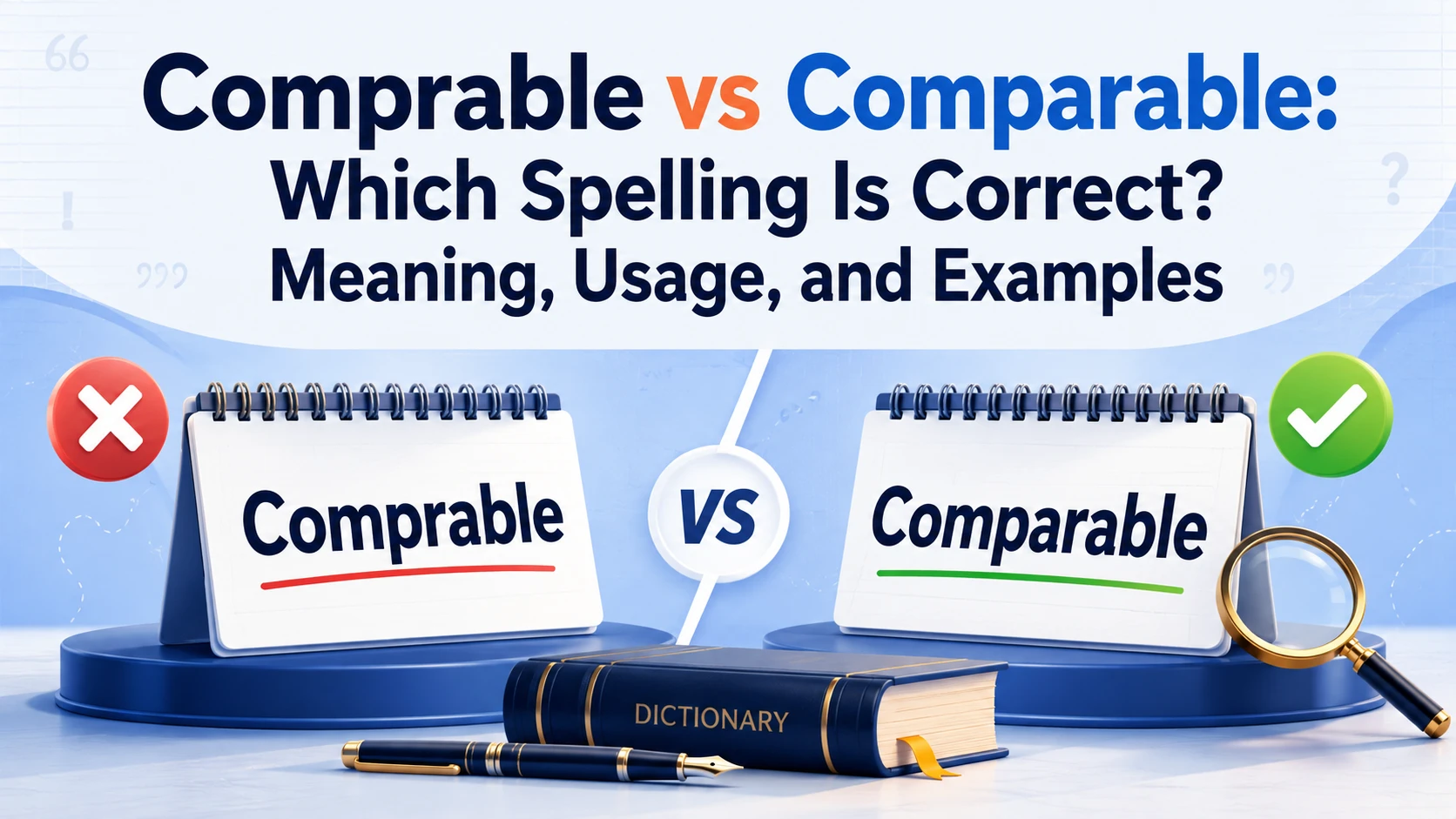
The correct spelling is comparable.
Comparable is a standard English adjective that means able to be compared or similar enough to another person, object, or situation to allow a meaningful comparison.
The spelling comprable is incorrect and should not be used in formal or informal English writing.
Quick answer:
- ✅ Comparable = Correct
- ❌ Comprable = Incorrect
Is comprable a real word?
No.
Comprable is not recognized by major English dictionaries as a standard English word. It is simply a spelling mistake that occurs when writers accidentally omit the second “a” in comparable.
Although you may occasionally encounter comprable in blog posts, online comments, discussion forums, or social media, these examples reflect user errors rather than accepted English usage.
Why people confuse comprable and comparable
Several factors contribute to this common mistake.
The biggest reason is pronunciation. In natural speech, the middle vowel often receives very little stress, making comparable sound shorter than it is.
Fast typing also plays a role. Writers frequently skip one vowel without noticing, producing comprable instead of comparable.
Finally, repeated exposure to incorrect spellings online causes some people to believe both forms are acceptable, even though dictionaries consistently recognize only comparable.
A simple rule to remember the correct spelling
Think about the base word:
Compare → Comparable
If you can clearly see the complete word compare inside comparable, you’ve almost certainly spelled it correctly.
A simple memory tip is:
If it comes from “compare,” it must keep the “a” before “-able.”
Comprable vs Comparable at a Glance
Side-by-side comparison
| Feature | Comparable | Comprable |
| Correct English spelling | ✅ Yes | ❌ No |
| Dictionary entry | Yes | No |
| Part of speech | Adjective | Not recognized |
| Meaning | Able to be compared | Misspelling of comparable |
| Accepted in formal writing | Yes | No |
| Common usage | Business, education, research, everyday English | Typing and spelling errors |
Correct spelling
The only accepted spelling in standard English is comparable.
Meaning
Comparable describes two or more things that share enough similarities to be fairly compared.
Part of speech
Comparable functions as an adjective.
Dictionary status
Major dictionaries recognize comparable, while comprable does not appear as a standard English entry.
Common usage
You’ll commonly find comparable in business reports, academic writing, financial analysis, scientific research, product reviews, and everyday communication.
Example sentence
- The two laptops offer comparable performance at similar prices.
- Both candidates have comparable qualifications for the position.
- These apartments are comparable in size and location.
What Does Comparable Mean?
Definition and pronunciation
Comparable means capable of being compared or similar enough to another person or thing to allow a meaningful comparison.
Pronunciation
- American English: KOM-puh-ruh-buhl or kuhm-PAIR-uh-buhl
- British English: Similar pronunciation with slight regional variation.
Word origin and etymology
The adjective comparable comes from the verb compare, which traces back to the Latin comparare, meaning to examine side by side, to match, or to evaluate similarities.
The suffix -able means capable of or worthy of.
Together, the word literally means:
Capable of being compared.
How comparable is used in everyday English
Comparing quality
Businesses often compare products or services based on quality.
Examples
- Both brands offer comparable customer service.
- The two smartphones have comparable camera quality.
Comparing size or value
The word is frequently used when discussing measurements, prices, salaries, or market value.
Examples
- The homes have comparable market prices.
- Their salaries are comparable despite different job titles.
Comparing performance or results
Researchers, teachers, employers, and analysts regularly use comparable when discussing outcomes.
Examples
- Both studies produced comparable results.
- The athletes delivered comparable performances during the competition.
Common collocations with comparable
Some of the most natural word combinations include:
- Comparable quality
- Comparable value
- Comparable products
- Comparable prices
- Comparable experience
- Comparable performance
- Comparable evidence
- Comparable results
- Comparable qualifications
- Comparable standards
Is Comprable a Real Word?
One of the biggest reasons people search for “comprable vs comparable” is to find out whether comprable is an accepted English word. Since the spelling appears in emails, online forums, social media posts, and even business documents, it’s understandable why many writers assume it might be a legitimate alternative.
The short answer is no. Comparable is the only standard spelling recognized in modern English. Comprable is simply a spelling mistake that has become common because of typing habits and pronunciation.
Why comprable is considered a misspelling
The adjective comparable comes directly from the verb compare. When English forms adjectives by adding the suffix -able, the spelling of the base word is generally preserved.
For example:
- Compare → Comparable
- Predict → Predictable
- Depend → Dependable
- Value → Valuable
Following this pattern, compare naturally becomes comparable, not comprable.
Since comprable breaks this standard spelling pattern, dictionaries and style guides classify it as a misspelling rather than an accepted word.
How the spelling mistake happens
Although comprable isn’t correct, the mistake is easy to understand.
Several factors contribute to it:
- Writers accidentally omit the second “a” while typing.
- The middle vowel receives little emphasis in normal pronunciation.
- Long words are more likely to lose letters during fast typing.
- People rely on memory instead of recognizing the base word compare.
- Repeated exposure to incorrect spellings online reinforces the mistake.
This combination explains why comprable appears surprisingly often despite being incorrect.
Expert Tip: Whenever you’re unsure about the spelling, identify the root word first. If the base word is compare, the adjective must remain comparable.
Does any dictionary recognize comprable?
No reputable English dictionary lists comprable as a standard word.
Major dictionaries consistently recognize only comparable, including:
- Merriam-Webster
- Cambridge Dictionary
- Oxford English Dictionary
- Collins Dictionary
- Dictionary.com
If you search for comprable, most dictionaries either:
- Return no result,
- Suggest comparable, or
- Redirect you to the correct spelling.
This consistency across dictionaries is a strong indication that comparable is the only accepted form.
When you might still see comprable online
Even though it’s incorrect, comprable appears in many places across the internet.
You may encounter it in:
- Blog comments
- Social media posts
- Online marketplaces
- Draft business documents
- Student assignments
- Discussion forums
- User-generated content
Its appearance doesn’t make it correct. It simply reflects the fact that spelling mistakes spread quickly online.
Always treat comprable as an error that should be corrected before publishing or submitting your writing.
Comprable vs Comparable: What’s the Difference?
Although the two spellings differ by only one letter, there’s an important distinction between them.
The difference isn’t about meaning—it’s about correctness.
Difference in spelling
The most obvious difference is the missing letter.
- ✅ Comparable
- ❌ Comprable
The extra “a” isn’t optional. It’s part of the standard spelling because the word comes directly from compare.
Difference in meaning
Interestingly, there’s no difference in intended meaning.
People who write comprable almost always intend to write comparable.
The problem is that one spelling is correct while the other isn’t.
For example:
Incorrect:
- The products are comprable in quality.
Correct:
- The products are comparable in quality.
The meaning stays exactly the same, but only the corrected sentence follows standard English.
Difference in dictionary recognition
This is where the distinction becomes definitive.
| Feature | Comparable | Comprable |
| Listed in dictionaries | ✅ Yes | ❌ No |
| Accepted in formal writing | ✅ Yes | ❌ No |
| Used by professional editors | ✅ Yes | ❌ No |
| Recommended by grammar guides | ✅ Yes | ❌ No |
If a word doesn’t appear in standard dictionaries, it shouldn’t appear in polished writing.
Why only one spelling is accepted in standard English
English spelling follows historical patterns that aren’t always obvious from pronunciation alone.
Because comparable developed from the verb compare, its spelling became standardized centuries ago.
Publishing houses, universities, businesses, newspapers, and professional editors all follow that standardized spelling.
Using comprable instead of comparable may seem like a minor mistake, but it can affect:
- Academic grades
- Professional credibility
- Business communication
- Published content
- SEO quality
- Reader trust
That’s why careful writers consistently use comparable.
When Should You Use Comparable?
Knowing that comparable is the correct spelling is only part of the story. Equally important is understanding when the word is appropriate.
Use comparable whenever two or more things share enough characteristics to allow a meaningful comparison. The comparison doesn’t require them to be identical—it simply requires sufficient similarity.
Comparing products and services
One of the most common uses of comparable is in product comparisons.
Consumers frequently evaluate:
- Features
- Quality
- Performance
- Durability
- Customer support
- Overall value
Examples
- Both laptops offer comparable battery life.
- The streaming services provide comparable content libraries.
- These smartphones deliver comparable camera quality despite different prices.
Here, the products aren’t identical, but they share enough characteristics for comparison.
Comparing prices, costs, and value
Businesses and consumers often compare financial information.
Comparable helps describe items with similar economic value.
Examples
- The two houses sold for comparable prices.
- Their consulting fees are comparable.
- Several retailers offer comparable discounts during the holiday season.
- The vehicles have comparable maintenance costs.
This usage is especially common in real estate, retail, insurance, and finance.
Comparing people, skills, or achievements
The adjective also works well when discussing individuals.
Examples include:
- qualifications
- experience
- abilities
- accomplishments
- education
Examples
- Both candidates have comparable experience.
- Their leadership skills are comparable.
- The athletes achieved comparable results throughout the season.
- The universities maintain comparable academic standards.
Notice that comparable suggests fairness rather than complete equality.
Comparing data, research, and statistics
Researchers frequently use comparable when evaluating evidence.
Examples include:
- survey results
- scientific studies
- laboratory findings
- statistical analyses
- economic reports
Examples
- The studies produced comparable findings.
- Researchers collected comparable datasets.
- Both experiments generated comparable outcomes.
- Analysts examined comparable financial reports before reaching conclusions.
In research writing, comparable indicates that information can be evaluated consistently.
Comparing businesses, markets, and financial performance
In business and finance, comparable is one of the most frequently used descriptive adjectives.
Professionals compare:
- revenue
- profits
- expenses
- investments
- market performance
- business growth
Examples
- The companies reported comparable quarterly earnings.
- Investors reviewed comparable market data.
- The firms operate in comparable industries.
- Analysts identified several comparable transactions before estimating the company’s value.
This usage is particularly common in accounting, investment analysis, mergers, acquisitions, and business valuation.
Correct sentence examples
The following examples show how naturally comparable fits into everyday English.
- The hotels offer comparable amenities.
- Their salaries are comparable despite different positions.
- Both textbooks provide comparable explanations.
- The software packages include comparable security features.
- Researchers reached comparable conclusions independently.
- These neighborhoods have comparable property values.
- The two hospitals provide comparable levels of patient care.
- Although their teaching styles differ, their classroom results are comparable.
These examples demonstrate that comparable is a versatile adjective used across education, business, science, technology, finance, healthcare, and everyday communication.
Comparable vs Similar vs Equal vs Equivalent
Many writers use comparable, similar, equal, and equivalent as if they mean the same thing. While they all describe relationships between two or more things, each word has a distinct meaning. Choosing the right one makes your writing more precise and professional.
Comparable vs Similar
These two words overlap, but they aren’t interchangeable in every situation.
Comparable means two things are similar enough to allow a fair comparison. They may differ in many ways but still share important characteristics.
Similar simply means two things resemble each other. It doesn’t necessarily imply that comparing them is useful or meaningful.
| Comparable | Similar |
| Means capable of being compared | Means resembling each other |
| Focuses on making a comparison | Focuses on likeness |
| Common in business, finance, research, and education | Common in everyday conversation |
| Doesn’t mean identical | Doesn’t mean identical |
Examples
- The two smartphones offer comparable performance.
- The twins look similar, but their personalities are very different.
- These insurance plans have comparable coverage.
- Their handwriting is remarkably similar.
Comparable vs Equal
People often confuse comparable with equal, especially when discussing value or quality.
Equal means exactly the same in amount, size, number, or value.
Comparable means close enough to compare but not necessarily identical.
| Comparable | Equal |
| Similar in important ways | Exactly the same |
| Allows comparison | Indicates complete equality |
| May contain differences | No meaningful difference |
Examples
- The two houses are comparable in value, but one has a larger yard.
- Both employees receive equal pay for the same work.
- Their qualifications are comparable, although one has more experience.
- Each team scored an equal number of points.
Comparable vs Equivalent
These words are closely related but still differ.
Equivalent means two things have the same function, value, effect, or purpose even if they look different.
Comparable simply means they can reasonably be compared.
| Comparable | Equivalent |
| Suitable for comparison | Essentially equal in function or value |
| Doesn’t require identical results | Often implies interchangeability |
| Broader meaning | More specific meaning |
Examples
- The software packages have comparable features.
- This generic medicine is equivalent to the brand-name version.
- Their experiences are comparable, but not identical.
- One liter is approximately equivalent to 1.0567 U.S. liquid quarts.
Which word should you choose?
Use this quick guide.
| If you want to express… | Best word |
| Things can fairly be compared | Comparable |
| Things resemble each other | Similar |
| Things are exactly the same | Equal |
| Things have the same value or function | Equivalent |
Choosing the most accurate word improves clarity and prevents misunderstandings.
Common Collocations with Comparable
Native English speakers frequently pair comparable with certain nouns. Learning these natural combinations makes your writing sound more fluent.
Business and finance
Common collocations include:
- Comparable sales
- Comparable revenue
- Comparable earnings
- Comparable market value
- Comparable assets
- Comparable companies
- Comparable pricing
- Comparable investments
Examples
- Analysts reviewed comparable sales before preparing the report.
- Investors compared several comparable companies within the industry.
Education and research
You’ll often see comparable in academic writing.
Common phrases include:
- Comparable results
- Comparable studies
- Comparable evidence
- Comparable findings
- Comparable data
- Comparable samples
Examples
- Both experiments produced comparable results.
- Researchers collected comparable data from each participant.
Everyday English
Outside professional settings, these combinations are common.
- Comparable quality
- Comparable performance
- Comparable experience
- Comparable size
- Comparable standards
- Comparable products
- Comparable services
- Comparable opportunities
Examples
- The restaurants provide comparable service.
- Both vehicles deliver comparable performance.
Common verb combinations
You’ll frequently see comparable used with these verbs:
- be comparable to
- remain comparable
- become comparable
- appear comparable
- make something comparable
Examples
- Their salaries are comparable to industry averages.
- The updated data is now comparable across all departments.
- Standardized testing helps make results comparable.
Learning these combinations helps your writing sound more natural than simply memorizing the definition.
Common Mistakes to Avoid
Although comparable is straightforward once you know the spelling, several mistakes appear regularly in student writing, business communication, and online content.
Mistake 1: Writing comprable
This is by far the most common error.
❌ The products are comprable in quality.
✅ The products are comparable in quality.
Always remember that the adjective comes from compare.
Mistake 2: Assuming comparable means identical
Many writers mistakenly believe comparable means “exactly the same.”
That’s incorrect.
Comparable things have enough similarities to compare fairly, but they often differ in important ways.
Example
- Two cars may have comparable fuel efficiency while offering completely different safety features.
Mistake 3: Using comparable when no comparison exists
Don’t use comparable unless at least two things are being evaluated.
❌ Her presentation was comparable.
✅ Her presentation was comparable to last year’s award-winning presentation.
The comparison should be clear from the sentence or surrounding context.
Mistake 4: Confusing comparable with comparative
These words belong to different parts of speech.
Comparable is an adjective describing something that can be compared.
Comparative usually refers to comparisons in grammar, language, or analytical studies.
Examples
- These products are comparable.
- English uses the comparative form “faster.”
Mistake 5: Overusing comparable
Instead of repeating comparable throughout your writing, vary your vocabulary where appropriate.
Alternative words include:
- similar
- equivalent
- alike
- consistent
- corresponding
- parallel
- closely matched
Easy Ways to Remember the Correct Spelling
Even after learning that comparable is the correct spelling, it’s normal to second-guess yourself while writing. Fortunately, a few simple memory techniques can help you remember the word correctly every time.
Remember the root word: Compare
The easiest trick is to start with the verb compare.
Since comparable comes directly from compare, the spelling keeps the “a” before the -able ending.
Think of it like this:
Compare → Comparable
If you can’t clearly see compare inside the word, you’ve probably misspelled it.
Break the word into smaller parts
Long words become easier to spell when you divide them into meaningful pieces.
Comparable
→ Compare + able
This method is much easier than trying to memorize the entire word as one long sequence of letters.
Think about the meaning
Instead of memorizing letters, connect the spelling with its meaning.
Ask yourself:
Can these things be compared?
If the answer is yes, the correct adjective is comparable.
This mental connection strengthens both your spelling and vocabulary.
Watch for spell-check warnings
Modern writing tools often detect comprable immediately.
However, don’t rely entirely on spell check.
Developing the habit of proofreading helps you catch spelling errors that automated tools occasionally miss.
Memory Tip: Whenever you write comparable, pause for one second and ask yourself, “Can I still see the word compare?” If yes, you’ve almost certainly spelled it correctly.
Practice Exercises
Test your understanding before moving on. These short exercises reinforce the correct spelling and usage.
Exercise 1: Choose the correct spelling
Select the correct word.
- The two hotels offer ________ services.
- a) Comprable
- b) Comparable
- Their qualifications are ________.
- a) Comparable
- b) Comprable
- These products are not directly ________ because they serve different markets.
- a) Comparable
- b) Comprable
Answers
- Comparable
- Comparable
- Comparable
Exercise 2: Correct the sentence
Rewrite each sentence using the correct spelling.
- The houses have comprable values.
- Both candidates have comprable experience.
- We found several comprable products online.
Correct Answers
- The houses have comparable values.
- Both candidates have comparable experience.
- We found several comparable products online.
Exercise 3: Fill in the blank
Complete each sentence with comparable, similar, equal, or equivalent.
- The two laptops have ________ battery life.
- Both workers receive ________ pay.
- These medicines are medically ________.
- Their writing styles are very ________.
Suggested Answers
- Comparable
- Equal
- Equivalent
- Similar
Quick Checklist Before You Use “Comparable”
Use this checklist whenever you’re unsure.
| Question | Yes |
| Am I comparing two or more things? | ✅ |
| Did I spell it comparable? | ✅ |
| Does it come from comparison? | ✅ |
| Would another word like equal or similar be more accurate? | ✅ |
| Have I proofread the sentence? | ✅ |
If you answered yes to these questions, you’re likely using the word correctly.
Conclusion
Understanding the difference between comprable vs comparable is simpler than it first appears. Comparable is the only correct spelling in standard English, while comprable is a common misspelling that should be avoided in academic, professional, and everyday writing. Remember that comparable comes directly from compare, making its spelling much easier to recall. Also, choose related words such as similar, equal, or equivalent only when they accurately express your intended meaning. One final actionable tip: proofread important documents by checking whether the word still contains compare before the -able ending. A common mistake to avoid is assuming that frequent online usage makes comprable acceptable—it doesn’t. Consistently using comparable will make your writing clearer, more credible, and more professional.
Frequently Asked Questions
Q1. Is comprable ever considered correct?
No. Comprable is a misspelling of comparable. It isn’t recognized by standard English dictionaries or style guides. Whether you’re writing an email, essay, report, or article, always use comparable to maintain accuracy and professionalism.
Q2. Why do so many people spell comparable words incorrectly?
The mistake usually happens because the word is pronounced quickly, making one vowel less noticeable. Others accidentally omit the second “a” while typing. Remembering the base word comparison is the easiest way to avoid this common spelling error.
Q3. Can comparable describe things that aren’t exactly the same?
Yes. Comparable doesn’t mean identical. It means two or more things are similar enough to be fairly compared. They may still differ in design, quality, size, or performance while remaining comparable in important ways.
Q4. Is the spelling different in British and American English?
No. Both British English and American English use the same spelling: comparable. Unlike words such as colour/color or centre/center, there is no regional spelling variation for this adjective.
Q5. What words can I use instead of comparable?
Depending on the context, you can use similar, equivalent, parallel, corresponding, alike, or equal. However, these words aren’t perfect substitutes, so choose the one that best matches your intended meaning rather than replacing comparable automatically.
