
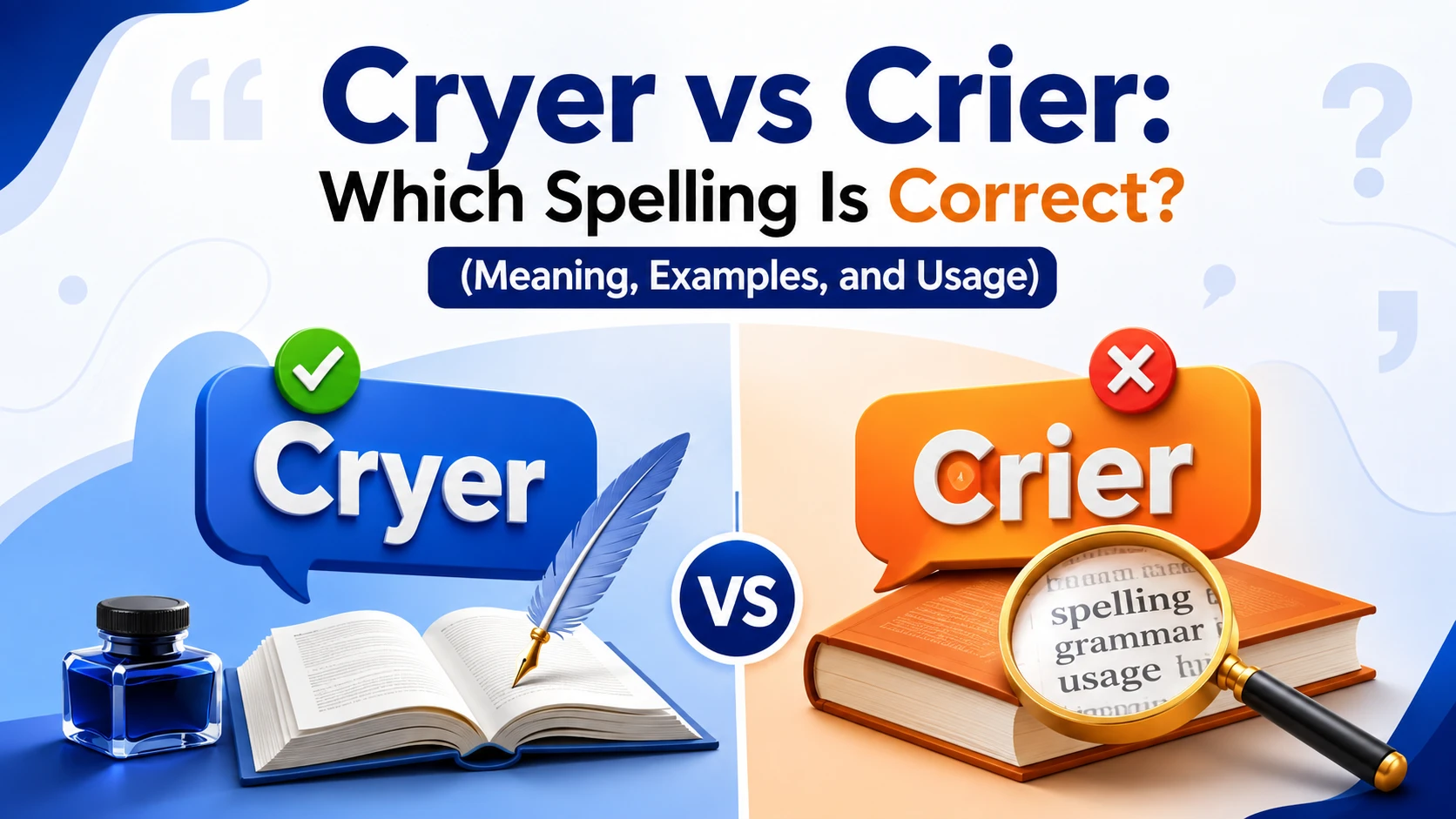
Cryer vs crier is a spelling confusion that catches many English learners and even native speakers. At first glance, both words appear plausible because English has many nouns ending in -er, such as teacher, writer, and runner. However, this pair doesn’t follow that pattern. In standard English, crier is the correct spelling for a person who cries or someone who publicly announces news, while Cryer is usually found as a surname or proper noun. Understanding this distinction helps you write more accurately and avoid one of English’s lesser-known spelling traps.
The confusion also arises because both words are pronounced almost identically. You may come across Cryer in newspaper articles, movie credits, business names, or legal documents, leading you to believe it’s an acceptable alternative spelling. In reality, context is everything. Whether you’re describing a town crier, an emotional child who is a crier, or referring to someone named Jon Cryer, choosing the correct spelling depends entirely on whether you’re using a common noun or a proper name.
In this guide, you’ll learn the difference between cryer and crier, discover their meanings, explore their history and grammar, compare their usage in modern English, and see practical examples from everyday writing. You’ll also learn when Cryer is correct, why crier remains the accepted dictionary spelling, common mistakes writers make, and simple techniques to remember the difference every time.
Key Takeaway
Crier is the correct standard English spelling for a person who cries or publicly announces information. Cryer is generally a surname or proper noun, not the standard spelling of the common noun.
Cryer vs Crier: The Short Answer
If you’re writing standard English, crier is almost always the correct choice.
Use crier when referring to:
- A person who cries easily
- A town crier
- A public announcer
- A court official who makes announcements
- Someone who proclaims news or information
Use Cryer only when referring to:
- A person’s last name
- A company, organization, or place with that name
- Official records where the spelling is part of a proper noun
Which Spelling Is Correct in Standard English?
Modern English dictionaries recognize crier as the standard noun.
Examples
- She has always been a crier during emotional films.
- The town crier announced the royal proclamation.
- Every court crier followed a formal ceremony before proceedings began.
Outside of proper names, replacing crier with cryer is generally considered a spelling error.
When Should You Use a Crier?
Use crier whenever you’re referring to a common English noun.
Common situations include:
- Describing someone who cries frequently
- Discussing historical officials
- Writing educational or grammar content
- Referring to ceremonial announcers
- Using the expression town crier
Is Cryer Ever Correct?
Yes. Cryer is correct when it’s part of someone’s official name.
Examples include:
- Jon Cryer
- Families with the surname Cryer
- Businesses named after the Cryer family
In these cases, changing the spelling to Crier would be incorrect because proper names should always keep their original spelling.
A Quick Memory Trick to Tell Them Apart
Remember this simple rule:
- Crier = Common noun
- Cryer = Proper name
If you’re describing what someone is, use crier.
If you’re writing who someone is, such as their last name, keep the spelling Cryer.
Cryer vs Crier at a Glance
A side-by-side comparison makes the distinction much easier to understand.
Side-by-Side Comparison Table
| Feature | Crier | Cryer |
| Standard dictionary word | ✔ Yes | ✖ Generally no (except as a proper noun) |
| Common noun | ✔ Yes | ✖ No |
| Proper noun | Rare | ✔ Yes |
| Refers to a person who cries | ✔ Yes | ✖ No |
| Refers to a public announcer | ✔ Yes | ✖ No |
| Commonly used as a surname | ✖ No | ✔ Yes |
Quick Decision Guide
| If you’re writing about… | Correct Spelling |
| Someone who cries easily | Crier |
| A town official | Crier |
| A courtroom announcer | Crier |
| A historical messenger | Crier |
| Jon Cryer | Cryer |
| A family named Cryer | Cryer |
What Does Crier Mean?
The word crier has been part of English for centuries and has two well-established meanings. Most commonly, it refers either to someone who cries frequently or someone whose job is to publicly announce information. Although these meanings seem unrelated, both developed from the verb cry, which historically meant not only shedding tears but also calling out loudly.
Definition and Pronunciation
Crier is a noun that means:
- A person who cries easily or often.
- A person who publicly announces news, official notices, or proclamations.
Pronunciation: /ˈkraɪər/ (“CRY-er”)
Despite the pronunciation, the accepted spelling is crier, not cryer.
The Origin and History of Crier
The word crier comes from the Old French crier (“to cry out or proclaim”), which ultimately traces back to Latin roots related to calling or shouting. In medieval England, literacy was limited, so rulers appointed town criers to announce laws, market days, public meetings, and royal proclamations.
Over time, the word also came to describe someone who cries frequently, creating the dual meaning it has today.
Different Meanings of Crier
A Public Announcer
Historically, a town crier served as the community’s official messenger. Before newspapers, radio, or the internet existed, these officials informed residents about important events and government announcements.
Typical responsibilities included:
- Announcing royal decrees
- Reading legal notices
- Declaring market days
- Delivering emergency warnings
- Gathering citizens for public meetings
Although the role is largely ceremonial today, town criers still appear at historical festivals and civic events.
Someone Who Cries Easily
In modern English, crier also refers to someone who becomes emotional and cries often.
Examples include:
- A baby who cries frequently
- A child who tears up easily
- An adult moved by emotional stories
- Someone who openly expresses sadness or joy through tears
Examples
- She’s always been a crier during weddings.
- I’m not usually a crier, but that movie was heartbreaking.
- He wasn’t much of a crier as a baby.
A Person Who Calls Out or Proclaims Information
Beyond the traditional town crier, the word also describes officials whose role involves making public announcements.
Examples include:
- Court crier
- Auction crier
- Ceremonial crier
- Public crier
Although these roles are less common today, they still appear in legal settings, historical reenactments, and ceremonial events.
Common Collocations with Crier
These natural combinations frequently appear in English:
- Town crier
- Court crier
- Public crier
- Official crier
- Village crier
- Bell crier
- Emotional crier
- Frequent crier
- Natural crier
- Professional crier
Example Sentences Using Crier
- The town crier rang his bell before reading the announcement.
- My younger sister has always been a crier during sad films.
- The court crier called everyone to order before the hearing began.
- He isn’t much of a crier, even during emotional moments.
- Every morning, the village crier shared the latest community news.
What Does Cryer Mean?
Unlike crier, which is a standard English noun, Cryer is not commonly used as a dictionary word. In most situations, it appears as a proper noun, especially a surname. This distinction is important because many writers mistakenly assume cryer is simply another accepted spelling of crier. Standard English dictionaries do not treat it that way.
Whenever you encounter Cryer in books, articles, news reports, or online sources, ask yourself one question: Is it referring to a person’s name? If the answer is yes, the spelling is almost certainly correct. If not, crier is usually the word you need.
Cryer as a Surname
The most common use of Cryer is as a family name.
Like many English surnames, it has been passed down through generations and has no connection to the spelling rules that govern common nouns. Proper names retain their original spelling, even when they resemble ordinary words.
Examples include:
- Jon Cryer, the American actor
- Individuals with the surname Cryer
- Businesses or charities named after the Cryer family
Examples
- Jon Cryer won praise for his television performances.
- Ms. Cryer will lead today’s meeting.
- The Cryer family has lived in the village for generations.
In each example, changing Cryer to Crier would incorrectly alter the person’s legal name.
Cryer as a Misspelling of Crier
Outside proper names, cryer most often appears because writers assume it follows the spelling pattern of words like teacher, driver, or runner.
For example, these sentences are incorrect:
❌ She is a cryer during emotional movies.
❌ The cryer announced the king’s arrival.
The corrected versions are:
✔ She is a crier during emotional movies.
✔ The town crier announced the king’s arrival.
Although spell-check software may occasionally overlook the mistake because Cryer exists as a surname, editors and dictionaries still regard crier as the correct common noun.
Is Cryer Recognized in Dictionaries?
Most major English dictionaries recognize crier as the standard noun.
You may occasionally find Cryer listed only as:
- A surname
- A proper noun
- A biographical reference
It is not listed as an accepted alternative spelling for the common noun meaning “someone who cries” or “public announcer.”
This distinction is why reputable dictionaries, style guides, and educational resources consistently recommend crier in general writing.
When You May Legitimately See the Spelling Cryer
Although uncommon as a regular vocabulary word, Cryer is perfectly correct in several situations.
These include:
- Personal names
- Company names
- Historical records
- Legal documents
- Genealogical research
- Official signatures
For example:
- The contract was signed by Michael Cryer.
- The scholarship honors the Cryer family.
- Researchers discovered several references to Cryer in census records.
In each case, the spelling belongs to a proper noun and should never be changed.
Cryer vs Crier: What’s the Difference?
At first glance, cryer and crier differ by only one letter. In practice, however, they serve completely different purposes. One is a standard English noun with recognized dictionary meanings, while the other is generally a surname.
Understanding this distinction eliminates almost every situation where writers hesitate between the two spellings.
Difference in Spelling
The visual difference is simple:
- Crier
- Cryer
Despite their similar pronunciation, English spelling is based on historical development rather than strict phonetic rules. As a result, crier became the accepted noun, while Cryer remained primarily a family name.
Difference in Meaning
The meanings are even more important than the spelling.
| Crier | Cryer |
| A person who cries | Usually a surname |
| A town or court announcer | Proper noun |
| Common English noun | Personal or family name |
| Listed in dictionaries | Generally listed only as a name |
This comparison highlights why the words should never be treated as interchangeable.
Difference in Usage
The easiest way to choose the correct spelling is to consider how the word functions in your sentence.
Use crier when describing:
- A person’s behavior
- A historical occupation
- A ceremonial official
- A public announcer
Use Cryer when referring to:
- Someone’s legal surname
- A business or organization bearing that name
- Official documents containing the proper noun
Thinking about function rather than spelling often leads to the correct choice immediately.
Why These Words Are Often Confused
Several factors contribute to this spelling confusion.
First, both words are pronounced the same in most English accents.
Second, English contains countless nouns ending in -er, encouraging writers to assume cryer follows the same pattern.
Finally, internet searches often display results containing famous people named Cryer, making it appear that both spellings are equally acceptable.
In reality, they belong to different categories of words:
- Crier = common noun
- Cryer = proper noun
Recognizing that difference is the key to using each spelling correctly.
When Should You Use a Crier?
Knowing that crier is the standard spelling is helpful, but understanding where it naturally appears is even more valuable. From everyday conversations to historical writing, the word has several established uses that remain consistent across both British and American English.
In the next section, you’ll see exactly when “crier” is the correct choice, supported by practical examples and real-world contexts that writers encounter most often.
When Should You Use a Crier?
The word crier belongs in your writing whenever you’re referring to a person who cries, a public announcer, or an official whose job is to proclaim information aloud. These meanings are well established in English dictionaries and style guides, making crier the standard choice in both formal and informal writing.
If you’re unsure which spelling to use, don’t focus only on how the word sounds. Instead, think about what the person is doing. If they’re crying or announcing information, crier is almost certainly correct.
Referring to a Town Crier
One of the oldest and most recognizable meanings of crier is town crier.
Before newspapers, television, and the internet, towns relied on appointed officials to share important news. A town crier walked through public squares, rang a bell to gather attention, and read official announcements aloud.
Typical announcements included:
- Royal proclamations
- New laws
- Market schedules
- Public celebrations
- Emergency warnings
- Community meetings
Examples
- The town crier announced the beginning of the annual festival.
- Visitors gathered as the town crier rang his bell.
- The museum hired a town crier for its historical reenactment.
Although the role is largely ceremonial today, the expression town crier remains common in books, history, and tourism.
Referring to Someone Who Cries Frequently
The second common meaning of crier describes someone who becomes emotional easily.
This usage appears regularly in everyday conversation. It doesn’t suggest weakness; it simply describes a person’s tendency to cry more often than others.
For example:
- A child who cries during small disappointments
- Someone who tears up at emotional stories
- A person who openly expresses feelings
Examples
- I’ve always been a crier during family movies.
- My brother isn’t much of a crier, even when he’s upset.
- She’s never embarrassed about being a crier.
This meaning is especially common in informal speech and personal writing.
In Historical, Legal, and Ceremonial Contexts
While most people associate crier with history, the word is still used in several official settings today.
Examples include:
- Court crier
- Auction crier
- Public crier
- Ceremonial crier
These positions involve announcing information loudly so that everyone present can hear.
Examples
- The court crier instructed everyone to stand.
- The auction crier introduced the first item.
- The ceremonial crier welcomed visitors to the event.
Although technology has replaced many traditional announcing roles, these titles continue to exist in specific professions and ceremonial occasions.
In Modern Writing and Journalism
Modern publications still use crier in both literal and figurative ways.
You’ll commonly encounter the word in:
- History books
- News articles
- Biographies
- Literature
- Grammar resources
- Educational materials
Journalists may also use town crier figuratively to describe someone who publicly spreads information or attracts attention.
For example:
- He became the company’s unofficial town crier, sharing every update with the staff.
Understanding these figurative uses helps readers recognize the word outside historical contexts.
Correct Sentence Examples
Here are additional examples showing crier used correctly.
Historical meaning
- The town crier announced the arrival of the royal guests.
- Every morning, the village crier shared local news.
Emotional meaning
- She’s always been a crier during graduation ceremonies.
- My father isn’t a crier, but even he became emotional.
Professional meaning
- The court crier opened the proceedings promptly.
- The experienced auction crier kept the bidding moving quickly.
Across all these examples, crier functions as a common noun, making it the only correct spelling.
When Is Cryer the Right Choice?
Many people assume cryer is simply an alternative spelling of crier, but that’s rarely true. In nearly every situation, Cryer is correct only because it’s part of a proper name. Unlike common nouns, names follow their own spelling conventions and should never be altered.
Understanding this distinction prevents one of the most frequent mistakes writers make.
When It’s Someone’s Last Name
The most common reason you’ll encounter Cryer is that it’s a surname.
Just as names like Taylor, Parker, or Sawyer have fixed spellings, Cryer must always remain unchanged.
Examples
- Jon Cryer appeared in several successful television series.
- Professor Cryer delivered the keynote address.
- Emily Cryer received the community award.
In every case, changing the spelling to Crier would incorrectly alter the person’s name.
When Quoting Names, Records, or Official Documents
Official documents should always preserve the original spelling of names.
This applies to:
- Birth certificates
- Passports
- Legal contracts
- Academic publications
- Census records
- Historical archives
For example:
- The deed lists William Cryer as the original owner.
- Researchers located the Cryer family in nineteenth-century census records.
Accuracy is especially important when quoting names because even a single-letter change creates a different identity.
Why You Shouldn’t Replace a Surname with Crier
Some writers mistakenly “correct” Cryer to Crier, believing they’re fixing a spelling error.
In reality, this creates a new mistake.
Compare these examples:
✔ Jon Cryer won several acting awards.
✖ Jon Crier won several acting awards.
Similarly:
✔ Sarah Cryer signed the agreement.
✖ Sarah Crier signed the agreement.
Names should always appear exactly as their owners spell them.
Correct Sentence Examples
These examples show appropriate uses of Cryer as a proper noun.
- Jon Cryer became widely known for his comedic roles.
- The Cryer family donated the historic building.
- Dr. Cryer published research on language development.
- We received a letter from Mr. Cryer yesterday.
- The Cryer Foundation supports local education programs.
Notice that Cryer refers to a specific person or organization, not a general noun.
Common Expressions and Phrases That Use Crier
One of the easiest ways to remember the correct spelling is to learn the fixed expressions that English speakers have used for centuries. These phrases consistently use crier, never cryer, because they refer to occupations, roles, or descriptions rather than names.
In the next section, we’ll examine the most common expressions featuring crier, explain what they mean, and show how they’re used in modern English alongside the mistakes writers should avoid.
Practice Exercises
Test your understanding of crier and Cryer with these exercises. They reinforce the spelling rules and help you apply them confidently in real-world writing.
Exercise 1: Choose the Correct Spelling
Fill in each blank with crier or Cryer.
- The town _______ announced the beginning of the parade.
- Emma has always been a _______ during emotional movies.
- Jon _______ is a well-known American actor.
- The court _______ asked everyone to stand.
- Mrs. _______ donated several historical documents to the museum.
- My younger brother isn’t much of a _______.
- The _______ rang a bell before reading the proclamation.
- The contract was signed by Michael _______.
Exercise 2: Identify the Mistake
Each sentence contains one spelling error. Rewrite it correctly.
- The town cryer welcomed visitors to the festival.
- She has always been a cryer when watching sad films.
- Jon Crier appeared in the television series.
- Every public cryer carried a bell.
- The judge entered after the court cryer made the announcement.
Exercise 3: Choose the Best Context
Select the correct answer.
1. Which sentence uses the correct spelling?
A. The town cryer read the proclamation.
B. The town crier read the proclamation.
C. The town Cryer read the proclamation.
2. Which word should be used for a person’s surname?
A. Crier
B. Cryer
3. Which sentence refers to an emotional person?
A. She’s a crier.
B. She’s a Cryer.
4. Which spelling belongs in a courtroom announcement?
A. Court crier
B. Court cryer
Answer Key with Explanations
Exercise 1
- crier ✔ (public announcer)
- crier ✔ (someone who cries)
- Cryer ✔ (surname)
- crier ✔ (court official)
- Cryer ✔ (surname)
- crier ✔ (emotional person)
- crier ✔ (town official)
- Cryer ✔ (proper name)
Exercise 2
- The town crier welcomed visitors to the festival.
- She has always been a crier when watching sad films.
- Jon Cryer appeared in the television series.
- Every public crier carried a bell.
- The judge entered after the court crier made the announcement.
Exercise 3
- B
- B
- A
- A
Conclusion
Choosing between crier and Cryer is much simpler once you understand their roles in English. Crier is the standard dictionary spelling for someone who cries or a public announcer, while Cryer is typically a surname that should remain unchanged when referring to a person’s name. Paying attention to context will help you avoid one of the most common spelling mistakes involving this word pair. One final actionable tip: whenever you’re unsure, ask yourself whether you’re describing a role or a person’s name. If it’s a role, use crier. If it’s someone’s legal name, keep Cryer exactly as written. A common mistake to avoid is assuming both spellings are interchangeable simply because they sound alike. They are not. Using the correct form will make your writing more accurate, professional, and easier for readers to trust.
Frequently Asked Questions
Q1. Is cryer a real English word?
Cryer is generally recognized as a surname or proper noun, not as the standard English noun. If you’re referring to someone who cries or a public announcer, crier is the correct spelling. Use Cryer only when it’s part of a person’s official name.
Q2. Why is crier spelled with -ier instead of -yer?
English spelling often reflects a word’s historical development rather than modern pronunciation. Crier evolved from older forms of the verb cry, and its spelling became standardized over time. Although cryer sounds similar, it never became the accepted common noun.
Q3. Can crier describe someone who cries a lot?
Yes. Besides referring to a town or court official, crier also describes someone who cries easily or frequently. This informal meaning appears regularly in everyday conversation, parenting discussions, and personal writing.
Q4. Is Cryer only used as a surname?
In almost every case, yes. Cryer is primarily used as a family name or other proper noun. You’ll commonly see it in personal names, legal records, business names, and historical documents, but not as the standard spelling of the common noun.
Q5. What is a town crier?
A town crier was an official responsible for announcing laws, royal proclamations, public notices, and community news before newspapers and electronic media existed. While largely ceremonial today, town criers still appear at historical festivals, civic events, and cultural celebrations around the world.
