Developed vs Developped is a spelling question that catches many English learners, students, professionals, and even experienced writers off guard. Since both spellings look believable and the pronunciation doesn’t clearly reveal whether the letter p should be doubled, it’s easy to understand why the confusion exists. However, only one version is accepted in standard English. Using the wrong spelling in an essay, business email, report, or website can reduce your credibility and distract readers from your message. Knowing the correct form helps you write with greater confidence and accuracy.
English spelling follows patterns, but those patterns aren’t always obvious. Some verbs double their final consonant before adding -ed, while others don’t. That’s why many writers wonder whether develop should become developed or developped. The answer depends on English spelling rules rather than pronunciation alone. Once you understand why the word is spelled the way it is, you’ll find it much easier to remember and avoid this common mistake in future writing.
This guide explains which spelling is correct, why developped is considered a misspelling, how developed is used in different contexts, and how English spelling rules determine the correct form. You’ll also learn practical memory techniques, see real-world examples, compare developed with related words like improved, created, and evolved, and discover common mistakes that writers should avoid. By the end, you’ll know exactly which spelling belongs in polished English writing.
Developed vs Developped: The Quick Answer
Which spelling is correct?
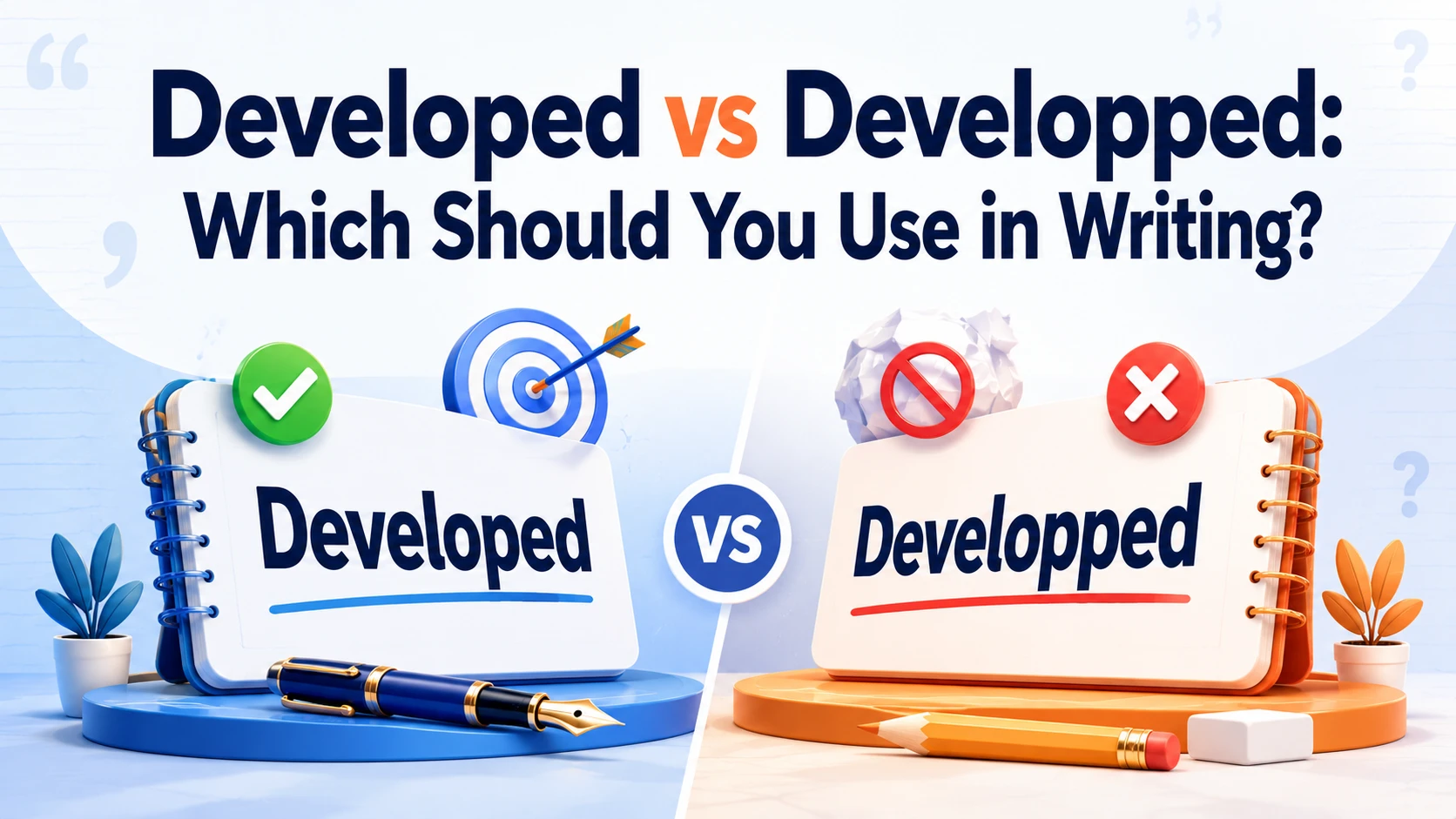
The correct spelling is developed.
Developed is the standard past tense and past participle of the verb develop. It is recognized by all major English dictionaries and style guides.
The spelling developped is incorrect in modern English and should not be used in academic, professional, or everyday writing.
For a quick answer:
- ✅ Developed = Correct
- ❌ Developped = Incorrect
Is developped a real English word?
No.
Developped is not accepted as a standard English word. It is a common spelling error that usually occurs because writers incorrectly apply the double-consonant rule.
Although you may occasionally find developped in:
- Online forums
- Social media posts
- Student assignments
- Draft documents
- User-generated content
These examples represent spelling mistakes rather than accepted English usage.
The correct spelling at a glance
| Feature | Developed | Developped |
| Correct English spelling | ✅ Yes | ❌ No |
| Past tense of develop | ✅ Yes | ❌ No |
| Past participle | ✅ Yes | ❌ No |
| Listed in dictionaries | ✅ Yes | ❌ No |
| Appropriate for formal writing | ✅ Yes | ❌ No |
Why this spelling mistake is so common
Many writers assume develop follows the same spelling pattern as verbs like:
- stop → stopped
- plan → planned
- prefer → preferred
Since these verbs double their final consonant before adding -ed, people mistakenly believe develop should become developped.
However, develop follows a different spelling rule, which you’ll learn later in this article.
What Does Developed Mean?
Definition of developed
The word developed is the past tense and past participle of develop.
Depending on the context, it can mean:
- To grow or progress
- To create or produce something
- To improve over time
- To become more advanced
- To acquire a skill, habit, or ability
- To build or design something new
Its exact meaning depends on the sentence in which it appears.
Pronunciation and word origin
Pronunciation (American English):
di-VEL-uhpt
The verb develop entered English through French and ultimately traces back to words meaning to unwrap, unfold, or reveal gradually. Over time, its meaning expanded to include growth, improvement, construction, innovation, and progress.
Why developed is the correct past tense and past participle
English forms the past tense of most regular verbs by adding -ed.
Examples include:
- work → worked
- clean → cleaned
- answer → answered
- develop → developed
Since develop doesn’t require doubling the final consonant before adding -ed, the correct spelling remains developed.
Common meanings of developed in modern English
The word appears in many different situations.
It may describe:
- A country that has advanced economically.
- Software that programmers created.
- Skills someone gained through practice.
- A disease that appeared over time.
- A photograph produced from film.
- A relationship that became stronger.
Because it has several meanings, developed is one of the most versatile verbs in English.
Is Developped Ever Correct?
Why developped is considered a misspelling
The spelling developped violates standard English spelling rules.
The verb develop ends with two different consonants (l and p), and the stress does not fall on the final syllable. As a result, English does not double the final p before adding -ed.
The correct form is therefore:
develop → developed
not
develop → developped
Does any English dictionary recognize developped?
No major English dictionary lists developped as the correct spelling.
You’ll find developed in respected references such as:
- Oxford English Dictionary
- Cambridge Dictionary
- Merriam-Webster
- Collins Dictionary
- Dictionary.com
Searching for developped typically produces either no entry or a suggestion to use developed instead.
Why people accidentally type developped
Several factors contribute to this spelling error.
The most common include:
- Confusing English consonant-doubling rules.
- Applying spelling patterns from words like planned or stopped.
- Typing quickly and relying on pronunciation.
- Exposure to incorrect spellings online.
- Influence from other languages, particularly French, where similar words may contain double consonants.
Fortunately, once you understand the spelling rule, the mistake becomes much easier to avoid.
Developed vs Developped: Side-by-Side Comparison
Although developed and developped differ by just one letter, only one belongs in modern English. The distinction isn’t about meaning—it’s about correct spelling and accepted usage.
Quick comparison table
| Feature | Developed | Developped |
| Correct English spelling | ✅ Yes | ❌ No |
| Dictionary entry | Yes | No |
| Past tense of develop | Yes | No |
| Past participle of develop | Yes | No |
| Accepted in academic writing | Yes | No |
| Used in business communication | Yes | No |
| Recognized by grammar checkers | Yes | Usually flagged as an error |
This table summarizes the most important difference: developed is the only spelling you should use in standard English.
Spelling differences
The difference comes down to one extra p.
- ✅ Developed
- ❌ Developped
Many writers assume the final p should be doubled before adding -ed, but that assumption is incorrect. English spelling rules do not require doubling the p in develop.
Meaning differences
Interestingly, there is no intended meaning difference.
Anyone who writes developped almost always intends to write developed.
For example:
Incorrect:
- The company developped a new mobile application.
Correct:
- The company developed a new mobile application.
The meaning remains exactly the same, but only the corrected sentence follows standard English.
Dictionary recognition
Every major English dictionary recognizes developed.
None recognize developped as a standard English spelling.
If you’re unsure while writing, checking a trusted dictionary will immediately confirm the correct form.
Formal vs informal writing
Whether you’re writing:
- a university essay,
- a business proposal,
- a research paper,
- a resume,
- an email,
- or a website article,
you should always use developed.
There is no situation in modern English where developped is preferred.
How to Use Developed Correctly in Sentences
Knowing the correct spelling is only the beginning. Understanding how developed functions in different grammatical roles helps you use it naturally and accurately.
Using developed as a past tense verb
The most common use of developed is as the simple past tense of develop.
It describes an action that happened and finished in the past.
Examples
- Scientists developed a new vaccine.
- She developed excellent communication skills during college.
- Our team developed the software in six months.
- The city developed rapidly after new businesses arrived.
In each sentence, developed describes a completed action.
Using developed as a past participle
Developed also functions as a past participle.
It often appears with helping verbs such as:
- has
- have
- had
- was
- were
- is
- been
Examples
- Researchers have developed a more efficient process.
- The disease had developed before treatment began.
- A new strategy has been developed for the project.
- The technology was developed by engineers in collaboration with universities.
This form is common in academic, scientific, and professional writing.
Using developed as an adjective
In many situations, developed describes the condition or characteristics of a noun.
Common examples include:
- developed country
- developed economy
- developed infrastructure
- developed skills
- developed muscles
- developed market
Examples
- Japan has a highly developed transportation system.
- She possesses well-developed leadership skills.
- The child has a fully developed vocabulary for his age.
- Investors often focus on developed markets.
Here, developed functions as an adjective rather than a verb.
Common sentence structures
You’ll frequently encounter these patterns.
- Subject + developed + object
Engineers developed a new engine.
- Subject + has/have developed + object
The company has developed several successful products.
- Subject + be + developed
The software was developed last year.
Developed + noun
- Developed countries generally have advanced infrastructure.
Recognizing these patterns makes it easier to write naturally.
Real-World Examples of Developed in Different Contexts
One reason developed appears so often is its versatility. It fits naturally into business, education, science, technology, healthcare, economics, and everyday conversation.
Business and economic writing
Companies regularly use developed when discussing innovation, products, strategies, and growth.
Examples
- The startup developed an AI-powered customer service platform.
- Management developed a long-term expansion strategy.
- The manufacturer developed environmentally friendly packaging.
- The company has developed strong relationships with suppliers.
Technology and software development
The technology industry relies heavily on this verb.
Examples
- Developers developed the application using Python.
- Engineers developed new cybersecurity tools.
- The software was developed to automate repetitive tasks.
- Our team developed an improved search algorithm.
Education and learning
Teachers and educators often use developed when discussing knowledge and skills.
Examples
- Students developed critical thinking abilities.
- She developed confidence through classroom presentations.
- The course developed practical workplace skills.
- Children gradually developed stronger reading habits.
Science and medical contexts
Researchers frequently use developed when describing discoveries, treatments, diseases, or biological processes.
Examples
- Scientists developed a faster diagnostic test.
- The patient developed mild symptoms after exposure.
- Researchers have developed several promising therapies.
- Doctors developed new treatment guidelines.
Personal growth and professional skills
The verb also describes gradual improvement in everyday life.
Examples
- He developed excellent time-management skills.
- She developed patience through years of teaching.
- Athletes developed greater endurance through training.
- I developed an interest in photography while traveling.
Geography and international development
One of the most recognizable uses appears in economics and geography.
Examples include:
- developed nation
- developed country
- developed economy
- developed region
Examples
- Canada is considered a developed country.
- Highly developed economies often have advanced healthcare systems.
- The report compared developed and developing nations.
- Infrastructure is generally more extensive in developed regions.
Common Phrases and Collocations with Developed
Native English speakers naturally combine developed with certain nouns. Learning these collocations helps your writing sound fluent and professional.
Economy and geography
Common expressions include:
- Developed country
- Developed economy
- Developed nation
- Developed market
- Developed region
- Developed infrastructure
Business and innovation
Frequently used phrases include:
- Developed strategy
- Developed product
- Developed technology
- Developed software
- Developed solution
- Developed process
Personal development
These combinations appear regularly in education and career writing.
- Developed skills
- Developed abilities
- Developed confidence
- Developed expertise
- Developed habit
- Developed mindset
Science and healthcare
Researchers often write:
- Developed treatment
- Developed vaccine
- Developed symptoms
- Developed condition
- Developed method
- Developed technique
Example sentences using common collocations
- She has developed expertise in digital marketing.
- The organization developed a strategy for long-term growth.
- Researchers developed a method for faster testing.
- Several developed countries adopted the new environmental policy.
- The engineering team developed innovative technology for renewable energy.
Learning these common word pairings makes your writing more natural and helps you use developed confidence across different contexts.
Developed vs Improved vs Evolved vs Created vs Built: Which Word Should You Use?
One reason writers become uncertain about developed is that English offers several similar words. While these verbs overlap in meaning, they are not interchangeable. Choosing the right one depends on what you’re describing and how something changed over time.
Comparison Table: Developed vs Similar Words
| Word | Primary Meaning | Best Used For | Example |
| Developed | Grew, progressed, or was created through a process | Skills, products, technology, economies, diseases | The company developed new software. |
| Improved | Became better than before | Performance, quality, health, efficiency | Her writing improved after practice. |
| Evolved | Changed gradually over a long period | Languages, species, ideas, technology | The language evolved over centuries. |
| Created | Brought into existence | Art, documents, designs, inventions | The designer created a new logo. |
| Built | Constructed or assembled something | Buildings, systems, machines, relationships | Engineers built a new bridge. |
The key distinction is that developed often emphasizes growth, progress, or systematic creation, while the others highlight different aspects of change.
When to Use Developed
Choose developed when something:
- Progresses over time
- Is created through planning or research
- Becomes more advanced
- Grows from an early stage into a mature form
Examples
- Scientists developed a new treatment.
- She developed excellent leadership skills.
- The country developed a strong manufacturing sector.
- Engineers developed a safer production process.
When Improved Is a Better Choice
Use is improved when the focus is on making something better rather than creating or expanding it.
Examples
- His pronunciation improved after daily practice.
- Customer satisfaction improved significantly.
- The updated software improved battery life.
Notice that these examples describe enhancement rather than development.
When Evolved Fits Better
Evolved suggests gradual, natural, or continuous change over an extended period.
Examples
- English has evolved dramatically over hundreds of years.
- The company’s business model evolved with changing markets.
- Smartphones have evolved into powerful computers.
Here, the emphasis is on transformation rather than deliberate development.
When to Use Created
Created focuses on bringing something into existence.
Examples
- The artist created a beautiful painting.
- The programmer created a mobile application.
- They created a detailed business plan.
Although something may later be developed, it is often first created.
When Built Is the Right Word
Use built when discussing physical construction or assembling something piece by piece.
Examples
- Workers built a new hospital.
- Engineers built the testing platform.
- She built a successful career over many years.
Sometimes built can also describe gradual achievement, but it still differs from developed in emphasis.
Common Mistakes Writers Make with Developed
Although developed is a familiar word, writers frequently misuse it in ways that reduce clarity or create spelling errors. Understanding these common mistakes helps you write with greater confidence.
Mistake 1: Writing Developped
This is by far the most common error.
❌ The software was developped last year.
✅ The software was developed last year.
Adding an extra p is incorrect in both American and British English.
Mistake 2: Assuming British English Uses Developped
Many people believe British spelling doubles the p.
It doesn’t.
Both varieties of English use:
- ✅ developed
- ❌ developped
The spelling remains identical regardless of region.
Mistake 3: Using Developed When You Mean Improved
These words are related but not identical.
Less precise:
- The update developed battery performance.
Better:
- The update improved battery performance.
Choose the word that best reflects the intended meaning.
Mistake 4: Confusing Creation with Development
Creating something and developing something are often different stages.
For example:
- A designer created the prototype.
- Engineers developed it into a commercial product.
Recognizing this distinction makes your writing more accurate.
Mistake 5: Overusing Developed
Because developed is versatile, writers sometimes rely on it too often.
Instead of repeating it, consider alternatives when appropriate:
- improved
- expanded
- enhanced
- refined
- strengthened
- advanced
- created
- established
Using varied vocabulary improves readability without changing your meaning.
Why Does the Confusion Happen?
If developped is always incorrect, why do so many people type it?
The confusion usually comes from English spelling patterns rather than pronunciation.
The Double-Consonant Rule Explained
English sometimes doubles the final consonant before adding -ed or -ing.
For example:
- stop → stopped
- plan → planned
- admit → admitted
Because of these examples, writers mistakenly expect:
- develop → developped
However, develop does not follow that pattern.
The correct form is simply:
- develop → developed
Pronunciation Can Be Misleading
The spoken pronunciation doesn’t clearly reveal whether one p or two should appear in writing.
As a result, many learners spell the word by sound instead of by standard spelling conventions.
Spell-checkers usually catch this mistake immediately.
Influence from Other Languages
Some European languages frequently double consonants in similar words.
Writers who regularly switch between languages may unintentionally produce developped, even though standard English does not.
British English vs American English: Is There Any Difference?
This question appears frequently because many spelling differences exist between British and American English.
Examples include:
| American English | British English |
| Color | Colour |
| Organize | Organise |
| Center | Centre |
| Traveling | Travelling |
Naturally, many people wonder whether developed follows a similar pattern.
The Answer
There is no spelling difference.
Both American English and British English use:
- develop
- developed
- developing
- development
The incorrect spelling developped is not accepted in either variety of modern English.
Quick Tip
If you’re ever unsure, remember this simple rule: the verb develop keeps a single p in all of its standard forms, including developed, developing, and development.
A Simple Memory Trick to Remember Developed
If you occasionally type developped, you’re not alone. Fortunately, there’s an easy way to remember the correct spelling.
Memory Tip: Develop has one P, so developed also has one P.
Think of it this way:
- Develop → Developed
- Develop → Developing
- Develop → Development
Notice that every form keeps the same single p. Since the base word never changes to developp, you never need to add an extra p before -ed or -ing.
Another helpful reminder is to compare it with words that really do double their final consonant:
- Stop → Stopped ✅
- Plan → Planned ✅
- Develop → Developed ✅ (not developped)
The more you see developed in books, articles, and professional writing, the more natural the correct spelling becomes.
Practice Exercises: Test Your Understanding
Try these short exercises to reinforce what you’ve learned.
Exercise 1: Choose the Correct Spelling
Select the correct answer.
- The engineers ________ a safer braking system.
- a) developped
- b) developed
- She has ________ strong communication skills.
- a) developed
- b) developped
- The software was ________ by a team of programmers.
- a) developped
- b) developed
- Researchers ________ an effective testing method.
- a) developed
- b) developped
- The country has ________ rapidly over the past decade.
- a) developed
- b) developped
Answers
- b) developed
- a) developed
- b) developed
- a) developed
- a) developed
Every correct answer uses developed, because developped is not a standard English spelling.
Exercise 2: Correct the Mistakes
Rewrite each sentence using the correct spelling.
- The company developped a new marketing strategy.
- Scientists have developped a faster vaccine.
- He developped an interest in astronomy.
- Our software was developped in-house.
- She developped excellent leadership skills.
Correct Answers
- The company developed a new marketing strategy.
- Scientists have developed a faster vaccine.
- He developed an interest in astronomy.
- Our software was developed in-house.
- She developed excellent leadership skills.
Quick Reference Summary
| Question | Correct Answer |
| Is developed correct? | ✅ Yes |
| Is developped correct? | ❌ No |
| Used in American English? | ✅ Yes |
| Used in British English? | ✅ Yes |
| Found in standard dictionaries? | Only developed |
| Safe for academic and professional writing? | ✅ Always use developed |
Conclusion
Understanding the difference between developed and developped is simpler than it first appears. Developed is the only correct spelling accepted in modern English, while developped is a common misspelling that should be avoided in academic papers, business documents, professional emails, and everyday writing. Knowing how developed functions as a verb, past participle, and adjective also helps you choose it confidently in different contexts. One final actionable tip: whenever you finish writing, do a quick proofreading pass or use a reliable spell checker to catch accidental typing errors before publishing or sending your work. A common mistake to avoid: don’t assume that develop follows the same double-consonant pattern as words like stop or plan. It doesn’t. Remember that develop always keeps a single p, making developed the correct spelling every time.
Frequently Asked Questions
Q1. Is developped ever a correct English spelling?
No. Developped is considered a misspelling in modern English. Whether you’re writing in American English or British English, the correct form is always developed. Grammar checkers, dictionaries, and style guides consistently recommend using the single-p spelling.
Q2. Why doesn’t develop double the letter p before adding -ed?
English spelling follows different patterns depending on the structure of the base word. Develop does not meet the conditions that require doubling the final consonant, so it becomes developed, developing, and development without adding another p.
Q3. Is it developed as a verb or an adjective?
It can be both. As a verb, it describes an action completed in the past. As an adjective, it describes something that is advanced, mature, or fully formed, such as a developed economy, developed skills, or a developed country.
Q4. Can spell-check software detect developped?
Yes. Most modern spelling and grammar tools immediately identify developped as an error and recommend developed instead. Even so, understanding why the correction is necessary helps you become a more confident and accurate writer.
Q5. What’s the easiest way to remember the correct spelling?
Remember the base word: develop has one p, and every standard form keeps that spelling. If you can spell develop correctly, simply add -ed to form developed. This simple habit prevents one of the most common spelling mistakes.
