Convertor or Converter is a spelling question that catches many English learners, students, technical writers, and even experienced professionals off guard. Although both words appear online, they aren’t used equally, and choosing the wrong one can make your writing look outdated or inconsistent. Whether you’re writing an academic paper, creating website content, documenting software, or simply trying to improve your English, understanding the difference matters more than you might think. This guide explains which spelling is preferred, why it became the standard, and when—if ever—the alternative is acceptable.
At first glance, the difference between convertor and converter seems like a single letter. In reality, it reflects how English forms nouns, how dictionaries classify words, and how language evolves through real-world usage. Many websites stop at saying that “converter is correct,” but that leaves important questions unanswered. Why does convertor still appear in technical documents? Is it wrong in British English? Could using it cost marks in an exam or affect professional credibility? You’ll find clear, evidence-based answers throughout this article.
Rather than repeating dictionary definitions, this guide takes a practical approach. You’ll see side-by-side comparisons, real examples, dictionary guidance, and expert writing recommendations that help you choose the right spelling with confidence. By the end, you’ll not only know which word to use but also understand the linguistic reasoning behind it, making it much easier to remember in future writing.
Quick Answer: Is It “Convertor” or “Converter”?
If you’re looking for the short answer, here it is:
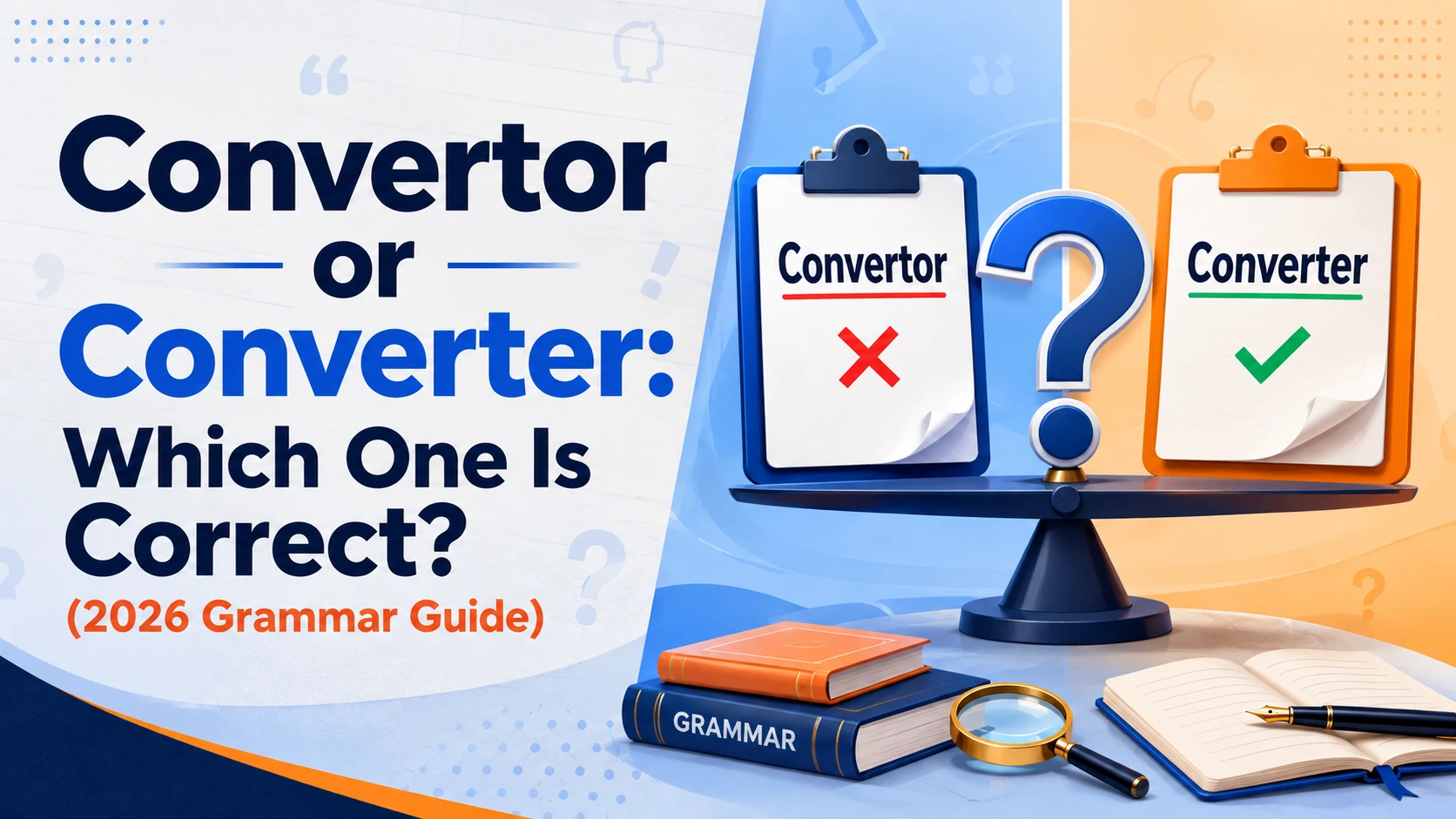
Converter is the preferred and standard spelling in modern English. It is the form recommended in dictionaries, style guides, educational materials, technical documentation, and professional writing.
While convertor is recognized as a legitimate variant by some dictionaries, it is far less common and is generally considered an alternative or historical spelling rather than the default choice.
The Correct Spelling in Modern English
Today, converter is the spelling you’ll encounter in almost every context, including:
- Academic writing
- Business communication
- Technical manuals
- Software documentation
- Engineering publications
- Educational resources
- Online articles
Examples:
- I downloaded a PDF converter to merge my files.
- My laptop requires a power converter when traveling abroad.
- The mechanic replaced the catalytic converter.
These examples reflect standard modern English and are appropriate in both formal and informal writing.
When “Convertor” May Still Appear
Although uncommon, convertor hasn’t disappeared completely. You may still encounter it in:
- Older engineering textbooks
- Legacy technical documentation
- Product names or proprietary terminology
- Archived publications
- Historical dictionaries
In most cases, its appearance reflects established terminology rather than current spelling preferences.
Expert Tip: If you’re unsure which spelling to use, choose converter. It’s the safer and more widely accepted option in nearly every writing situation.
What Do “Convertor” and “Converter” Mean?
Before comparing the spellings, it’s important to understand that both words refer to essentially the same concept.
A converter is a person, device, system, or program that changes something from one form, format, unit, or state into another.
Depending on the context, it might convert:
- Electrical voltage
- Digital file formats
- Measurement units
- Currency values
- Chemical energy
- Mechanical motion
The spelling difference does not create a different meaning in everyday English.
Definition of Converter
A converter is a noun formed from the verb convert and refers to something that performs the act of converting.
Examples include:
- Video converter
- Currency converter
- Unit converter
- Voltage converter
- Torque converter
- Catalytic converter
This spelling dominates modern English because it follows the common noun-forming pattern used with many English verbs.
Definition of Convertor
A convertor has the same core meaning but is used much less frequently.
Some specialized industries and older publications have historically used this spelling, particularly in engineering and electronics. However, modern publications overwhelmingly favor converter, even within technical fields.
Do They Mean the Same Thing?
Yes.
For most readers, there is no difference in meaning between the two spellings.
The distinction is primarily one of usage preference, not definition.
| Feature | Converter | Convertor |
| Meaning | Changes one thing into another | Same meaning |
| Modern usage | Very common | Rare |
| Professional writing | Preferred | Usually avoided |
| Dictionaries | Primary entry | Alternative or variant entry in some dictionaries |
| Recommended for learners | ✅ Yes | ❌ Usually no |
Why the Spelling Causes Confusion
Several factors contribute to this common spelling question:
- Both spellings exist in dictionaries.
- Older books sometimes use convertor.
- Some engineering fields historically favored the variant.
- English contains many nouns ending in both -er and -or, making it difficult to predict the correct ending.
- Search engines display results for both forms, leading many people to assume they’re equally preferred.
This combination explains why the question continues to appear in classrooms, writing forums, and search engines.
Convertor vs. Converter: What’s the Difference?
Although the two spellings share the same meaning, they differ significantly in frequency, acceptance, and recommended usage.
For most writers, the practical question isn’t whether convertor exists—it’s whether it’s the best choice.
The answer is almost always no.
Side-by-Side Comparison
| Feature | Converter | Convertor |
| Standard modern spelling | ✅ Yes | No |
| Accepted by major dictionaries | ✅ Yes | Yes (as a variant in some dictionaries) |
| Preferred in education | ✅ Yes | Rarely |
| Common in professional writing | ✅ Yes | Uncommon |
| Frequently used online | ✅ Very common | Much less common |
| Best choice for exams | ✅ Yes | Not recommended |
| Best for SEO and web content | ✅ Yes | No |
Key Differences in Practice
The biggest distinction isn’t grammatical—it’s conventional.
Professional editors, publishers, educators, and technical writers overwhelmingly choose converter because it reflects current language standards.
Using convertor won’t always be considered incorrect, but it may appear outdated or inconsistent to many readers.
Which Form Is More Common Today?
Across modern English, converter clearly dominates.
You’ll find it in:
- Product packaging
- Software interfaces
- Academic publications
- Government documents
- Technical standards
- Consumer electronics
- Automotive manuals
Because consistency is an important part of clear communication, most organizations standardize on converter rather than allowing both spellings interchangeably.
Why Is “Converter” the Preferred Spelling?
The widespread preference for converter isn’t arbitrary. It reflects how English typically forms nouns, how dictionaries present the word, and how language has evolved through modern usage.
Understanding the reasoning makes the spelling much easier to remember.
The English Word-Formation Pattern (-er vs. -or)
English often creates nouns by adding -er to a verb to indicate a person, device, or thing that performs an action.
Examples include:
- Print → printer
- Scan → scanner
- Mix → mixer
- Record → recorder
- Compute → computer
- Convert → converter
This pattern feels natural to native speakers because it appears in thousands of everyday words.
By contrast, nouns ending in -or usually come from different historical or Latin-derived formations, such as:
- Actor
- Creator
- Doctor
- Governor
- Instructor
While English doesn’t follow one universal rule, converter aligns more closely with modern noun-formation patterns, which helps explain its widespread adoption.
How Dictionaries Classify Both Spellings
Most leading dictionaries list converter as the primary spelling for the noun meaning “something that converts.”
Some dictionaries also recognize convertor, but typically as:
- A variant spelling
- A less common alternative
- An older form in certain contexts
This distinction is important because dictionary recognition doesn’t necessarily indicate equal preference. Many English words have accepted variants, yet one form is clearly favored in contemporary writing.
Why Most Style Guides Recommend “Converter”
Professional style guides prioritize clarity, consistency, and current usage. Since converter is overwhelmingly more common across publishing, education, engineering, and digital communication, it has become the recommended default.
For that reason, editors generally advise using converter unless you’re quoting historical material, preserving an official product name, or following established terminology within a specialized field.
Key Takeaway: If your goal is clear, modern, and professional English, converter is the spelling you should choose in almost every situation.
Is “Convertor” Ever Correct?
After learning that converter is the standard spelling, many readers naturally ask another question: Does that mean convertor is always wrong? The answer is more nuanced than a simple yes or no.
In modern English, converter should be your default choice. However, convertor still exists in certain contexts and is recognized by some dictionaries as a variant spelling. Understanding when it appears—and why—will help you make informed writing decisions instead of assuming every occurrence is a mistake.
Technical and Industry-Specific Usage
Historically, some engineering disciplines used convertor in specialized documents, especially in electrical engineering and power electronics. You may still find the term in:
- Legacy engineering manuals
- Older research papers
- Industrial equipment documentation
- Technical patents
- Archived product specifications
For example, an older engineering manual might refer to a rotary convertor or a frequency convertor. In many cases, newer editions of the same documents have updated these terms to converter to align with modern language standards.
If you’re writing new technical documentation today, converter is almost always the preferred choice unless your organization follows an established naming convention.
Historical Usage in Older Publications
Language evolves over time, and spelling preferences often change with it. During the nineteenth and early twentieth centuries, both convertor and converter appeared in books, newspapers, and technical journals.
As publishing standards became more consistent, converter gradually became dominant. This shift wasn’t driven by a change in meaning but by a preference for clearer and more consistent English.
When reading historical documents, remember that older spellings often reflect the conventions of their time rather than modern grammar rules.
Why You May Still Encounter “Convertor” Online
Seeing convertor on a website doesn’t necessarily mean the content is wrong. There are several reasons why the spelling still appears:
- The article hasn’t been updated in years.
- The website copied terminology from older technical sources.
- A company uses convertor as part of its official product name.
- The author follows a regional or organizational style guide.
- The content was translated from another language where spelling conventions differ.
As a reader, it’s helpful to recognize these possibilities instead of assuming every instance is an error.
Expert Insight: Modern editors generally recommend preserving convertor only when it’s part of an official name, a direct quotation, or historical material. For all new writing, converter remains the better choice.
British English vs. American English
Many spelling differences in English are regional. Words such as colour/color, centre/center, and travelling/traveling change depending on whether you’re writing for a British or American audience.
Because of this, many people assume convertor and converter follow the same pattern. Surprisingly, they do not.
Does Either Variety Prefer “Convertor”?
No.
Unlike many common spelling differences, converter is the preferred form in both British English and American English.
Whether you’re writing for readers in:
- The United Kingdom
- The United States
- Canada
- Australia
- New Zealand
you’ll generally find converter used in modern publications.
Dictionary Comparison
A quick comparison of major English dictionaries shows a consistent trend.
| Dictionary Type | Preferred Entry | Notes |
| British English dictionaries | Converter | Primary spelling |
| American English dictionaries | Converter | Primary spelling |
| Some comprehensive dictionaries | Convertor | Listed as a variant or less common form |
Although some dictionaries acknowledge convertor, they rarely present it as the recommended everyday spelling.
Is This a Regional Difference?
No.
This is one of the biggest misconceptions surrounding these words.
Unlike organise/organize or licence/license, the choice between convertor and converter isn’t determined by geography. Instead, it’s determined by modern usage.
That means writers in both British and American English should generally choose converter.
How “Converter” Is Used in Everyday English
One reason converter has become so common is its remarkable versatility. The word appears in technology, engineering, transportation, finance, education, science, and countless everyday situations.
Understanding these contexts makes the word easier to remember and use correctly.
Technology
Technology is where many people encounter the word first.
Examples include:
- PDF converter
- Video converter
- Audio converter
- File converter
- Image converter
- Document converter
Example sentences:
- I used a file converter to change the document into PDF format.
- This video converter supports more than fifty formats.
- An online image converter reduced the file size without losing quality.
Electronics
In electronics, a converter changes electrical energy from one form to another.
Common examples include:
- Voltage converter
- Power converter
- AC-to-DC converter
- DC-to-DC converter
- Signal converter
Example:
- You’ll need a voltage converter before using that appliance overseas.
Automotive
The automotive industry uses the word frequently.
Examples include:
- Catalytic converter
- Torque converter
- Fuel converter
Example:
- The mechanic replaced the damaged catalytic converter during the repair.
Finance and Measurement
Many online tools are also called converters because they transform one value into another.
Examples:
- Currency converter
- Unit converter
- Temperature converter
- Time-zone converter
Example:
- I checked the exchange rate using a currency converter before booking my trip.
Everyday Communication
Outside technical fields, people use converter whenever something changes one format into another.
Examples include:
- Recipe converter
- Language converter
- Measurement converter
- Text converter
The underlying idea remains the same: something performs the act of converting.
Real Sentence Examples
Looking at authentic examples is one of the quickest ways to understand correct usage.
Correct Examples Using Converter
These examples reflect standard modern English.
- Please install a reliable video converter before editing large files.
- This currency converter updates exchange rates automatically.
- The electrician installed a new power converter in the control panel.
- Our software includes a built-in PDF converter.
- The mechanic inspected the catalytic converter during the service.
Notice that converter works naturally across different industries without changing its meaning.
Examples Where Convertor Appears
Although less common, you may still encounter sentences like these:
- The older manual refers to a rotary convertor.
- The archived specification mentions a frequency convertor.
- The museum displayed an early electrical convertor from the twentieth century.
These examples are not necessarily incorrect, but they reflect historical or specialized usage rather than current writing conventions.
Incorrect Examples and Their Corrections
The following examples show where writers often make avoidable mistakes.
| Incorrect | Correct |
| I downloaded a PDF convertor yesterday. | I downloaded a PDF converter yesterday. |
| Please buy a voltage convertor. | Please buy a voltage converter. |
| Every website needs a file convertor tool. | Every website needs a file converter tool. |
| Our app includes a currency convertor. | Our app includes a currency converter. |
Writing Tip: If you’re creating new content, replacing convertor with converter will usually make your writing appear more current and professional.
Common Collocations with “Converter”
A collocation is a combination of words that native speakers naturally use together. Learning common collocations improves both writing and speaking because your language sounds more fluent and idiomatic.
Below are some of the most common collocations you’ll encounter.
Technology and Software
- PDF converter
- Video converter
- Audio converter
- File converter
- Image converter
- Document converter
- Text converter
Example:
This free PDF converter preserves the original formatting.
Engineering and Electronics
- Voltage converter
- Power converter
- Signal converter
- Frequency converter
- Digital converter
- Analog converter
Example:
The technician replaced the faulty power converter during maintenance.
Automotive
- Catalytic converter
- Torque converter
Example:
A failing torque converter can cause transmission problems.
Measurement and Calculations
- Currency converter
- Unit converter
- Temperature converter
- Length converter
- Weight converter
These combinations are widely recognized and appear frequently in educational materials, professional writing, and online tools.
Which Dictionaries Recognize “Convertor”?
One reason this spelling debate persists is that several dictionaries acknowledge both forms. However, recognizing a word and recommending it are not the same thing.
Major Dictionary Listings
Leading dictionaries consistently present converter as the standard headword.
Some comprehensive dictionaries also include convertor, typically identifying it as:
- A variant spelling
- A less common alternative
- An older usage
- A secondary entry
This distinction is important because dictionaries aim to document how language is used, including historical and less common forms.
Preferred Labels and Usage Notes
Many dictionaries use labels to help readers understand current usage.
For example, they may indicate that a spelling is:
- Less common
- Variant
- Alternative
- Historical
- Primarily technical
These notes don’t mean the word is incorrect—they simply show that another spelling is generally preferred.
What Dictionary Evidence Tells Us
Taken together, modern dictionary evidence leads to a clear conclusion:
- Converter is the standard spelling for contemporary English.
- Convertor is recognized but uncommon.
- Most writers, editors, educators, and publishers recommend converter for new writing.
Key Takeaway: Dictionaries preserve language as it exists, including uncommon spellings. That doesn’t mean every listed variant is equally suitable for everyday communication.
Usage Frequency: Which Spelling Do People Actually Use?
Knowing that converter is the preferred spelling is helpful, but it’s equally important to understand how real people use these words today. Modern English isn’t shaped by dictionaries alone—it also evolves through publishing, education, professional writing, and everyday communication.
Across nearly every industry, converter is overwhelmingly more common than convertor. Whether you’re reading a university textbook, browsing an e-commerce website, installing software, or reviewing technical documentation, you’ll encounter converter far more frequently.
Search Popularity and Writing Trends
Modern search behavior provides valuable insight into language preferences. While both spellings are searchable, converter consistently dominates in:
- Search engine queries
- Software product names
- Educational websites
- Technical blogs
- Business documentation
- Consumer electronics
For example, people typically search for:
- PDF converter
- Video converter
- Currency converter
- Unit converter
- Voltage converter
The alternative spelling appears much less often and usually in older content or niche technical references.
Academic and Professional Usage
Educational institutions and professional organizations prioritize consistency. As a result, converter has become the standard choice in:
- University textbooks
- Research publications
- Engineering documentation
- Government resources
- Professional certifications
- Software manuals
If you’re writing for an academic or professional audience, using converter demonstrates familiarity with current English conventions.
Why “Converter” Dominates Modern English
Several factors explain why converter has become the preferred spelling:
- It follows a familiar English noun pattern.
- It is recognized as the primary form by leading dictionaries.
- Editors and publishers standardize on it.
- It creates consistency across industries.
- It aligns with readers’ expectations.
The result is simple: converter has become the default spelling in contemporary English, while convertor remains a recognized but uncommon variant.
How to Choose the Right Spelling
For most people, the easiest approach is also the best one: use converter unless you have a specific reason not to.
Different writing situations, however, deserve slightly different considerations.
For School Assignments and Exams
Students should almost always write converter.
Teachers, examiners, and educational publishers expect the standard modern spelling. Even if convertor isn’t technically wrong, using converter avoids unnecessary confusion and reflects current language standards.
Best choice: ✅ Converter
For Business and Professional Writing
Professional communication values clarity and consistency.
Whether you’re writing:
- Reports
- Emails
- User guides
- Product descriptions
- Technical specifications
converter is the spelling that readers are most likely to recognize immediately.
Best choice: ✅ Converter
For Websites, Blogs, and SEO Content
Online content should match the language users naturally search for.
Since converter is the dominant spelling across search engines and user behavior, it is generally the better option for:
- Blog articles
- Landing pages
- Product pages
- Educational content
- Tutorials
Using the standard spelling also improves consistency throughout your website.
Best choice: ✅ Converter
For Technical Documentation
Modern engineering documentation also favors converter.
The main exception is when:
- Updating legacy documentation
- Quoting historical material
- Referring to an official product name
- Preserving terminology from archived specifications
Otherwise, converter remains the recommended spelling.
Common Mistakes to Avoid
Many spelling mistakes happen because writers make assumptions instead of checking current usage. Avoiding these common errors will help your writing look more polished and professional.
Assuming Both Spellings Are Equally Preferred
Although both spellings exist, they are not used equally.
Many beginners assume they can switch between them freely because both appear in dictionaries. In reality, converter is overwhelmingly preferred in modern English.
Better approach: Choose one spelling—preferably converter—and use it consistently.
Mixing Spellings in the Same Document
Inconsistent spelling distracts readers and reduces credibility.
For example:
❌ The software includes a converter tool.
❌ This convertor also supports image files.
Even if both spellings are recognized, mixing them within one document creates an impression of poor editing.
Better approach: Maintain the same spelling throughout your writing.
Confusing Spelling Preference with Regional English
Some writers believe:
- Converter = American English
- Convertor = British English
This is a misconception.
Unlike words such as color/colour, both British and American English generally prefer converter.
Copying Outdated Terminology
Older books and archived manuals sometimes use convertor.
Copying those spellings into modern content without considering today’s conventions can make your writing seem outdated.
When creating new material, always follow current usage rather than historical preferences.
Quick Memory Trick
Simple memory devices often make spelling easier to remember than grammar rules.
An Easy Way to Remember the Correct Spelling
Think about familiar words ending in -er that describe something performing an action:
- Printer
- Scanner
- Blender
- Mixer
- Recorder
- Computer
Now add:
Convert → Converter
Because many English devices and tools end in -er, converter feels natural and is much easier to remember.
Related Words That Follow Similar Patterns
Looking at similar word formations reinforces the pattern.
| Verb | Correct Noun |
| Printer | |
| Scan | Scanner |
| Mix | Mixer |
| Record | Recorder |
| Compute | Computer |
| Convert | Converter |
Although English has exceptions, this pattern covers many everyday nouns.
Similar Word Pairs That Cause Confusion
The convertor vs. converter debate isn’t unique. English contains many similar word pairs where one spelling is preferred or usage depends on context.
Adviser vs. Advisor
Both spellings are accepted.
- Adviser is generally preferred in British English.
- Advisor is common in North America and many professional titles.
Always follow the style guide used by your organization.
Adapter vs. Adaptor
This pair closely resembles a converter.
While both spellings exist, adapter has become the standard in general English. Adaptor still appear in certain technical fields and product names.
Canceled vs. Cancelled
This difference is regional.
- Canceled is standard in American English.
- Cancelled is standard in British English and many Commonwealth countries.
Unlike converter, this spelling genuinely depends on the variety of English you’re using.
Toward vs. Towards
Both forms are correct.
- Toward is more common in American English.
- Towards appears more frequently in British English.
Neither is considered incorrect when used consistently.
Expert Tip: Don’t assume every spelling variation follows the same rule. Some differences are regional, while others—like converter—have one clearly preferred modern form.
Conclusion
Choosing between convertor and converter becomes much easier once you understand how modern English uses these words. Although both spellings exist, converter has clearly become the standard choice in education, professional writing, technical documentation, and everyday communication. Unless you’re quoting historical material or preserving an official product name, there’s rarely a practical reason to choose the less common variant. One final actionable tip: whenever you write about software, electronics, vehicles, or any tool that changes one form into another, make converter your default spelling and use it consistently throughout the document. A common mistake to avoid is assuming that convertor is the British English version of converter. It isn’t. Both British and American English overwhelmingly prefer converter, making it the safest and most professional choice for nearly every writing situation.
Frequently Asked Questions
Q1. Is convertor a real English word?
Yes. Convertor is recognized by some dictionaries as a variant spelling of converter. However, it is much less common in modern English and is rarely recommended for new writing unless you’re preserving historical or specialized terminology.
Q2. Which spelling is correct in British English?
Converter is the preferred spelling in British English, just as it is in American English. Although you may occasionally encounter convertor in older or technical sources, modern British publications overwhelmingly use converter.
Q3. Why do some websites still use convertor?
Several older websites, archived technical documents, and product names continue using convertor because they were created before modern spelling preferences became widely standardized. In many cases, the spelling has simply never been updated.
Q4. Can using convertor affect exams or professional writing?
In most situations, using a converter is the safer option. It aligns with current dictionary preferences, educational materials, and professional style guides, reducing the chance of your writing appearing outdated or inconsistent.
Q5. Which spelling is better for SEO and online content?
If you’re creating modern web content, converter is generally the better choice because it reflects the spelling readers expect to see and naturally matches the terminology used across educational, technical, and commercial websites.
