
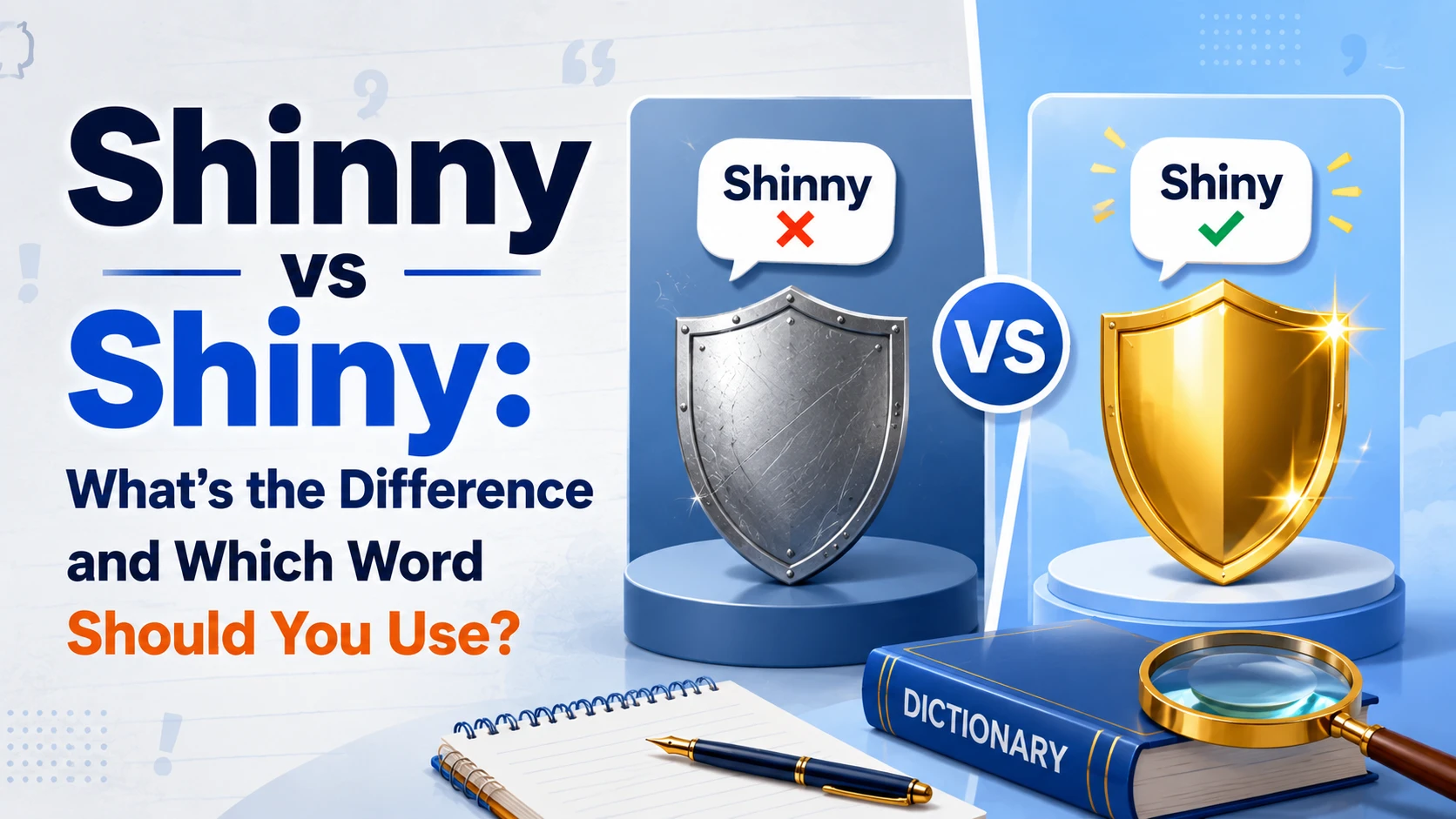
Shinny vs shiny is a surprisingly common point of confusion because the two words look similar but have entirely different meanings. One belongs to everyday English and describes something that reflects light, while the other is a niche term primarily associated with hockey and, less commonly, climbing. If you use the wrong one, your sentence can instantly sound incorrect or confusing. Understanding when each word fits will help you write with greater accuracy, whether you’re drafting an email, writing an essay, or simply trying to improve your English vocabulary.
Many people assume shinny is just a misspelling of shiny, and in most situations, that assumption seems reasonable. After all, shiny appears frequently in books, advertisements, product descriptions, and everyday conversations, whereas shinny rarely shows up outside specific contexts. However, shinny is a legitimate English word with its own history and meaning. Knowing the distinction not only prevents embarrassing mistakes but also helps you recognize the word when you encounter it in sports articles or historical texts.
This guide explains the difference between shinny and shiny, how each word is used, their pronunciation, origins, common mistakes, and practical examples. You’ll also discover simple memory tricks, comparison tables, and real-world scenarios that make choosing the correct word effortless. By the end, you’ll know exactly which spelling belongs in every situation and why context—not appearance—is the key to using these two similar-looking words correctly.
Key Takeaway
Shiny is the correct word when describing something that reflects light or appears bright and polished. Shinny is a real but uncommon English word referring mainly to an informal game of hockey or, in some cases, climbing by gripping with the arms and legs.
The Quick Answer: Is It “Shinny” or “Shiny”?
For most English learners and writers, the answer is simple: you almost always want “shiny.” It describes anything that reflects light, has a polished appearance, or looks bright and attractive. You’ll encounter it in everyday conversations, literature, product descriptions, advertising, and academic writing.
Shinny, on the other hand, has a specialized meaning. It usually refers to an informal game of hockey played without strict rules. In older English, it can also mean to climb awkwardly using your hands and legs, though that usage is far less common today.
The easiest way to decide is to ask yourself what you’re talking about.
- If it’s an object, surface, hair, shoes, jewelry, or appearance, use shiny.
- If it’s an informal hockey game or the act of climbing in certain contexts, use shinny.
When Shiny Is the Correct Word
Use shiny whenever you describe something that reflects light or appears polished, smooth, glossy, or new.
Common contexts include:
- A shiny car after being washed
- Shiny shoes before a job interview
- A shiny gold coin
- Shiny kitchen appliances
- Shiny black hair
- A shiny phone screen
- A shiny new laptop
Examples
- She bought a shiny silver necklace.
- The floor looked shiny after it was polished.
- His new bicycle still had shiny paint.
When Shinny Is the Correct Word
Use shinny only when referring to the sport-related term or its less common verb form.
Examples include:
- The children played shinny on the frozen pond after school.
- They organized a neighborhood shinny game every Saturday.
- The boy tried to shinny up the tree to rescue the kite.
Outside these contexts, shinny is usually not the word you want.
A Simple Trick to Remember the Difference
Think of it this way:
- Shiny = Shine = Light
- Shinny = Hockey
If your sentence involves something that shines, choose shiny. If it involves playing hockey, shinny is likely correct.
Shinny vs Shiny at a Glance
The following comparison highlights the most important differences between these commonly confused words.
| Feature | Shiny | Shinny |
| Part of speech | Adjective | Noun and verb |
| Primary meaning | Reflecting light; glossy or polished | Informal game of hockey; to climb awkwardly |
| Everyday use | Very common | Rare |
| Common context | Objects, appearance, materials, products | Sports and historical climbing usage |
| Formal writing | Frequently used | Only when context requires |
| Common mistake | Rarely confused with other words | Often mistaken for a misspelling of shiny |
Quick Decision Guide
| If your sentence is about… | Use |
| A polished object | Shiny |
| Jewelry | Shiny |
| Hair | Shiny |
| Metal surfaces | Shiny |
| A hockey game | Shinny |
| Climbing a tree (older usage) | Shinny |
What Does “Shiny” Mean?
Shiny is an adjective that describes something that reflects light well or has a smooth, polished, or glossy surface. Depending on the context, it can also describe something new, attractive, or impressive rather than literally reflective.
Because it’s widely used across both spoken and written English, shiny appears in everything from children’s books and product packaging to technical descriptions and marketing copy.
Definition
In standard English, shiny means:
- Reflecting light
- Bright or glossy in appearance
- Smooth and polished
- Looking new or well maintained
Although these meanings are closely related, context determines which shade of meaning the writer intends.
Origin and Etymology
The word shiny comes from the verb shine, which traces back to Old English scīnan, meaning “to emit light” or “to be bright.” Over time, English speakers added the suffix -y to create an adjective describing something that possesses the quality of shining.
Unlike many confusing English spellings, shiny has remained relatively stable through centuries of use, making it one of the standard descriptive adjectives in modern English.
Common Meanings in Everyday English
Most uses of shiny fall into one of four categories.
Objects and Materials
Many everyday items naturally reflect light.
Examples include:
- A shiny mirror
- A shiny marble floor
- A shiny stainless-steel sink
- A shiny diamond
Hair and Appearance
People often describe healthy hair or polished clothing as shiny.
Examples:
- Her hair became shiny after using the conditioner.
- His dress shoes stayed shiny all evening.
Technology and Consumer Products
Marketing frequently uses shiny to emphasize products that appear new or visually appealing.
Examples:
- A shiny smartphone
- A shiny sports car
- A shiny gaming console
Figurative Meaning
Sometimes shiny doesn’t describe physical brightness at all. Instead, it suggests something attractive, exciting, or superficially impressive.
Examples:
- Don’t let the shiny promises fool you.
- The proposal looked shiny on paper but lacked practical details.
Synonyms and Related Words
Depending on context, suitable alternatives include:
- Glossy
- Polished
- Lustrous
- Gleaming
- Sparkling
- Reflective
- Bright
- Burnished
- Radiant
- Sheen-covered
Each synonym carries a slightly different nuance, so choosing the right one depends on what you’re describing.
What Does “Shinny” Mean?
Unlike shiny, shinny is not an adjective. It is a legitimate English word with a specialized meaning that many people never encounter unless they follow hockey or read historical texts.
Because it appears so rarely in general writing, many readers mistakenly assume it is simply a spelling error. In reality, dictionaries recognize shinny as a distinct word with its own history and usage.
Definition
Shinny most commonly means:
- A casual game of hockey, usually played outdoors without formal teams, referees, or strict rules.
It can also function as a verb meaning:
- To climb using the hands and legs while gripping a vertical object, such as a tree or pole.
The History of the Word
The exact origin of shinny is uncertain, but the term has been associated with informal stick-and-ball games for centuries. In Canada and parts of the United States, it eventually became closely linked with recreational ice hockey played on frozen ponds and neighborhood rinks.
Even today, many hockey communities continue to use the word to describe friendly pickup games where enjoyment matters more than competition.
Shinny as an Informal Hockey Game
Unlike organized hockey, a shinny game typically involves:
- No official referee
- Flexible teams
- Minimal equipment
- Informal scoring
- Community participation
Because the rules are relaxed, players of different ages and skill levels can join without extensive preparation.
Examples
- We played shinny until sunset.
- Every winter, the neighborhood organizes a weekend shinny tournament.
- The frozen pond became the perfect place for shinny.
Shinny as a Verb
Although uncommon today, shinny can also mean to climb by gripping with both arms and legs.
Examples include:
- He shined up the tree to retrieve the ball.
- The child shined down the pole carefully.
Modern English speakers often prefer shinning or simply climbing, making this sense increasingly rare.
Shinny vs Shiny: Key Differences Explained
Although only one letter separates these words, their meanings belong to entirely different categories.
| Category | Shiny | Shinny |
| Meaning | Reflects light or appears polished | Informal hockey game or climbing |
| Grammar | Adjective | Noun or verb |
| Frequency | Extremely common | Uncommon |
| Typical readers | Everyone | Mostly hockey enthusiasts or readers of older texts |
| Typical mistake | None | Mistakenly used instead of shiny |
Difference in Meaning
The biggest distinction is what each word represents. Shiny describes appearance, while shinny describes an activity or, less commonly, an action.
Difference in Pronunciation
Although the spellings are similar, their pronunciations differ slightly because shiny contains the long “i” sound associated with the word shine, whereas shinny is pronounced with a shorter vowel sound similar to skinny.
Difference in Usage
One appears in everyday English across countless contexts. The other is limited to specialized situations, particularly hockey culture.
Difference in Frequency
A quick look at modern books, newspapers, and online publications reveals that shiny is vastly more common than shinny. That’s why spell-check software and readers often assume shinny is a typo—even when it isn’t.
Why These Words Are Often Confused
The confusion usually stems from three factors:
- Their spellings differ by only one letter.
- Shiny is extremely common, while shinny is relatively rare.
- Many people have never encountered shinny in sports or historical contexts.
As a result, writers sometimes replace one with the other without realizing the meaning changes completely.
How to Use Shiny Correctly in Sentences
Since shiny is an adjective, it modifies a noun by describing how something looks. In most cases, it suggests that an object reflects light, has been polished, or appears clean and new. However, the word can also be used figuratively to describe something attractive or appealing on the surface.
The key is to match shiny with nouns that can logically have a glossy, bright, or polished appearance. Using it in unrelated contexts can make a sentence sound unnatural, even if the grammar is technically correct.
Using Shiny as an Adjective
An adjective answers questions like What kind? or What does it look like? That’s exactly what shiny does.
Examples:
- The mechanic polished the shiny motorcycle.
- We admired the shiny marble floor.
- Her shiny earrings caught everyone’s attention.
- The puppy had a shiny black coat.
- He bought a shiny new laptop for college.
Notice that shiny always describes the noun rather than the action.
Literal Uses of Shiny
Most uses of shiny are literal, meaning the object actually reflects light.
Common examples include:
| Object | Example Sentence |
| Car | The shiny sports car stood out in the parking lot. |
| Shoes | His shiny leather shoes completed the outfit. |
| Coins | The child collected shiny silver coins. |
| Glass | Sunlight reflected off the shiny windows. |
| Jewelry | She wore a shiny gold bracelet to the wedding. |
These examples show how shiny naturally describes physical appearance.
Figurative Uses of Shiny
English speakers also use shiny metaphorically to describe something that appears attractive or impressive, even if no light is involved.
For example:
- Every startup has a shiny new idea, but execution matters more.
- Don’t be distracted by the shiny features if the product doesn’t solve your problem.
- The proposal looked shiny, yet it lacked a realistic budget.
In these cases, shiny suggests superficial appeal rather than physical brightness.
Expert Tips for Using Shiny
Writing Tip
Use shiny only when appearance is part of the meaning. If you’re describing durability, quality, or performance, another adjective may be more accurate.
For example:
❌ The software is shiny and processes data quickly.
✔ The software has a sleek interface and processes data quickly.
The second sentence tells readers exactly what makes the software appealing.
How to Use Shinny Correctly in Sentences
Unlike shiny, shinny is not used to describe appearance. Instead, it refers to either a casual hockey game or, in older English, the act of climbing by gripping with the hands and legs.
Because many readers are unfamiliar with the word, using it correctly requires understanding its context.
Shinny as a Noun
The noun shinny refers to an informal game of hockey, usually played outdoors with relaxed rules.
Characteristics often include:
- No official referee
- Flexible team sizes
- Community participation
- Casual atmosphere
- Frozen ponds or neighborhood rinks
Examples:
- The children organized a shinny game after school.
- We played shinny on the frozen lake all afternoon.
- Every winter, local families gather for weekend shinny.
Shinny as a Verb
As a verb, shinny means to climb by gripping something vertically with your arms and legs.
Although dictionaries still recognize this meaning, modern English speakers rarely use it in everyday conversation.
Examples:
- The boy shone up the tree to rescue the kite.
- She shined down the pole without hesitation.
- The cat watched as he shinnied over the fence.
Today, writers often prefer climbing, unless they specifically want the older or more descriptive wording.
When Should You Use Shinny?
Use shinny only when discussing:
- Informal hockey
- Historical accounts
- Canadian hockey culture
- Older literary works
- The specific climbing action
If none of these contexts apply, shiny is probably the correct choice.
Real-Life Examples of Shinny and Shiny
Seeing words in realistic situations makes the difference much easier to remember.
Everyday Conversations
Correct
- I finally bought a shiny coffee table.
- Your shoes still look shiny after all these months.
- The lake looked shiny in the afternoon sun.
Incorrect
- I bought a shinny coffee table.
Since tables don’t play hockey or climb trees, shinny doesn’t make sense here.
Sports Writing
Correct
- The neighborhood hosts a shinny tournament every January.
- The kids enjoyed a friendly shinny game before dinner.
Incorrect
- They played shiny on the frozen pond.
Here, shinny refers to the hockey game, making it the only correct option.
Business and Marketing
Product descriptions frequently use shiny because appearance influences purchasing decisions.
Examples:
- The company launched a shiny redesigned smartphone.
- Customers loved the shiny aluminum finish.
- The advertisement featured shiny kitchen appliances.
Marketing rarely uses shinny, unless discussing hockey equipment or community sporting events.
Books and Creative Writing
Authors often use shiny to create vivid imagery.
Examples:
- The knight’s shiny armor reflected the sunrise.
- She discovered a shiny key hidden beneath the leaves.
- Tiny shiny stars filled the night sky.
Meanwhile, historical novels or sports stories might include:
- After dinner, everyone gathered outside for a game of shinny.
Shinny vs Shiny in British and American English
Many spelling differences exist between British and American English, but shinny and shiny are not one of them.
Is There a Regional Spelling Difference?
No.
Both varieties of English spell the words exactly the same.
- Shiny always means bright or reflective.
- Shinny always refers to hockey or climbing.
Unlike words such as color/colour or center/centre, there is no regional spelling variation here.
Where Is Shinny More Common?
Although dictionaries recognize shinny, its popularity varies by region.
It is most commonly associated with:
- Canada
- Northern United States
- Hockey communities
- Historical sporting literature
Outside these areas, many English speakers have never encountered the word.
Which Word Appears More Frequently?
Modern English overwhelmingly favors shiny.
You’ll find it in:
- News articles
- Product reviews
- Academic writing
- Children’s books
- Novels
- Business communication
- Everyday conversations
Shinny appears mainly in specialized contexts.
This difference explains why many people mistakenly think shinny is simply a typo.
Common Words People Confuse with Shinny and Shiny
Confusion doesn’t stop with these two words. Several related terms also cause mistakes.
| Word | Meaning | Common Confusion |
| Shine | To emit or reflect light | Verb form of shiny |
| Shiny | Bright or reflective | Sometimes confused with shinny |
| Shinny | Informal hockey game or climbing | Mistaken for shiny |
| Glossy | Smooth and reflective | Similar meaning to shiny |
| Polished | Carefully cleaned or refined | Often interchangeable in some contexts |
Understanding these relationships makes vocabulary choices much easier.
Shine vs Shiny
- Shine is usually a verb.
- Shiny is an adjective.
Examples:
- The stars shine brightly.
- The stars looked shiny in the clear sky.
Glossy vs Shiny
Both describe reflective surfaces, but they aren’t always identical.
Glossy often refers to smooth finishes such as:
- Magazine pages
- Printed photographs
- Paint
- Product packaging
Shiny has a broader meaning and works for almost anything that reflects light.
Polished vs Shiny
Something can be polished without becoming shiny.
Likewise, something may naturally appear shiny without anyone polishing it.
For example:
- A polished speech is well prepared.
- A polished table has been cleaned.
- A shiny diamond naturally reflects light.
Common Mistakes and How to Avoid Them
Many writing errors occur because people assume similar spellings must have similar meanings.
Here are the most frequent mistakes.
Mistake 1: Assuming Shinny Is Always Incorrect
Some spell-checkers flag shinny, leading writers to replace it automatically.
However, if you’re discussing informal hockey, shinny is exactly the right word.
Mistake 2: Writing Shinny Instead of Shiny
This is by far the most common error.
Incorrect:
- She bought shinny jewelry.
Correct:
- She bought shiny jewelry.
Always ask yourself whether you’re describing appearance or a hockey game.
Mistake 3: Treating the Words as Interchangeable
Although they look similar, they belong to different parts of speech.
One is primarily an adjective.
The other is a noun or verb.
Interchanging them changes the meaning completely.
Mistake 4: Ignoring Context
Context solves almost every spelling question.
Ask yourself:
- Am I describing appearance?
- Am I discussing sports?
- Am I referring to climbing?
The answer usually identifies the correct word immediately.
Memory Tricks to Never Confuse Shinny and Shiny Again
Memorization becomes much easier when you connect words with meaningful associations.
Trick 1: Shiny Means Shine
If something shines, it’s shiny.
Think:
Shiny → Shine → Light
Trick 2: Shinny Starts with “Hockey” in Your Mind
Picture children playing hockey on a frozen pond whenever you see shinny.
Creating a vivid mental image makes the uncommon word easier to remember.
Trick 3: Ask One Simple Question
Before choosing the spelling, ask:
Can this thing reflect light?
If the answer is yes, choose shiny.
If the sentence involves hockey or climbing, shinny is probably correct.
Quick Self-Check Checklist
Before you finish writing, run through this checklist:
- ✅ Am I describing an object’s appearance?
- ✅ Could the object logically shine?
- ✅ Am I writing about hockey?
- ✅ Is climbing part of the sentence?
- ✅ Does the context support my word choice?
A five-second review prevents nearly every mistake involving these two words.
Practice Exercises
Now that you’ve learned the difference between shinny and shiny, it’s time to put that knowledge into practice. These exercises reinforce the meanings, help you recognize common mistakes, and build confidence in choosing the correct word based on context.
Exercise 1: Choose the Correct Word
Select shinny or shiny to complete each sentence.
- The mechanic polished the car until it looked ________.
- Every winter, the neighborhood gathers for a game of ________ on the frozen pond.
- She admired the ________ diamond in the display case.
- The children decided to play ________ after school.
- His dress shoes were so ________ that they reflected the ceiling lights.
- The young boy managed to ________ up the tree to retrieve his frisbee.
- We bought a ________ stainless-steel refrigerator for the new kitchen.
- The hockey players organized a friendly ________ match before the tournament.
- The trophy remained ________ despite being decades old.
- She carefully ________ down the pole after reaching the platform.
Exercise 2: Find and Correct the Mistake
Each sentence contains one incorrect word. Rewrite the sentence using the correct term.
- I bought a shinny watch for my birthday.
- They played shiny on the frozen lake all afternoon.
- The museum displayed several shinny gold coins.
- He wore shinny leather boots to the interview.
- Our neighbors invited us to a weekend shiny game.
Exercise 3: Fill in the Blank
Choose the word that best fits each situation.
- A polished mirror is __________.
- An informal outdoor hockey game is called __________.
- Healthy hair often looks __________.
- Children sometimes play __________ during the winter.
- A freshly waxed floor appears __________.
Exercise 4: Match the Context
Match each context with the correct word.
| Context | Correct Word |
| Reflective jewelry | |
| Casual hockey game | |
| Glossy magazine cover | |
| Climbing a tree (older usage) | |
| Polished marble floor |
Answer Key with Explanations
Exercise 1
- Shiny – The sentence describes appearance.
- Shinny – Refers to an informal hockey game.
- Shiny – Diamonds can reflect light.
- Shinny – The activity is casual hockey.
- Shiny – Shoes can be polished.
- Shinny – The verb means to climb.
- Shiny – Describes a reflective surface.
- Shinny – Refers to a hockey game.
- Shiny – The trophy has a polished appearance.
- Shinnied – Past tense of the verb shinny.
Exercise 2
- I bought a shiny watch for my birthday.
- They played shinny on the frozen lake all afternoon.
- The museum displayed several shiny gold coins.
- He wore shiny leather boots to the interview.
- Our neighbors invited us to a weekend shinny game.
Exercise 3
- Shiny
- Shinny
- Shiny
- Shinny
- Shiny
Exercise 4
| Context | Correct Word |
| Reflective jewelry | Shiny |
| Casual hockey game | Shinny |
| Glossy magazine cover | Shiny |
| Climbing a tree | Shinny |
| Polished marble floor | Shiny |
Conclusion
Although shinny and shiny differ by only one letter, they belong to completely different parts of the English language. Shiny is the everyday adjective you use to describe something bright, glossy, polished, or reflective, while shinny is a specialized word referring to an informal hockey game or, in older usage, climbing with your arms and legs. Paying attention to the context is the easiest way to avoid confusion and write with confidence. One final actionable tip: Before choosing either word, ask yourself whether you’re describing appearance or an activity. That simple question will usually lead you to the correct answer. A common mistake to avoid: Don’t assume shinny is always a typo. It is a real English word, but it belongs only in its specific sporting or historical contexts. Mastering this distinction will make your writing clearer, more accurate, and more professional.
Frequently Asked Questions
Q1. Is shinny a real English word or just a misspelling of shiny?
Yes. Shinny is a legitimate English word recognized by major dictionaries. It most commonly refers to an informal game of hockey and, less frequently, the act of climbing using your hands and legs. Although it’s much less common than shiny, it is not a spelling mistake when used in the correct context.
Q2. Why do so many people confuse shinny and shiny?
The confusion comes from their similar spelling and the fact that shiny is used far more often in everyday English. Many people never encounter shinny outside hockey-related discussions, so they naturally assume it’s an incorrect spelling of shiny.
Q3. Can shinny be used outside of hockey?
Yes, but only in limited situations. Besides referring to a casual hockey game, shinny can also function as a verb meaning to climb by gripping with the arms and legs. This usage is considered uncommon in modern English and appears mostly in older literature or regional speech.
Q4. Is shiny always used to describe something that reflects light?
Not always. While shiny usually describes bright or reflective surfaces, it can also be used figuratively. For example, people may refer to a shiny new idea, shiny marketing campaign, or shiny technology to suggest something attractive or impressive at first glance.
Q5. How can I remember the difference between shinny and shiny?
A simple memory trick is to connect shiny with shine, since both relate to light and reflection. Associate shinny with hockey, imagining children playing on a frozen pond. This mental image makes choosing the correct word much easier whenever you write.
