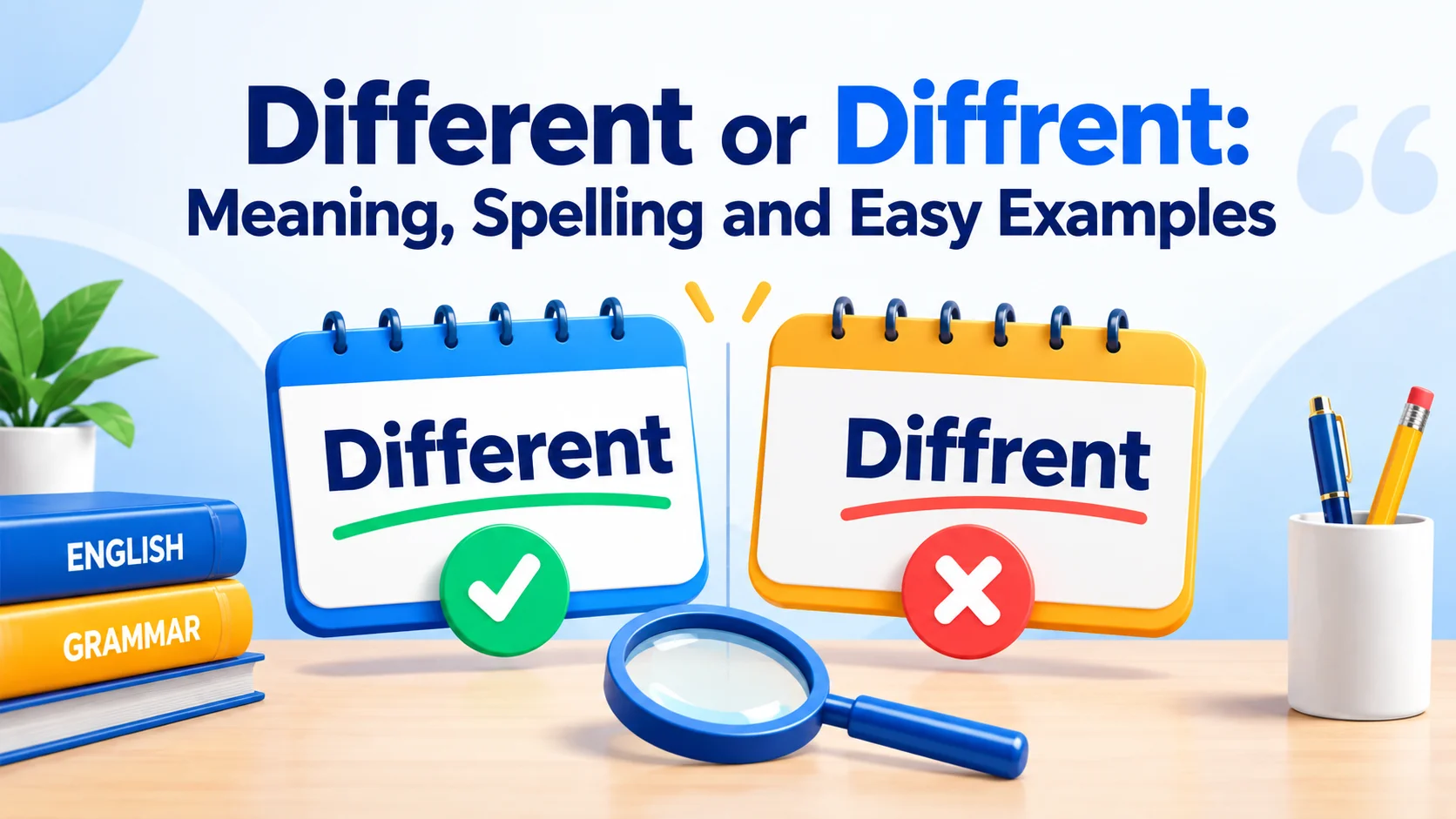
Different or diffrent? If you have ever typed this word quickly, you may have paused over that missing-looking vowel in the middle. The correct spelling is different, while diffrent is a common misspelling. The confusion is understandable because the middle of the word is not strongly pronounced in ordinary speech. That can make the spelling seem shorter than it actually is. In this guide, you will learn what different means, how to spell it correctly, why diffrent is so common, how to use different in sentences, and when to use different from, different than, or different to.
The word different is more useful than its basic definition suggests. It can describe two things that are not alike, a change from an earlier situation, an unusual characteristic, or an alternative choice. It also belongs to a useful word family that includes differ, difference, differently, and differing. Understanding these connections makes the spelling easier to remember and helps prevent grammar mistakes at the same time. Rather than memorizing one isolated spelling, you can learn the structure behind the word and recognize it confidently whenever you encounter it.
There is another reason this small spelling question deserves attention: different appears constantly in everyday, academic, and professional English. A missing letter can make otherwise polished writing look careless, particularly in applications, reports, emails, and formal assignments. The good news is that the mistake is easy to fix once you know what causes it. Below, we will look at the spelling, pronunciation, meaning, related words, comparison patterns, common errors, and practical examples so you can use different naturally and accurately.
Different or Diffrent: Which Spelling Is Correct?
The correct spelling is different.
Diffrent is a misspelling and is not the standard spelling of the English adjective.
| Form | Status | Meaning | Example |
| Different | Correct | Not the same; unlike | The two answers are different. |
| Diffrent | Incorrect | Misspelling of different | ❌ The two answers are diffrent. |
The most important spelling detail is easy to overlook:
different = D-I-F-F-E-R-E-N-T
Notice the two f’s and the e after them.
A useful way to see the structure is:
differ + ent = different
That connection is particularly helpful because differ is already a familiar English word. If you can remember differ, you have most of the spelling of different in place.
Quick rule: If you are writing about things that are not the same, use different, never diffrent.
What Does “Different” Mean?
Different is an adjective that generally means not the same as another person, thing, situation, or idea.
For example:
- My answer is different from yours.
- We chose a different restaurant.
- Her approach is different.
- These two machines produce different results.
The exact meaning depends on context. Sometimes different simply identifies a contrast. In other situations, it emphasizes a change or something distinctive.
Different Meaning in Everyday English
In ordinary conversation, different often appears when people compare two things.
“This coffee tastes different from the one we had yesterday.”
The speaker is not necessarily saying the new coffee is better or worse. It simply does not taste the same.
That distinction matters. Different is neutral by itself. The surrounding words and situation determine whether the difference is positive, negative, surprising, or merely factual.
Different Can Mean “Not the Same”
This is the central meaning.
Consider:
“The two jackets are different.”
The sentence tells us that the jackets are not identical in some relevant way. They might have different colors, sizes, materials, designs, or prices.
You do not always need to explain the exact difference if the context already makes it clear.
Different Can Mean “Unusual” or “Distinctive”
Sometimes different describes something that stands out from what people normally expect.
“She has a different way of solving problems.”
Here, different may suggest that her method is unusual or distinctive, but it does not automatically mean that the method is wrong.
Similarly:
“The restaurant has a different atmosphere.”
The meaning is closer to distinctive or unlike what the speaker is accustomed to.
Different Can Describe Change
Different can also describe how something has changed.
“You look different today.”
This does not necessarily mean the person has become completely unlike themselves. It could refer to clothing, hairstyle, mood, appearance, or simply the speaker’s perception.
Another example:
“The city feels different at night.”
Here, different describes a contrast between two situations: the city during the day and the city at night.
How Do You Spell “Different” Correctly?
The complete spelling is:
D-I-F-F-E-R-E-N-T
There are two features worth remembering:
- Double f: ff
- An e after the r: …erent
A common misspelling removes the internal e:
diffrent ❌
The correct version is:
different ✅
The Spelling Pattern Inside “Different”
A practical spelling breakdown is:
differ + ent
The word differ already has the important sequence:
d-i-f-f-e-r
Adding -ent gives:
d-i-f-f-e-r-e-n-t
This is more useful than trying to memorize every letter separately.
The same strategy works with related forms:
- differ
- different
- difference
- differently
- differing
Seeing these words together creates a stronger mental pattern.
The “Double F + E” Check
When proofreading, look specifically at the middle:
DIFF-E-R-ENT
Ask yourself:
“Did I keep both f’s and the e?”
If the word looks like diffrent, the answer is no. Put the e back:
diffrent → different
Why Do People Spell “Different” as “Diffrent”?
The mistake usually has nothing to do with not understanding the meaning. It is primarily a spelling and processing problem.
Several factors make different particularly easy to shorten accidentally.
Pronunciation Does Not Clearly Reveal Every Letter
In normal speech, the middle of different is not pronounced with every letter receiving equal emphasis.
When people speak quickly, the word can sound compressed. A learner may hear something closer to “dif-frent” and unconsciously reproduce that sound in writing.
This is a useful reminder:
English spelling cannot always be reconstructed perfectly from pronunciation.
The same principle applies to many other English words. Written English preserves spellings that speech may reduce or blur.
Fast Typing and Missing Letters
A person typing quickly may simply skip the e.
For example:
“The results are diffrent this year.”
The writer knows the word and its meaning but makes a mechanical typing error.
Because the resulting form still looks surprisingly familiar, the mistake can survive a quick visual scan.
Visual Familiarity and Habit
Repeated exposure to your own spelling can make an error look normal.
If someone frequently writes diffrent, the brain may begin recognizing that form as familiar. During proofreading, familiarity can make the missing letter harder to notice.
This is why proofreading is more effective when you deliberately look for specific error patterns instead of simply rereading quickly.
Overreliance on Autocorrect
Spellcheckers are useful, but they are not a substitute for knowing the correct spelling.
A writing tool may identify diffrent, but depending entirely on automated correction can create problems when:
- the tool is disabled,
- the correction is overlooked,
- the text is pasted somewhere without checking,
- or the error occurs in a context where automated suggestions are limited.
Knowing the correct form yourself is faster in the long run.
Different vs Diffrent: What Is the Difference?
There is no difference in meaning between the two forms because diffrent is not a standard alternative spelling of different.
The distinction is simply:
- different = correct
- diffrent = misspelled
Compare:
Correct: These two methods are different.
Incorrect: These two methods are diffrent.
The second sentence is understandable, but the spelling is wrong.
Is “Diffrent” Ever Correct?
Not as the standard spelling of the adjective different.
You may occasionally see diffrent in informal usernames, deliberately altered text, fictional dialogue, quoted material, or other nonstandard contexts. Those appearances do not make it a standard English spelling.
If you are writing:
- an essay,
- a resume,
- an email,
- a report,
- a website,
- an application,
- or professional correspondence,
use different.
Different vs Difference: Two Related Words That Are Easy to Confuse
Another common problem is not spelling but word choice.
Different and difference come from the same word family, but they perform different grammatical jobs.
| Word | Part of Speech | Meaning | Example |
| Different | Adjective | Not the same | The two plans are different. |
| Difference | Noun | The distinction between things | What is the difference? |
| Differ | Verb | To be unlike or vary | The two opinions differ. |
| Differently | Adverb | In a different way | They approached it differently. |
| Differing | Verb/adjectival form | Varying or being unlike | They presented differing opinions. |
Different vs Difference in Questions
Compare these two questions:
How are the two products different?
What is the difference between the two products?
Both are correct.
The first uses different, an adjective.
The second uses difference, a noun.
A common mistake is:
❌ What is the different?
The correct sentence is:
✅ What is the difference?
Different vs Differ
These words can also be confused because they express closely related ideas.
“The two studies differ in their conclusions.”
Here, differ is the verb.
“The two studies have different conclusions.”
Here, different is the adjective.
The meaning is related, but the grammar is not interchangeable.
Different in a Sentence: Easy Examples
The best way to understand different is to see how it behaves in natural sentences.
Everyday Conversation
- “I want to try something different tonight.”
- “This shirt looks different in natural light.”
- “Your recipe tastes different from mine.”
- “We took a different route home.”
- “She has a different opinion about the movie.”
These examples show that different can describe objects, choices, opinions, experiences, and actions.
School and Academic Writing
In academic contexts, different often introduces comparisons.
- “The two experiments produced different results.”
- “Students use different strategies when solving the problem.”
- “The researchers examined different groups.”
- “The results were different from those reported earlier.”
For formal writing, clarity matters more than simply using sophisticated vocabulary. If you know exactly what differs, say so.
Instead of:
“The results were different.”
you might write:
“The results differed significantly in their response rates.”
The second sentence gives the reader more useful information.
Workplace and Professional Writing
Different is common in professional communication:
- “We need a different approach.”
- “The two departments use different procedures.”
- “This version is different from the previous one.”
- “Customers have different expectations.”
- “The new policy created different requirements.”
In workplace writing, avoid using different so vaguely that readers have to guess what changed.
Describing People and Personalities
The word can describe a person’s behavior, perspective, or personality:
“He has a different way of explaining complicated ideas.”
That does not automatically mean the person is strange. It simply means the approach is unlike another approach.
Context determines the emotional tone.
Comparing Objects and Ideas
You can use different with nearly any meaningful comparison:
- different methods
- different opinions
- different cultures
- different priorities
- different results
- different materials
- different approaches
- different experiences
The important question is always: different in what way?
Different From, Different Than, or Different To?
This is a separate issue from the different vs diffrent spelling question.
All three constructions occur in English, but their use varies by region and context.
Different From
Different from is the safest choice for broad, formal, and international English.
Examples:
- “This design is different from the original.”
- “Her approach is different from mine.”
- “The new system is different from the old one.”
If you are unsure which form to use in formal writing, different from is generally the best default.
Different Than
Different than is well established, particularly in American English.
It can be especially natural when what follows is a clause:
“The result was different than I expected.”
It also appears in ordinary American usage:
“The situation is different than it was last year.”
Some writers prefer different from in formal prose, but different than is not simply a spelling mistake.
Different To
Different to is established in British English and some other varieties.
For example:
“This model is different to the previous one.”
A writer working in British English may encounter and use this construction naturally.
Which Form Should You Use?
| Construction | Typical use | Practical advice |
| Different from | Broad international/formal English | Safest general choice |
| Different than | Common in American English | Natural in many contexts, especially before clauses |
| Different to | Common in British English and some other varieties | Appropriate when following regional usage |
The key point is that different from, different than, and different to are usage choices, not spelling variants.
The word itself remains:
different
Common Grammar Patterns With “Different”
Understanding a few common structures will make your writing sound more precise.
Different From + Noun or Pronoun
“This phone is different from that one.”
“My opinion is different from yours.”
The construction identifies the two things being compared.
Different From + Possessive Pronoun
“Her method is different from mine.”
Notice that mine replaces “my method.”
You would not normally write:
❌ Her method is different from my.
Different in + Noun
Sometimes the comparison concerns a particular characteristic:
- different in size
- different in shape
- different in quality
- different in appearance
- different in design
Examples:
“The two versions are different in size.”
“The materials are different in quality.”
Different Than + Clause
A clause can follow different than:
“The outcome was different than we expected.”
The structure works naturally in varieties of English where different than is preferred or accepted.
Very Different, Slightly Different, and Completely Different
Modifiers can show the degree of difference.
| Expression | Meaning |
| Slightly different | A small difference |
| Somewhat different | A moderate or noticeable difference |
| Very different | A substantial difference |
| Completely different | Almost no meaningful similarity |
Compare:
“The second version is slightly different.”
with:
“The second version is completely different.”
The adjective stays the same; the modifier changes the strength.
Common Spelling Mistakes With “Different”
Different has several predictable misspellings.
Diffrent
❌ diffrent
The internal e has disappeared.
✅ different
Diferent
❌ diferent
One of the two f’s is missing.
✅ different
Differant
❌ differant
The final vowel pattern is incorrect.
✅ different
Differnt
❌ differnt
The e has been removed.
✅ different
Diferant
❌ diferant
This combines more than one spelling problem.
✅ different
A useful proofreading technique is not to memorize every incorrect version individually. Instead, memorize the correct structure:
DIFF + ER + ENT
The “Different” Word Family
Learning the word family makes both spelling and grammar easier.
Differ
Differ is a verb.
“The two reports differ in several important ways.”
It means to be unlike or to vary.
Difference
Difference is a noun.
“There is a significant difference between the two results.”
It names the distinction itself.
Differently
Differently is an adverb.
“The two teams approached the problem differently.”
It tells us that an action was performed in another way.
Differing
Differing can describe things that vary from each other.
“The researchers presented differing interpretations.”
It is particularly useful in formal and academic writing.
Why Learning the Word Family Helps
Instead of treating five words as unrelated spelling challenges, connect them:
differ → different → difference → differently → differing
Once the spelling pattern becomes familiar, you are less likely to lose letters when writing quickly.
Common Usage Mistakes With “Different”
Spelling is only one part of using the word correctly.
Mistaking “Different” for “Difference”
Incorrect:
❌ “What is the different between these products?”
Correct:
✅ “What is the difference between these products?”
The noun difference is required after “what is the.”
Using “Different” Without a Clear Comparison
The word can be used without explicitly naming the comparison:
“Something feels different.”
That is perfectly natural when the context supplies the missing comparison.
However, in formal writing, vague uses can weaken the sentence.
Compare:
“The results were different.”
with:
“The results were different in accuracy and response time.”
The second gives the reader a clearer reason for the comparison.
Assuming “Different” Means Better or Worse
Different does not automatically mean superior, inferior, strange, or wrong.
Consider:
“The second approach is different.”
The sentence makes no judgment.
To express an evaluation, you need additional language:
“The second approach is different and more efficient.”
or:
“The second approach is different but less practical.”
Treating Different From, Different Than, and Different To as Spelling Variants
They are not different spellings of the word.
The spelling is always:
different
The variation concerns the grammatical construction that follows it.
Correct vs Incorrect Examples
| Incorrect | Correct | Explanation |
| These results are diffrent. | These results are different. | The e is missing. |
| The two methods are diferent. | The two methods are different. | The second f is missing. |
| What is the different? | What is the difference? | The sentence needs the noun difference. |
| The results are differant. | The results are different. | The ending is misspelled. |
| This version is diffrent than the first. | This version is different than the first. | The spelling must contain the internal e. |
One important distinction: a sentence containing different than is not automatically wrong. The spelling problem and the regional usage question are separate issues.
How to Proofread “Different” in Your Own Writing
A good proofreading routine does more than search for red underlines.
First, Check the Internal Letters
Look directly at:
D-I-F-F-E-R-E-N-T
Make sure both f’s are present and the internal e has not disappeared.
Next, Check the Word Family
Ask yourself whether the sentence requires:
- different
- difference
- differ
- differently
- differing
This catches grammar problems that a simple spelling check may not address.
Then, Read the Whole Sentence
Ask:
- What two things are being compared?
- Is different describing something?
- Do I actually need difference?
- Is the comparison clear?
- Is the sentence appropriate for my variety of English?
Finally, Use Spellcheck
Automated tools are useful as a final layer, especially for repeated typing mistakes. But they work best when you already understand the word.
Quick Reference: Different or Diffrent?
| Question | Answer |
| Correct spelling? | Different |
| Is “diffrent” standard English? | No |
| What does different mean? | Not the same; unlike |
| How many f’s? | Two |
| Is there an e after the r? | Yes |
| Related noun? | Difference |
| Related verb? | Differ |
| Related adverb? | Differently |
| Safest comparison form? | Different from |
| Is different than used in English? | Yes, especially in American English |
| Is different to used in English? | Yes, especially in British English |
Mini Practice: Can You Spot the Correct Form?
Choose the Correct Spelling
- These two paintings look different / diffrent.
- Her answer was different / diffrent from mine.
- We need a different / diffrent solution.
- The new design is completely different / diffrent.
- Their opinions are different / diffrent.
Answers:
- different
- different
- different
- different
- different
Choose Different or Difference
- What is the ______ between these two plans?
- The two plans are ______.
- Their opinions ______ considerably.
- They approached the task ______.
Answers:
- difference
- different
- differ
- differently
Correct the Sentence
“The two products are diffrent, but I can’t see the differance.”
Correct version:
“The two products are different, but I can’t see the difference.”
This example demonstrates why learning the word family together is more effective than memorizing one spelling in isolation.
Conclusion
The correct spelling is different, not diffrent. The easiest way to remember it is to notice the double f and the internal e, or break the word into differ + ent. Just as importantly, remember that different is an adjective, while difference is the related noun and differ is the verb. When comparing things, different from is a dependable choice across formal and international English, while different than and different to have established regional uses. One final actionable tip: whenever you type different, quickly check the middle letters before moving on. A common mistake to avoid is treating pronunciation as a perfect spelling guide. In English, what you hear and what you write do not always match exactly.
Frequently Asked Questions
Q1. Is “diffrent” a correct spelling?
No. Diffrent is a common misspelling of different. The correct spelling contains two f’s followed by e-r-e-n-t. The missing internal e often results from fast typing or from writing the word according to its compressed pronunciation.
Q2. Why is “different” often misspelled as “diffrent”?
The pronunciation of different can make the middle vowel less noticeable, especially in quick speech. Writers may also omit the letter accidentally while typing. Once an incorrect form becomes visually familiar, it can be surprisingly easy to overlook during proofreading.
Q3. How can I remember the spelling of different?
Think of differ + ent. Another useful visual reminder is DIFF-E-RENT, which keeps both f’s and the important internal e visible. Connecting different with difference, differ, and differently also reinforces the spelling.
Q4. Should I use “different from” or “different than”?
Different from is the safest broadly accepted choice, especially in formal and international writing. Different than is well established in American English and works naturally in many constructions. The best choice can therefore depend on region and sentence structure.
Q5. What is the difference between “different” and “difference”?
Different is an adjective describing things that are not the same: “The answers are different.” Difference is a noun referring to the distinction itself: “What is the difference?” They are related words but cannot always replace one another grammatically.
