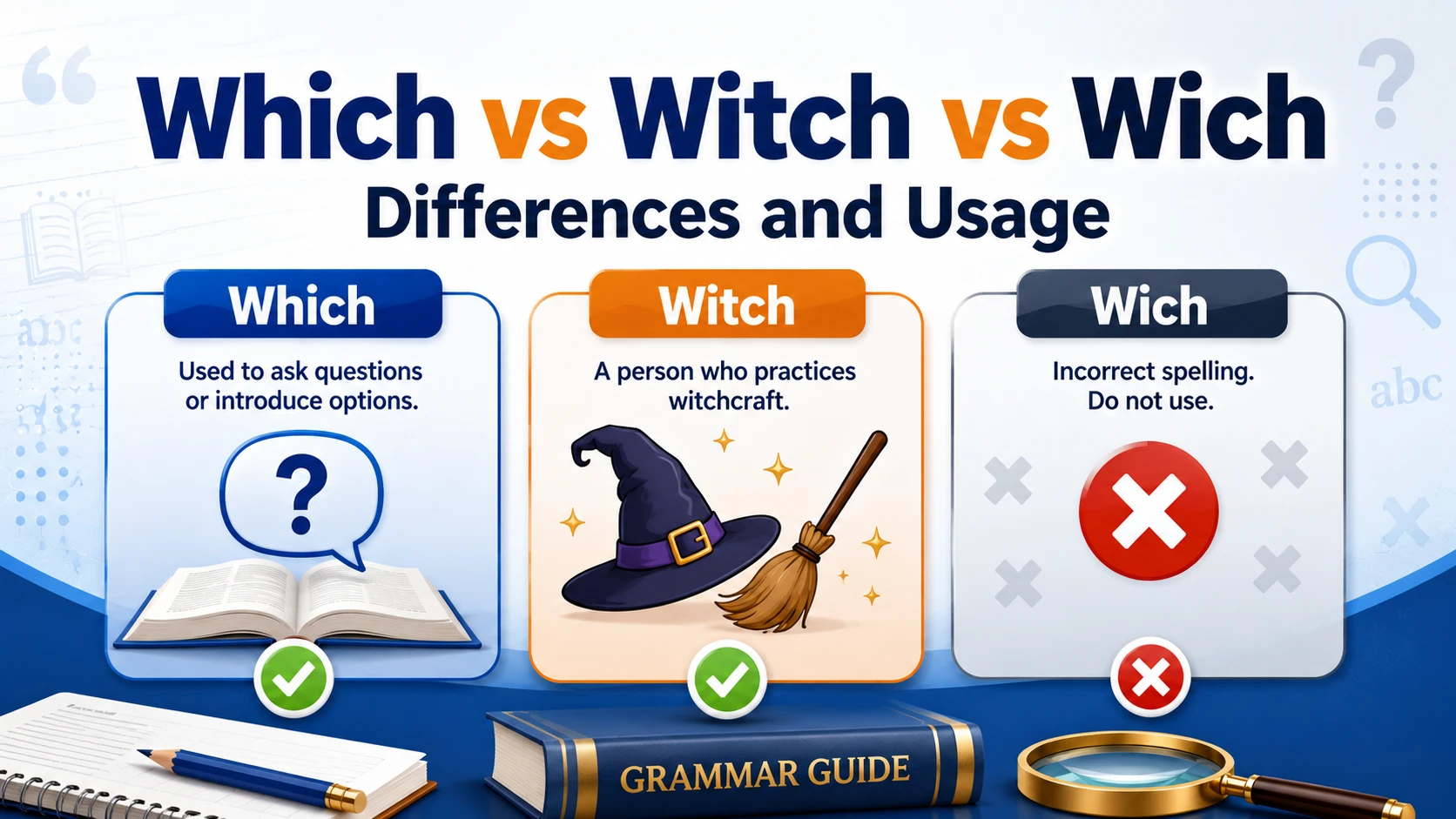
Which vs witch vs wich can be confusing because the three spellings look remarkably similar, while only two are normally used in everyday English. Which is a grammar word used to identify or select something, while witch is a noun associated with witchcraft, magic, folklore, or fantasy. Wich, by contrast, is usually a misspelling of which when someone is asking about a choice. The confusion becomes stronger because which and witch sound the same in many English accents. Once you separate their meanings, grammatical roles, and spelling patterns, the distinction becomes much easier to remember.
The most important point is that which and witch are different words with different meanings, even when their pronunciation is identical. You might ask, “Which jacket should I buy?” but you could also write, “The witch lives in an old cottage.” The first sentence involves selection, whereas the second describes a person associated with witchcraft. Meanwhile, writing “Wich jacket should I buy?” creates a spelling error in ordinary modern English. This guide explains not only the basic difference but also pronunciation, grammar, common mistakes, unusual uses of wich, and practical ways to choose the correct spelling.
A good spelling rule is simple: which chooses, witch practices magic, and wich usually needs checking. However, real English has a few details worth knowing. Which can function as a determiner, pronoun, or relative pronoun, and its use can depend on sentence structure. Witch has its own grammatical forms and can appear in cultural, historical, and fictional contexts. You may also encounter -wich in place names, where it isn’t simply a misspelling. By the end, you’ll be able to distinguish which vs witch vs wich quickly, understand why people confuse them, and avoid the error in everyday, academic, and professional writing.
Quick Answer: Which vs Witch vs Wich
Here’s the distinction you usually need:
| Word | What it means | Typical role | Example |
| which | Identifies or asks about a choice | Determiner or pronoun | “Which option do you prefer?” |
| witch | A person associated with witchcraft | Noun | “The witch appears in the story.” |
| wich | Usually a spelling error for which | Not normally a standard everyday word | “Wich one?” → “Which one?” |
The easiest rule
Use which for choices or identification.
Which restaurant should we try?
Use witch for a person associated with witchcraft.
The witch disappeared into the forest.
Treat wich as an error unless it appears in a genuine name or historical term.
❌ Wich book did you choose?
✅ Which book did you choose?
That rule handles almost every everyday situation.
What Does “Which” Mean?
Which is a standard English grammar word used when you want to identify or select something from a set of possibilities. It can refer to people, objects, places, ideas, dates, options, or other things.
The word has several grammatical functions, so understanding its role is more useful than memorizing a single definition.
Which as a Determiner
A determiner comes before a noun and helps identify which particular person or thing you mean.
Examples:
- Which book did you buy?
- Which student answered the question?
- Which road leads to the airport?
- Which color looks better?
- Which computer belongs to Sarah?
In each example, which works directly with the noun that follows it.
A useful test is to look at the next word. If which + noun forms the relevant phrase, which is functioning as a determiner.
Which as a Pronoun
Which can also stand alone when the noun is already understood.
- Which do you prefer?
- Which is yours?
- Which should we choose?
- Which did they recommend?
For example:
We have two meeting rooms. Which do you want?
The speaker doesn’t repeat meeting room because the meaning is already clear.
Which in Questions
The most familiar use of which appears in questions involving a known, limited, or understood set of possibilities.
Which train are you taking?
The question assumes there are relevant trains to choose from.
Compare:
What do you want to eat?
This can be an open-ended question.
Which dessert do you want?
This normally suggests a particular set of desserts is available.
The distinction isn’t absolute in every conversation, but it’s a useful practical guideline.
Which in Relative Clauses
Which also introduces relative clauses.
I bought a new laptop, which arrived yesterday.
Here, which connects additional information to laptop.
This use is particularly important in formal writing because punctuation can affect meaning.
Compare:
The car, which I bought last year, is still reliable.
The commas indicate that the information is additional rather than essential to identifying the car.
In American English, writers should pay attention to the distinction between restrictive and nonrestrictive relative clauses and choose punctuation deliberately rather than adding commas simply because which appears.
Which vs What: A Related Question
A common beginner mistake is treating which and what as exact substitutes.
Consider:
What movie do you want to watch?
This can invite a broad answer.
Which movie do you want to watch?
This often implies that several specific movies are available.
The practical question is: Are you selecting from an identifiable set? If so, which is often the better choice.
What Does “Witch” Mean?
Witch is a noun referring to a person traditionally associated with witchcraft or magical practices. The word appears frequently in folklore, literature, fantasy, history, Halloween traditions, and popular culture.
Examples include:
- The witch entered the castle.
- The children dressed as witches for Halloween.
- The novel features a powerful witch.
- The villagers feared the witch in the old legend.
Unlike which, witch is a content word with a concrete meaning. It doesn’t ask a question or identify an option.
Witch in Folklore and Fantasy
The image of a witch varies considerably across cultures and historical periods. In modern English, the word can refer to a fictional magical character, a figure from folklore, or someone described within a historical or cultural context.
A children’s story might portray a witch as a magical character:
The witch turned the pumpkin into a carriage.
A fantasy novel may use the word more neutrally:
The young witch studied ancient spells.
The surrounding context determines how the word should be understood.
Witch in Modern Culture
You’ll commonly encounter witch in:
- Halloween discussions
- Fantasy novels
- Fairy tales
- Films and television
- Folklore
- Historical writing
- Games
- Cultural discussions
The meaning can therefore be literal, fictional, historical, or cultural.
Related Forms of Witch
Several words are built from witch:
- witches — plural
- witchcraft — practices or beliefs associated with witchcraft
- witchy — resembling or associated with a witch
- witching — associated with witchcraft or used in certain established expressions
For example:
The novel is filled with witchcraft and supernatural events.
The important point remains unchanged: witch belongs to the semantic field of magic and witchcraft, not grammar or choice.
Is “Wich” a Word?
This is where the spelling question gets interesting.
In ordinary modern English, wich is not the standard spelling of the grammar word which. If you’re writing a question such as “Which one should I choose?”, spelling it “Wich one should I choose?” is an error.
However, saying that wich can never appear anywhere would be too broad.
Why “Wich” Is Usually Incorrect
When someone types:
Wich one is yours?
they almost certainly mean:
Which one is yours?
The missing h makes wich a spelling mistake.
The same problem appears in:
- ❌ Wich answer is correct?
- ❌ Wich road should I take?
- ❌ Wich color do you prefer?
- ❌ Wich book did she choose?
Correct versions:
- ✅ Which answer is correct?
- ✅ Which road should I take?
- ✅ Which color do you prefer?
- ✅ Which book did she choose?
When You May Actually See “Wich”
You may encounter -wich in English place names, surnames, historical references, or other proper names.
For example, names such as Sandwich contain wich. That doesn’t mean wich is being used as a modern alternative to which.
This distinction matters:
Which is a normal English grammar word.
-wich may be part of a proper name or historical place-name element.
Therefore, don’t automatically “correct” wich when it appears inside a legitimate name.
Wich vs Which in Everyday Writing
If you’re writing a normal sentence and you’re unsure whether to use wich or which, the answer is overwhelmingly likely to be which.
❌ Wich dress should I wear?
✅ Which dress should I wear?
If wich appears as part of a proper name, preserve the established spelling instead.
Which vs Witch: Understanding the Core Difference
The simplest way to distinguish which vs witch is to ask what the word is doing in the sentence.
| Question to ask | Correct word |
| Am I choosing between options? | which |
| Am I identifying something? | which |
| Am I introducing certain relative-clause information? | which |
| Am I referring to someone associated with witchcraft? | witch |
| Did I write “wich” while intending the question word? | Change it to which |
Consider these pairs:
Which character is your favorite?
The witch is the main character.
The first sentence asks for a selection. The second identifies a person in a story.
Another pair:
Which house belongs to the mayor?
The witch lives in the house.
The words may sound similar, but their meanings have nothing to do with each other.
Why Substitution Doesn’t Work
Replacing which with witch can completely change the sentence.
Which book did you read?
becomes:
Witch book did you read?
The second version isn’t a normal grammatical sentence.
Likewise:
The witch entered the room.
cannot become:
The which entered the room.
The grammar and meaning collapse because the words perform different jobs.
Which vs Witch Pronunciation
Pronunciation is one reason this spelling problem survives.
Are Which and Witch Homophones?
In many modern English accents, which and witch are pronounced the same or nearly the same. When two words share pronunciation but have different spellings and meanings, they’re commonly described as homophones.
For many speakers:
- which → /wɪtʃ/
- witch → /wɪtʃ/
This means you can’t always determine the spelling from hearing the word.
The Wine–Whine Distinction
Some English accents preserve a distinction between the initial sounds in words such as:
- wine / whine
- weather / whether
- witch / which
In accents with this distinction, which may begin with a slightly different sound from witch.
However, this pronunciation difference isn’t universal. That’s why learners shouldn’t rely on pronunciation alone when deciding how to spell the word.
Why Spelling Matters When They Sound Alike
Imagine someone says:
“Which one?”
You hear the sound, but there is no visible spelling.
If you’re writing the sentence, you must use the word’s meaning and grammatical function, not merely its sound.
That’s a broader English lesson: homophones often require context to spell correctly.
What About “Wich”?
If you type wich because you hear /wɪtʃ/, you’ve removed the spelling clue that distinguishes the standard word which.
The safest approach is to connect:
which → choice
rather than trying to spell the word phonetically.
Which vs Witch for Everyday Writing
The easiest way to avoid errors is to recognize the context before worrying about spelling.
Use “Which” for Choices
- Which shirt should I wear?
- Which bus goes downtown?
- Which answer did you select?
- Which option is cheaper?
Use “Witch” for Witchcraft or Magic
The witch cast a spell.
The story begins with a mysterious witch.
She dressed as a witch for Halloween.
Don’t Use “Wich” as a Shortcut
❌ Wich option is better?
✅ Which option is better?
The missing h is small, but it matters.
Which vs Witch in Sentences
Seeing the words in realistic contexts is often more useful than memorizing definitions.
Examples With “Which”
- Which restaurant are we visiting tonight?
- Which candidate received the most votes?
- Which route takes less time?
- I don’t know which answer to choose.
- The laptop, which I bought last month, is already damaged.
- Which of these keys opens the door?
- She asked which train we planned to take.
Examples With “Witch”
- The witch lived near the edge of the village.
- The children wore witch costumes for Halloween.
- The fantasy novel follows a young witch.
- The story describes a powerful witch and her apprentice.
- The old legend mentions a witch who lived in the forest.
Examples With “Wich” Corrected
| Incorrect | Correct | Reason |
| Wich one is yours? | Which one is yours? | The sentence asks for a choice. |
| Wich color do you like? | Which color do you like? | Which identifies a choice. |
| Wich bus should I take? | Which bus should I take? | Wich is a misspelling here. |
| The witch cast a spell. | The witch cast a spell. | Witch refers to a magical person. |
Common Mistakes With Which, Witch, and Wich
Mistake 1: Writing “Wich” Instead of “Which”
This is probably the most straightforward error.
❌ Wich phone should I buy?
✅ Which phone should I buy?
Why it happens: The word is often pronounced quickly, so writers may leave out the silent-looking h.
Fix: Memorize the association which = choice.
Mistake 2: Writing “Witch” Instead of “Which”
This usually happens when someone relies entirely on sound.
❌ Witch option do you recommend?
✅ Which option do you recommend?
If the sentence asks a question about alternatives, witch doesn’t belong there.
Mistake 3: Assuming “Wich” Is an Alternative Spelling
It’s not normally acceptable to treat wich as a shorter version of which.
❌ Wich is better?
✅ Which is better?
English spelling doesn’t generally permit dropping the h from which.
Mistake 4: Correcting a Proper Name
The opposite mistake can also happen.
Suppose a place or business has an established name containing Wich. Automatically changing it to Which could create a new error.
Expert practice: Correct ordinary vocabulary according to standard usage, but preserve genuine proper names.
Why People Confuse Which, Witch, and Wich
There are several overlapping reasons.
Similar Letter Patterns
Which and witch share most of their letters:
- w
- i
- c
- h
Only the position of h creates the visible difference.
Wich looks even more tempting because it removes just one letter.
Identical or Similar Pronunciation
When which and witch sound identical, the listener receives no spelling information.
That makes the confusion understandable rather than random.
English Has Many Homophones
English contains numerous word pairs where sound isn’t enough to determine spelling:
- their / there / they’re
- to / too / two
- your / you’re
- hear / here
- right / write
Which and witch belong to the same general spelling challenge.
Fast Digital Writing
Text messages, comments, and rushed notes encourage people to type according to sound. A missing letter may go unnoticed, particularly when the sentence remains understandable.
That doesn’t make the spelling correct. It simply explains why the mistake is common.
Which vs Witch Memory Tricks That Actually Work
A useful mnemonic should connect meaning and spelling, not just pronunciation.
Remember “Which” With “Choice”
Think:
Which = Which choice?
If you’re selecting something, use which.
Remember “Witch” With “Magic”
Think:
Witch = witchcraft
Both words connect directly with magic.
Remember “Wich” as the Warning
If you see:
wich
stop for a second.
Ask:
“Do I mean the question word?”
If yes, add the h:
which
The Three-Word Rule
Which chooses. Witch casts. Wich checks.
It’s short enough to remember when you’re writing quickly.
Which vs Witch Examples by Context
Context makes these words much easier to distinguish.
Everyday Conversation
Which coffee do you want?
Which seat should I take?
Which movie are we watching?
These all involve choices.
School and Academic Writing
Which theory best explains the results?
The article, which was published in 2025, examines the issue.
Here, which performs grammatical work.
Professional Communication
Which version should I send to the client?
Please confirm which file contains the final data.
Professional writing benefits from getting this distinction right because a spelling error can make otherwise polished communication look careless.
Creative Writing
The witch stood beneath the moonlight.
The young witch discovered an ancient spell.
Here, witch is a meaningful noun.
Digital Communication
Which one do you prefer?
A rushed writer might type:
Wich one do you prefer?
The meaning remains obvious, but the spelling is still incorrect in standard English.
Which Witch Is Which? Understanding the Famous Phrase
“Which witch is which?” is a useful phrase because it places two commonly confused words next to each other.
It means, roughly:
Which particular witch is being referred to or identified?
Here:
- Which = asks for identification.
- witch = refers to a person associated with witchcraft.
- which = asks for identification again.
The phrase is therefore an excellent spelling exercise.
Why the Phrase Is So Memorable
It demonstrates a key principle of English:
Pronunciation alone doesn’t always tell you which spelling to use.
If you hear the phrase spoken in an accent where which and witch are homophones, the sounds won’t tell you which written form belongs in each position.
The surrounding meaning does.
A Practical Spelling Test
When you encounter a confusing sentence, temporarily replace the word with its meaning.
If the sentence means:
“What choice or item?”
use which.
If it means:
“A person associated with witchcraft?”
use witch.
This meaning-first approach is more reliable than trying to hear the spelling.
Practice: Which, Witch, or Wich?
Practice is especially useful when two words sound alike.
Fill-in-the-Blank Practice
Choose which, witch, or wich where appropriate.
- ______ book would you like to borrow?
- The ______ lived in an isolated cottage.
- ______ train arrives first?
- She dressed as a ______ for Halloween.
- ______ answer did you select?
- I don’t know ______ route is shorter.
Answers:
- Which
- witch
- Which
- witch
- Which
- which
Notice that ordinary sentences almost never require wich.
Correct the Spelling
Correct each sentence:
- Wich one should I choose?
- The witch lives in the castle.
- Wich color is your favorite?
- Witch route should we take?
- The witch appeared in the legend.
Corrected versions:
- Which one should I choose?
- The witch lives in the castle.
- Which color is your favorite?
- Which route should we take?
- The witch appeared in the legend.
Multiple-Choice Practice
1. ___ dress do you prefer?
A. Witch
B. Which
C. Wich
Answer: B — Which
2. The story features an evil ___.
A. which
B. wich
C. witch
Answer: C — witch
3. ___ answer did the teacher mark correct?
A. Which
B. Witch
C. Wich
Answer: A — Which
Context-Based Challenge
Consider this short passage:
Two costumes were hanging by the door. Maya asked, “___ one should I wear?” Her brother pointed to the black costume and said, “The ___ costume looks more convincing.”
The answers are:
Which one should I wear?
and
The witch costume looks more convincing.
The same general topic can contain both words because their grammatical roles remain different.
Which vs Witch vs Wich: Quick Decision Guide
Use this decision table whenever you’re uncertain:
| What are you trying to say? | Correct form | Example |
| Asking someone to choose | which | Which one do you want? |
| Identifying something | which | Which car is yours? |
| Referring to a relative clause | which | The book, which I enjoyed, was long. |
| Referring to a magical person | witch | The witch entered the room. |
| Writing a normal question with “wich” | which | Which answer is correct? |
| Seeing -wich in a proper name | Preserve the established spelling | Sandwich |
The Fastest Test
Ask yourself:
Am I talking about a choice or a person associated with witchcraft?
- Choice or identification → which
- Witchcraft or a magical person → witch
- Neither → inspect the context carefully before using wich
Best Practices for Using Which and Witch Correctly
A few habits make these errors almost disappear.
Read for Meaning Before Spelling
Don’t begin by asking, “How does this sound?”
Ask:
What does this word mean in my sentence?
Meaning will usually reveal the correct spelling.
Watch for Question Structures
Words such as:
- which one
- which book
- which option
- which person
- which way
- which answer
almost always signal which.
Watch for Witchcraft Context
Words such as:
- spell
- magic
- broom
- potion
- wizard
- cauldron
- Halloween
- witchcraft
can provide clues that witch is the intended noun.
The surrounding vocabulary isn’t a grammar rule, but it can make the intended meaning obvious.
Proofread Homophones Separately
When proofreading, don’t only look for obvious typos. Check homophones and near-homophones because spell-checkers may not catch them.
A sentence such as:
Witch option should we use?
contains a correctly spelled English word in the wrong grammatical position. A basic spell-checker may not identify that as a spelling error.
Meaning-based proofreading catches what ordinary spell-checking misses.
Common Misconceptions About Which, Witch, and Wich
“Wich Is Just a Short Version of Which”
No. In standard everyday English, wich isn’t an informal shortened spelling of which.
Use which.
“Which and Witch Are Always Pronounced Differently”
Not necessarily. Many speakers pronounce them identically.
Accent matters.
“If a Word Sounds Right, Its Spelling Is Right”
English doesn’t work that way.
Homophones prove why. Two different words can share pronunciation while having completely different spellings and meanings.
“Wich Is Never Found in English”
That’s too absolute.
You can encounter wich as part of proper names, place names, or historical forms. The important distinction is that these specialized occurrences don’t make wich an everyday alternative to which.
“Which Only Appears in Questions”
No.
Which can also appear in relative clauses:
The car, which was parked outside, belongs to me.
Understanding this broader use helps advanced writers avoid an unnecessarily narrow definition.
Conclusion
The difference between which vs witch vs wich becomes straightforward once you focus on meaning rather than pronunciation. Which is the standard grammar word used to identify or select among possibilities, while witch is a noun associated with witchcraft, folklore, magic, or fictional characters. Wich is normally a misspelling when someone intends which, although it can legitimately appear within certain proper names or historical forms. Because which and witch sound identical for many speakers, context is your best spelling guide. One final actionable tip: whenever you’re unsure, replace the word mentally with “choice” or “magic.” Choice points to which; magic points to witch. A common mistake to avoid is treating wich as an acceptable shortened form of which. In standard everyday writing, keep the h.
Frequently Asked Questions
Q1. Is “wich” a correct English word?
In ordinary modern English, wich isn’t the standard spelling of which. If you’re asking about a choice, write which. However, wich can appear in proper names and historical place-name elements, so context matters when the spelling occurs as part of a name.
Q2. Are “which” and “witch” homophones?
Often, yes. In many English accents, which and witch are pronounced alike or nearly alike. Some accents preserve a distinction between their initial sounds. Because pronunciation varies, writers should rely on meaning and grammar, not sound alone.
Q3. Which is correct: “wich one” or “which one”?
Which one is correct in standard English when you’re asking someone to select or identify something. Wich one is normally a spelling error. For example: “Which one would you like?” The h belongs in the standard spelling.
Q4. Why is “which” spelled with an h?
The spelling reflects the historical development of English rather than a simple modern pronunciation rule. English contains many spellings whose letters aren’t obvious from contemporary pronunciation. That’s why learning which as a whole word is more reliable than trying to spell it phonetically.
Q5. Can “wich” ever be correct?
Yes, but usually in a proper name, historical reference, or established place-name element, rather than as the ordinary question word. For everyday writing, if you mean “which option?” or “which one?”, use which. Don’t replace the standard spelling merely because wich looks simpler.
