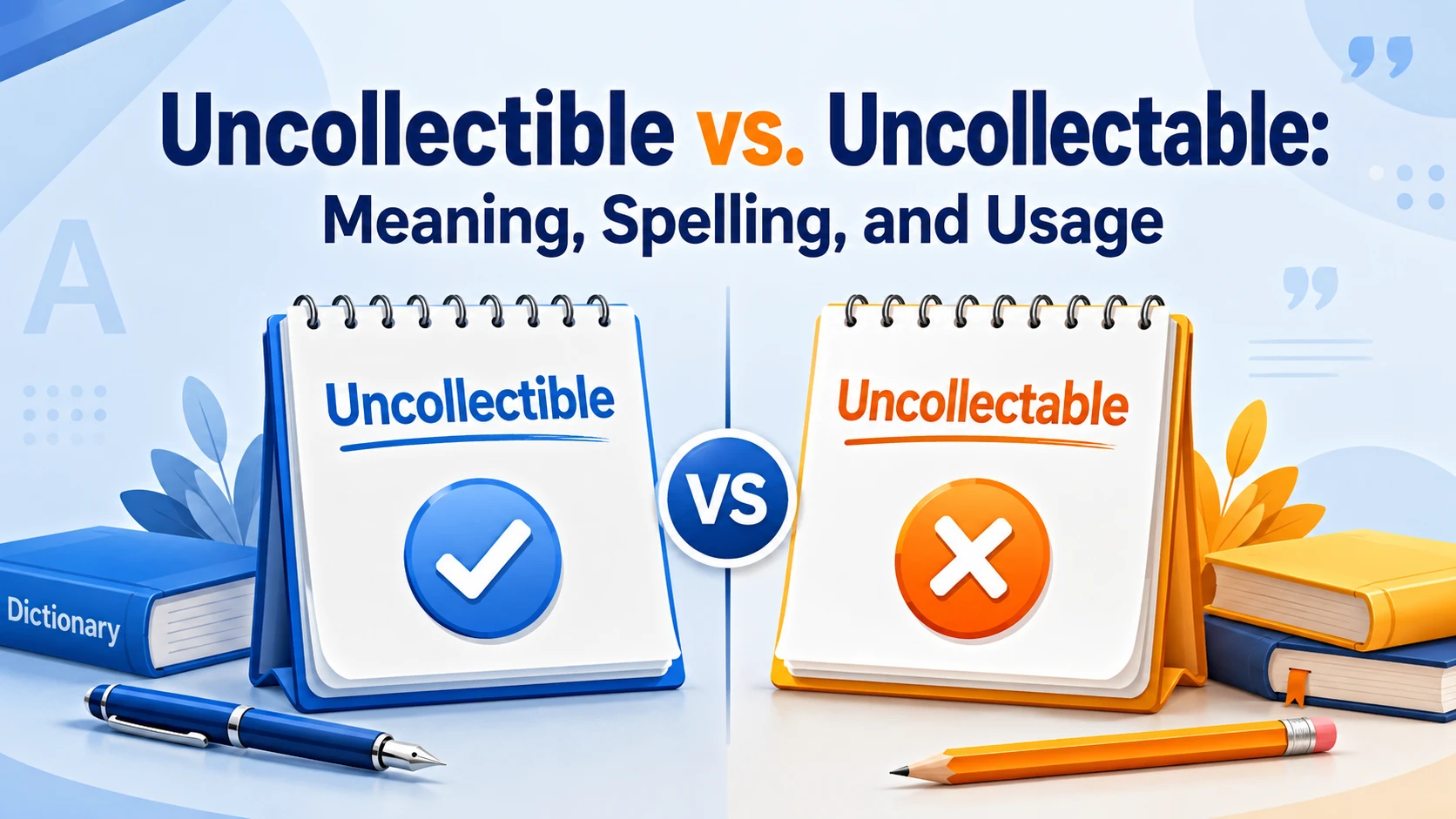
Uncollectible vs. uncollectable can confuse writers because both spellings are valid and have nearly the same meaning. You may see them in financial reports, business documents, legal writing, dictionaries, or general English, which can make it difficult to know which form to use. The confusion becomes stronger because many spellcheck tools accept both words without explaining which spelling is more common in a particular context.
In most cases, uncollectible and uncollectable mean “unable to be collected or recovered.” They are often used to describe unpaid money, debts, invoices, loans, or accounts that a business is unlikely to recover. The main difference is not meaning but spelling preference, frequency, and editorial style. Uncollectible is generally the more common form, especially in accounting and financial writing, while uncollectable is also an accepted spelling.
This guide explains the meaning of both words, their spelling differences, common uses, examples, and the best choice for professional writing. By the end, you will know when to use each form and how to keep your writing clear and consistent.
Quick Answer
Uncollectible and uncollectable generally mean “unable to be collected or recovered.” Both spellings are correct, but uncollectible is more common, especially in accounting, finance, and business writing.
For most modern professional writing, uncollectible is usually the safest choice.
Why Do People Confuse Uncollectible and Uncollectable?
The confusion comes from the English endings -ible and -able. Both endings are common, and English does not always provide a simple rule for choosing between them.
Writers may feel uncertain because:
- Both spellings appear in dictionaries.
- Both forms have the same basic meaning.
- Both can appear in professional writing.
- Different publications may follow different style preferences.
- Spellcheck tools may accept both without giving usage advice.
Unlike many word comparisons, this is not mainly a difference in meaning. It is mostly a question of spelling preference and consistency.
What Does Uncollectible Mean?
Uncollectible means unable to be collected, recovered, or obtained. The word is commonly used in accounting, finance, banking, and business to describe money that is unlikely to be received.
Simple Definition
Uncollectible means unlikely or impossible to collect or recover.
The word often applies to:
- Unpaid invoices
- Overdue customer balances
- Defaulted loans
- Unpaid accounts receivable
- Debts that a creditor is unlikely to recover
Example
“The company classified the unpaid invoice as uncollectible.”
This means the company believes it is unlikely to receive the money.
How Is Uncollectible Formed?
The word can be divided into three parts:
- Un- = not
- Collect = to gather, obtain, or recover
- -ible = capable of or able to be
Together, the word means:
Not capable of being collected.
The ending -ible also appears in words such as:
- Visible
- Reversible
- Divisible
However, English spelling does not always follow one universal rule, so it is best to learn the accepted form of each word.
Uncollectible in Accounting and Finance
In accounting, uncollectible usually describes money owed to a business that is not expected to be recovered.
For example:
“The business recorded an expense for uncollectible accounts.”
An account may become uncollectible when:
- A customer cannot pay
- A borrower defaults
- A business closes
- The debtor becomes insolvent
- Repeated collection attempts fail
Companies track uncollectible amounts because financial records should reflect the money they reasonably expect to receive.
What Are Uncollectible Accounts?
Uncollectible accounts are customer balances that a company does not expect to recover.
Examples may include:
- Unpaid invoices
- Overdue credit balances
- Defaulted loans
- Customer accounts with unsuccessful collection efforts
In accounting, these amounts may be associated with terms such as bad debt or doubtful accounts, depending on the situation and accounting method.
What Does Uncollectable Mean?
Uncollectable has the same basic meaning as uncollectible.
It means:
Unable to be collected or recovered.
For example:
“The debt was considered uncollectable after repeated collection attempts failed.”
The meaning is the same as it would be with uncollectible.
The difference is mainly related to:
- Spelling preference
- Usage frequency
- Publication style
- Regional or editorial conventions
Is Uncollectable a Correct Word?
Yes. Uncollectable is a correct English spelling.
It is not a spelling mistake, and it should not automatically be changed to uncollectible. However, uncollectible is generally more common in modern financial and professional writing.
If you are writing for a specific organization, publication, school, or client, follow its preferred dictionary or style guide.
Uncollectible vs. Uncollectable: The Main Difference
| Feature | Uncollectible | Uncollectable |
| Meaning | Unable to be collected or recovered | Unable to be collected or recovered |
| Correct spelling? | Yes | Yes |
| General frequency | More common | Less common |
| Accounting use | Common | Less common |
| Financial writing | Usually preferred | Acceptable but less frequent |
| Meaning difference | None in ordinary usage | None in ordinary usage |
| Best general choice | Usually recommended | Use when required by a style preference |
The difference is mainly about frequency and style, not meaning.
Which Spelling Should You Use?
For most modern writing, use:
Uncollectible
It is generally the more familiar and widely used spelling, particularly in:
- Accounting
- Finance
- Banking
- Business reports
- Accounts receivable
- Professional communication
Use uncollectable when:
- A dictionary or style guide used by your organization prefers it
- You are following an established publication style
- You are editing a document that consistently uses that spelling
- The spelling is already part of a quoted or official term
The most important rule is to remain consistent throughout the document.
Is Uncollectible American and Uncollectable British?
Not exactly. It is better not to treat this as a strict American English versus British English rule.
Both spellings are recognized, and usage can vary between dictionaries, publishers, industries, and regions. Although uncollectable may appear in some British, international, or older publications, it is not simply the British replacement for uncollectible.
For formal writing, check the style guide or dictionary required by your school, employer, or publication.
How to Use Uncollectible Correctly
Use uncollectible when discussing money, debts, invoices, or accounts that are unlikely to be recovered.
Correct Examples
“The company classified several overdue invoices as uncollectible.”
“The accountant reviewed the uncollectible accounts at the end of the year.”
“The lender considered the remaining balance uncollectible.”
“The business estimated its potential uncollectible receivables.”
Each example refers to money or payment that is unlikely to be recovered.
How to Use Uncollectable Correctly
Use uncollectable in the same grammatical situations because it has the same basic meaning.
Correct Examples
“The debt was considered uncollectable after all reasonable recovery efforts failed.”
“The organization identified several uncollectable balances.”
“The report included an estimate of uncollectable amounts.”
Although these sentences are correct, uncollectible may sound more familiar in many professional contexts.
Uncollectible vs. Collectible
Do not confuse uncollectible with collectible.
| Word | Meaning |
| Collectible | Worth collecting or able to be collected |
| Uncollectible | Unable or unlikely to be collected or recovered |
| Uncollectable | Another accepted spelling of uncollectible |
The meaning of collectible depends on context.
For example:
“The company has collectible accounts receivable.”
Here, collectible means likely to be recovered.
However:
“The rare coin is a valuable collectible.”
Here, collectible means an item that collectors value.
Context determines the meaning.
Common Mistakes
Assuming Uncollectable Is Incorrect
Incorrect belief:
“Uncollectable is always a spelling mistake.”
Correct:
Both uncollectible and uncollectable are accepted spellings.
However, uncollectible is generally more common.
Treating the Words as Different in Meaning
The two words generally have the same meaning.
Uncollectible:
“The unpaid balance was considered uncollectible.”
Uncollectable:
“The unpaid balance was considered uncollectable.”
Both sentences communicate the same basic idea.
Switching Spellings in the Same Document
Avoid writing:
“The company reviewed its uncollectible accounts and reported several uncollectable balances.”
Both spellings are valid, but switching between them can look inconsistent.
Choose one spelling and use it throughout the document.
Assuming One Spelling Is Always American and the Other Is Always British
This is too simple. Both forms can appear in different varieties of English. Check the required style guide when regional consistency matters.
Easy Ways to Remember Which Spelling to Use
Think About Financial Writing
If your topic involves:
- Debt
- Invoices
- Loans
- Accounts receivable
- Bad debt
Choose uncollectible unless a specific style guide says otherwise.
Remember the More Common Form
For general and professional writing:
Uncollectible is usually the safer choice.
Stay Consistent
If you choose uncollectible, use it throughout the article, report, or document.
If you choose uncollectable because of a required style, use that form consistently.
Real-World Examples
Business Example
“The company classified several unpaid customer invoices as uncollectible.”
Banking Example
“The lender reviewed loans that were considered uncollectible.”
Small Business Example
“After repeated payment reminders failed, the owner treated the balance as uncollectible.”
Legal or Recovery Example
“The creditor considered the debt uncollectable after unsuccessful recovery efforts.”
Accounting Example
“The financial report included an estimate of uncollectible accounts.”
Quick Comparison Cheat Sheet
| Question | Answer |
| Are both spellings correct? | Yes |
| Do they have different meanings? | No, not in ordinary usage |
| Which spelling is more common? | Uncollectible |
| Which spelling is common in accounting? | Uncollectible |
| Is uncollectable wrong? | No |
| Should you use both in one document? | No; choose one and stay consistent |
| What is the safest general choice? | Uncollectible |
Conclusion
Uncollectible and uncollectable are both correct spellings with the same basic meaning: unable or unlikely to be collected or recovered. The difference is mainly one of spelling preference and usage frequency rather than meaning. In modern accounting, finance, and business writing, uncollectible is generally the more common and recognizable choice. Uncollectable is also valid, but it appears less frequently. If you are unsure which form to use, choose uncollectible and follow the style guide required by your organization, school, or publication. The most important rule is simple: choose one accepted spelling and use it consistently.
Frequently Asked Questions
Q1. What do uncollectible and uncollectable mean?
Both words generally mean unable or unlikely to be collected or recovered. They are often used for unpaid debts, invoices, loans, or accounts.
Q2. Are uncollectible and uncollectable both correct?
Yes. Both are accepted English spellings. However, uncollectible is generally more common, especially in accounting and financial writing.
Q3. What is the main difference between uncollectible and uncollectable?
There is usually no difference in meaning. The main difference involves spelling preference, usage frequency, and editorial style.
Q4. Which spelling should I use?
For most modern professional writing, use uncollectible. Use uncollectable when it matches a required dictionary, publication style, or organizational preference.
Q5. How can I avoid confusion?
Remember that both spellings are correct, but uncollectible is generally the more common choice. Use one spelling consistently and follow the relevant style guide when writing for a specific audience.
