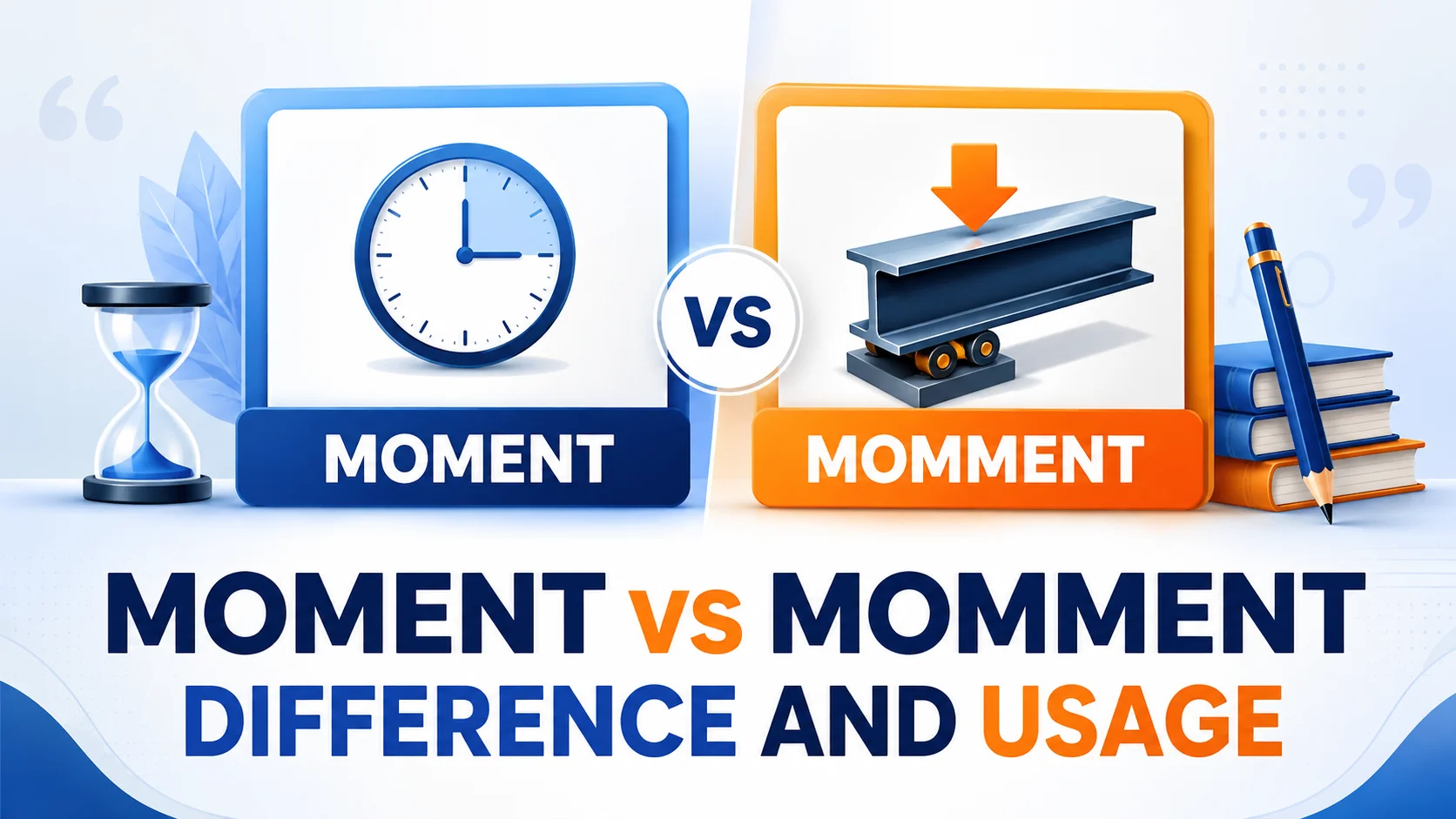
Moment vs momment is a common spelling question because the two versions look similar, yet only one is recognized in standard English. Whether you’re writing an email, completing schoolwork, publishing online, or sending a quick text, using the correct spelling reflects attention to detail and strengthens your credibility. Many people accidentally add an extra “m” because of the way the word sounds, but pronunciation doesn’t always reveal the correct spelling. Understanding why this mistake happens makes it much easier to avoid.
English contains many words that are pronounced more simply than they’re spelled, and moment is one of them. Search engines regularly receive queries such as “Is momment a word?”, “Moment or momment?”, and “How do you spell moment correctly?” because writers want reassurance before submitting important work. The good news is that this confusion has a straightforward explanation once you understand the spelling pattern, common usage, and a few memorable techniques.
This guide explains the difference between moment and momment, why only one spelling is correct, how to use moment confidently in different contexts, and practical ways to remember the correct form every time. Along the way, you’ll also learn common expressions, grammar tips, sentence examples, and simple proofreading habits that help eliminate this mistake from your writing.
Moment vs Momment: The Quick Answer
If you only need a quick explanation, here’s the answer:
- ✅ Moment is the correct English word.
- ❌ Momment is a misspelling and isn’t recognized as a standard English word.
Although momment appears in search results and social media posts, dictionaries don’t list it as a valid spelling. It is simply a common typing or spelling error.
Which Spelling Is Correct?
The correct spelling is always:
Moment
Examples:
- Please wait a moment.
- That was a memorable moment.
- She paused for a moment before answering.
- We shared an unforgettable moment together.
Every one of these examples uses the accepted spelling.
The version with two m’s in the middle—
momment
—is always incorrect in standard English.
Is Momment Ever a Real English Word?
No.
Unlike some spelling variants that differ between American English and British English, momment isn’t accepted in either variety.
You’ll find moment in:
- dictionaries
- books
- newspapers
- academic writing
- business communication
- legal documents
- professional publications
You won’t find momment as a legitimate dictionary entry because it isn’t considered a separate word.
Quick Comparison Table
| Feature | Moment | Momment |
| Correct spelling | ✅ Yes | ❌ No |
| Dictionary word | Yes | No |
| Standard English | Yes | No |
| Used in professional writing | Yes | Never |
| Recommended spelling | Always | Never |
What Does “Moment” Mean?
The word moment has several closely related meanings, but they all center on the idea of time, importance, or significance.
Depending on the context, moment can refer to:
- a very short period of time
- a specific point in time
- an important event
- significance or consequence
- a scientific concept in physics and engineering
Understanding these meanings helps you use the word naturally in both everyday conversation and specialized fields.
The Dictionary Meaning of Moment
In everyday English, moment most commonly means:
A very short period of time.
Examples:
- I’ll be back in a moment.
- Wait just a moment.
- She looked away for a moment.
- Everything changed in a single moment.
Although the word often refers to a brief amount of time, the exact length depends on the situation.
For example:
- “One moment” while waiting on the phone might last several seconds.
- A historical moment may describe an event remembered for generations.
Context determines the precise meaning.
Different Meanings Based on Context
The flexibility of moment is one reason it’s among the most frequently used time-related nouns in English.
Let’s look at its major meanings.
A Short Period of Time
This is the meaning most English learners encounter first.
Examples:
- Please give me a moment.
- She hesitated for a moment.
- Everything became quiet for a brief moment.
Here, moment simply means a short interval.
An Important Point in Time
Sometimes moment refers not to duration but to significance.
Examples:
- Graduation was a life-changing moment.
- Winning the championship became a defining moment.
- Their first meeting was a memorable moment.
In these examples, the word highlights emotional or historical importance rather than the amount of time involved.
Significance or Importance
In more formal English, moment can also mean importance.
Examples:
- This issue is of great moment.
- The decision carried enormous moment.
This usage appears more often in literature, legal writing, and historical texts than in everyday conversation.
Although less common today, you’ll still encounter it when reading older books or formal documents.
Scientific Meaning (Physics and Engineering)
Outside everyday English, moment has a specialized meaning.
In physics, a moment measures the tendency of a force to cause rotation around a point or axis.
Common scientific terms include:
- moment of force
- bending moment
- turning moment
- magnetic moment
- dipole moment
For example:
An engineer calculating the load on a bridge may analyze the bending moment acting on structural beams.
Although this meaning differs from the everyday sense of time, it’s an established technical definition used in engineering, mechanics, and physics.
Did You Know?
The word moment comes from the Latin momentum, which originally referred to movement, influence, or importance. Over time, English expanded its meaning to include short periods of time, making it one of the language’s most versatile words.
Is “Momment” a Word?
One of the most searched questions about this topic is surprisingly simple:
Is “momment” a real word?
The answer is no.
Despite appearing in online searches and informal writing, momment isn’t accepted by major English dictionaries, style guides, educational institutions, or professional publishers.
If you use momment in formal writing, it will be treated as a spelling error.
Why Momment Is a Common Misspelling
Several factors explain why people accidentally write momment.
The most common reasons include:
- doubling the middle consonant by mistake
- typing too quickly
- relying on pronunciation instead of spelling
- confusing it with words that legitimately contain double letters
Words such as:
- common
- committee
- summer
- recommend
contain doubled consonants, so some writers instinctively apply the same pattern to moment, even though it doesn’t belong there.
Why Spell Check Sometimes Misses It
Modern spell-check tools are extremely helpful, but they aren’t perfect.
Some situations where errors slip through include:
- browser extensions being disabled
- handwritten assignments
- autocorrect turned off
- images containing text
- copied documents that bypass spell checking
This is why careful proofreading remains an essential writing skill.
Common Typing and Pronunciation Mistakes
Because moment is pronounced smoothly, many people assume there should be another m in the middle.
However, English spelling doesn’t always mirror pronunciation.
Consider these examples:
| Incorrect | Correct |
| momment | moment |
| enviroment | environment |
| goverment | government |
| seperate | separate |
These errors share one thing in common:
The spelling looks believable, but standard English follows a different pattern.
Writing Tip
If you’re unsure about a spelling, don’t rely on how the word sounds. Instead, verify it using a trusted dictionary or remember the simple rule: moment has only one “m” after “mo.”
Moment vs Momment: The Difference Explained
At first glance, moment and momment seem almost identical. The only visible difference is one extra “m.” However, that single letter completely changes whether the spelling is correct.
The distinction is straightforward:
- Moment is the correct English word.
- Momment is a spelling mistake.
Unlike pairs such as color/colour or center/centre, this isn’t a regional variation. Every major English dictionary, style guide, and educational resource recognizes moment as the only standard spelling.
Why Only One Spelling Is Correct
English spelling follows historical patterns rather than simple pronunciation rules. The word moment comes from the Latin momentum, which entered English through Old French. During its development, the spelling retained a single “m” after “mo.”
Because of this established history, there has never been a standard English form spelled momment.
You’ll see moment used consistently in:
- Newspapers
- Books
- Academic journals
- Business communication
- Government documents
- Professional websites
If you encounter momment, it’s almost always a typographical or spelling error.
Pronunciation: Why the Words Seem Confusing
One reason writers make this mistake is that pronunciation provides almost no clue about spelling.
Both versions would be pronounced similarly:
/ˈmoʊ.mənt/ (American English)
When people write from memory instead of visual recognition, they sometimes insert an unnecessary second m.
This is why developing strong spelling habits is often more effective than relying on pronunciation.
The Grammar and Spelling Rule You Should Remember
A simple rule solves the confusion:
The word is always spelled “moment” with one “m” after “mo.”
Think of the spelling as three parts:
mo + ment
There is never an additional m between these two parts.
How to Spell “Moment” Correctly Every Time
Even experienced writers occasionally misspell familiar words when typing quickly. Fortunately, moment is easy to remember once you use a few practical techniques.
A Simple Memory Trick
Break the word into two familiar parts:
Mo + ment
Notice that:
- Mo already ends with one o.
- Ment begins with m.
There’s no reason to insert another m between them.
A helpful reminder is:
One moment needs one middle “m.”
Although simple, this phrase helps many learners remember the correct spelling.
Breaking the Word into Syllables
Pronouncing the word in syllables can also reinforce the spelling.
Mo-ment
Instead of thinking about individual letters, picture the two syllables.
Many spelling mistakes occur because writers focus only on how quickly the word sounds rather than how it’s constructed.
Common Letter Patterns in English
The ending -ment appears in hundreds of English words.
Examples include:
- agreement
- payment
- movement
- improvement
- development
- achievement
- encouragement
Notice that none of these words double the m before -ment.
Recognizing this pattern makes the moment feel much more intuitive.
Proofreading Tips for Avoiding Spelling Errors
Before submitting important writing, spend a few seconds checking commonly misspelled words.
A useful checklist includes:
- Read slowly instead of skimming.
- Pay extra attention to longer words.
- Look for unnecessary doubled letters.
- Read the sentence aloud.
- Use a trusted dictionary if you’re uncertain.
Quick Tip
If a word “looks unusual,” pause and verify it. Most spelling mistakes are caught during careful proofreading rather than during the first draft.
How to Use “Moment” Correctly in Sentences
Because moment has several meanings, understanding its different uses makes your writing clearer and more natural.
Everyday Conversations
Most conversations use moment to refer to a short period of time.
Examples:
- Please wait a moment.
- I’ll be there in a moment.
- Give me a moment to think.
- She smiled for a brief moment.
These examples sound natural because the word refers to a short interval.
Academic and Professional Writing
In formal writing, moment often describes an important event, turning point, or stage in a process.
Examples:
- This discovery marked an important moment in medical research.
- The agreement represented a historic moment for both countries.
- The presentation included several memorable moments.
Here, the emphasis is on significance rather than duration.
Literary and Creative Writing
Writers frequently use moment to create emotion and imagery.
Examples:
- For one silent moment, nobody spoke.
- Time seemed to stop in that unforgettable moment.
- Every moment felt precious.
Creative writing often combines moment with descriptive language to make scenes more vivid.
News and Media Examples
Journalists regularly describe major events as defining moments.
Examples:
- The election became a defining moment in the nation’s history.
- Scientists called the discovery a groundbreaking moment.
- The final goal created one of the greatest moments in the team’s history.
This usage emphasizes lasting importance instead of the passage of time.
Common Expressions That Use “Moment”
Many English expressions include the word moment. Learning these phrases helps you sound more natural in both speech and writing.
At the Moment
Meaning:
Now or currently.
Examples:
- I’m busy at the moment.
- She isn’t available at the moment.
- We can’t discuss that at the moment.
In a Moment
Meaning:
Very soon or after a short time.
Examples:
- I’ll join you in a moment.
- Dinner will be ready in a moment.
- Please hold while I check that in a moment.
For the Moment
Meaning:
Temporarily or for now.
Examples:
- Everything is under control for the moment.
- Let’s leave the issue for the moment.
- The office will remain closed for the moment.
The Moment (That…)
Meaning:
Refers to the exact time when something happens.
Examples:
- I knew the answer the moment I saw the question.
- She smiled the moment he arrived.
- Call me the moment you reach home.
From That Moment On
Meaning:
Beginning at a specific point and continuing afterward.
Examples:
- From that moment on, their friendship grew stronger.
- From that moment on, nothing was the same.
- He never looked back from that moment on.
A Moment of Truth
Meaning:
The point when reality must be faced or an important result becomes known.
Examples:
- The interview was her moment of truth.
- The championship game became the team’s moment of truth.
A Moment of Silence
Meaning:
A brief period during which people remain quiet to show respect.
Examples:
- The audience observed a moment of silence.
- Students stood for a moment of silence before the ceremony.
A Defining Moment
Meaning:
An event that permanently shapes a person, organization, or period of history.
Examples:
- Graduation became a defining moment in her life.
- The invention marked a defining moment in technology.
Language Insight
These expressions are fixed phrases, so it’s important to memorize them as complete units. Replacing moment with another word often sounds unnatural or changes the meaning.
Memory Tricks to Never Misspell “Moment”
Even if you understand the definition, you might occasionally hesitate when typing the word. A few simple memory techniques can help you spell moment correctly without stopping to think.
Visual Spelling Technique
Picture the word exactly as it appears:
M O M E N T
Notice that there is only one “m” after “mo.”
A useful habit is to visualize the word before writing it. Over time, your brain begins to recognize the correct spelling automatically.
Word Association Method
Connect moment with a familiar phrase.
For example:
One moment, one middle “m.”
Because the phrase repeats the idea every time you hear or say it, it reinforces the correct spelling naturally.
Another easy reminder is:
A moment passes quickly, so don’t add extra letters.
Simple associations often work better than memorizing spelling rules.
Read-It-Back Proofreading Strategy
One of the most effective proofreading methods is to read your writing backward, one word at a time.
Instead of focusing on the meaning of the sentence, you focus entirely on spelling.
For example, after writing:
Please wait a moment.
Read it as:
- moment
- a
- wait
- Please
This technique helps your eyes catch spelling errors that might otherwise go unnoticed.
Expert Tip
Most spelling mistakes happen because writers read what they expect to see rather than what is actually on the page. Slowing down for a final review dramatically improves accuracy.
Practice Exercises
Choose the Correct Spelling
Select the correct word.
- Please wait a (moment / momment).
- That was an unforgettable (moment / momment).
- I’ll call you in a (moment / momment).
- The ceremony marked an important (moment / momment).
- Give me a (moment / momment) to finish this email.
Fill in the Blanks
Complete each sentence using moment.
- I’ll be ready in a __________.
- That single __________ changed her career.
- Please wait just a __________.
- It was a proud __________ for the entire family.
- Everything became quiet for a brief __________.
Correct the Spelling Mistakes
Rewrite each sentence correctly.
- I’ll be back in a momment.
- It was a historical momment.
- Wait one momment, please.
- Every momment matters.
- We shared a special momment together.
Rewrite the Sentences Correctly
Replace the highlighted idea with moment where appropriate.
- Please wait a short time.
- That was an unforgettable point in time.
- Graduation became an important event in her life.
- Everything changed very quickly.
- We paused briefly before continuing.
Answer Key with Explanations
Choose the Correct Spelling
- moment
- moment
- moment
- moment
- moment
Explanation: Moment is the only accepted spelling in standard English.
Fill in the Blanks
- moment
- moment
- moment
- moment
- moment
Explanation: Each sentence refers to either a short period of time or an important event, making moment the correct choice.
Correct the Spelling Mistakes
- I’ll be back in a moment.
- It was a historical moment.
- Wait one moment, please.
- Every moment matters.
- We shared a special moment together.
Explanation: The only correction needed is replacing momment with moment.
Conclusion
Understanding the difference between moment and momment is easier than it first appears because only one spelling is correct. Moment is the accepted English word used to describe a short period of time, a significant event, or a specialized scientific concept, while momment is simply a common misspelling. Once you recognize the correct spelling pattern and practice using it in everyday writing, this mistake becomes easy to avoid. One final actionable tip: pause briefly to visualize the word moment before typing it in important documents. A common mistake to avoid is trusting pronunciation instead of verified spelling. With consistent practice and careful proofreading, you’ll use moment confidently and accurately in every context.
Frequently Asked Questions
Q1. Is momment ever correct?
No. Momment is not a recognized English word in either American or British English. Whether you’re writing casually or professionally, moment is always the correct spelling. If you type momment, treat it as a spelling mistake and replace it before publishing or sending your work.
Q2. Why do people spell moment with two “m”s?
Many writers rely on pronunciation rather than spelling. Because English contains words with double consonants, such as common and summer, some people mistakenly apply the same pattern to moment, even though it uses only one middle “m.”
Q3. What is the difference between moment and movement?
A moment refers to a short period of time, an important event, or a scientific concept, while movement refers to motion, physical action, or an organized social or political effort. Although the words look similar, they have different meanings and should never be used interchangeably.
Q4. What does at the moment mean?
At the moment means currently or right now. It describes a situation that is true at the present time. For example, “She’s busy at the moment” means she is busy now, though that situation may change later.
Q5. How can I remember the correct spelling of moment?
A simple memory trick is “One moment, one middle ‘m.'” You can also break the word into mo + ment and remember that the -ment ending never requires an extra m. Reading your work carefully before submitting it will reinforce the correct spelling over time.
