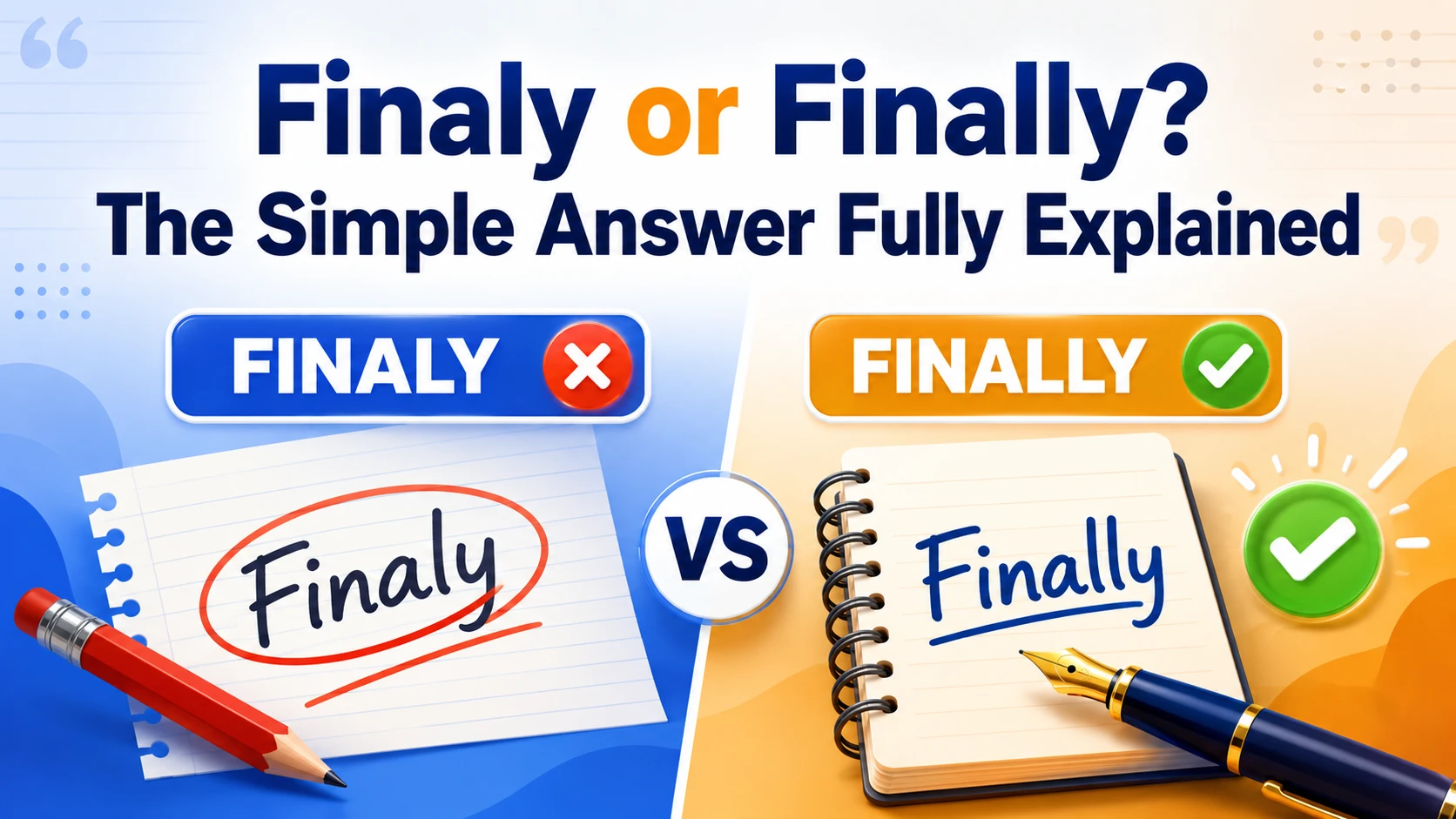
Finaly or finally is a common spelling question with a very simple answer: finally is the correct standard English spelling. The form finaly is a misspelling and should not be used in standard American or British English. The confusion usually comes from the fact that the base word final has only one l, while the adverb finally contains two. That small spelling difference can cause trouble in emails, essays, assignments, and everyday writing. Once you understand how the word is formed and how finally functions in a sentence, the correct spelling becomes much easier to remember.
The word finally is an adverb with several closely related uses. It can mean after a long wait or difficulty, as in “We finally arrived.” It can also introduce the last point in a sequence, as in “Finally, check your answers.” In some contexts, it expresses a sense of something becoming settled or definite. Cambridge Dictionary identifies these major uses, including “after a long time or some difficulty” and introducing the last point or idea.
The spelling matters because final, finally, finaly, lastly, and ultimately do not all perform the same grammatical job. In this guide, you’ll learn why finally has two ls, how it differs from final, where it belongs in a sentence, when it can express relief or sequence, and which common mistakes to avoid. By the end, you’ll have a simple rule you can use whenever you’re unsure whether to write finaly or finally.
Finaly or Finally: Which Spelling Is Correct?
The correct spelling is:
finally ✅
The incorrect standard spelling is:
finaly ❌
There is no modern standard-English spelling distinction in which finaly is an accepted alternative to finally. If you’re writing an essay, email, report, article, school assignment, or professional document, use finally.
A Quick Example
❌ She finaly completed the assignment.
✅ She finally completed the assignment.
The second sentence is correct because finally is the established adverb formed from final.
Another example:
❌ Finaly, we reached an agreement.
✅ Finally, we reached an agreement.
The error is easy to overlook because both versions are pronounced essentially the same. The problem becomes obvious when you connect the spelling to the word’s structure.
The One-Second Answer
If you’re asking:
“Should I write finaly or finally?”
The answer is:
Always choose “finally” in standard modern English.
The rest of the article explains why.
Why Does “Finally” Have Two L’s?
The spelling becomes easier when you look at the relationship between final and finally.
The base word is:
final
Add the adverb-forming suffix:
final + ly
The result is:
finally
The two ls occur because the base word already ends in l, and the suffix -ly begins with another l.
So visually:
final + ly = finally
That is the easiest spelling pattern to remember.
The “Final + Ly” Pattern
Think of the word as two pieces:
FINAL + LY
When they are joined:
FINALLY
This prevents the common mistake of writing:
FINALY
The incorrect version effectively drops one of the two letters that appear where the base word and suffix meet.
Why “Finaly” Looks Reasonable
The mistake isn’t completely random.
Writers often know that the base word is:
final
They may then add -y mentally and produce:
finaly
There is also a pronunciation issue. The two spellings don’t sound different in ordinary speech, so listening alone won’t tell you which one is correct.
That’s why this is primarily a spelling and word-formation problem, not a pronunciation problem.
Similar Words Can Reinforce the Pattern
Consider these related formations:
| Base word | Adverb | Correct spelling |
| final | finally | finally |
| usual | usually | usually |
| actual | actually | actually |
| natural | naturally | naturally |
| general | generally | generally |
| personal | personally | personally |
These examples aren’t all formed under exactly the same spelling circumstances, but they reinforce an important visual pattern: adjectives ending in -al commonly form adverbs ending in -ally.
So when you see:
final + ly
don’t stop after the first l.
The standard form is:
finally
What Does “Finally” Mean?
Finally is an adverb. Its meaning depends on the context, but its main uses revolve around time, sequence, and completion.
Cambridge Dictionary identifies finally as an adverb meaning, among other things, something happening after a long period or difficulty and something used to introduce the last point or idea.
Finally Meaning “At Last”
This is probably the most familiar use.
We finally found the missing keys.
The sentence suggests that finding the keys took time or effort.
Compare:
We found the missing keys.
This simply reports the event.
We finally found the missing keys.
This adds the idea that the search lasted for some time or involved difficulty.
Other examples:
She finally answered my message.
The bus finally arrived.
After several attempts, he finally solved the problem.
They finally reached an agreement.
In each case, finally adds a sense of completion after waiting, effort, delay, or difficulty.
Finally as the Last Point in a Sequence
The word can also introduce the final item in a series.
First, read the instructions. Next, complete the questions. Finally, check your answers.
Here, finally doesn’t necessarily mean that something took a long time. It means this is the last step.
Cambridge specifically identifies this use for introducing the last point or idea, especially at the beginning of a sentence.
Finally as a Sign of Completion
Consider:
After months of negotiation, the contract was finally approved.
The word highlights the endpoint of a process.
Without it:
The contract was approved.
The sentence remains grammatical, but it loses some of the sense of delay, anticipation, or completion.
Finally and Emotional Tone
Context can give finally an emotional flavor.
He finally apologized.
Depending on the situation, the speaker may sound:
- relieved
- frustrated
- impatient
- satisfied
- sarcastic
Compare:
She arrived.
with:
She finally arrived.
The second sentence can imply that the speaker had been waiting for quite a while.
Final vs Finally: What Is the Difference?
Final and finally are related, but they have different grammatical functions.
“Final” Is an Adjective
Final commonly functions as an adjective meaning last, concluding, or not subject to further change.
Examples:
This is the final chapter.
We received the final report.
The committee made its final decision.
Tomorrow is the final day of registration.
In each sentence, final describes a noun.
“Finally” Is an Adverb
Finally modifies a verb, clause, or larger statement.
She finally answered.
We finally finished the project.
Finally, we reached the last stage.
Here, finally tells the reader something about when or how the action occurred or signals the final point in a sequence.
Final and Finally Side by Side
| Word | Part of speech | Typical function | Example |
| final | Adjective | Describes a noun | the final decision |
| finally | Adverb | Modifies an action or introduces a final point | She finally agreed. |
| finaly | — | Standard spelling error | ❌ She finaly agreed. |
A useful test is to look at the word immediately after the blank.
the ___ answer
You need an adjective:
final answer
But:
She ___ answered.
You need an adverb:
She finally answered.
Don’t Use “Finally” Before a Noun Just Because It Sounds Related
A common mistake is assuming that finally can replace final.
❌ the finally decision
✅ the final decision
The noun decision needs an adjective here. Finally cannot fill that role.
When Should You Use “Finally”?
There are three especially useful situations.
Use Finally for Something That Happens at Last
Use it when an event occurs after waiting, effort, obstacles, or repeated attempts.
After three hours, the mechanic finally fixed the car.
She finally received the package.
We finally understood the instructions.
The word emphasizes the endpoint.
Use Finally to Introduce the Last Point
This is common in:
- essays
- presentations
- speeches
- explanations
- instructions
- lists
For example:
First, identify the problem. Second, examine the evidence. Finally, choose the best solution.
This tells the reader that the sequence has reached its final stage.
Use Finally to Emphasize Completion
It can also highlight the point at which something becomes settled.
The proposal was finally approved.
The date has finally been confirmed.
The results are finally available.
Here, the word gives the sentence a sense of an outcome arriving after uncertainty or waiting.
Where Should “Finally” Go in a Sentence?
One reason finally can confuse learners is that it can appear in several positions.
Finally at the Beginning
This is especially common when introducing the last point in a sequence.
Finally, review your answers.
Finally, I’d like to thank everyone for attending.
Finally, we need to consider the cost.
A comma is commonly used when finally functions as an introductory sentence adverb or transition.
Finally in the Middle
It can appear inside a clause.
She finally understood the problem.
We finally reached the station.
The team finally agreed to the proposal.
This placement is natural when finally directly modifies the event.
Finally Near the End
The word can also occur later in the sentence.
We reached the station finally.
This is grammatically possible, but it can sound less natural in ordinary modern prose than:
We finally reached the station.
The best position depends on the sentence’s rhythm and the emphasis you want.
Does Punctuation Change the Meaning?
Punctuation can help readers understand the role of finally, but it doesn’t change the spelling.
Compare:
Finally, we submitted the report.
with:
We finally submitted the report.
The first version strongly presents finally as a transition or introductory marker. The second focuses more directly on the delayed action of submitting the report.
Finally vs Lastly vs Ultimately vs At Last
These words overlap, but they aren’t interchangeable in every sentence.
Finally vs Lastly
Finally can mean the last point in a sequence, while lastly is especially associated with introducing the final item or point.
First, explain the problem. Second, present the evidence. Finally, recommend a solution.
First, explain the problem. Second, present the evidence. Lastly, recommend a solution.
Both can work here.
However, finally has another important meaning that lastly doesn’t normally express:
We finally found the house.
You wouldn’t normally replace finally with lastly here.
Finally vs Ultimately
Ultimately often focuses on the final result, conclusion, or outcome rather than simply the last step.
The project finally started in June.
This emphasizes that the project eventually began.
Ultimately, the project failed.
This focuses on the eventual outcome.
Cambridge also distinguishes eventually from finally and lastly: finally or lastly can introduce the last item in a list, while eventually means something happens in the end, particularly after time, effort, or problems.
Finally vs At Last
At last often carries a stronger emotional sense of relief or impatience.
The train finally arrived.
The train arrived at last.
Both suggest waiting, but at last can sound more emotionally expressive.
Choosing the Right Word
| Intended meaning | Useful word | Example |
| Something happened after a delay | finally | She finally arrived. |
| Last item in a sequence | finally / lastly | Finally, check the totals. |
| Eventual outcome | ultimately | Ultimately, they rejected the proposal. |
| Strong relief after waiting | at last | At last, the results arrived. |
“Finally” in Formal, Academic, and Everyday Writing
The word is flexible enough to appear across many types of English.
Finally in Academic Writing
In essays, finally can introduce the final argument or consideration.
Finally, the study raises questions about long-term sustainability.
However, don’t force it into every paragraph. If you have already used first, second, and finally repeatedly, the writing can become formulaic.
Other transitions may sometimes be more precise:
- in conclusion
- lastly
- overall
- ultimately
- in the final analysis
Choose according to the actual relationship between ideas.
Finally in Professional Writing
It works naturally in reports, emails, instructions, and project updates.
Finally, please review the attached figures before submitting the report.
Or:
The team finally completed the migration on Friday.
The first describes the final step in instructions. The second emphasizes completion after a process.
Finally in Everyday Conversation
People use finally constantly in ordinary speech.
You finally made it!
I finally found my phone.
Finally! It’s Friday.
The last example illustrates how context and punctuation can make the word express strong emotion.
Common Grammar Mistakes Involving “Finally”
Mistake 1: Writing “Finaly”
This is the primary spelling error.
❌ The work is finaly complete.
✅ The work is finally complete.
Mistake 2: Confusing Final With Finally
❌ We reached the finally decision.
✅ We reached the final decision.
But:
We finally reached a decision.
The first requires an adjective. The second requires an adverb.
Mistake 3: Using “Finally” When You Mean “Final”
These words belong to the same word family, but their grammatical roles are different.
final exam
final payment
final version
but:
finally completed
finally approved
finally arrived
Mistake 4: Using “Eventually” for the Last Item in a List
This distinction is worth remembering.
❌ First, we’ll review the budget. Second, we’ll discuss staffing. Eventually, we’ll consider the marketing plan.
If you’re simply introducing the last item, finally or lastly is more appropriate:
First, we’ll review the budget. Second, we’ll discuss staffing. Finally, we’ll consider the marketing plan.
Eventually focuses on something happening after time or difficulty rather than functioning as a simple list marker.
Mistake 5: Overusing “Finally”
Using the word once to introduce a final point is useful.
Using it repeatedly can make prose predictable:
Finally, we discuss costs. Finally, we discuss staffing. Finally, we discuss risks.
Better organization would make the relationships between ideas clearer.
Why People Misspell “Finally” as “Finaly”
Understanding the error makes it easier to prevent.
The Base Word Creates the Trap
The writer sees:
final
and knows that many adverbs are formed by adding -ly.
Instead of mentally combining the two complete parts:
final + ly
the writer may reduce the spelling to:
final + y
That produces:
finaly
Pronunciation Doesn’t Help Much
The incorrect and correct spellings don’t give you a useful pronunciation contrast. A listener won’t normally hear whether you’ve written one l or two.
This is why reading the word aloud isn’t enough.
Fast Typing Encourages the Error
Short words with repeated letters are easy to mistype.
The same general issue occurs with words containing adjacent repeated letters. When proofreading, don’t rely only on automatic spell-checking. Look closely at words you know you frequently misspell.
How to Remember the Spelling of Finally
Memory Trick: FINAL + LY
This is the strongest simple method:
FINAL + LY = FINALLY
Don’t memorize finally as a completely separate word. Connect it directly to final.
Visual Memory Trick
Look at the middle of the word:
finally
There are two l’s together.
You can think:
final + ly = finally
Use a Sentence Pair
Memorize this contrast:
This is the final answer.
She finally gave her answer.
The first uses the adjective final. The second uses the adverb finally.
A One-Second Proofreading Test
Whenever you see:
finaly
pause and ask:
“Can I split this into FINAL + LY?”
Yes.
Therefore:
FINALLY
This is faster and more reliable than trying to remember the spelling letter by letter.
Examples of “Finally” in Real Sentences
Everyday Examples
I finally finished cleaning the kitchen.
She finally called me back.
We finally found a parking space.
The rain finally stopped.
He finally understood what I meant.
School and Academic Examples
I finally finished my research paper.
Finally, compare your answer with the model response.
The students finally completed the experiment.
Finally, the essay considers the limitations of the study.
Workplace Examples
The company finally approved the proposal.
Finally, let’s review the projected costs.
The team finally completed the software update.
We finally reached an agreement with the supplier.
Examples Showing Different Meanings
After a delay:
The doctor finally arrived.
Last point in a sequence:
Finally, submit the completed form.
Completion after effort:
After weeks of testing, the engineers finally identified the problem.
Definitive result:
The date has finally been confirmed.
Finaly or Finally: Practice Exercise
Try these examples without looking at the answers.
Exercise 1: Correct the Spelling
- She finaly called me.
- We finaly reached the station.
- Finaly, check the totals.
- He finaly understood the instructions.
- The problem was finaly resolved.
Answers
- She finally called me.
- We finally reached the station.
- Finally, check the totals.
- He finally understood the instructions.
- The problem was finally resolved.
Exercise 2: Choose Final or Finally
- This is the ___ version of the document.
- We ___ completed the project.
- The ___ exam is next Friday.
- She ___ answered the question.
- Please submit the ___ report.
Answers
- final
- finally
- final
- finally
- final
The key is grammatical function. Final describes a noun, while finally functions as an adverb.
Exercise 3: Choose Finally, Lastly, or Ultimately
- First, explain the problem. Second, present the evidence. ___, give your recommendation.
- After months of negotiations, the agreement was ___ signed.
- The plan looked promising, but ___ it failed.
Answers
- Finally or lastly
- finally
- ultimately
The first sentence needs a sequence marker. The second emphasizes an event after delay. The third focuses on the eventual outcome.
A Practical Finaly vs Finally Checklist
Before submitting an article, essay, email, or report, check the following:
- Is the word supposed to mean at last?
- Is it introducing the last point?
- Am I using it as an adverb?
- Have I accidentally written finaly?
- Am I confusing final with finally?
- Would lastly, ultimately, or at last be more precise?
- Have I used finally too many times in the same passage?
If the intended word is the adverb meaning “at last” or introducing the final point, the spelling should be:
finally
Conclusion
When choosing between finaly or finally, there isn’t a genuine spelling choice to make in standard English: finally is the correct form. The extra l isn’t decorative. It reflects the way the word is built from final + -ly. Once you see that structure, the spelling becomes much easier to remember. One final actionable tip: whenever you hesitate, mentally separate the word into FINAL + LY. If you’re writing about something happening after a delay, use finally: “We finally arrived.” If you’re introducing the last point in a sequence, use finally again: “Finally, check your work.” A common mistake to avoid is replacing final with finally simply because the words are related. A final answer is a thing; someone finally gives an answer. That small grammatical distinction keeps both words in their proper place.
Frequently Asked Questions
Q1. Is “finaly” a correct English word?
No. Finaly is not the standard spelling of the English adverb. The correct form is finally, with two consecutive ls. The spelling comes from combining final with -ly: final + ly = finally. Use finally in standard English writing.
Q2. Why does “finally” have two Ls?
Finally contains two ls because the base adjective final ends in l, while the suffix -ly begins with another l. Combining them gives final + ly = finally. Remembering the word as two parts makes the spelling much easier to reproduce correctly.
Q3. Is “finally” an adjective or an adverb?
Finally is an adverb. It can describe an action that occurs after a delay, as in “She finally arrived,” or introduce the last point in a sequence, as in “Finally, check your work.” The related adjective is final, as in “the final answer.”
Q4. Can “finally” start a sentence?
Yes. Finally can naturally appear at the beginning of a sentence when it introduces the last point, step, or idea. For example: “Finally, review your calculations.” It can also begin a sentence to emphasize that something happened after a delay: “Finally, the package arrived.”
Q5. Is “finally” the same as “lastly”?
Not always. Finally can introduce the last item in a sequence, making it similar to lastly. However, finally also means after a delay or difficulty, as in “We finally found the missing file.” Lastly generally doesn’t carry that same meaning of delayed completion.
