
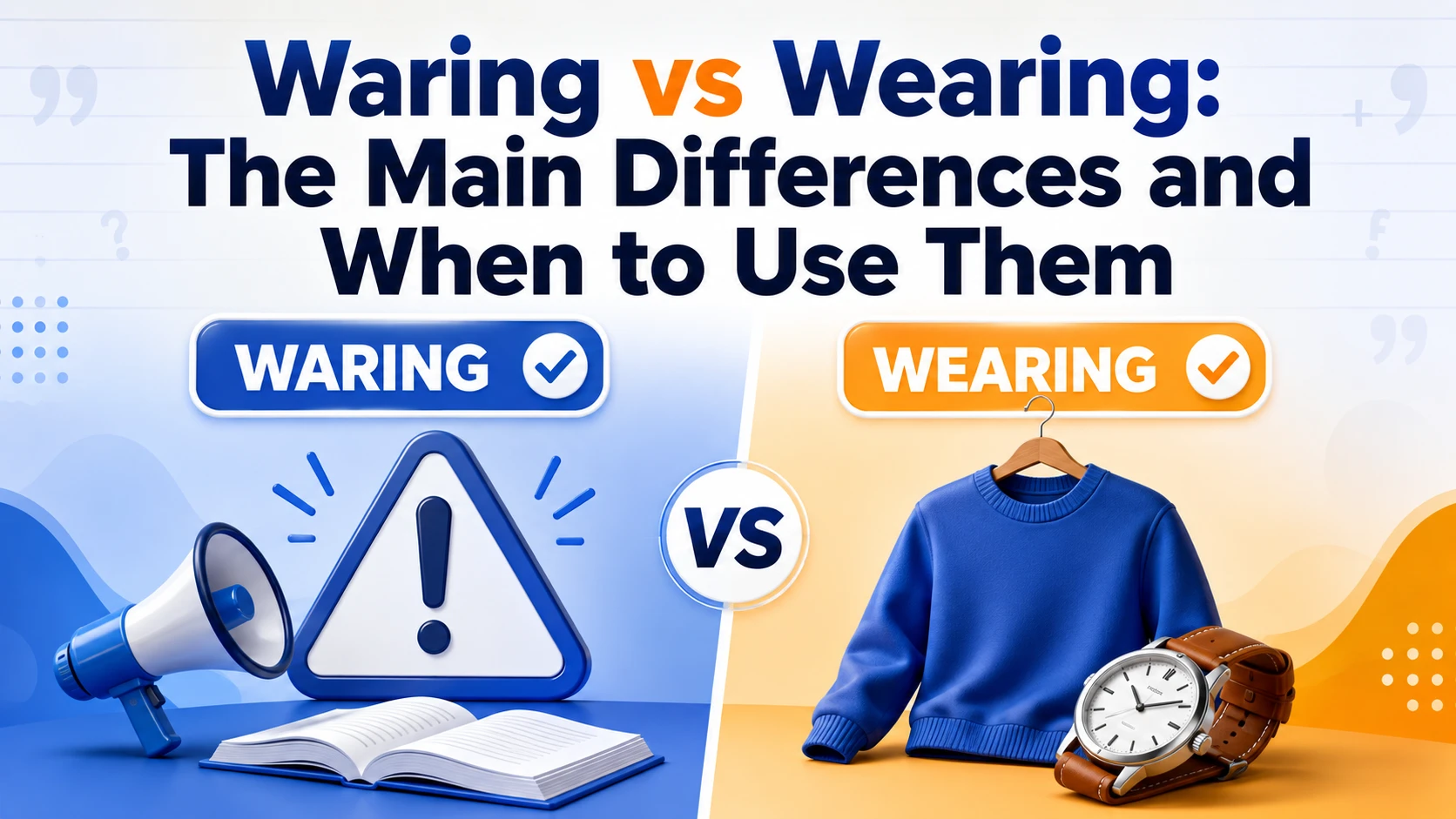
Waring vs wearing can be confusing because the two forms look almost identical and are pronounced alike in many varieties of English. Yet they do not normally serve the same purpose. Wearing is the familiar form related to the verb wear, as in “She is wearing a blue jacket.” Waring, meanwhile, can be a legitimate but uncommon English verb form derived from ware, and it is also used as a surname and proper name. Merriam-Webster records waring as an inflected form of ware, including an archaic sense meaning “beware of” or “avoid” and a Scottish sense meaning “spend” or “expend.”
For most modern writers, though, the practical choice is much simpler. If you’re talking about clothes, jewelry, glasses, makeup, a uniform, or something else a person has on, the word you want is wearing. Cambridge defines wear in this sense as having clothing or jewelry on the body and gives wearing as its present-participle form.
The real challenge appears when Waring is capitalized. It may be someone’s surname rather than a spelling mistake. There are also cases in which waring is a genuine dictionary form, although those uses are rare and unlikely to be what a learner means. This guide separates these possibilities, explains the grammar behind wearing, compares waring, wearing, and warring, and gives you a practical test for choosing the right form without relying on guesswork.
Quick Answer: Waring vs Wearing
The answer depends on what the word is doing in the sentence.
- Wearing = the present participle of wear, usually meaning having something on your body.
- Waring = a rare legitimate form of ware in certain dictionary-defined senses, and also a proper name or surname.
- Warring = a different word meaning fighting or engaged in conflict.
Compare:
She is wearing a black coat.
Mr. Waring joined the meeting.
The two warring groups agreed to negotiate.
For ordinary modern English, wearing is overwhelmingly likely to be the correct choice when the sentence is about clothing or something worn.
The Fastest Way to Choose
Ask yourself one question:
Does the sentence mean “having something on your body”?
If the answer is yes, use wearing.
He is wearing a hat.
She is wearing glasses.
They are wearing uniforms.
If the word refers to a person’s name, Waring may be correct:
Waring will present the report tomorrow.
And if the context involves conflict, you may actually need warring:
The warring factions reached an agreement.
What Does “Wearing” Mean?
Wearing is the present participle and gerund form of the verb wear. The most familiar meaning is having clothing, jewelry, or another item on your body. Cambridge lists wear with the forms wore and worn and gives examples involving clothes, rings, glasses, makeup, and other things worn on the body.
Wearing as the Present Participle of “Wear”
The basic verb forms are:
| Verb form | Example |
| wear | I wear glasses. |
| wears | She wears glasses. |
| wore | She wore glasses yesterday. |
| worn | She has worn glasses for years. |
| wearing | She is wearing glasses now. |
The important point is that wearing comes directly from wear.
wear + -ing → wearing
It isn’t normally spelled waring when you mean the action of wearing something.
Wearing Clothes, Shoes, and Accessories
The most common use concerns clothing and personal items.
Examples include:
- wearing a shirt
- wearing a dress
- wearing jeans
- wearing shoes
- wearing a coat
- wearing a hat
- wearing glasses
- wearing a watch
- wearing a ring
- wearing a uniform
For example:
Maria is wearing a green sweater.
The students were wearing their school uniforms.
He was wearing sunglasses because the sunlight was bright.
Wearing Something in a Broader Sense
The verb wear has a broader range than simply putting on clothes.
You can wear your hair in a particular style:
She is wearing her hair in a ponytail.
You can also wear a smile or another expression:
He was wearing a confident smile.
Cambridge specifically recognizes uses of wear involving facial expressions and hairstyles in addition to clothing and accessories.
You may also encounter:
wearing makeup
wearing a badge
wearing a seat belt
The exact interpretation depends on the object.
Wearing as Part of a Continuous Tense
Because wearing is a present participle, it commonly follows a form of be:
She is wearing a red dress.
They were wearing protective equipment.
He has been wearing that jacket all winter.
Here, wearing helps create a continuous verb phrase. It doesn’t become a different word simply because the tense changes.
Is “Waring” a Correct English Word?
This is where a simple “waring is always wrong” explanation falls short.
Waring can be a real word, but it isn’t normally the word you’re looking for when you mean wearing clothes.
Merriam-Webster lists waring under ware, giving wared; waring as its verb forms. One sense is an archaic verb meaning to beware of or avoid, used chiefly as a command to hunting animals. Another Scottish sense means to spend or expend.
Those meanings are very different from modern wear.
Why “Waring” Is Usually Not the Word You Mean
Consider:
❌ She is waring a blue dress.
If the intended meaning is “She has a blue dress on,” this is incorrect.
The correct sentence is:
✅ She is wearing a blue dress.
The problem isn’t that waring can never exist. The problem is that it isn’t the ordinary -ing form of the verb wear.
When “Waring” Can Be Correct
There are two important situations where Waring may legitimately appear.
First, it can be a proper name.
Dr. Waring will speak at the conference.
Second, lowercase waring can occur as the rare inflected form of ware in the specialized or historical senses recorded by dictionaries.
This second use is uncommon enough that most general readers won’t encounter it in everyday writing.
“Waring” as a Surname
Waring is an established surname. Family-name references trace it as an English surname and a variant associated with the Norman personal name Warin.
That means you shouldn’t automatically “correct” every occurrence of Waring to wearing.
For example:
Professor Waring published a new study.
Changing the surname to Wearing would not fix a spelling error. It would change the person’s name.
Wearing vs Waring: Side-by-Side Comparison
The easiest way to understand the distinction is to compare their functions.
| Feature | Wearing | Waring |
| Related to wear | Yes | No |
| Common modern English word | Yes | Rare |
| Main everyday meaning | Having something on the body | Not normally related to clothing |
| Verb form | Present participle/gerund of wear | Inflected form of ware in rare senses |
| Can be a name? | Yes, potentially | Yes, commonly as a surname |
| Example | “She is wearing a coat.” | “Mr. Waring arrived.” |
| Use for clothes? | Yes | No |
A Simple Decision Rule
Use:
wearing → when something is being worn
Use:
Waring → when it is a person’s or organization’s name
Use:
waring → only when the specific context supports the rare verb ware
This distinction is more accurate than simply memorizing “waring is wrong.”
Why Is “Wearing” Spelled With an E?
The spelling becomes easier when you start with the base verb.
The Formation of Wearing
The word is formed from:
wear + -ing = wearing
The e is part of the base word wear. It isn’t an unnecessary letter that must be removed before adding -ing.
Compare:
wear → wearing
with:
read → reading
hear → hearing
bear → bearing
The spelling of English verbs doesn’t follow one universal mechanical formula. That’s why learners benefit from learning the established form of common irregular verbs rather than applying a single rule to every word.
Why “Waring” Looks Plausible
The error is understandable because English has many verbs whose spelling changes when -ing is added.
For example:
make → making
The final e disappears.
So a learner may unconsciously reason:
wear → waring
But wear doesn’t follow that pattern.
The correct form is:
wearing
A Useful Memory Connection
Instead of memorizing wearing in isolation, remember the family:
wear → wears → wore → worn → wearing
Once you connect wearing to its base verb, the missing e becomes much easier to spot.
Wearing vs Other -ing Forms
English spelling becomes less confusing when you compare similar verbs.
| Base verb | Correct -ing form | Incorrect form |
| wear | wearing | waring |
| bear | bearing | berring |
| hear | hearing | — |
| fear | fearing | — |
| tear | tearing | — |
The important lesson isn’t to memorize a giant spelling rule. It’s to recognize that wearing preserves the spelling of wear.
How to Use “Wearing” Correctly in a Sentence
Wearing With Clothing
This is the most common use.
She is wearing a white shirt.
He was wearing a heavy winter coat.
The children are wearing school uniforms.
The word tells us what someone has on their body at a particular time.
Wearing With Accessories
You can use wearing for many personal items:
She is wearing a silver necklace.
He is wearing a wristwatch.
I was wearing sunglasses.
The athlete was wearing a protective helmet.
Wearing With Appearance
The word can describe an overall look or arrangement:
She was wearing her hair in a short bob.
He was wearing a serious expression.
The actor was wearing a broad smile.
These uses demonstrate why wearing isn’t restricted to garments.
Wearing in Figurative Expressions
English also uses wear figuratively.
For example:
She wears her heart on her sleeve.
This idiom means that someone openly displays their emotions.
Another expression is:
He was wearing a smile.
The smile isn’t a physical garment. The construction uses wear figuratively to describe displaying an expression.
Wearing vs Wore vs Worn: Related Forms You Should Know
Many mistakes involving wearing come from confusion about the irregular verb wear itself.
Wear
Use wear as the base form:
I wear glasses every day.
It also follows modal verbs:
You should wear a helmet.
Wears
Use wears with third-person singular subjects in the simple present:
She wears a uniform.
My brother wears glasses.
Wore
Wore is the simple past:
She wore a blue dress yesterday.
Don’t use wearing when the sentence requires a simple past verb.
Worn
Worn is the past participle:
She has worn that dress before.
The shoes had been worn several times.
Wearing
Wearing is the present participle or gerund:
She is wearing the dress now.
Wearing comfortable shoes can make a long walk easier.
Wearing in a Sentence: Real-World Examples
Everyday Examples
I’m wearing my favorite shoes today.
She is wearing a blue jacket.
Why are you wearing sunglasses indoors?
The baby is wearing a warm sweater.
Workplace Examples
All employees are required to be wearing their identification badges.
The technician was wearing protective gloves.
Staff members should be wearing appropriate safety equipment.
In formal workplace writing, the exact construction depends on the organization’s policy and the intended meaning.
School Examples
The students were wearing their uniforms.
Everyone must be wearing appropriate sports shoes.
She was wearing a laboratory coat during the experiment.
Formal Descriptions
The individual was wearing a dark jacket and gray trousers.
The performer entered the stage wearing traditional clothing.
The photograph shows a child wearing a red hat.
These constructions are common in descriptions because wearing efficiently identifies a person’s appearance.
Common Mistakes With Waring and Wearing
Mistake 1: Writing “Waring” for “Wearing”
This is the most common problem.
❌ She is waring a black dress.
✅ She is wearing a black dress.
If the sentence describes clothing or something worn on the body, wearing is the form you need.
Mistake 2: Treating “Wearing” as If It Were “Waring”
A writer may know the word but omit the e while typing quickly.
This can happen especially when the writer is composing from memory rather than checking the base form.
A simple proofreading technique is to ask:
“What is the base verb?”
If the answer is wear, the corresponding -ing form is wearing.
Mistake 3: Confusing Wearing With Warring
This is a different and surprisingly useful distinction.
Wearing concerns wear:
She is wearing a blue coat.
Warring concerns conflict:
The two warring groups refused to compromise.
The extra r changes the word and its meaning completely.
Mistake 4: Assuming Waring Is Always a Typo
This is the opposite error.
If you see:
Dr. Waring
don’t automatically change it.
Waring can be a legitimate surname, so context matters. Family-name references recognize it as an established surname.
Mistake 5: Changing Someone’s Name During Editing
Proper names should receive special treatment.
Suppose a manuscript says:
Professor Waring delivered the lecture.
An editor who changes this to:
Professor Wearing
hasn’t corrected grammar. They’ve potentially changed the person’s identity.
Names should be verified, not normalized.
Waring vs Wearing vs Warring
If you’re trying to master this spelling family, learning all three forms is worthwhile.
Wearing
Wearing means having something on the body or, in some contexts, displaying something such as an expression.
She is wearing a necklace.
Warring
Warring means engaged in conflict or fighting.
The two warring sides agreed to a ceasefire.
It comes from war:
war + -ing → warring
Waring
Waring has limited legitimate uses.
It can be:
- a surname
- a proper name
- a rare inflected form of ware in dictionary-recorded senses
Merriam-Webster specifically records waring as a form of ware, including the archaic sense “beware of; avoid” and a Scottish sense meaning “spend, expend.”
Three-Way Comparison
| Word | Related base | Main meaning | Example |
| wearing | wear | Having something on | “She is wearing a coat.” |
| warring | war | Fighting or in conflict | “The warring groups met.” |
| waring | ware | Rare/historical verb form | Specialized or archaic context |
| Waring | Proper name | Surname/name | “Mr. Waring called.” |
Remember: clothes → wearing; conflict → warring; a person’s name → possibly Waring.
Why Do People Write “Waring” Instead of “Wearing”?
The spelling error has several plausible causes.
The Vowel Is Easy to Miss
When people type quickly, short internal vowels are easy to omit.
Because wearing is pronounced as a single smooth unit, a writer may type the sounds they perceive rather than reconstructing the spelling letter by letter.
Pronunciation Doesn’t Fully Reveal the Spelling
English spelling and pronunciation don’t always line up neatly.
The words waring and wearing can sound identical or extremely similar depending on the speaker and context. That makes this a homophone-like spelling problem for many writers.
The written context, therefore, does most of the work.
The Base-Word Test Solves It
When unsure, return to the base verb:
What does the sentence mean?
If it means:
“has on”
then think:
wear → wearing
That is more reliable than trying to hear the missing vowel.
Autocorrect Isn’t a Complete Solution
Spell-checking tools can help, but they aren’t perfect.
A dictionary may recognize waring as a legitimate word because, as Merriam-Webster shows, it has rare dictionary uses.
That means software may not always flag waring even when you intended wearing.
Context-based proofreading remains important.
When “Waring” Is Actually Correct
Waring as a Surname
The capitalized form Waring is a recognized surname.
For example:
Laura Waring was mentioned in the report.
The spelling should remain exactly as the person’s name requires.
Waring as a Place or Other Proper Name
A name can also refer to a place, institution, brand, or other entity.
For example, Waring is also associated with a community in Texas.
The practical rule is simple:
Don’t “correct” a proper name based solely on how familiar the spelling looks.
Waring as a Rare Verb Form
Lowercase waring can be grammatically legitimate when it derives from ware in the specialized senses documented by dictionaries. Merriam-Webster gives examples of ware as a verb with waring as its -ing form.
However, this is not a form most modern English learners need in ordinary conversation.
You should not use it as an alternative to wearing.
Context Matters: Choosing Waring or Wearing
Context is the most reliable way to distinguish the words.
Ask What the Sentence Means
Consider:
Sarah is ___ a jacket.
The sentence describes clothing.
Therefore:
Sarah is wearing a jacket.
Now consider:
Mr. ___ will speak at the conference.
This could be a surname:
Mr. Waring will speak at the conference.
The surrounding words reveal the intended function.
Check Capitalization
Capitalization can provide an important clue.
Waring
is likely to be a proper noun when capitalized in a name context.
But capitalization alone isn’t absolute proof. A word can appear at the beginning of a sentence simply because of sentence position.
That’s why you should examine the whole sentence.
Use a Meaning Substitution Test
Try replacing the word with having on.
She is wearing a dress.
→ She is having on a dress.
The substitution isn’t elegant English, but it reveals the intended sense.
If that meaning works, wearing is almost certainly the correct form.
Look at the Surrounding Noun
Words that strongly suggest wearing include:
- shirt
- dress
- pants
- shoes
- coat
- hat
- glasses
- jewelry
- uniform
- makeup
- helmet
For example:
He is ___ protective gloves.
The answer is:
wearing
Waring vs Wearing in Different Types of Writing
Casual Messages
Typos are common in texting, but waring can still create confusion.
“What are you waring tonight?”
should be:
“What are you wearing tonight?”
Professional Writing
In business writing, spelling mistakes can distract readers from the actual message.
“Employees must be waring safety equipment.”
should be:
“Employees must be wearing safety equipment.”
The correction is especially important in policies, instructions, and formal notices.
Academic Writing
Academic writing benefits from precise verb forms.
❌ The participants were waring protective clothing.
✅ The participants were wearing protective clothing.
Formal Documents Containing Names
Here the opposite caution applies.
Dr. Waring
should not be changed simply because the editor expects wearing.
In a formal record, name accuracy is more important than applying a presumed spelling correction.
A Practical Editing Checklist
Before you finalize a sentence containing waring or wearing, ask these questions.
Meaning Checklist
- Does the word mean having clothes or an item on the body?
- Is it the -ing form of wear?
- Is the sentence describing someone’s appearance?
- Is the word connected with clothing, jewelry, glasses, or equipment?
If yes, use wearing.
Proper-Name Checklist
- Is the word capitalized?
- Is it someone’s surname?
- Is it a company, organization, place, or other name?
- Have I verified the official spelling?
If yes, Waring may be correct.
Rare-Word Checklist
If you’re considering lowercase waring, ask:
- Am I actually using the verb ware?
- Does the context have a historical, dialectal, or specialized meaning?
- Does a reliable dictionary support this usage?
If not, you almost certainly want wearing instead.
Quick Decision Guide: Waring or Wearing?
| If you mean… | Choose |
| Having a shirt on | wearing |
| Having shoes on | wearing |
| Having glasses on | wearing |
| Having jewelry on | wearing |
| Having a uniform on | wearing |
| Displaying a smile or expression | wearing |
| Present participle of wear | wearing |
| A person’s surname | Waring |
| A legitimate proper name | Waring, if officially spelled that way |
| Rare verb form of ware | waring |
| Fighting or engaged in conflict | warring |
The One-Question Test
When you’re stuck between waring and wearing, ask:
“Does this mean having something on?”
If yes, write:
wearing
This simple test handles the overwhelming majority of everyday cases.
Practice: Waring or Wearing?
Try these before checking the answers.
Exercise 1: Fill in the Blank
Choose waring, Waring, or wearing.
- She is ___ a blue sweater.
- Professor ___ published the paper.
- What are you ___ to the party?
- The children were ___ helmets.
- Mr. ___ called this morning.
- He is ___ a gold watch.
Answers
- wearing
- Waring
- wearing
- wearing
- Waring
- wearing
The pattern should now be clear. Clothing and personal items require wearing, while the capitalized surname requires Waring.
Exercise 2: Correct the Errors
Correct these sentences:
She is waring a black jacket.
Correct:
She is wearing a black jacket.
What are you waring today?
Correct:
What are you wearing today?
Dr. Wearing will lead the session.
This one requires context. If the person’s surname is actually Wearing, the sentence is correct. If the intended surname is Waring, then the name must be corrected to Waring.
That is an important lesson: not every spelling decision can be made without context.
Exercise 3: Wearing or Warring?
Choose the correct word:
The soldiers belonged to two ___ factions.
Answer:
warring
But:
The soldiers were ___ protective clothing.
Answer:
wearing
The nouns around the blank give you the clue.
Conclusion
The distinction between Waring vs wearing becomes easy once you stop treating the two spellings as simple alternatives. If you’re describing someone who has clothes, jewelry, glasses, makeup, a uniform, or another item on, the correct word is wearing. It is the present participle of wear. Waring has legitimate but uncommon uses as a form of ware, and capitalized Waring can be a surname or other proper name. One final actionable tip: when you see waring in your own writing, ask whether you mean “having something on.” If you do, change it to wearing. A common mistake to avoid is assuming that every occurrence of Waring is a typo; a person’s name deserves to be checked rather than automatically corrected. And if the sentence is about conflict, don’t forget the third possibility: warring. A single letter can completely change the meaning.
Frequently Asked Questions
Q1. Is “waring” the correct spelling of “wearing”?
No, not when you mean having clothing or something else on your body. The correct form of wear is wearing. However, waring is not completely nonexistent: dictionaries record it as an inflected form of the rare verb ware, and Waring is also an established surname.
Q2. What is the difference between Waring and wearing?
Wearing is the present participle of wear: “She is wearing a coat.” Waring may be a surname or a rare form of ware. Therefore, the meaning and context matter. If the sentence concerns clothing, accessories, or something on the body, wearing is the correct choice.
Q3. Is Waring a real word?
Yes. Waring can be legitimate, but its uses are uncommon. Merriam-Webster records lowercase waring as a form of ware in rare senses, while Waring is also an established surname.It should not, however, be used as an ordinary substitute for wearing.
Q4. Why do people spell wearing as waring?
The error usually happens because wearing and waring can sound very similar, and writers may omit the internal e while typing quickly. Another source of confusion is that some English verbs do drop letters when forming -ing words. Remembering the base verb wear helps preserve the correct spelling.
Q5. What is the difference between wearing and warring?
Wearing comes from wear and usually means having something on your body. Warring comes from war and means fighting or being in conflict. Compare “She is wearing a uniform” with “The two warring groups signed an agreement.” One extra r completely changes the meaning.
