
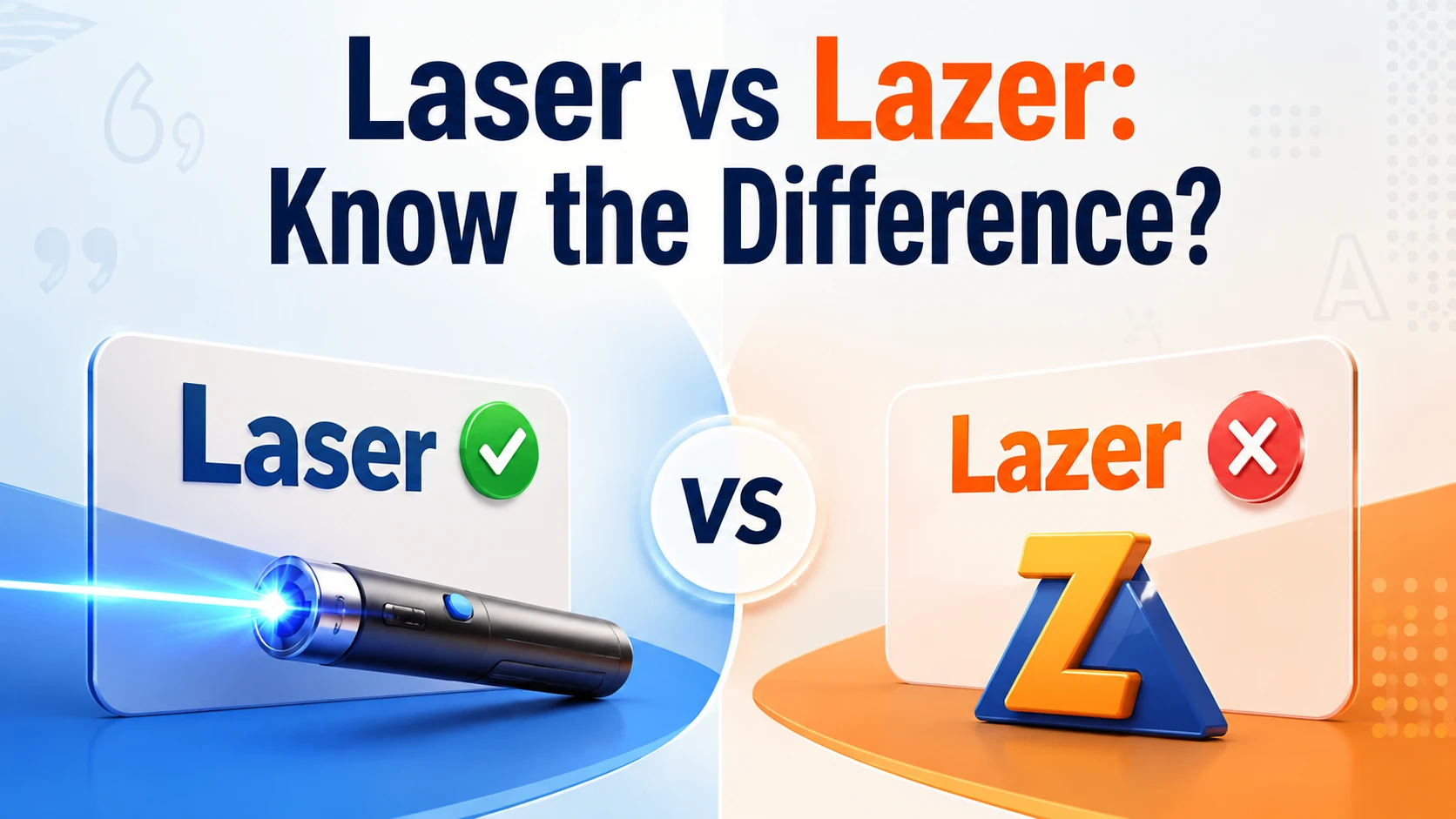
Laser vs Lazer is a surprisingly common spelling question because both forms sound exactly alike. If you’re talking about the technology that produces a concentrated beam of light, laser is the standard English spelling. Lazer, with a “z,” is generally a nonstandard spelling, although it can appear in brand names, usernames, fictional names, and other creative contexts.
The distinction matters more than it first appears. You might encounter the word in medical information, scientific writing, technology documentation, business material, product descriptions, or everyday conversation. In those settings, using the established spelling makes your writing clearer and more credible. This guide explains what each form means, why the confusion exists, and when a spelling such as “Lazer” can legitimately appear.
Understanding the difference also helps you avoid errors in familiar expressions such as laser surgery, laser printer, laser beam, laser cutting, and laser technology. You’ll see how the word developed, why it is spelled with an “s,” and how context changes the answer. By the end, you’ll have a simple rule for deciding between laser and lazer without having to second-guess yourself.
Laser vs Lazer: The Quick Answer
If you mean the technology or device that produces a highly concentrated beam of light, use laser.
Laser is the standard English spelling. Lazer is not the normal spelling of the technology and should generally be treated as a misspelling unless it is deliberately being used as part of a proper name, brand, username, fictional term, or other creative expression.
| Term | Standard English spelling? | Typical meaning/use | Example |
| Laser | Yes | A device or technology that produces a concentrated beam of light | The surgeon used a laser during the procedure. |
| Lazer | Generally no | Creative spelling, proper name, brand, username, or error | The company uses “Lazer” in its official name. |
So the practical rule is simple:
Use “laser” when you mean the technology. Use “Lazer” only when the unusual spelling is intentional and officially established.
That distinction is especially important in formal writing. If you’re writing an assignment, article, report, instruction manual, medical explanation, or business document, laser is almost certainly the form you need.
What Does Laser Mean?
Laser as a Noun
Laser is primarily a noun referring to a device or system that produces a narrow, concentrated beam of electromagnetic radiation through a process called stimulated emission of radiation.
The word began as an acronym for Light Amplification by Stimulated Emission of Radiation. Over time, the acronym became an ordinary English noun, which is why you normally see it written in lowercase as laser rather than as an all-capital abbreviation.
A laser can produce light with characteristics that make it useful for highly precise applications. Depending on the type of laser, the emitted radiation can be used for cutting, measuring, scanning, communication, surgery, manufacturing, research, and many other purposes.
For example:
- The technician aligned the laser before beginning the measurement.
- The doctor used a laser to treat the affected tissue.
- The factory uses a laser to cut metal components.
- A laser pointer was used during the presentation.
The important point for spelling purposes is that all of these examples require laser, not lazer.
What “Laser” Refers to in Science and Technology
A laser is not simply an unusually bright flashlight.
A flashlight generally spreads light in many directions. A laser produces a much more directional and concentrated beam, although the exact properties vary among different laser systems.
Lasers can also differ considerably in their wavelength, power, pulse duration, and method of operation. Some are designed for extremely precise scientific measurements, while others are built for industrial cutting or medical procedures.
That range explains why laser appears in so many specialized terms:
- laser beam
- laser light
- laser diode
- laser printer
- laser scanner
- laser cutting
- laser engraving
- laser surgery
- laser treatment
- laser pointer
- laser measurement
- laser communication
The spelling stays the same even though the applications are very different.
Why “Laser” Is Written With an “S”
The spelling laser comes from the original acronym rather than from the pronunciation of the word.
The acronym is:
Light
Amplification by
Stimulated
Emission of
Radiation
The S in “laser” comes from stimulated.
That historical origin explains why replacing the “s” with a “z” does not create an alternative standard spelling. The word became established in English as laser, and that spelling remains standard today.
What Does Lazer Mean?
Is “Lazer” a Standard English Word?
In ordinary modern English, lazer is not the standard spelling of the technology.
When someone writes:
The technician repaired the lazer.
the expected correction is:
The technician repaired the laser.
Likewise:
The hospital offers lazer treatment.
should normally be:
The hospital offers laser treatment.
This distinction matters because lazer can look plausible. English contains many words with a “z” sound, and the pronunciation of laser does not clearly reveal whether the middle consonant should be written s or z.
That makes lazer an understandable spelling mistake, but it does not make it a standard alternative.
When “Lazer” Appears as a Name or Nonstandard Spelling
There is one important qualification.
A spelling can be unusual in ordinary English but still be correct as part of a proper name.
For example, a business, product, entertainment character, online account, or fictional organization might deliberately use the spelling Lazer. In such a case, changing it to Laser could actually make the name inaccurate.
Consider the difference:
The machine uses a laser beam.
Here, laser describes technology.
But:
Lazer is the name of the fictional character.
Here, Lazer is a proper name.
The unusual spelling is intentional in the second sentence. Proper names do not have to follow ordinary dictionary spelling patterns.
Why “Lazer” Should Usually Be Replaced With “Laser”
When lazer is being used as an ordinary noun rather than a specific name, correcting it to laser improves both accuracy and readability.
This is particularly important in:
- Academic papers
- School assignments
- Medical articles
- Technical documentation
- Business communication
- Product instructions
- Professional websites
- News writing
A reader may understand lazer immediately, but recognizable meaning does not make a spelling standard.
Laser vs Lazer: Why Do People Confuse Them?
They Have the Same Pronunciation
The biggest source of confusion is simple: laser and lazer sound the same in ordinary English pronunciation.
When you hear the word, there is no visible “s” or “z” to guide your spelling. You have to remember which written form is conventional.
This is similar to many other English spelling problems where pronunciation alone cannot reliably determine spelling.
For example, English speakers hear the same sound in:
- there / their / they’re
- to / too / two
- right / write
- site / sight / cite
With laser and lazer, the problem is narrower because one form is standard and the other is usually not.
The “-er” Ending Makes the Spelling Easy to Misremember
The final sound in laser is pronounced with an “er” sound, and the middle consonant is voiced. Some writers therefore instinctively choose z because they associate that sound with the letter z.
That reasoning is understandable but unreliable.
English spelling does not always provide a one-to-one relationship between sounds and letters. The sound you hear in laser does not mean the word should be written with z.
The safest approach is to memorize the established spelling rather than trying to reconstruct it from pronunciation.
Brand Names and Creative Spellings Add Confusion
Marketing makes spelling even trickier.
Companies sometimes alter familiar words to create names that look distinctive, memorable, or available for trademark and branding purposes. A business might deliberately choose Lazer because it looks different from the standard word laser.
The same thing can happen with:
- Product names
- Band names
- Gaming handles
- App names
- Fictional characters
- Sports teams
- Online communities
That does not change the standard spelling of the underlying technology.
If a company officially calls its product Lazer, reproduce the name accurately. If you’re describing the product’s technology, however, laser may still be the correct common noun.
Laser vs Lazer: The Key Differences at a Glance
The easiest way to understand the distinction is to separate standard vocabulary from intentional naming.
| Feature | Laser | Lazer |
| Standard English word for the technology | Yes | No |
| Used in scientific writing | Yes | No |
| Used in medical terminology | Yes | No |
| Used in technical documentation | Yes | No |
| Used in everyday English | Yes | Rarely |
| May appear in a brand name | Yes | Yes |
| May appear as a username | Yes | Yes |
| May appear in fiction | Yes | Yes |
| Appropriate as a normal replacement for “laser” | Yes | No |
The distinction is therefore not really about two competing dictionary definitions.
It is primarily a question of standard spelling versus intentional alternative naming.
When Should You Use “Laser”?
In Medical and Healthcare Writing
Use laser whenever you are describing medical equipment, procedures, or treatments involving laser technology.
Examples include:
- laser eye surgery
- laser therapy
- laser treatment
- laser resurfacing
- laser ablation
- laser dentistry
For example:
The specialist explained how laser treatment would be performed.
Writing lazer treatment in a medical article would be a spelling error unless the phrase occurred inside an official name.
Medical writing benefits from precision because terminology needs to be immediately recognizable to both professionals and patients.
In Science and Academic Writing
Academic writing should use the established spelling laser.
Examples:
The researchers measured the wavelength of the laser.
The experiment used a pulsed laser.
The team developed a more efficient laser system.
There is little reason to use lazer in this context. A nonstandard spelling can distract from otherwise careful technical work.
In Technology and Engineering
Engineering and technology publications routinely use laser as the standard term.
You may encounter phrases such as:
- laser sensor
- laser scanner
- laser diode
- laser printer
- laser cutting system
- laser engraving machine
- laser measurement device
For technical communication, consistency matters. Using the conventional spelling allows readers to identify the relevant technology immediately.
In Business and Professional Communication
Use laser when describing technology in proposals, reports, presentations, websites, or workplace correspondence.
For example:
We purchased a new laser printer for the design department.
The manufacturer uses laser cutting to produce the components.
The company is investing in laser-based measurement equipment.
In professional writing, there is rarely any advantage to replacing the standard s with z.
Common Expressions and Terms With “Laser”
Laser Surgery and Laser Treatment
Laser surgery and laser treatment are established expressions.
Examples:
She researched laser surgery before scheduling a consultation.
The clinic provides several types of laser treatment.
Do not automatically write lazer surgery simply because the pronunciation makes the spelling feel plausible.
Laser Printer and Laser Printing
A laser printer uses laser technology as part of its printing process.
Correct:
Our office needs a new laser printer.
Incorrect in ordinary usage:
Our office needs a new lazer printer.
The same applies to laser printing.
Laser Beam and Laser Light
Laser beam refers to the directed beam produced by a laser system.
Examples:
The laser beam was directed toward the target.
Never look directly into a high-powered laser beam.
Laser light is another common expression used in scientific and technical contexts.
Laser Pointer and Laser Scanner
A laser pointer produces a visible beam or spot used to highlight information, often during presentations.
A laser scanner uses laser-based sensing to collect information about an object, surface, or environment.
Both terms retain the standard laser spelling.
Laser Cutting and Laser Engraving
Industrial equipment commonly uses lasers for extremely precise cutting and engraving.
Examples:
The workshop uses laser cutting for metal sheets.
The company specializes in laser engraving.
These are excellent examples of why consistent spelling matters in technical writing. A reader searching for equipment or services will expect the established term laser.
Common Laser vs Lazer Mistakes to Avoid
Writing “Lazer” in Formal or Academic Work
The most straightforward mistake is using lazer as though it were an accepted alternative spelling.
If you’re writing a paper, report, essay, or professional article, use laser.
Calling a Medical Procedure “Lazer Surgery”
This is especially noticeable because medical terminology is normally standardized and carefully edited.
Use:
laser surgery
not:
lazer surgery
The same principle applies to laser treatment, laser therapy, and other established medical terms.
Writing “Lazer Printer” Instead of “Laser Printer”
The word may be familiar enough that readers understand what you mean, but the spelling remains incorrect in standard usage.
Use:
laser printer
The spelling should not change simply because the technology is being discussed in an everyday context.
Assuming “Lazer” Is an Alternative Standard Spelling
This is perhaps the most important misconception to eliminate.
Laser and lazer are not two standard spellings with different ordinary meanings.
Instead:
- laser = standard English term
- lazer = usually a misspelling or intentional proper name
That distinction gives you a reliable rule for almost every writing situation.
Changing an Official Name Because It Looks Incorrect
There is one mistake on the opposite side.
Suppose a company officially uses Lazer in its name. Correcting it to Laser would alter the company’s identity.
For example:
The product is manufactured by Lazer Technologies.
If that is the company’s official spelling, retain it.
The fact that the name resembles a misspelling does not give an editor permission to change a proper name without checking the official form.
The History Behind the Word “Laser”
The spelling laser isn’t arbitrary. It comes from the initial letters of the scientific phrase “light amplification by stimulated emission of radiation.” The term was formed as an acronym and eventually became an ordinary English noun.
That history explains why laser became the established spelling rather than lazer. Once the term entered scientific and technical writing, laser became standardized across fields such as physics, engineering, medicine, telecommunications, and manufacturing.
The technology itself developed from earlier research into stimulated emission and optical amplification. Today, the word is so well established that most readers encounter laser as a normal dictionary word rather than as an acronym.
Why the Original Spelling Matters
English contains many words whose spellings become fixed through scientific and professional usage. Laser is one of them.
Changing the s to a z doesn’t create a new standard spelling. It simply produces a spelling that resembles the way many English speakers pronounce the word.
That distinction is useful when you’re writing professionally:
- laser technology is standard.
- laser surgery is standard.
- laser printer is standard.
- laser beam is standard.
- laser treatment is standard.
- lazer technology is generally nonstandard unless Lazer is part of a proper name.
How “Laser” Is Used in Modern English
Laser can function as both a noun and a modifier in English. Its meaning depends on the context, but the spelling remains the same.
Laser as a Noun
As a noun, laser refers to a device or source that produces a concentrated beam of coherent light.
For example:
- The technician aligned the laser before beginning the procedure.
- The experiment used a low-power laser.
- Never look directly into a high-powered laser beam.
- The scanner uses a laser to read the surface.
In everyday language, however, people often use laser more broadly to refer to the beam itself.
Laser as a Modifier
The word frequently appears before another noun to describe equipment, technology, treatment, or a process involving lasers.
Common combinations include:
| Expression | Meaning |
| laser printer | A printer that uses laser technology |
| laser beam | A concentrated beam produced by a laser |
| laser surgery | Surgery using laser technology |
| laser cutting | Cutting material with a laser |
| laser pointer | A handheld device that projects a visible laser beam |
| laser scanner | A scanner using laser technology |
| laser treatment | Treatment involving laser technology |
| laser engraving | Marking or engraving material with a laser |
This is one reason spelling the word correctly matters. A typo such as lazer printer can look especially noticeable because laser appears in many established technical terms.
Laser vs Lazer: The Practical Difference
The easiest way to understand the distinction is to separate standard English usage from proper names and creative spelling.
| Word | Standard English? | Typical use | Example |
| laser | Yes | Scientific, technical, medical, and everyday writing | The laser damaged the sensor. |
| lazer | Generally no | Names, branding, usernames, creative writing, or intentional stylization | The company was called Lazer Systems. |
The important point: lazer isn’t normally an alternative spelling of laser.
If you’re writing a sentence about the technology, choose laser.
If you’re reproducing the official name of a company, product, character, organization, or other proper name that deliberately uses Lazer, preserve that spelling.
Why People Write “Lazer”
The confusion is understandable because laser and lazer are pronounced the same way in ordinary English.
When people hear the word, they may naturally assume that the middle sound should be represented by z. English has plenty of words in which a /z/ sound is spelled with the letter z, so lazer can look plausible.
Pronunciation Encourages the Mistake
Consider the sound of laser. The s is pronounced with a /z/ sound.
That can make the spelling feel inconsistent to someone who is learning English.
However, English spelling isn’t determined entirely by pronunciation. Words can retain spellings based on their origins, historical development, or established usage.
So this is a useful rule:
Don’t change the spelling of laser simply because its “s” sounds like “z.”
The correct written form remains laser.
Brand Names Create Additional Confusion
Businesses sometimes intentionally alter familiar spellings to make a name distinctive.
A company might use Lazer because it wants a memorable brand identity. A musician, gaming group, fictional character, or online creator might do the same.
That doesn’t make lazer the standard spelling of the technology.
It simply means that Lazer may be correct as a particular name.
When Should You Use “Laser”?
Use laser whenever you’re referring to the technology, device, beam, process, or concept in standard English.
This applies across most forms of writing.
Academic and Scientific Writing
Scientific and educational material should use the established spelling laser.
Examples:
- The laser emitted light at a specific wavelength.
- Researchers measured the intensity of the laser beam.
- The experiment required a stable laser source.
In technical writing, consistency matters because readers expect standardized terminology.
Medical Writing
Medical terminology also uses laser.
Examples include:
- laser eye surgery
- laser therapy
- laser treatment
- laser ablation
- laser surgery
For example:
The specialist discussed whether laser treatment was appropriate for the patient.
Writing lazer treatment would generally be treated as a spelling error rather than a medical variant.
Business and Professional Writing
Use laser in reports, emails, proposals, product descriptions, and workplace documents.
For example:
Our facility recently installed a new laser cutting system.
A professional document is not the place to introduce a creative spelling unless it belongs to an official name.
Everyday Writing
The same rule applies to casual writing.
- She bought a laser printer.
- The presentation used a laser pointer.
- The machine uses a laser scanner.
You don’t need a different spelling simply because the conversation is informal.
When Can “Lazer” Be Correct?
There are situations in which Lazer can appear legitimately. The key is that it usually isn’t being used as the ordinary English spelling of the technology.
Brand and Company Names
If an organization officially spells its name Lazer, reproduce the name exactly.
For example, if a fictional or real business is officially called Lazer Solutions, changing it to Laser Solutions would alter its name.
Proper names follow their own spelling conventions.
Product Names
A manufacturer may deliberately use Lazer in a product name.
In that case, the unusual spelling is part of the branding rather than evidence that lazer is an accepted alternative spelling.
Usernames and Online Handles
People frequently modify spellings when creating usernames, gaming names, social media handles, or online identities.
Someone may choose LazerKing instead of LaserKing simply because the first version is available or looks more distinctive.
That usage doesn’t change standard English spelling.
Fiction and Creative Writing
Authors can intentionally use Lazer for a fictional company, character, weapon, organization, or futuristic technology.
For instance:
Captain Nova activated the Lazer Core.
If Lazer Core is the fictional device’s official name, the spelling can be intentional.
Common “Laser” and “Lazer” Mistakes
Most errors involving these words are easy to prevent once you understand the distinction.
Mistake: Writing “Lazer” for the Technology
Incorrect:
The dentist recommended lazer treatment.
Standard form:
The dentist recommended laser treatment.
The same correction applies to phrases such as laser surgery, laser printer, and laser beam.
Mistake: Assuming the Pronunciation Determines the Spelling
The pronunciation can make lazer look logical. But pronunciation alone doesn’t determine English spelling.
A better habit is to remember the established word rather than trying to reconstruct its spelling from its sound.
Mistake: Treating “Laser” and “Lazer” as Interchangeable
They aren’t interchangeable in ordinary writing.
If you’re referring to laser technology, use laser.
If you’re quoting or naming something officially spelled Lazer, retain the proper spelling.
Mistake: Correcting an Official Name
The opposite mistake can happen, too.
Suppose a business officially calls itself LazerTech. Changing it to LaserTech in a quotation, directory entry, or business profile may introduce an error.
Standard spelling rules don’t override an official proper name.
A Quick Decision Guide
When you’re unsure which spelling to choose, ask what the word is doing in your sentence.
| What are you referring to? | Correct choice |
| A beam of concentrated light | laser |
| Laser surgery | laser |
| A laser printer | laser |
| Laser technology | laser |
| A scientific experiment | laser |
| A company’s official name spelled “Lazer” | Lazer |
| A fictional product called “Lazer” | Lazer |
| A username containing “Lazer” | Lazer |
| A normal reference to laser technology | laser |
The Three-Second Test
Try this:
Are you describing the technology, or naming something?
- Describing the technology → laser
- Naming a person, company, product, character, or brand → use its official spelling
That simple distinction handles almost every situation.
Examples of “Laser” in Real Sentences
Seeing the word in different contexts makes its usage easier to recognize.
Science and Technology
- The laser produced a narrow beam of light.
- Engineers adjusted the laser to improve accuracy.
- The device contains a compact laser module.
- The researchers measured the laser’s wavelength.
Medicine
- The doctor explained how laser therapy works.
- The clinic uses a laser for certain procedures.
- The patient asked about possible side effects of laser treatment.
Manufacturing
- The factory uses laser cutting to shape metal.
- A laser scanner measures the dimensions of the component.
- The machine uses a focused laser beam for engraving.
Consumer Technology
- I need a new laser printer for the office.
- The presenter couldn’t find the laser pointer.
- The barcode system uses laser scanning technology.
Everyday Conversation
- Don’t point the laser toward someone’s eyes.
- The presentation room has a laser pointer.
- The technician replaced the damaged laser.
Examples Where “Lazer” May Be Correct
The following examples demonstrate a different situation.
- LazerTech opened a new office downtown.
- The game’s fictional weapon is called the Lazer Cannon.
- Her username is LazerFox.
- The band’s album includes a character named Lazer.
In each case, the spelling is potentially correct because it is being used as a name or deliberate stylistic form, not as the ordinary spelling of the technology.
How “Laser” Became So Widespread
The word laser eventually moved beyond physics laboratories and became part of everyday vocabulary.
That transition is important because some scientific terms remain highly specialized while others become ordinary words. Laser belongs to the second group.
You can now encounter it in:
- medicine
- telecommunications
- manufacturing
- computing
- consumer electronics
- surveying
- entertainment
- research
- education
- transportation
This widespread use reinforces the established spelling. When a technical term becomes common vocabulary, its conventional form becomes increasingly familiar to readers.
Where Laser Technology Appears in Everyday Life
You may use or encounter laser technology without thinking about the underlying science.
Healthcare
Lasers are used in various medical and dental applications. The exact procedure and appropriate technology depend on the clinical purpose.
That is why phrases such as laser treatment, laser surgery, and laser therapy are common in medical contexts.
Manufacturing
Industrial lasers can be used for processes such as:
- cutting
- welding
- marking
- engraving
- measurement
Their precision makes them valuable where controlled material processing is required.
Communication
Lasers play an important role in optical communication systems. Light can carry information through optical fibers over long distances.
This connects the word laser with concepts such as:
- fiber optics
- optical communication
- data transmission
- photonics
- wavelength
Consumer Devices
Laser technology appears in products such as:
- laser printers
- barcode scanners
- optical equipment
- measurement devices
- laser pointers
The everyday examples are useful because they show that laser isn’t limited to scientific writing.
Why “Lazer” Appears Online
If you search the internet, you may encounter lazer frequently enough to wonder whether dictionaries or modern usage have accepted it.
Usually, several different things are being mixed together.
Search Results Include Proper Names
Search engines index company names, usernames, product names, social profiles, and fictional terminology alongside ordinary dictionary words.
A large number of results for Lazer doesn’t automatically mean it is the standard spelling.
Informal Writing Contains Misspellings
People make spelling mistakes online. A frequently repeated mistake can become highly visible without becoming grammatically standard.
This is particularly common with words whose pronunciation makes an alternative spelling seem reasonable.
Branding Encourages Alternative Spellings
Brands often alter familiar words to make names distinctive.
That’s why you’ll sometimes see spelling variations involving:
- z instead of s
- doubled letters
- removed vowels
- unusual capitalization
These choices belong to branding, not necessarily standard English.
A Simple Memory Trick for Laser vs Lazer
If you need a quick way to remember the standard spelling, connect laser with its scientific origin.
LASER = Light Amplification by Stimulated Emission of Radiation
The word’s original scientific formation uses S, not Z.
You don’t need to memorize the entire expansion every time you write the word. Simply remember:
Scientific technology = LASER
Then reserve Lazer for an intentional proper name or creative spelling.
Conclusion
The choice between laser vs lazer is straightforward once you separate standard English from intentional naming. Laser is the correct spelling when you mean the technology, device, beam, treatment, or related scientific concept. Lazer may appear in a company name, product name, username, or creative work, but that doesn’t make it a standard alternative spelling. One final actionable tip: when writing about science, medicine, technology, or everyday equipment, choose laser without hesitation. A common mistake to avoid is assuming that pronunciation justifies changing the s to z. English spelling often preserves forms that aren’t obvious from sound alone. When you remember that laser is the established scientific term, the spelling becomes much easier to get right. The best rule is simple: technology is laser; intentional names may be Lazer.
Frequently Asked Questions
Q1. Is “lazer” a correct spelling of laser?
No, lazer is generally not the standard English spelling for the technology. The established spelling is laser. However, Lazer can be correct when it forms part of an official brand, company, product, username, or fictional name that intentionally uses that spelling.
Q2. Why is laser spelled with an “s” if it sounds like a “z”?
The s in laser is pronounced with a /z/ sound, but English spelling doesn’t always match pronunciation directly. More importantly, laser comes from a scientific acronym and has become the established spelling in standard English.
Q3. Should I write “laser surgery” or “lazer surgery”?
Write laser surgery. In standard medical and general English, laser is the correct spelling. Lazer surgery would normally be considered a spelling error unless the phrase is deliberately reproducing an unusual proper name or brand.
Q4. Can “Lazer” ever be correct?
Yes. Lazer can be correct as part of an official name or deliberate creative spelling. A company, product, fictional character, or username may use it intentionally. In those cases, preserve the name’s official spelling rather than changing it to Laser.
Q5. Is “laser” an acronym or an ordinary word?
Laser originated as an acronym for “light amplification by stimulated emission of radiation.” It has since become a fully established English word. Because of that development, it is normally written as the lowercase noun laser, not as an all-capital acronym.
