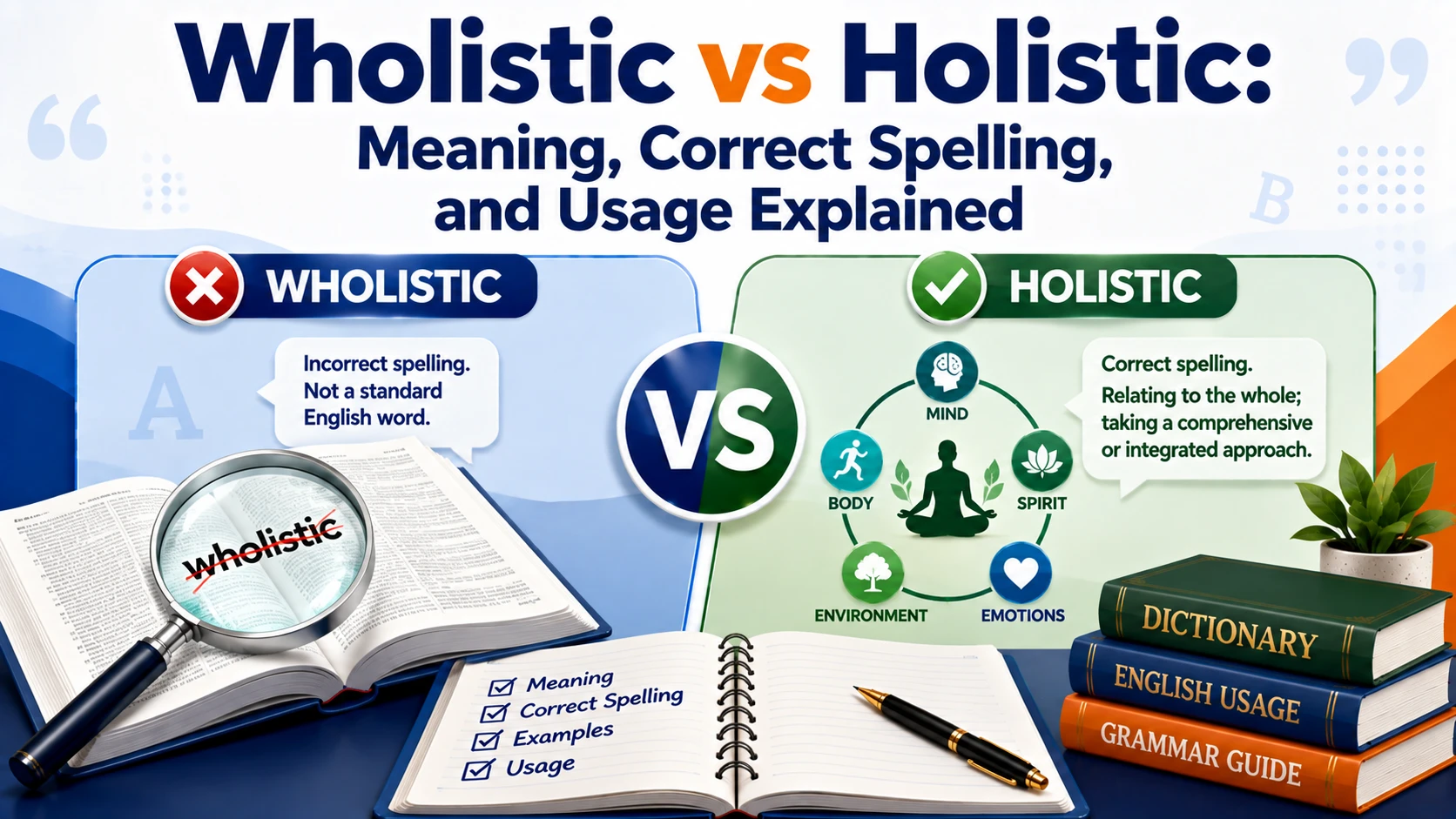
Wholistic vs holistic is a spelling question that looks deceptively simple. Both forms appear in English, and both are used to describe an approach that considers something as a whole rather than focusing on isolated parts. That naturally raises a practical question: if both exist, which one should you actually write? For most readers, the answer is straightforward: holistic is the established and preferred form. Major dictionaries define holistic as relating to complete systems or wholes rather than individual parts.
The confusion usually comes from the word whole. Because wholistic visibly contains whole, it can seem like the more logical spelling. English, however, isn’t always built according to the spelling patterns that look most obvious today. Holistic developed from holism, and Merriam-Webster traces its formation to holism + -istic. Its first known use dates to 1926, while wholistic is treated as an alteration influenced by whole.
This guide explains holistic and wholistic meaning, spelling, pronunciation, grammar, usage, and context without treating the issue as a simple right-versus-wrong spelling quiz. You’ll learn why holistic is normally the better choice, when wholistic can legitimately appear, how to use both forms in sentences, and how to distinguish holistic from related words such as comprehensive, integrated, complete, and all-inclusive. By the end, you’ll have a simple rule you can apply confidently in everyday, academic, professional, and online writing.
Quick Answer: Should You Use Wholistic or Holistic?
If you’re choosing a spelling for ordinary English, use holistic.
Holistic is the standard form found in major English dictionaries. Merriam-Webster defines it as relating to or concerned with complete systems rather than individual parts, while Cambridge describes it as dealing with or treating the whole of something or someone rather than only a part.
Wholistic isn’t simply an invented spelling, though. Merriam-Webster lists it as meaning “holistic”, and Collins identifies it as a variant spelling of holistic.
That distinction matters. Calling wholistic an outright nonexistent word would be inaccurate. Calling it the normal spelling would also be misleading.
The simplest rule
When you mean “considering the whole rather than just individual parts,” choose holistic unless you have a specific reason to preserve wholistic.
That rule works well for:
- School assignments
- Academic writing
- Business documents
- Professional communication
- Blog posts
- Reports
- General correspondence
- Most websites and published content
You may retain wholistic when it appears in an official name, title, quotation, or deliberate branding choice.
| Situation | Best choice | Why |
| General writing | Holistic | Standard and familiar |
| Academic paper | Holistic | Conventional formal usage |
| Business report | Holistic | Clear and professional |
| Health article | Holistic | Established terminology |
| SEO content | Holistic | Natural standard form |
| Quoting a source | Wholistic, if original | Preserve the source’s wording |
| Official organization name | Wholistic, if official | Proper names should remain unchanged |
| Deliberate branding | Wholistic, if intended | Brand spelling can be unconventional |
What Does Holistic Mean?
Holistic is an adjective describing an approach that considers a whole system, person, problem, or situation, rather than examining only one part.
Cambridge defines holistic as dealing with or treating the whole of something or someone rather than just a part. Merriam-Webster similarly describes it in terms of complete systems and individual parts.
Consider a school trying to improve student performance.
A narrow approach might look only at test scores. A holistic approach could consider teaching quality, attendance, family circumstances, motivation, learning environment, access to resources, and the student’s broader development.
The distinction isn’t necessarily about choosing the whole instead of the parts. A good holistic approach can examine individual parts while also asking how those parts interact.
Holistic Meaning in Simple Terms
Think of a bicycle.
You can inspect its tires, chain, brakes, pedals, and gears separately. That’s useful when diagnosing a particular fault. But if you want to understand how well the bicycle functions as a system, you need to consider how those components work together.
That’s the basic idea behind holistic.
It often asks:
- What is happening to the whole?
- How are the parts connected?
- What factors influence one another?
- What happens when one part changes?
- Is a solution addressing the underlying system or only one symptom?
This is why the word appears in fields as different as education, healthcare, ecology, business, design, psychology, and systems thinking.
Common Phrases With Holistic
Some combinations are especially common:
- holistic approach
- holistic view
- holistic perspective
- holistic solution
- holistic assessment
- holistic development
- holistic care
- holistic health
- holistic education
- holistic planning
- holistic analysis
- holistic strategy
Merriam-Webster’s usage material also shows holistic modifying terms such as approach, equation, project, restoration, and growth.
What Does Wholistic Mean?
Wholistic generally means the same thing as holistic.
The important difference is that wholistic is much less conventional. Merriam-Webster lists it as a variant whose definition is simply holistic, while Collins explicitly calls it a variant spelling.
So if you encounter a sentence such as:
The organization takes a wholistic approach to community development.
The intended meaning is generally clear. The writer is saying that the organization considers the different aspects of community development together rather than treating each one in isolation.
The issue is not usually meaning. It is standard spelling and reader expectation.
Is Wholistic a Correct Word?
The safest answer is: yes, it is an attested variant, but it isn’t the preferred standard form for most writing.
This is an important distinction.
A spelling can appear in dictionaries without being equally common or equally suitable in every context. Collins classifies wholistic as a variant of holistic, and Merriam-Webster gives it as an alteration influenced by whole.
Therefore:
- “Wholistic doesn’t exist” is too absolute.
- “Wholistic is just as standard as holistic” is also misleading.
- “Holistic is the normal spelling; wholistic is a recognized variant” is the most useful explanation.
Holistic vs. Wholistic: What’s the Difference?
The difference is primarily conventional usage, not a substantial difference in definition.
| Aspect | Holistic | Wholistic |
| Basic meaning | Considering a whole or complete system | Generally the same |
| Part of speech | Adjective | Adjective |
| Standard form | Yes | Variant |
| Familiarity | High | Lower |
| Formal writing | Recommended | Usually unnecessary |
| Academic writing | Recommended | Generally avoid |
| Business writing | Recommended | Generally avoid |
| Health terminology | Common | Less common |
| Official names | Use if that is the established name | Preserve if officially spelled this way |
| General recommendation | Use this by default | Use only when context calls for it |
The distinction becomes especially important when you’re writing for people who expect conventional English spelling. A reader may understand wholistic immediately, but the unusual spelling can still interrupt the reading experience or make the sentence look less polished.
Does Holistic Mean Something Different From Wholistic?
Usually, no meaningful difference in ordinary usage exists.
Both words express the idea of looking at something in its entirety or considering interconnected parts as a system.
If someone writes:
We need a holistic approach to employee development.
and another person writes:
We need a wholistic approach to employee development.
the intended idea is essentially the same.
The reason to prefer holistic isn’t that it carries a superior meaning. It’s that holistic is the established spelling readers are more likely to expect.
Are Holistic and Wholistic Pronounced the Same?
Generally, yes. The spelling difference doesn’t normally create a different pronunciation in ordinary English.
Cambridge gives the American pronunciation of holistic as approximately /hoʊˈlɪs.tɪk/ and the British pronunciation as /həʊˈlɪs.tɪk/.
The important point for writers is that the h-o-l spelling doesn’t sound like the ordinary adjective whole. That’s another reason the word can feel surprising when you first encounter it.
Why Is It “Holistic” Rather Than “Wholistic”?
The spelling makes more sense once you look at the history of holism.
Merriam-Webster traces holistic to holism + -istic and gives its first known use as 1926.
Oxford’s entry for holism explains that the word dates from the 1920s and comes from holo-, meaning “whole,” plus -ism. It also identifies J. C. Smuts as the person who coined holism to describe the tendency in nature to produce organized wholes from grouped units.
That gives us a useful word family:
holo- → holism → holistic
The spelling isn’t simply:
whole → wholistic
That’s why holistic became the established form even though modern readers can easily see a connection with the everyday word whole.
Is Holistic Related to “Whole”?
Yes, conceptually and historically, the idea is connected with “whole.”
But the spelling history is more specific than simply taking whole and adding a suffix.
Oxford traces holism to the combining form holo-, meaning “whole.
That distinction explains why the spelling can seem unintuitive.
You aren’t looking at a random spelling. You’re looking at a word that entered English through a particular technical and philosophical vocabulary.
Why Does “Wholistic” Look So Natural?
Because English gives readers several familiar patterns:
- whole
- wholly
- wholes
- wholeness
When someone hears the meaning “considering the whole,” writing wholistic feels logical.
That is a classic example of spelling by analogy. A writer recognizes a familiar word and builds a new-looking form around it.
The result may be understandable without being the conventional form.
How to Use “Holistic” in a Sentence
Because holistic is an adjective, it normally comes before a noun or follows a linking verb.
Before a Noun
The company adopted a holistic strategy for improving customer retention.
Our teacher uses a holistic approach to student assessment.
The researchers developed a holistic model of community health.
Here, holistic describes the type of strategy, approach, or model.
After a Linking Verb
The new framework is holistic rather than narrowly focused.
Her approach to leadership is holistic.
This pattern is less common than adjective + noun constructions but is perfectly natural.
Using Holistic With “Approach”
Holistic approach is one of the most useful phrases to understand because it appears across many fields.
For example:
Instead of fixing each department separately, management took a holistic approach to the company’s workflow.
The sentence doesn’t mean that every department receives identical treatment. It means the organization considers the relationships among departments and the effect of changes across the wider system.
Using Holistic in Everyday Situations
You don’t need a technical subject to use the word.
We need a holistic view of the problem before making a decision.
She took a holistic approach to planning the move.
The coach considered the team’s performance from a holistic perspective.
These examples demonstrate the word’s broader meaning without tying it specifically to medicine.
How to Use “Wholistic” in a Sentence
Grammatically, wholistic behaves like holistic because it is an adjective.
You might see:
The program takes a wholistic approach to employee development.
The organization promotes wholistic care.
They developed a wholistic framework for community planning.
The problem isn’t that these sentences are impossible to understand. The problem is that holistic would normally be the more conventional editorial choice.
If you’re writing a sentence from scratch, use:
The program takes a holistic approach to employee development.
If you’re reproducing an organization’s official wording, however, changing wholistic may be inappropriate.
When Should You Keep “Wholistic”?
There are several legitimate reasons.
An Official Name Uses Wholistic
Suppose a company is officially called Wholistic Learning Center.
Don’t silently “correct” the company’s name to Holistic Learning Center. Proper names belong to their owners.
You’re Quoting a Source
If the original source says wholistic, preserve the spelling when accuracy requires a direct quotation.
The Spelling Is Part of a Brand
Some organizations deliberately choose unusual spellings to emphasize a particular idea or distinguish their brand.
In that situation, the unusual spelling isn’t a typo. It’s a branding decision.
Editorial rule: Correct ordinary prose, but don’t “correct” a proper name simply because its spelling differs from the dictionary default.
Holistic Examples in Different Contexts
One reason holistic is worth understanding properly is that it has expanded well beyond one specialized field.
Holistic Thinking in Business
A company might initially focus only on sales.
A holistic analysis could also consider:
- customer satisfaction
- employee workload
- product quality
- operating costs
- retention
- brand reputation
- long-term sustainability
For example:
The company needs a holistic strategy that addresses customer experience and internal operations together.
The word signals that the writer isn’t treating one business metric as the entire picture.
Holistic Education
A school may measure success through exam results. A broader educational approach can consider academic knowledge alongside other forms of development.
The school follows a holistic approach to education, emphasizing academic skills, creativity, collaboration, and practical learning.
Here, holistic doesn’t mean “ignore grades.” It means don’t reduce the student’s entire development to one measurement.
Holistic Design
A designer might focus only on visual appearance.
A holistic design process considers several dimensions together:
- usability
- accessibility
- visual clarity
- performance
- user needs
- maintenance
- long-term functionality
The team took a holistic approach to product design, considering accessibility and usability alongside appearance.
That is more precise than simply calling the design “complete.”
Holistic Technology
In technology, a holistic perspective can involve more than whether software works.
A development team might consider:
- user experience
- security
- scalability
- performance
- accessibility
- maintenance
- data requirements
- long-term costs
For instance:
The company evaluated the platform from a holistic perspective rather than judging it solely by processing speed.
Holistic Environmental Thinking
Environmental problems often involve interconnected systems.
A policy might affect:
- ecosystems
- communities
- agriculture
- energy consumption
- transportation
- economic activity
A holistic analysis tries to understand those relationships instead of treating each issue as completely independent.
Holistic Health: What Does It Actually Mean?
Holistic health is one of the most recognizable uses of the word.
In general language, it refers to considering a person’s health in a broader context rather than focusing exclusively on one symptom, body part, or diagnosis. Cambridge gives the example of holistic medicine as an approach concerned with the whole person, including mind and body.
The term can appear in phrases such as:
- holistic health
- holistic healthcare
- holistic care
- holistic wellness
- holistic treatment
- holistic approach to health
However, there’s an important writing distinction.
Holistic is a descriptive word, not proof that a particular treatment works.
Calling a treatment “holistic” tells you something about the approach being claimed. It doesn’t automatically establish its medical effectiveness or safety.
That’s particularly important for health writers. Don’t turn a definition of holistic into an unsupported endorsement of a medical practice.
Holistic vs. Related Words: Are They Interchangeable?
Not always.
Holistic, comprehensive, integrated, and complete overlap, but they emphasize different ideas.
| Word | Core idea | Best used when you mean… | Example |
| Holistic | Whole system and relationships | The parts should be understood together | a holistic approach |
| Comprehensive | Broad coverage | Many or all relevant areas are included | a comprehensive report |
| Integrated | Connected components | Separate elements work together | an integrated system |
| Complete | No missing parts | Something has all necessary elements | a complete application |
| Overall | General picture | You’re stepping back from details | the overall result |
| All-inclusive | Includes everything relevant | Little or nothing is intentionally excluded | an all-inclusive package |
This distinction is useful because writers sometimes use holistic as a fashionable substitute for every word meaning “broad.”
That can weaken precision.
When “Comprehensive” Is Better
Use comprehensive when the emphasis is on coverage.
We conducted a comprehensive review of the available evidence.
This means the review is broad or thorough. It doesn’t necessarily say that the reviewer is analyzing how every component interacts.
When “Integrated” Is Better
Use integrated when the important idea is coordination or combination.
The hospital developed an integrated care system.
That emphasizes different services working together.
When “Holistic” Is Better
Use holistic when the central idea is understanding the whole system and its interconnected elements.
The committee took a holistic view of the city’s transportation problems.
That suggests the committee considered how different transportation factors affect one another.
Common Holistic vs. Wholistic Mistakes
Mistake 1: Choosing Wholistic Because It Contains “Whole”
This is the most understandable mistake.
The reasoning is:
whole → wholistic
It looks logical, but established English vocabulary doesn’t always follow the spelling pattern that seems most intuitive.
Better choice: Use holistic unless a specific context requires wholistic.
Mistake 2: Saying Wholistic Is Completely Fake
That’s the opposite error.
Major dictionaries recognize the form. Merriam-Webster defines wholistic as holistic, and Collins labels it a variant spelling.
Better explanation: It’s a recognized but less conventional variant.
Mistake 3: Treating Both Spellings as Equally Preferred
Recognition doesn’t mean equal frequency or editorial preference.
If you’re writing an article, report, essay, or business document and have no special reason to use wholistic, holistic is the stronger choice.
Mistake 4: “Correcting” a Brand Name
If an organization deliberately calls itself Wholistic Wellness, don’t change its name merely because holistic is the standard spelling.
Proper names are an exception to ordinary spelling preferences.
Mistake 5: Using Holistic as a Vague Synonym for “Good”
Holistic doesn’t simply mean:
- excellent
- beneficial
- complete
- modern
- natural
- healthy
It specifically carries the idea of considering a whole or interconnected system.
A “holistic solution” should therefore have some meaningful relationship to that broader approach.
How to Remember the Correct Spelling
If you frequently confuse the two spellings, don’t try to memorize a complicated historical explanation.
Use this practical association:
Holism → holistic
The noun is holism.
The adjective is holistic.
Merriam-Webster explicitly traces holistic to holism + -istic.
A second reminder is even simpler:
Holistic = the standard form.
Wholistic = a recognized variant.
This keeps the useful distinction without pretending that wholistic never appears.
Which Spelling Is Best for Formal Writing?
For most formal situations, choose holistic.
Academic Writing
Use holistic in:
- essays
- dissertations
- research papers
- academic reports
- presentations
- scholarly articles
For example:
The researchers adopted a holistic framework for analyzing the social effects of the policy.
If you encounter wholistic in a source, preserve it when quoting the source directly, but don’t adopt the spelling unnecessarily in your own prose.
Business Writing
In business documents, conventional vocabulary helps communication move smoothly.
Prefer:
We need a holistic approach to customer retention.
rather than:
We need a wholistic approach to customer retention.
The latter isn’t incomprehensible. It simply introduces an unusual spelling without giving the reader any benefit.
Website and SEO Writing
If you’re creating web content, don’t use wholistic merely to capture a spelling variation.
Good SEO writing should reflect natural language and user expectations. If your article is about holistic health, holistic education, or a holistic approach, use the established term naturally.
You can mention wholistic when the spelling itself is the subject of the page—as it is here.
That provides genuine value instead of forcing an uncommon variant into unrelated content.
A Practical Decision Guide for Wholistic vs. Holistic
Use this checklist whenever you’re unsure:
- Are you writing ordinary English? → Use holistic.
- Are you writing an academic paper? → Use holistic.
- Are you writing a business document? → Use holistic.
- Are you describing a broad, interconnected approach? → Use holistic.
- Are you quoting someone who wrote “wholistic”? → Preserve wholistic when appropriate.
- Is “Wholistic” part of an official name? → Keep the official spelling.
- Is it a deliberate brand name? → Follow the brand’s spelling.
- Are you choosing a spelling because “whole” seems logical? → Choose holistic instead.
The One-Question Test
Ask yourself:
Am I writing the word myself, or am I reproducing someone else’s established wording?
If you’re writing it yourself, holistic is almost always the answer.
If you’re reproducing an official name or exact quotation, preserve the original spelling.
Conclusion
Holistic is the spelling you should normally choose when you mean an approach that considers a whole system, person, problem, or situation rather than only individual parts. It is the established form used by major English dictionaries, while wholistic is recognized as a less common variant. The difference, therefore, isn’t primarily about meaning. It’s about standard usage, context, and editorial judgment. If you’re writing an essay, report, webpage, email, or professional document, holistic is the clean default. If wholistic appears in an official name, brand, or quotation, preserve it when accuracy requires. One final actionable tip: when you’re writing from scratch, choose holistic and move on. A common mistake to avoid is assuming that wholistic must be the “more correct” spelling simply because it resembles whole. In English, the established form wins—and here, that form is holistic.
Frequently Asked Questions
Q1. Is “wholistic” a misspelling of “holistic”?
Not necessarily. Wholistic is a recognized variant spelling. Merriam-Webster defines it as “holistic,” while Collins explicitly labels it a variant of holistic. However, holistic is the conventional spelling and the better choice for most general, academic, and professional writing.
Q2. Which is more common, holistic or wholistic?
Holistic is considerably more established in standard English usage. It is the form consistently presented as the primary dictionary entry by major references. Wholistic is generally treated as a variant rather than the default form. For normal writing, choosing holistic avoids unnecessary spelling ambiguity.
Q3. Is “holistic” related to the word “whole”?
Yes, but not simply because holistic was formed by adding a suffix to whole. The word belongs to the family built around holism, which Oxford traces to holo- meaning “whole.” Holistic subsequently developed from holism.
Q4. Can I use “wholistic” in an academic paper?
You can encounter wholistic in legitimate English, but holistic is normally the better editorial choice in academic writing. Use wholistic when reproducing a source’s exact wording or when the spelling belongs to an official name or title. Otherwise, conventional terminology generally produces clearer, more polished prose.
Q5. Does holistic only refer to health?
No. Holistic is much broader than healthcare. It can describe approaches to business, education, design, technology, environmental policy, research, planning, and problem-solving. The common thread is considering a whole system or interconnected set of factors instead of examining one component in isolation.
