
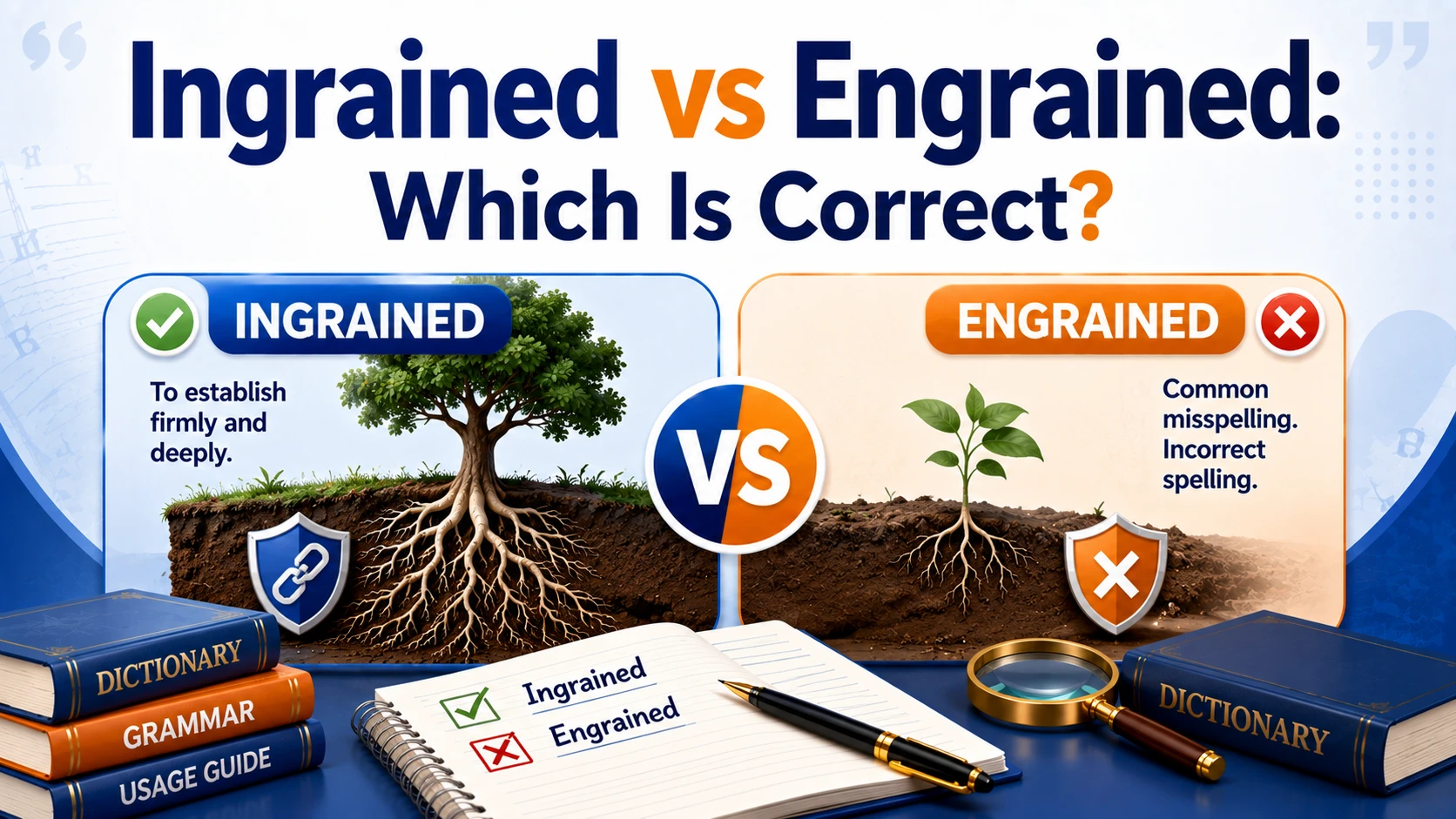
Ingrained vs engrained is a spelling comparison that causes confusion because both forms appear in dictionaries and real-world writing. For most modern English writing, ingrained is the better default. It describes something that has become deeply established, difficult to change, or deeply embedded, whether you’re talking about a habit, belief, attitude, behavior, or even dirt. Oxford lists engrained as a variant of ingrained, so calling it an outright misspelling would be too simplistic.
The confusion becomes easier to understand when you look at the word’s structure. Ingrained is connected with the verb ingrain, meaning to establish something so firmly that it is unlikely to change. That explains expressions such as deeply ingrained habits, ingrained beliefs, and ingrained attitudes. Cambridge also uses ingrained for dirt that has worked beneath a surface and become difficult to remove.
So, which should you actually type? In ordinary contemporary writing, choose “ingrained” unless you have a specific reason to preserve or use engrained. This article explains why, shows how each form is used, separates ingrained from engraved, and gives you practical tests for choosing the right word without relying on guesswork.
Ingrained vs Engrained: The Quick Answer
Is “ingrained” the correct spelling?
Yes. Ingrained is the standard and very common form.
It is used when something has become so firmly established that changing or removing it is difficult. Oxford defines it in relation to long-established habits and attitudes and also gives a physical meaning involving dirt beneath a surface.
Examples:
His morning routine is ingrained.
The company has an ingrained culture of caution.
The carpet was covered with ingrained dirt.
Is “engrained” also a word?
Yes. Engrained is a legitimate variant, not simply a random spelling error.
Oxford has a separate entry for engrained and explicitly cross-references ingrained. Its definition covers the same two broad areas: deeply established habits or attitudes and dirt that is difficult to remove.
That distinction matters when editing. If you encounter engrained in a published text, it isn’t automatically evidence that the writer doesn’t know English.
The key difference in modern English usage
The practical distinction is frequency and preference, not meaning.
| Form | Status | Meaning | Best general choice |
| ingrained | Standard, very common | Deeply established or embedded | Yes |
| engrained | Recognized variant | Essentially the same | Usually use ingrained |
For a website, school assignment, business report, or general article, ingrained is the safest choice.
Quick rule: If you’re deciding which spelling to write yourself, use ingrained.
What Does Ingrained Mean?
Ingrained is an adjective describing something that has become deeply fixed or embedded.
The word is especially useful when ordinary words such as common or familiar aren’t strong enough. An ingrained habit isn’t merely something you do often. It has become so established that changing it can take deliberate effort.
Ingrained meaning and definition
Oxford defines ingrained as something, particularly a habit or attitude, that has existed for a long time and is therefore difficult to change. It also applies to dirt located beneath a surface.
Cambridge gives the same core idea for beliefs, describing something ingrained as firmly held and unlikely to change.
In plain English:
Ingrained = deeply established or deeply embedded.
How “ingrained” describes habits, beliefs, and attitudes
This is the most common figurative use.
She has an ingrained habit of checking her phone before bed.
His fear of public speaking is deeply ingrained.
The organization has an ingrained belief that quality comes first.
The word suggests persistence. Something ingrained usually wasn’t created in a moment. It developed through repetition, experience, culture, upbringing, or long-term exposure.
How “ingrained” can describe physical characteristics
The word isn’t limited to psychology or behavior.
You can describe dirt, stains, oil, or other substances as ingrained when they have penetrated a surface and become difficult to remove.
The workshop floor had ingrained oil stains.
Years of dust had become ingrained in the fabric.
Cambridge specifically recognizes this physical meaning, explaining that ingrained dirt has gotten beneath a surface and is difficult to remove.
Ingrained in everyday and professional writing
The word works comfortably across different registers.
Everyday:
Checking the lock twice has become ingrained in her routine.
Professional:
The company has an ingrained preference for internal promotion.
Academic:
These assumptions became deeply ingrained in the institution’s culture.
Physical description:
The fabric contained ingrained dirt that ordinary washing couldn’t remove.
Its flexibility is one reason ingrained is far more useful than a narrow synonym such as habitual.
What Does Engrained Mean?
Engrained means essentially the same thing as ingrained. The important point is that it exists as a recognized variant.
Engrained as a variant spelling
Oxford’s dictionary entry for engrained defines it in the same semantic territory as ingrained. It specifically gives ingrained as the alternative form.
So this sentence is understandable and dictionary-supported:
The belief was deeply engrained in the community.
However, if you’re choosing the wording yourself, deeply ingrained is generally the more familiar and safer form.
Why “engrained” appears in dictionaries and real-world writing
Language doesn’t always develop in perfectly tidy categories.
Speakers can associate the word with grain and imagine something being worked into or embedded in a material. That can naturally lead writers toward engrained. The form has enough historical and modern usage to receive dictionary recognition.
But dictionary recognition doesn’t mean that two variants are equally common or equally advisable in every context.
That’s an important lesson for editors:
“A word exists” and “this is the best word to use here” are two different questions.
When “engrained” overlaps with “ingrained”
You can often substitute one for the other without changing the intended meaning:
The tradition is deeply ingrained in the community.
The tradition is deeply engrained in the community.
The second sentence isn’t communicating a completely different idea. The difference is primarily one of form and conventional preference.
Why “engrained” is usually not the best choice
For general-purpose writing, ingrained has three practical advantages:
- Readers are more likely to recognize it immediately.
- It matches the standard headword used by major dictionaries.
- It avoids confusion with engrave and engraved.
If your goal is clarity rather than preserving a particular historical or quoted form, ingrained wins.
Ingrain vs Engrain: Understanding the Verbs
The spelling question becomes clearer when you look at the verbs behind the adjectives.
What does “ingrain” mean?
Ingrain is a transitive verb meaning to establish something so firmly that it becomes difficult to change.
Cambridge gives examples involving financial habits, beliefs, and ideas becoming firmly established.
For example:
Parents can ingrain healthy habits through repetition.
The training ingrained discipline into the team’s routine.
The related adjective is:
ingrained
Is “engrain” a legitimate verb?
The situation is less straightforward than with engrained. Engrain does occur, particularly in variant usage, but ingrain is the established form to choose when you need the verb.
That means a writer who wants to avoid uncertainty should use:
ingrain → ingrained
rather than building the word backward from engrained.
How the two verb forms relate to “ingrained” and “engrained”
Think of the forms this way:
| Word | Recommended use |
| ingrain | Standard verb |
| ingrained | Standard, common adjective/past participle |
| engrained | Recognized variant |
| engrain | Much less useful as a default choice |
This is one reason ingrained is the better spelling to learn first.
Why “ingrain” is the safer choice in standard modern English
When you need to describe the process of making something deeply established, ingrain is clear and widely recognized:
Repetition can ingrain a behavior.
Teachers aim to ingrain good study habits.
The noun or object can be a habit, value, belief, principle, response, or pattern.
Ingrained vs Engrained: Side-by-Side Comparison
| Feature | Ingrained | Engrained |
| Recognized English word? | Yes | Yes |
| Standard/common form? | Yes | Variant |
| Meaning | Deeply fixed or embedded | Essentially the same |
| Used for habits? | Yes | Yes |
| Used for beliefs? | Yes | Yes |
| Used for attitudes? | Yes | Yes |
| Used for dirt? | Yes | Yes |
| Best choice for general writing | Yes | Usually not |
| Easily confused with engraved? | Less likely | More likely |
Which spelling should you choose?
If you’re writing an original sentence, choose ingrained.
Use engrained only when there is a contextual reason to retain that variant, such as quoting a source, preserving an established wording, or following a particular editorial convention.
When “engrained” may appear without being a spelling error
Suppose you see:
These assumptions are deeply engrained in the profession.
Don’t immediately mark it as an obvious spelling mistake. A reputable dictionary recognizes engrained as a variant.
A better editorial question is:
Does the publication want the more common form “ingrained”?
For most general audiences, the answer will be yes.
Why Is It “Ingrained” Instead of “Engrained”?
This is where word history helps, but it shouldn’t be turned into an overly rigid spelling rule.
The connection between “ingrain” and “grain”
The word is associated with grain, and its figurative meaning developed around the idea of something becoming deeply fixed or embedded.
That physical image remains useful today:
Something ingrained is difficult to remove because it has become part of the material.
The same conceptual image works for habits and beliefs:
A habit can become so ingrained that it feels almost automatic.
How the prefix “in-” contributes to the word
The in- element carries the idea of being in or into something in this formation. That makes the underlying image easier to remember: something becomes established within rather than simply placed on the surface.
Don’t overapply this logic to every English word beginning with in-, though. English prefixes have complex histories, and modern spelling isn’t always predictable from meaning alone.
Why “ingrained” is not simply another form of “engraved”
This is an especially important distinction.
Ingrained and engraved can both suggest something being deeply fixed, but they describe different processes.
The habit is ingrained.
The habit is deeply established.
Her initials were engraved on the ring.
The initials were physically cut or etched into the surface.
Oxford defines engrave as cutting words or designs into materials such as wood, stone, or metal.
How spelling confusion developed
The similar sounds of ingrained, engrained, and engraved can encourage spelling substitutions.
There’s also a natural visual association between engrain and engrave. But that association doesn’t make the words interchangeable.
Ingrained = deeply established or embedded.
Engraved = physically carved, etched, or figuratively fixed in memory.
That distinction is much more useful than memorizing letters in isolation.
Ingrained Meaning: From Physical Grain to Figurative Habit
The strongest way to understand ingrained is to picture something that has moved beyond the surface.
The original image behind “ingrained”
Imagine dirt worked deeply into fabric. Wiping the surface won’t remove it.
That gives you the central metaphor:
Deeply embedded → difficult to remove → difficult to change.
The word later becomes especially useful for ideas and behavior.
How something becomes “fixed deeply”
A behavior can become ingrained through:
- Repetition
- Long-term practice
- Social conditioning
- Cultural traditions
- Family expectations
- Professional routines
- Repeated reinforcement
For example, a person who has checked every email twice for ten years may develop an ingrained habit of proofreading.
From material grain to ideas and behavior
The physical and figurative meanings are connected by the same underlying concept: deep embedding.
That’s why both of these are natural:
Ingrained dirt covered the carpet.
Ingrained beliefs shaped the policy.
The first involves a physical substance. The second involves an idea.
Why the figurative meaning is now dominant
Modern writing frequently uses ingrained for abstract concepts:
- ingrained habits
- ingrained beliefs
- ingrained attitudes
- ingrained assumptions
- ingrained prejudice
- ingrained traditions
- ingrained behavior
Cambridge’s examples likewise show the word operating heavily in discussions of beliefs, habits, assumptions, and culture.
Ingrained vs Engrained: Physical and Figurative Uses
The word becomes much easier to use when you separate these two broad applications.
Ingrained dirt, stains, and material
Use ingrained when a substance has become difficult to remove from a material:
The shirt had an ingrained grease stain.
Years of smoke had left an ingrained odor in the curtains.
This is a literal physical use.
Ingrained habits and behaviors
For habits, ingrained means deeply established:
Waking before sunrise was an ingrained habit.
It suggests more than frequency. The behavior has become part of someone’s normal pattern.
Ingrained beliefs and attitudes
Use it when an idea has become deeply rooted:
The belief that failure is unacceptable was ingrained in him from childhood.
This doesn’t necessarily mean the belief is true. It means the belief is firmly established.
Ingrained cultural or social practices
The word can describe traditions or assumptions shared by groups:
The practice became ingrained in the community.
Certain assumptions remain deeply ingrained in the industry.
This usage is common in social commentary, journalism, education, and academic writing.
Engrained in physical contexts
Because engrained is a recognized variant, it can also appear in physical descriptions:
The dirt was engrained in the fabric.
But if you’re writing the sentence yourself, ingrained remains the safer choice.
Why “engrained” can create confusion with “engraved”
The first four letters of engrained can make readers think about engrave.
That matters because:
engraved lettering = physically carved or etched
while:
ingrained beliefs = deeply established
A spelling choice that creates unnecessary ambiguity isn’t ideal when a clearer standard form is available.
How to Use Ingrained in a Sentence
The adjective commonly appears with be, become, remain, and adverbs such as deeply.
Examples with habits
Checking the door became ingrained in her routine.
He has an ingrained habit of arriving early.
The behavior is so deeply ingrained that changing it will take time.
Examples with beliefs and attitudes
The assumption was ingrained in the company’s culture.
Her beliefs were deeply ingrained.
The team had an ingrained preference for traditional methods.
Examples with behavior and routines
Double-checking every figure became ingrained behavior.
The safety procedure is now ingrained in the staff’s routine.
Examples with culture and traditions
The tradition is deeply ingrained in the community.
These customs have become ingrained over generations.
Examples with physical substances
Mud had become ingrained in the carpet.
The mechanic struggled to remove the ingrained grease.
Examples in formal and academic writing
The study examined how ingrained assumptions influence decision-making.
The policy reflected an ingrained institutional preference.
Notice that ingrained is particularly useful in formal writing because it communicates long-term persistence without requiring a long explanation.
How to Use Engrained in a Sentence
Because engrained is a recognized variant, it can be grammatically natural even though it isn’t usually the first choice.
Examples where “engrained” appears as a variant
The custom was deeply engrained in the region.
These attitudes became engrained over decades.
The dirt was engrained in the fabric.
These sentences communicate the same basic ideas as their ingrained versions.
Why many editors prefer “ingrained”
Editing isn’t only about whether a word can be defended. It’s also about clarity, familiarity, and consistency.
If the reader expects ingrained, using the more common form removes a small point of friction.
When replacing “engrained” with “ingrained” improves clarity
Consider changing it when:
- You’re writing for a broad audience.
- You’re producing educational content.
- You’re editing formal prose.
- Your publication normally uses common modern forms.
- The variant could distract readers.
Don’t change it automatically in historical quotations or source material.
Ingrained vs Engrained in American and British English
Unlike pairs such as color/colour or traveling/travelling, this isn’t best understood as a clean American-versus-British spelling split.
Is “ingrained” standard in American English?
Yes. Ingrained is fully standard in American English. Oxford’s American entry defines it in terms of established beliefs, attitudes, habits, and physical dirt.
Is “ingrained” standard in British English?
Yes. It is also standard in British English. Oxford’s main entry uses ingrained as the primary form and lists engrained as an alternative.
Does British English prefer “engrained”?
There isn’t a simple rule that British English prefers engrained. Major dictionaries do not present the comparison as a straightforward regional division.
That’s a crucial point competitors often miss.
Are there meaningful regional differences?
Not in the same way there are for many obvious U.S./U.K. spelling pairs.
For practical writing:
Ingrained is the broadly safe standard form across major varieties of English.
That makes it a better default than trying to assign engrained to a particular country.
Ingrained vs Engrained: Common Collocations
Collocations can tell you whether a word sounds natural in context.
Ingrained habits
deeply ingrained habits
an ingrained habit of checking details
Ingrained beliefs
deeply ingrained beliefs
ingrained religious beliefs
Ingrained attitudes
- ingrained attitudes toward work
an ingrained attitude of caution
Ingrained behavior
ingrained behavior patterns
deeply ingrained behavioral responses
Ingrained prejudice and assumptions
- ingrained prejudice
- ingrained assumptions
These combinations are especially common because they describe ideas that persist beneath conscious decision-making.
Ingrained culture and traditions
ingrained cultural practices
deeply ingrained traditions
an ingrained workplace culture
Ingrained dirt and stains
- ingrained dirt
- ingrained grease
- ingrained stains
The physical collocations reinforce the central metaphor: something is difficult to remove because it has become deeply embedded.
Why collocations can help you choose the right spelling
If you’re unsure, try mentally completing a familiar phrase:
deeply ______ beliefs
Deeply ingrained beliefs sounds immediately natural.
This isn’t a formal spelling test, but it can help reveal which form is conventional in modern usage.
Ingrained vs Engrained: Synonyms and Better Alternatives
Not every synonym means exactly the same thing. Choosing a replacement depends on what you want to emphasize.
| Word | Best when you mean | Example |
| ingrained | Deeply established | an ingrained habit |
| deep-rooted | Strongly established over time | deep-rooted traditions |
| deep-seated | Firmly established, especially feelings or beliefs | deep-seated fear |
| embedded | Firmly incorporated into a system or structure | embedded assumptions |
| entrenched | Very difficult to change, often because of resistance | entrenched interests |
| habitual | Done regularly | habitual behavior |
| fixed | Firmly set | a fixed belief |
| indelible | Impossible or difficult to erase from memory or impression | an indelible memory |
Synonyms for ingrained habits and behaviors
Depending on context, you could use:
- habitual
- established
- deeply rooted
- automatic
- routine
But habitual doesn’t necessarily imply that changing the behavior is difficult.
Synonyms for ingrained beliefs and attitudes
Good alternatives include:
- deep-seated
- deep-rooted
- entrenched
- firmly held
- established
Choose entrenched when you want to emphasize resistance to change.
Synonyms for physical ingrained substances
For dirt or stains, alternatives include:
- embedded
- ground-in
- stubborn
- deeply embedded
- set-in
Ground-in dirt may sound more natural than ingrained dirt in some practical cleaning contexts.
When “deep-rooted” works better
The tradition is deep-rooted in the region.
This emphasizes origin and long history.
When “deep-seated” is more natural
He has a deep-seated fear of failure.
This often sounds particularly natural with emotions, fears, and beliefs.
When “embedded” or “fixed” changes the meaning
The value is embedded in the system.
This emphasizes structural integration rather than personal habit.
That’s why synonyms should never be swapped mechanically.
Ingrained vs Engrained vs Engraved
These three words deserve separate attention because engrained can visually resemble engraved.
| Word | Meaning | Example |
| ingrained | Deeply established or embedded | an ingrained habit |
| engrained | Variant of ingrained | an engrained belief |
| engraved | Cut or etched into a surface | an engraved ring |
Ingrained: deeply established or worked into something
The belief was ingrained from childhood.
Engrained: variant form associated with ingrain
The belief was engrained from childhood.
The meaning is essentially the same.
Engraved: cut, carved, or etched into a surface
Her initials were engraved on the bracelet.
This is a different word with a different process.
Why “engrained” and “engraved” are easy to confuse
They share the opening engr-, and both can evoke the idea of something becoming deeply fixed.
But the grammar and meaning separate them:
- ingrain a habit
- engrave a name
If you’re talking about a behavior, belief, attitude, or dirt that has become deeply embedded, ingrained is usually the word you need.
Common Mistakes With Ingrained and Engrained
Mistake: Assuming “engrained” is always the correct spelling
It’s not the safest default. Although dictionaries recognize it, ingrained is the more established general form.
Mistake: Assuming “engrained” can never be used
That’s equally inaccurate.
Oxford explicitly recognizes engrained as an alternative form.
Mistake: Confusing ingrained with engraved
This changes the meaning.
His name was engraved on the trophy.
Not:
His name was ingrained on the trophy.
Unless you mean something quite different.
Mistake: Using “ingrained” when “deep-seated” is more precise
Sometimes the problem isn’t spelling at all.
She has a deep-seated fear of flying.
This may be more natural than ingrained fear depending on the intended nuance.
Mistake: Choosing a spelling based only on pronunciation
The two forms sound essentially alike. You can’t reliably solve the spelling problem by saying the word aloud.
Mistake: Treating the two forms as completely different concepts
They aren’t.
Engrained is recognized as a variant of ingrained, so readers shouldn’t assume that the writer is describing a different process or idea.
How to Remember Ingrained vs Engrained
The “grain” memory trick
Think:
Grain → ingrain → ingrained
If something becomes deeply embedded, think of it as being in the grain or worked deeply into the material.
Connect “ingrained” with something embedded deeply
Picture a stain that won’t come out of fabric.
That is ingrained dirt.
Then transfer the same idea to behavior:
A habit that won’t easily disappear is ingrained.
A quick substitution test
When you’re unsure, replace the word with deeply rooted.
If the sentence still makes sense, you’re probably dealing with the figurative meaning of ingrained.
His belief is deeply rooted.
→ His belief is ingrained.
A one-second spelling check before publishing
Ask:
“Am I describing something deeply established or embedded?”
If yes, write ingrained unless you’re deliberately preserving the variant engrained.
Practical Editing Guide: Should You Change “Engrained” to “Ingrained”?
The answer depends on the document.
Change it when writing standard modern English
For most original content, ingrained is the cleaner choice.
It is familiar, widely accepted, and unlikely to distract readers.
Check the intended meaning before editing
Before changing engrained, make sure the writer actually means:
- deeply established
- firmly fixed
- deeply embedded
- difficult to remove
If the intended word is engraved, the correction is not merely a spelling change. It’s a vocabulary correction.
Preserve “engrained” in quotations when appropriate
If you’re directly quoting someone, changing their spelling may alter the original wording.
Follow your publication’s quotation and editorial rules.
Follow the relevant dictionary or style guide
When a publication has a house style, follow it rather than relying on personal preference.
For general English, Oxford and Cambridge provide strong reference points for meaning and usage.
Keep your terminology consistent in professional writing
Consistency is particularly important in:
- Academic papers
- Business reports
- Website copy
- Editorial work
- Educational materials
- Technical documentation
A document that consistently uses ingrained looks deliberate and polished.
Ingrained vs Engrained: Real-World Examples
Workplace example
An ingrained habit of documenting decisions helped the team avoid repeated mistakes.
The habit has become part of the organization’s normal behavior.
Education example
Years of practice had made careful proofreading an ingrained part of her writing process.
Here, ingrained describes a learned routine.
Psychology and behavior example
The therapist explored how ingrained patterns of avoidance affected the patient’s decisions.
The word suggests patterns that have become deeply established.
Cultural example
The custom is deeply ingrained in the community.
The emphasis is on long-term cultural establishment.
Physical-material example
The cleaning team struggled to remove ingrained grease from the machinery.
Here, the word has its literal physical sense.
Editorial example
Suppose an editor sees:
The company’s preference for handwritten records is deeply engrained.
The editor could reasonably change it to:
The company’s preference for handwritten records is deeply ingrained.
The revision doesn’t change the meaning. It simply chooses the more familiar standard form.
A Simple Decision Table for Writers
| If you mean… | Use |
| A habit deeply established over time | ingrained |
| A firmly held belief | ingrained |
| A deeply established attitude | ingrained |
| A cultural practice that is difficult to change | ingrained |
| Dirt beneath a surface | ingrained |
| A recognized variant of the above | engrained |
| Words cut into metal or stone | engraved |
This table captures the practical distinction without pretending that engrained is nonexistent.
Conclusion
Ingrained is the best default spelling when you mean something deeply established, firmly fixed, or embedded. It works for habits, beliefs, attitudes, cultural practices, and even stubborn dirt. Engrained is not simply a nonexistent spelling; Oxford recognizes it as a variant of ingrained. The bigger vocabulary trap is confusing ingrained with engraved. The first describes deep establishment or embedding, while the second describes something physically carved or etched. Once that distinction is clear, the spelling becomes much easier to manage. One final actionable tip: when writing a fresh sentence, choose ingrained unless a specific source or style requires engrained. A common mistake to avoid is treating every dictionary variant as equally preferable. A word can be valid while still being a less useful choice for your audience. In professional writing, clarity and conventional usage should guide the final decision.
Frequently Asked Questions
Q1. Is “ingrained” or “engrained” correct?
Ingrained is the preferred standard form, but engrained is also recognized as a variant by Oxford. Both can describe something deeply established or physically embedded. For new writing, especially formal or educational content, ingrained is the clearest default.
Q2. Is “engrained” considered a misspelling?
Not necessarily. Engrained appears as a dictionary-recognized variant, so automatically labeling it as an error is too strong. However, because ingrained is the more familiar form, editors often prefer it for general audiences. Context and house style should guide the final decision.
Q3. What is the difference between ingrained and engraved?
Ingrained means deeply established or embedded, while engraved means cut or etched into a surface. You can have an ingrained habit, but a name is engraved on a ring. The words may overlap metaphorically, but they aren’t interchangeable.
Q4. Can ingrained describe physical things?
Yes. Ingrained can describe dirt, grease, stains, or other substances that have become embedded beneath a surface and are difficult to remove. For example, ingrained dirt has worked into material rather than remaining loosely on top. This physical meaning connects naturally with the word’s broader idea of deep embedding.
Q5. Is there a difference between ingrained and deep-seated?
They overlap, but their usual emphasis differs. Ingrained often highlights something developed through repetition or long establishment, including habits and practices. Deep-seated commonly describes firmly rooted feelings, beliefs, or attitudes. Choose the word that best matches the kind of thing you are describing.
