
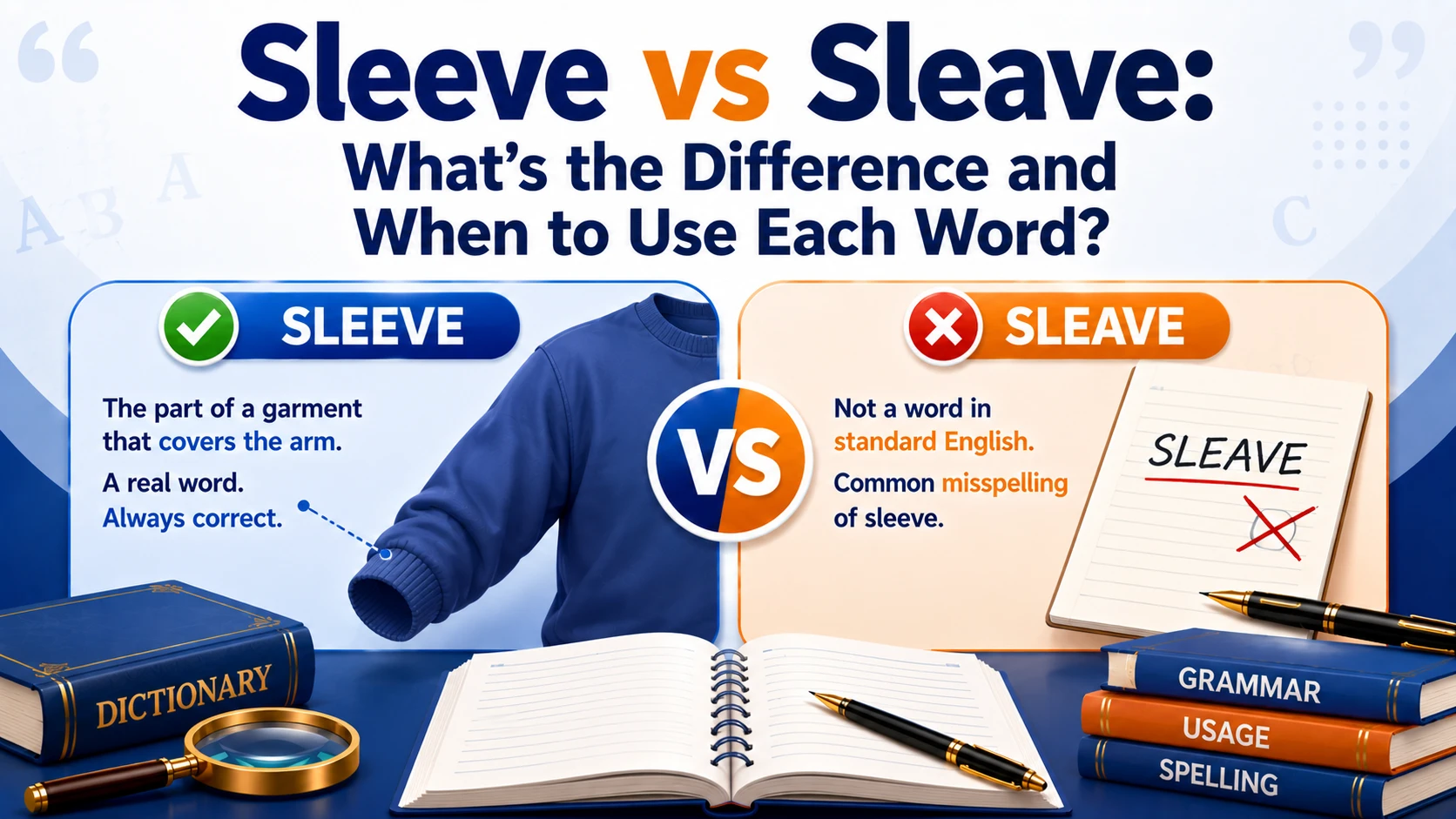
Sleeve vs sleave can be confusing because the two words look and sound remarkably similar, yet they have very different uses in modern English. Sleeve is the familiar word you use for the part of a shirt, jacket, coat, or other garment that covers the arm. It can also describe a protective covering around an object. Sleave, on the other hand, is a rare and specialized word associated mainly with silk thread or yarn, especially in older textile terminology. Knowing that distinction prevents a simple spelling mistake from turning into a vocabulary mistake.
The good news is that you will almost always want sleeve in everyday writing. You might talk about a long sleeve, roll up your shirt sleeve, measure sleeve length, or place a protective sleeve around a cable. Sleave belongs to a much narrower vocabulary and is most likely to appear in historical, literary, or specialized discussions of textiles. It isn’t simply a British spelling of sleeve, nor is it the old-fashioned version of the clothing word.
This guide explains sleeve and sleave from the ground up. You’ll learn what each word means, how they differ, where sleave comes from, how to pronounce them, and why writers sometimes mistake one for the other. You’ll also see practical examples, common collocations, a comparison table, and a simple decision rule. By the end, choosing between sleeve vs sleave should take only a second.
Sleeve vs Sleave: The Quick Answer
If you’re referring to clothing, a covering, or a protective tube, use sleeve.
If you’re referring to a specialized textile term involving silk thread or yarn, sleave may be the word you need.
| Word | Main meaning | Modern frequency | Typical context |
| Sleeve | Part of clothing or a covering around something | Very common | Fashion, clothing, engineering, packaging, everyday speech |
| Sleave | Loose or untwisted silk thread or yarn | Very rare | Historical and specialized textile contexts |
Is “sleeve” the correct spelling for clothing?
Yes. Sleeve is the standard spelling when you mean the part of a garment that covers the arm.
Examples:
- The shirt has short sleeves.
- She rolled up her sleeves before starting work.
- The jacket has a torn sleeve.
- Measure the sleeve length before ordering the coat.
Is “sleave” a real word?
Yes, but sleave is a rare word with a specialized meaning. It isn’t the ordinary spelling of sleeve.
Historically, sleave has been used for silk thread or yarn that has not been tightly twisted or is prepared in a loose form. Because that meaning is highly specialized, most modern readers rarely encounter the word.
The easiest rule to remember
Clothing or covering = sleeve.
Specialized silk thread or historical textile terminology = sleave.
For normal modern writing, sleeve is overwhelmingly the word you need.
What Does Sleeve Mean?
Sleeve is primarily a noun. Its most familiar meaning is the part of a garment that extends over the arm.
It can also describe a covering placed around something else. That broader meaning is common in technical, industrial, electrical, and packaging contexts.
Sleeve as a part of clothing
This is the meaning almost everyone knows.
A sleeve is the section of a shirt, sweater, jacket, coat, dress, or similar garment designed to cover some or all of the arm.
Examples:
The sleeve of my shirt is too long.
He pulled his sleeves over his hands.
The dress has loose, flowing sleeves.
She wore a jacket with leather sleeves.
The word works for both singular and plural forms:
- one sleeve
- two sleeves
Sleeve as a covering
The meaning extends beyond clothing.
A sleeve can be a tube-like covering fitted around another object for protection, insulation, reinforcement, or identification.
For example:
Put a protective sleeve around the cable.
The metal sleeve protects the connection.
The product comes in a cardboard sleeve.
This use is common because the object resembles a garment sleeve: something surrounds and covers another item.
Sleeve in technical contexts
You’ll find sleeve in many specialized fields.
For example:
- electrical sleeves
- cable sleeves
- pipe sleeves
- bearing sleeves
- insulation sleeves
- protective sleeves
- document sleeves
- packaging sleeves
The exact function varies by industry, but the central idea remains similar: a sleeve surrounds or covers something.
Common types of sleeves in clothing
Fashion uses many descriptive terms for sleeves.
Examples include:
- short sleeves
- long sleeves
- three-quarter sleeves
- full-length sleeves
- short puff sleeves
- bell sleeves
- raglan sleeves
- rolled sleeves
- fitted sleeves
- loose sleeves
- sleeveless designs
The terminology can become quite specific, but sleeve remains the basic word.
Example sentences with “sleeve”
The tailor shortened the sleeves of my jacket.
His shirt has a button near the sleeve cuff.
She rolled up her sleeves before cooking.
The technician replaced the damaged protective sleeve.
The book arrived inside a decorative paper sleeve.
These examples show why sleeve is such a versatile word.
What Does Sleave Mean?
Sleave is a much less common English word. Its traditional meaning is connected with silk thread or yarn, particularly material that is loose, untwisted, or prepared for further textile work.
It is therefore very different from the everyday meaning of sleeve.
Sleave as a textile term
In historical textile terminology, sleave can refer to silk thread in a loose or untwisted state.
This matters because older textile production used terminology that isn’t common in modern everyday English.
A historical document discussing silk production, weaving, embroidery, or thread preparation might use sleave in this specialized sense.
Why modern readers rarely see “sleave”
The word belongs to a narrow vocabulary.
Modern clothing discussions generally use terms such as:
- thread
- yarn
- silk thread
- fiber
- filament
- fabric
As textile manufacturing and terminology changed, specialized historical words such as sleave became much less familiar.
That doesn’t make the word meaningless. It simply means that context is essential.
Example sentences with “sleave”
Because sleave is rare, examples are likely to sound more historical or technical:
The textile worker prepared the sleave before twisting the silk.
The old manuscript describes the use of sleave in silk production.
The museum exhibit explains how sleave was prepared for textile work.
These aren’t sentences you’d normally expect to hear in casual conversation.
Why you shouldn’t replace “sleave” automatically
If you’re reading a historical textile text and encounter sleave, don’t assume the writer made a spelling mistake.
The word has a legitimate specialized meaning.
This is an important editing principle:
An unfamiliar word isn’t necessarily an incorrect word.
Before correcting it, determine what the writer is actually describing.
Sleeve vs Sleave: The Main Difference
The biggest difference is meaning and frequency.
Sleeve belongs to everyday English. Sleave belongs to specialized and historical vocabulary.
Meaning difference
| Category | Sleeve | Sleave |
| Clothing | Yes | No |
| Protective covering | Yes | No |
| Cable or pipe covering | Yes | No |
| Packaging | Yes | No |
| Silk thread | No | Yes |
| Historical textile terminology | Occasionally | Yes |
| Everyday conversation | Very common | Extremely rare |
Modern usage difference
You might use sleeve several times in an ordinary week.
You could go years without needing sleave unless you’re studying:
- textile history
- historical documents
- old literature
- specialized weaving terminology
- historical silk production
That enormous difference in frequency is one reason people often assume sleave must be a misspelling.
Dictionary difference
Both forms can be found in dictionaries, but they don’t have equal practical importance.
Sleeve is a common modern word with broad meanings.
Sleave is a specialized word whose meaning is much narrower.
Dictionary presence therefore shouldn’t be interpreted as proof that two words are equally common.
Why People Confuse Sleeve and Sleave
There are several reasons this pair causes trouble.
They look almost identical
Compare:
sleeve
sleave
Only one vowel changes.
When you’re typing quickly, your brain may recognize the overall shape of the word before processing every letter.
They sound similar
In many varieties of English, the two words are pronounced similarly or identically enough that pronunciation doesn’t provide a reliable spelling clue.
That creates a classic homophone-like spelling problem:
You hear the sound, but you need context to choose the spelling.
“Sleave” looks like a plausible spelling
English contains many words where ea represents a long vowel sound.
So sleave doesn’t look obviously impossible.
The problem is that the familiar clothing word is spelled sleeve.
People assume one must be a regional spelling
This is another common misconception.
Sleave isn’t simply the British equivalent of American sleeve.
American and British English both use sleeve for the clothing item.
The difference here is primarily vocabulary and historical specialization, not a standard U.S.-U.K. spelling distinction.
Sleeve vs Sleave: Pronunciation
Pronunciation won’t completely solve this spelling problem, but it’s still useful to understand.
How “sleeve” is pronounced
Sleeve is pronounced approximately:
/sliːv/
The vowel sound is the long ee sound found in words such as see and green.
The final consonant is a v sound.
How “sleave” is pronounced
Sleave is generally pronounced with a similar long ee vowel and final v sound.
That makes it difficult to distinguish the two simply by hearing them.
Why pronunciation isn’t a reliable test
Imagine someone says:
“I need another sleeve.”
You cannot determine the spelling from sound alone.
Fortunately, context makes the answer obvious because you’re discussing a garment.
If someone is describing historical silk thread, sleave becomes a possibility.
When pronunciation doesn’t distinguish two words, meaning becomes your spelling guide.
The Origin and History Behind Sleeve and Sleave
Word history explains why these terms shouldn’t be treated as interchangeable spellings.
The history of “sleeve”
Sleeve is an old English word with Germanic roots. Its history is connected to words referring to the arm covering or garment section.
Over centuries, its form developed into the modern sleeve.
The word has remained remarkably useful because clothing has remained central to everyday life.
The history of “sleave”
Sleave developed in a different vocabulary area associated with thread and textile materials, particularly silk.
Historical textile production required precise terms for different stages and forms of thread.
Some of those terms disappeared from everyday English as manufacturing practices changed.
Why historical vocabulary survives
Words don’t always disappear completely.
A term may survive in:
- dictionaries
- historical books
- archival documents
- literature
- museum descriptions
- specialist research
That’s why a rare word like sleave can still be legitimate even though most people don’t use it.
Sleeve vs Sleave in American and British English
This pair is sometimes incorrectly presented as a regional spelling difference.
It isn’t.
Is “sleeve” used in American English?
Yes.
The jacket has long sleeves.
I need to shorten the sleeves.
Is “sleeve” used in British English?
Yes.
The coat has long sleeves.
The shirt’s sleeves are too tight.
The basic word is the same.
Is “sleave” British English for “sleeve”?
No.
You shouldn’t write sleave simply because you’re using British English.
For example:
British: The shirt has long sleeves.
American: The shirt has long sleeves.
The spelling does not change.
Why this distinction matters
Some English word pairs genuinely differ by region:
- color / colour
- center / centre
- theater / theatre
Sleeve vs sleave isn’t one of those standard pairs.
That makes it important not to invent a regional rule that doesn’t exist.
Sleeve as a Protective Covering
One of the most useful meanings of sleeve extends beyond fashion.
Cable sleeves
Electrical and electronic equipment can use sleeves to protect cables or wires.
The technician installed a protective sleeve over the cable.
Pipe sleeves
A sleeve may surround a pipe or help protect an opening where a pipe passes through a structure.
The pipe runs through a protective sleeve.
Packaging sleeves
A product can come inside a removable cardboard or paper covering.
The box has a decorative sleeve around it.
Mechanical sleeves
Engineering uses sleeve for cylindrical components that fit around other parts.
The worn sleeve needs to be replaced.
The precise technical meaning depends on the field, but the underlying idea is consistent: something surrounds another object.
Sleave in Historical and Specialized Writing
If sleave appears in a text, the surrounding words can help you understand it.
Look for textile vocabulary
Words such as these can provide clues:
- silk
- thread
- yarn
- spinning
- weaving
- twisting
- loom
- textile
- fiber
- embroidery
If sleave appears alongside this vocabulary, it is more likely to be the specialized textile term.
Consider the age of the text
A historical document is much more likely to contain terminology that has fallen out of everyday use.
For example:
The merchant recorded the quantity of silk sleave received.
A modern reader may find sleave unfamiliar, but that doesn’t automatically make the sentence wrong.
Don’t modernize historical vocabulary blindly
When editing historical material, preserve specialized terminology when it contributes to accuracy.
If necessary, explain the word rather than replacing it with a modern term that changes the historical meaning.
Sleeve vs Sleave: Common Collocations
Collocations are combinations of words that naturally appear together. They can make the correct choice much easier.
Common collocations with “sleeve”
You will frequently see:
- shirt sleeve
- jacket sleeve
- coat sleeve
- long sleeve
- short sleeve
- sleeve length
- sleeve opening
- sleeve cuff
- sleeve design
- protective sleeve
- cable sleeve
- plastic sleeve
- paper sleeve
Examples:
The sleeve length is perfect.
The document came in a plastic sleeve.
He rolled up his shirt sleeves.
Vocabulary associated with “sleave”
Because sleave is specialized, its surrounding vocabulary is more likely to involve:
- silk
- thread
- yarn
- textile
- weaving
- spinning
- twisting
- historical manufacturing
This is another reason context can solve the problem.
Sleeve vs Sleave and Related Words
Several words can appear nearby in meaning or spelling.
Sleeve vs sleeveless
Sleeveless means lacking sleeves.
She wore a sleeveless dress.
The word is built from sleeve + -less.
Sleeve vs sleeved
Sleeved means having sleeves or being covered by a sleeve.
The device is sleeved for protection.
Sleeve vs slieve
Slieve is a separate word found especially in Irish place names and names of mountains or geographical features.
It isn’t another spelling of sleeve.
This is worth remembering because English has many words that look similar without sharing the same meaning.
Sleeve vs sleave vs engraved
These three can cause different kinds of confusion:
| Word | Meaning |
| Sleeve | Garment covering or protective covering |
| Sleave | Specialized historical textile term |
| Engraved | Cut, etched, or carved into a surface |
For example:
The sleeve of the shirt is torn.
The historical text mentions silk sleave.
Her initials were engraved on the bracelet.
Each sentence describes something different.
Common Mistakes With Sleeve and Sleave
Mistake: Writing “sleave” for clothing
Incorrect:
The jacket has long sleave.
Correct:
The jacket has long sleeves.
The clothing word is sleeve.
Mistake: Assuming sleave is an alternative spelling
Sleave isn’t a casual spelling variation of sleeve.
It has its own specialized meaning.
Mistake: Correcting every occurrence of “sleave”
If you’re editing a historical textile document, changing sleave to sleeve could destroy the intended meaning.
Always examine context before making an editorial correction.
Mistake: Assuming British English uses “sleave”
It doesn’t work that way.
The standard clothing word remains sleeve in both major varieties.
Mistake: Relying entirely on pronunciation
Because the words sound similar, listening alone may not tell you which spelling is correct.
Instead, ask:
What does the word mean in this sentence?
How to Choose Between Sleeve and Sleave
When you’re writing your own sentence, use this simple process.
Step 1: Identify the object
Are you talking about:
- a shirt?
- a jacket?
- a coat?
- a dress?
- a cable?
- a protective cover?
- packaging?
If yes, use sleeve.
Step 2: Check whether the context is historical textile terminology
If the passage discusses silk thread or historical textile production, sleave may be appropriate.
Step 3: Don’t confuse rarity with incorrectness
A rare word can still be legitimate.
The question isn’t:
“Have I seen this word before?”
The better question is:
“Does this word have the meaning required by the sentence?”
Step 4: Prefer the familiar word when writing for general readers
If you’re explaining something to a broad audience and the intended meaning is a garment covering, sleeve is the obvious choice.
There is no benefit to replacing it with sleave.
Sleeve vs Sleave: Practical Decision Table
| Your intended meaning | Correct choice | Example |
| Part of a shirt | Sleeve | The shirt has a loose sleeve. |
| Part of a jacket | Sleeve | The jacket sleeve is torn. |
| Part of a dress | Sleeve | The dress has short sleeves. |
| Protective covering | Sleeve | Place the wire inside a sleeve. |
| Packaging covering | Sleeve | Remove the paper sleeve. |
| Mechanical component | Sleeve | Replace the damaged sleeve. |
| Historical silk thread | Sleave | The text refers to silk sleave. |
| Specialized textile discussion | Sleave | The artisan prepared the sleave. |
| Everyday clothing conversation | Sleeve | Roll up your sleeves. |
Sleeve vs Sleave in Real-World Sentences
Fashion
The designer added wide sleeves to the evening gown.
Everyday conversation
I spilled coffee on my sleeve.
Workplace
Roll up your sleeves before working with the machine.
Engineering
A protective sleeve was placed over the exposed cable.
Packaging
The bottle comes inside a printed cardboard sleeve.
Historical textile writing
The manuscript describes the preparation of silk sleave.
Notice how the surrounding subject immediately reveals which word belongs.
What Does “Up Your Sleeve” Mean?
Up your sleeve is a common idiomatic expression associated with sleeve.
If someone has something up their sleeve, they have a secret plan, idea, trick, or strategy that they haven’t revealed yet.
The manager has another idea up her sleeve.
It doesn’t literally mean that the person is hiding something in a sleeve. The expression developed from the idea of physically hiding an object inside a sleeve.
Other common sleeve expressions
Roll up your sleeves
This can literally mean preparing to work.
We have a lot to finish, so let’s roll up our sleeves.
It can also be used figuratively to suggest getting serious about a task.
Wear your heart on your sleeve
This means to make your feelings obvious rather than hiding them.
He wears his heart on his sleeve and everyone knows when he’s upset.
Have something up your sleeve
This means to have a secret idea, plan, or surprise ready.
These expressions reinforce how deeply sleeve is established in modern English.
A Simple Memory Trick for Sleeve vs Sleave
Here’s an easy way to remember the difference:
Sleeve covers your sleeve area. Sleave belongs to specialized textile history.
Another approach is to connect sleeve with familiar clothing words:
shirt → sleeve → cuff → arm
If the sentence fits that chain, use sleeve.
For sleave, think:
silk → thread → textile history → sleave
The memory trick doesn’t need to be complicated. The key is associating each spelling with its meaning, rather than trying to memorize the letters alone.
Conclusion
When deciding between sleeve vs sleave, the meaning of the sentence gives you the answer. Sleeve is the standard modern word for a garment part that covers the arm, and it can also describe protective coverings used around cables, pipes, mechanical components, and packaged products. Sleave is a rare specialized word associated with silk thread or yarn, especially in historical textile terminology. The two words may look and sound similar, but they aren’t interchangeable. You should never write sleave simply because it seems like an alternative spelling of sleeve. At the same time, don’t automatically correct sleave when you encounter it in historical or specialist material. One final actionable tip: if you’re talking about a shirt, jacket, coat, dress, cable, or protective covering, choose sleeve. A common mistake to avoid is treating sleave as a British version of the same word. When in doubt, let the meaning and context determine the spelling.
Frequently Asked Questions
Q1. Is “sleave” another spelling of “sleeve”?
No. Sleave is a separate, rare word with a specialized textile meaning, particularly involving loose or untwisted silk thread or yarn. Sleeve is the standard word for the part of clothing that covers the arm and for various protective coverings. The two should not normally be substituted for one another.
Q2. Is sleave a British spelling of sleeve?
No. Sleave isn’t the British spelling of sleeve. British and American English both use sleeve when referring to the part of a shirt, jacket, coat, or dress. Sleave belongs to a specialized vocabulary and shouldn’t be used simply because you’re writing in British English.
Q3. What does sleave mean in English?
Sleave is a rare historical or specialized textile term associated with silk thread or yarn, particularly material that is loose or not tightly twisted. You are most likely to encounter it in historical documents, textile scholarship, older literature, or discussions of traditional silk production rather than ordinary modern conversation.
Q4. How do you spell the part of a shirt that covers your arm?
The correct spelling is sleeve. The plural is sleeves. For example, you can say, “The shirt has long sleeves” or “I rolled up my sleeves.” Sleave is not the spelling used for a shirt, jacket, coat, or dress sleeve.
Q5. Why is “sleave” so uncommon?
Sleave is uncommon because its meaning belongs to a narrow textile vocabulary that isn’t needed in ordinary modern conversation. Most people simply use terms such as silk thread, yarn, or thread. The word survives mainly in historical and specialized contexts where precise terminology matters.
