
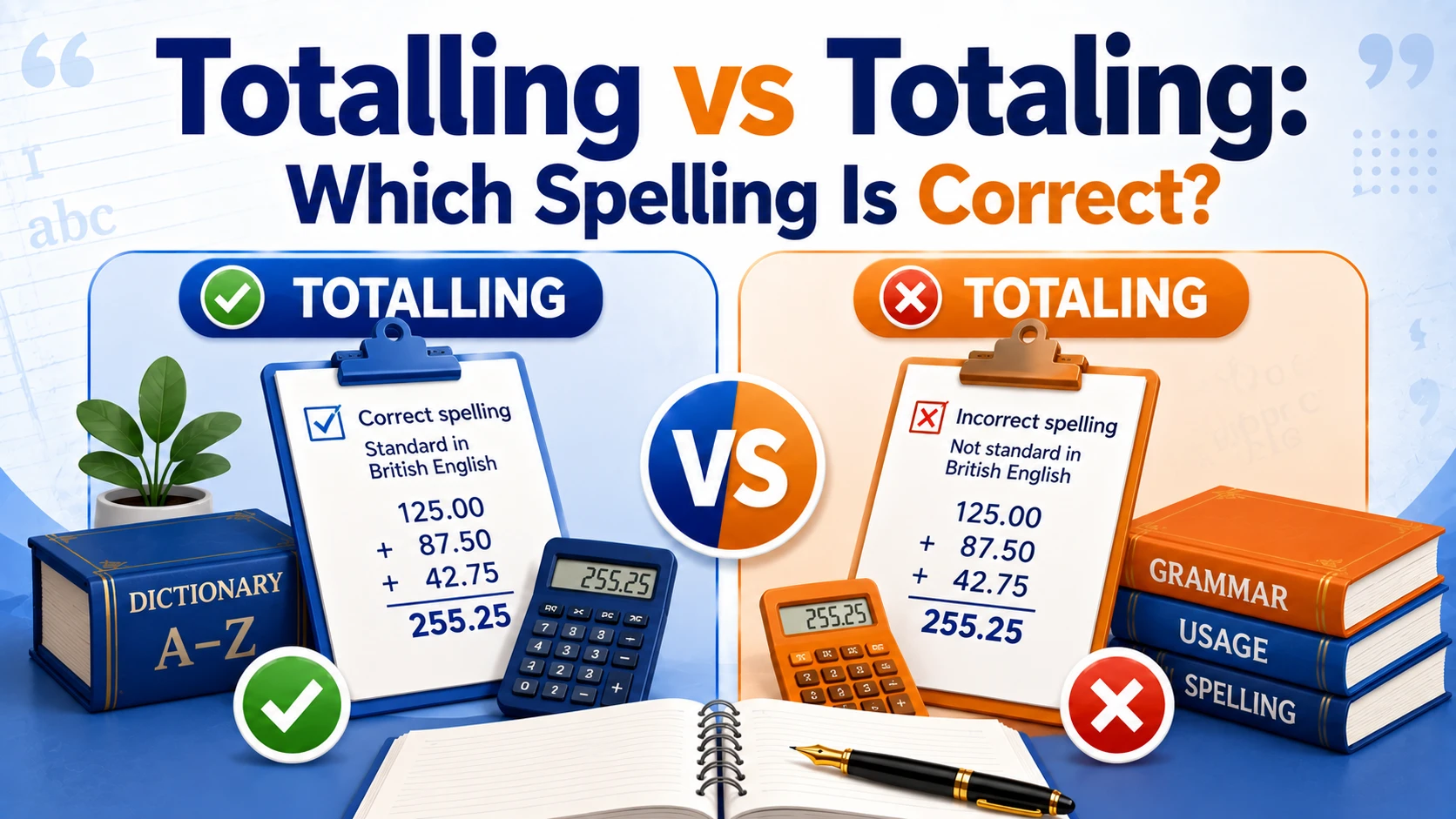
Totalling vs totaling are two spellings of the same verb form, and the difference is mainly a matter of regional English rather than meaning. If you write American English, totaling with one l is the standard choice. If you write British English, totalling with two l’s is standard. Neither spelling is inherently wrong.
This small spelling difference matters because English has several regional conventions for handling a final consonant before -ing. Writers often assume that one version must be a mistake, especially when a spell checker flags the other form. In reality, both are established dictionary forms. Merriam-Webster lists totaling and totalling, while Oxford identifies totalling as the standard -ing form and totaling as the U.S. English form.
The practical question, then, isn’t simply “Which spelling is correct?” It’s “Which spelling is correct for my audience?” This guide explains the difference, shows how the verb works in real sentences, explains why the extra l appears, and covers situations such as totaling up expenses, totalling scores, and totaling a car. By the end, you’ll know exactly which form to use and when.
Totalling vs Totaling: What’s the Difference?
The core difference is spelling convention.
Totaling and totalling both function as the present participle of total. They can describe adding figures, reaching a particular amount, or—in a North American usage—destroying a vehicle so badly that it is considered a total loss.
The main distinction is regional:
- Totaling → standard in American English
- Totalling → standard in British English
- Both forms are recognized and understandable internationally.
- They have the same basic meaning.
- They are pronounced the same.
The short answer: both spellings are correct
If you’re writing for readers in the United States, choose totaling:
The expenses are totaling more than $5,000.
If you’re following British English, choose totalling:
The expenses are totalling more than £4,000.
The difference doesn’t change the underlying word. It changes the spelling according to the English variety you’re using.
Totaling in American English
American English generally uses totaling with one l.
Examples:
- The repairs are totaling $3,200.
- The five invoices are totaling nearly $18,000.
- The team is totaling the points after each round.
- The damage is totaling more than the car’s value.
Totalling in British English and other varieties
British English uses totalling with two l’s.
Examples:
- The repairs are totalling £3,200.
- The bills are totalling nearly £18,000.
- The clerk is totalling the figures.
- The expenses are totalling more than expected.
Cambridge and Oxford both recognize totalling as the present participle of total. Oxford specifically gives totaling as the U.S. English form.
Do the two spellings have different meanings?
No. Totalling and totaling do not represent different meanings.
Compare:
The costs are totaling $10,000.
The costs are totalling £10,000.
The spelling changes, but the underlying idea remains the same: the costs add up to a particular amount.
What Does Totaling or Totalling Mean?
The word total has several grammatical roles. It can be a noun, adjective, or verb.
As a verb, it commonly means to add amounts together or to reach a particular total. Merriam-Webster defines the verb total in terms of adding up, amounting to, or making something a total wreck.
Total as a verb
When total means “add up” or “amount to,” its -ing forms are totaling and totalling.
For example:
The three invoices are totaling $2,450.
This means the three invoices together amount to $2,450.
You can also use the verb when something reaches an aggregate figure:
The three projects are totalling 120 hours of work.
Here, totalling tells us the combined amount.
Examples with money, numbers, costs, and amounts
This construction is especially common with financial information:
- expenses totaling $7,500
- donations totalling £20,000
- losses totaling $1.2 million
- fees totalling £850
- purchases totaling $430
Notice that the word often appears after a noun:
The company reported expenses totaling $75,000.
The participle phrase tells us the combined amount of the expenses.
Examples with scores, quantities, and figures
The same structure works beyond money:
The players earned 82 points, totaling 164 points across both matches.
The survey included six groups, totalling 240 participants.
The archive contains 14 volumes, totaling more than 6,000 pages.
The meaning is essentially “adding up to” or “amounting to.”
Totalling vs Totaling: American English vs British English
The most useful way to understand the difference is to treat it as a style choice tied to regional English.
| English variety | Preferred form | Example |
| American English | totaling | The costs are totaling $8,000. |
| British English | totalling | The costs are totalling £8,000. |
| U.S.-focused business writing | totaling | Expenses totaling $4,500 |
| U.K.-focused business writing | totalling | Expenses totalling £4,500 |
The American English spelling: totaling
American English commonly simplifies the spelling to totaling.
This fits a broader tendency seen in words such as:
- traveling
- labeling
- canceling
However, spelling patterns aren’t identical for every word, so you shouldn’t assume that every British double consonant automatically becomes a single consonant in American English.
The British English spelling: totalling
British English uses totalling.
The same regional distinction appears in the past-tense form:
- American English: totaled
- British English: totalled
Oxford lists totalled as the standard form and totaled as the U.S. form, while giving totalling and totaling for the -ing form.
Canadian, Australian, and other English varieties
English outside the United States and United Kingdom doesn’t always fit into a simple two-column rule. National usage can vary by word, publication, and style guide.
That’s why the safest professional practice is to identify the specific style standard you’re following rather than assuming that every English-speaking country uses exactly the same spelling system.
If your publication has a house style, follow it.
Why Does British English Spell It “Totalling”?
The extra l isn’t random. It reflects a spelling convention used in British English when forming certain words with suffixes such as -ing.
The doubling rule for final consonants
In many English words, a final consonant can be doubled before a suffix beginning with a vowel. The exact rule depends on the word’s structure, pronunciation, stress pattern, and spelling tradition.
With total, British English uses:
total + ing → totalling
The same pattern appears in:
travel + ing → travelling
and:
label + ing → labelling
How the spelling of total changes before -ing
The important point is that total already ends in l, so British spelling retains a doubled ll:
total → totalling
American spelling generally uses:
total → totaling
This is a spelling convention, not a pronunciation distinction.
Why British spelling tends to preserve the double L
British English has retained a number of traditional consonant-doubling patterns that American English has simplified in certain words.
This doesn’t mean British spelling is “more correct.” It simply means that different varieties of English have developed different conventions.
Similar British spellings such as travelling and labelled
Consider this familiar comparison:
| British English | American English |
| travelling | traveling |
| labelled | labeled |
| cancelled | canceled |
| totalling | totaling |
These examples help explain why totalling may look unusual to an American reader while being perfectly normal to a British reader.
Why Does American English Spell It “Totaling”?
American English generally uses totaling rather than totalling.
The American spelling convention
The difference is primarily historical and conventional. American spelling developed its own preferences for certain forms, including some consonant-doubling patterns.
The result is:
total + ing → totaling
rather than:
total + ing → totalling
Why American English often uses one L
American English commonly simplifies some British double-consonant spellings:
- travelling → traveling
- modelling → modeling
- labelling → labeling
The exact spelling of individual words still needs to be checked rather than inferred mechanically.
How totaling fits broader American spelling patterns
For a U.S. audience, totaling will generally look natural in business documents, academic writing, journalism, websites, and everyday communication.
For example:
The three projects are totaling $45,000.
There’s no reason to change it to totalling merely because another English variety uses that form.
Totalling vs Totaling: Side-by-Side Comparison
| Question | Totaling | Totalling |
| Correct spelling? | Yes | Yes |
| Main association | American English | British English |
| Meaning | Same | Same |
| Pronunciation | Same | Same |
| Present participle of total | Yes | Yes |
| Can mean “adding up”? | Yes | Yes |
| Can describe a combined amount? | Yes | Yes |
| Used in vehicle-damage context? | Yes | Yes |
| Preferred for U.S. readers? | Yes | Usually no |
| Preferred for U.K. readers? | Usually no | Yes |
Which spelling should you use?
Use the form that matches your target variety of English.
If you’re writing for a U.S. website, use totaling. If you’re writing for a U.K. publication, use totalling.
The key isn’t choosing the spelling that looks more familiar to you. It’s choosing the spelling that belongs to the language system you’re using consistently.
When either spelling is acceptable
In international communication, either form may be understood immediately.
A British reader won’t misunderstand totaling, and an American reader will understand totalling. The issue is primarily consistency and regional style, especially in polished professional writing.
Expert tip: Don’t “correct” a regional spelling simply because your word processor prefers another variety.
Is “Totaling” Correct?
Yes. Totaling is a standard and correct spelling, particularly in American English.
Merriam-Webster lists both totaling and totalling as forms of the verb total.
When totaling is the preferred spelling
Choose totaling when:
- You’re writing American English.
- Your audience is primarily in the United States.
- Your organization’s style guide uses U.S. spelling.
- The rest of your document follows American spelling conventions.
American English sentence examples
The receipts are totaling $1,250.
We received five payments totaling $4,800.
The project generated costs totaling $75,000.
The two teams earned 98 points totaling their combined score.
Totaling in business, finance, and reports
The form is particularly common in financial contexts:
The expenses were totaling more than the original estimate.
The invoices, totaling $18,500, were approved Friday.
In a U.S. report, changing these sentences to totalling would introduce a British spelling into an otherwise American document.
Is “Totalling” Correct?
Yes. Totalling is also a standard spelling, particularly in British English.
Cambridge defines totalling as the present participle of total and provides examples involving amounts, scores, and quantities.
When totalling is the preferred spelling
Use totalling when:
- You’re writing British English.
- Your readers expect U.K. spelling.
- Your publication uses British spelling.
- You’re following a British style guide.
British English sentence examples
The repairs are totalling £6,000.
The company reported losses totalling £2 million.
The teams earned 150 points totalling their combined score.
The invoices are totalling more than expected.
How to Use Totaling and Totalling in a Sentence
Both forms can appear in several grammatical constructions.
Using totaling to describe an amount
The donations are totaling $25,000.
Here, totaling $25,000 tells us the combined amount.
Using totalling to describe an amount
The donations are totalling £25,000.
The grammatical function is identical.
Using the words with “up”
Both varieties allow total up:
She is totaling up the receipts.
She is totalling up the receipts.
This means she is adding the figures together to determine the final amount.
Using the words with costs and expenses
The expenses are totaling $9,600.
The expenses are totalling £9,600.
This is a common business construction because it efficiently communicates a combined financial figure.
Using the words with scores and points
The players are totaling 80 points.
The players are totalling 80 points.
Depending on context, you may prefer adding up, scoring, or combining if those verbs communicate the action more precisely.
Using the words with time and quantities
The construction also works with measurable quantities:
The interviews were totaling 12 hours.
The interviews were totalling 12 hours.
However, always consider whether lasting, amounting to, or covering would sound more natural in your particular sentence.
“Totaling Up” vs “Totalling Up”: Which Is Correct?
Both are correct.
The regional spelling changes, but up doesn’t.
Totaling up in American English
I’m totaling up the receipts before submitting the report.
Totalling up in British English
I’m totalling up the receipts before submitting the report.
Is “total up” different from “total”?
There can be a slight difference in emphasis.
Total can mean either “add together” or “amount to”:
The costs total $8,000.
Total up more strongly suggests the deliberate process of adding separate figures:
I need to total up these invoices.
Both are natural. Choose according to the action you want to emphasize.
Does “Totaling a Car” Mean Something Different?
Yes, total has a special verb use in vehicle-related English.
To total a car generally means to damage it so severely that repairing it isn’t considered economically worthwhile. Oxford labels this use as especially North American and informal.
“Totaling” a vehicle in American English
The accident totaled her car.
The -ing form can appear in a sentence such as:
The accident nearly ended with him totaling the car.
“Totalling” a vehicle in British English
British English may use the corresponding spelling:
The crash left the vehicle totalling beyond economical repair.
However, British writers may more naturally use expressions such as writing off the car depending on context.
How “total” works as a verb for damaged vehicles
This meaning is different from simply adding numbers.
Compare:
The invoices are totaling $8,000.
Here, totaling means amounting to.
He was accused of totaling the car.
Here, totaling means destroying or severely damaging the car.
The spelling is the same. Context determines the meaning.
Totaling vs Adding: Are They the Same?
They’re related but not always interchangeable.
Adding emphasizes the mathematical operation of combining numbers.
Totaling can emphasize either the calculation or the resulting combined amount.
For example:
We are adding the five invoices.
This focuses on the action.
The five invoices are totaling $12,000.
This focuses on the resulting amount.
Cambridge describes total as both having a complete amount and calculating that amount.
When “totaling” means adding numbers
The accountant is totaling the figures.
Here, totaling means calculating the sum.
When “totaling” emphasizes the final amount
The bills are totaling $12,000.
Here, the important information is the final figure.
Totaling vs Amounting To: An Important Usage Difference
These expressions overlap, but their sentence structures can differ.
Totaling commonly follows a noun:
The donations, totaling $50,000, arrived in June.
Amounting to can emphasize what a quantity adds up to:
The donations, amounting to $50,000, arrived in June.
Neither is automatically better. Totaling often sounds concise in reports, lists, and financial writing.
Totaling and Totalling in Professional Writing
Spelling consistency becomes more important when you’re producing documents for clients, customers, students, or an organization.
Financial reports and invoices
Use the spelling expected by your regional style.
A U.S. report might say:
Expenses totaling $125,000
A British report might say:
Expenses totalling £125,000
Business documents and spreadsheets
Professional documents often contain many regional spelling signals. Mixing them can make a document look poorly edited.
If you write:
The expenses are totaling $20,000.
don’t later write:
The expenses are totalling $14,000.
Unless you’re intentionally quoting another source, pick one regional form and stay with it.
Academic and technical writing
Academic institutions and journals may prescribe a specific style. The best choice is therefore not based solely on whether you’re in the U.S. or U.K.
Check:
- The publication’s style guide.
- Your institution’s requirements.
- The spelling conventions used throughout the manuscript.
Legal and administrative documents
Consistency is especially valuable in formal documents because editors may review spelling closely.
A regional spelling difference won’t normally change the meaning, but inconsistent spelling can signal that the document wasn’t carefully standardized.
Common Mistakes With Totalling and Totaling
Mistake: Assuming one spelling is always wrong
This is the biggest misconception.
Both are established forms. The issue is regional preference, not right versus wrong.
Mistake: Mixing American and British spellings
A document that uses color, traveling, and canceled is already leaning toward American English. Introducing totalling may create an unnecessary inconsistency.
Mistake: Changing the spelling without considering the audience
Don’t automatically convert totalling to totaling simply because you’re writing in English.
First determine which English you’re using.
Mistake: Treating the double L as a pronunciation difference
The extra l doesn’t create a different pronunciation.
Totaling and totalling are pronounced essentially the same.
Mistake: Letting spell-check decide the English variety
A spell checker can be configured for American, British, Canadian, Australian, and other varieties. If it’s configured incorrectly, it may flag a perfectly valid word.
Best practice: Set your document’s language or proofing dictionary before editing. That reduces false spelling warnings and helps you maintain regional consistency.
How to Choose Between Totalling and Totaling
Use this decision table when you’re unsure:
| Your situation | Best choice |
| U.S. audience | totaling |
| British audience | totalling |
| American company style guide | totaling |
| British publication style guide | totalling |
| Academic assignment with U.S. spelling | totaling |
| Academic assignment with U.K. spelling | totalling |
| Mixed international audience | Follow your chosen house style |
| Quoting an original source | Preserve the source’s spelling |
Choose “totaling” for American English
If the rest of your content uses American forms such as color, center, traveling, and canceled, totaling is the natural choice.
Choose “totalling” for British English
If your document uses colour, centre, travelling, and cancelled, totalling will normally fit that style.
Follow your organization’s style guide
A house style always deserves priority over personal preference.
A company may have a global style guide that standardizes one variety of English for all markets.
Match the spelling used throughout the document
Think of regional spelling as a system rather than a collection of isolated words.
One word rarely causes a problem. Inconsistent patterns across dozens of words do.
Totalling vs Totaling: Related Spelling Patterns
The comparison becomes easier when you see related forms.
| Base word | American English | British English |
| total | totaling | totalling |
| travel | traveling | travelling |
| label | labeling | labelling |
| cancel | canceling | cancelling |
| model | modeling | modelling |
These examples show a broader difference in consonant doubling between major English varieties. They are useful as memory aids, but don’t treat them as a universal mechanical formula.
Total → totaling/totalling
The specific pair to remember is:
American: total → totaling
British: total → totalling
The pronunciation and meaning remain unchanged.
Totalling vs Totaling: Quick Decision Guide
Use “totaling” when:
- You’re writing American English.
- Your readers are primarily American.
- Your organization follows U.S. spelling.
- Your document already uses American spellings.
Use “totalling” when:
- You’re writing British English.
- Your readers expect British spelling.
- Your organization follows U.K. spelling.
- Your document already uses British spellings.
Always remember:
One L = American English.
Two L’s = British English.
That simple rule will solve the spelling question in most everyday situations.
Totalling vs Totaling: Practical Examples
Business example
American:
The three contracts are totaling $450,000.
British:
The three contracts are totalling £450,000.
Financial example
American:
The company reported expenses totaling $2.4 million.
British:
The company reported expenses totalling £2.4 million.
School or academic example
American:
The students earned 250 points totaling their scores from five activities.
British:
The students earned 250 points totalling their scores from five activities.
Shopping and household example
American:
Our purchases are totaling $315.
British:
Our purchases are totalling £315.
Sports and scoring example
American:
The two players are totaling 75 points.
British:
The two players are totalling 75 points.
Vehicle and insurance example
American:
The insurer determined that the crash had totaled the vehicle.
British usage may instead favor:
The insurer determined that the vehicle was a write-off.
This example illustrates an important point: regional differences sometimes involve vocabulary and idiom, not just spelling.
Formal report example
American:
The survey covered 18 locations, totaling 4,500 respondents.
British:
The survey covered 18 locations, totalling 4,500 respondents.
A Simple Memory Trick for Totaling vs Totalling
Think of the U.S. form as the shorter spelling:
U.S. → totaling → one L
For British English:
U.K. → totalling → two L’s
Another useful connection is:
traveling → American
travelling → British
and:
totaling → American
totalling → British
Why the memory trick works
It doesn’t explain the entire history of English spelling, but it gives you a quick practical distinction when you’re writing.
If you’re editing an American document and see totalling, change it to totaling. If you’re editing a British document and see totaling, change it to totalling—assuming the document’s style guide follows those conventional forms.
Conclusion
Totalling vs totaling isn’t a battle between a correct spelling and a misspelling. Both are legitimate forms of the verb total, and the main difference is regional English convention. American English normally uses totaling, while British English uses totalling. Major dictionaries, including Merriam-Webster, Cambridge, and Oxford, recognize the relevant forms. The best choice is therefore practical: match your audience, style guide, and existing spelling system. Don’t switch forms merely because a word processor prefers one version. If you’re writing in U.S. English, use totaling. If you’re writing in British English, use totalling. One final actionable tip: decide your English variety before you begin editing and apply it consistently. A common mistake to avoid is treating regional spelling differences as errors. When the audience and style are clear, choosing between totaling and totalling becomes simple.
Frequently Asked Questions
Q1. Is “totalling” or “totaling” correct?
Both are correct. The preferred form depends on regional English. Totaling is standard American English, while totalling is standard British English. They have the same meaning and grammatical function, so neither spelling should automatically be treated as a mistake.
Q2. Is totaling American or British English?
Totaling is the standard form in American English. American dictionaries and usage references recognize it as the -ing form of total. British English generally uses totalling instead. If you’re writing for U.S. readers, totaling is the safer regional choice.
Q3. Is “totalling” wrong in American English?
No. Totalling isn’t an unintelligible or invented spelling in American English. It is a recognized variant, but it doesn’t match the usual U.S. spelling convention. For polished American writing, totaling is normally preferable because it maintains regional consistency.
Q4. Is “totaling” wrong in British English?
No. British readers will understand totaling, but totalling is the conventional British form. Oxford lists totalling as the standard -ing form and identifies totaling as the U.S. English form.
Q5. Are totaling and totalling pronounced differently?
No. The extra l changes the spelling, not the pronunciation. Both forms come from the verb total and function as its present participle. If you hear either form spoken aloud, pronunciation alone generally won’t tell you whether the speaker would spell it with one l or two.
