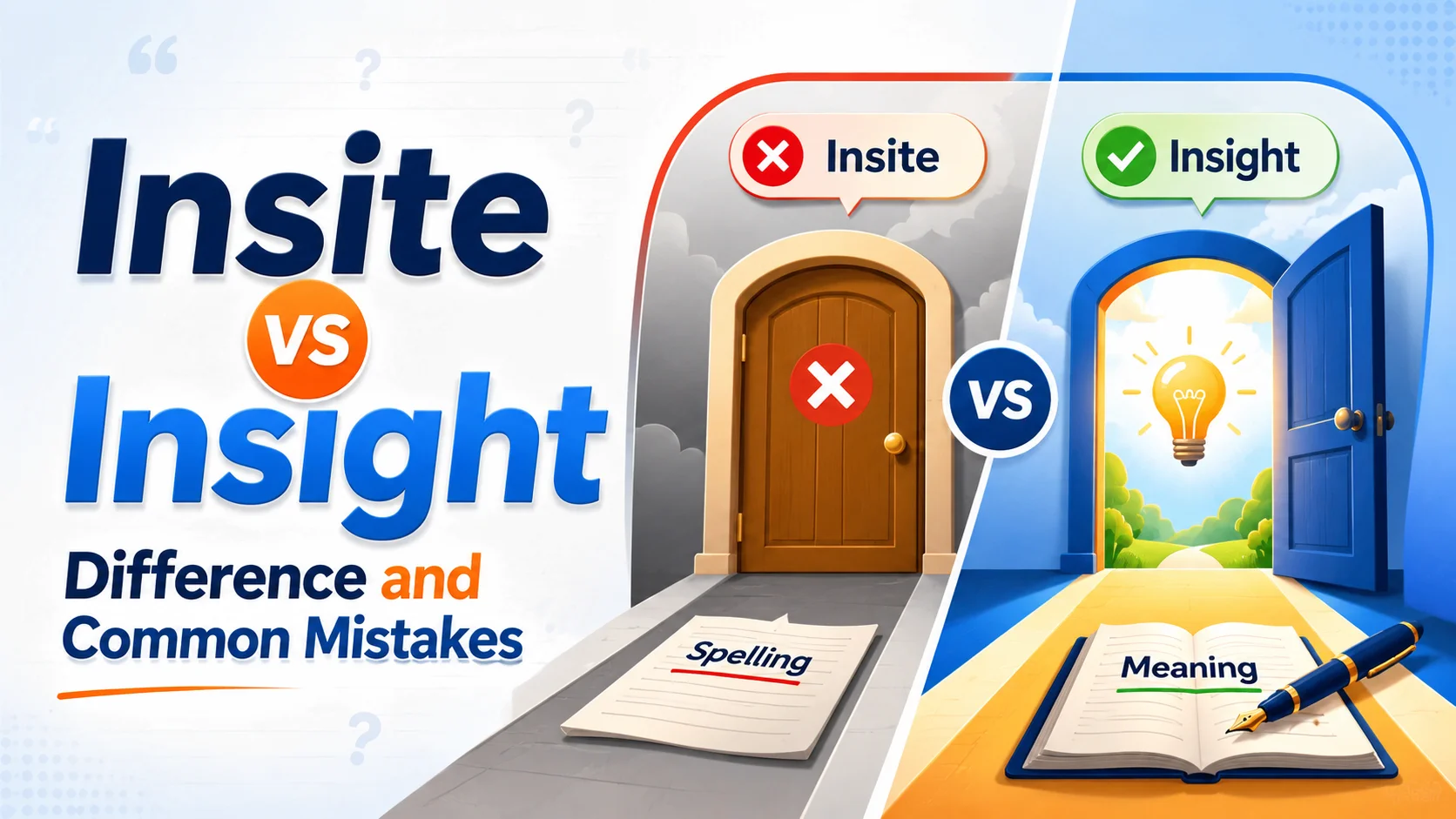
Insite vs insight is a common spelling question because both words look plausible at first glance, yet only one is correct in standard English. If you’ve ever paused before writing “insight” or wondered whether “insite” is an acceptable alternative, you’re not alone. This confusion appears in emails, resumes, business reports, academic papers, and online searches every day. Understanding the difference isn’t just about avoiding a spelling mistake—it helps you write with greater clarity, professionalism, and confidence in any situation.
English contains many words that sound alike but differ in spelling, meaning, or usage. In the case of insight, the confusion often comes from pronunciation, fast typing, and the existence of company or product names that intentionally use the spelling Insite. That can make it difficult for learners and even native speakers to know which version belongs in formal writing. Knowing when “Insite” is appropriate and when it is not can prevent embarrassing mistakes in professional and academic communication.
This guide explains everything you need to know about insite vs insight, including their meanings, spelling differences, grammatical roles, real-world examples, common phrases, related words, memory tricks, and proofreading tips. You’ll also learn why insight contains the word “sight,” how to avoid confusing it with words like incite and inside, and which spelling dictionaries and style guides recognize. By the end, you’ll know exactly which word to use in every context.
The Short Answer: Is It “Insite” or “Insight”?
If you’re looking for a quick answer, here it is:
Insight is the correct English word in almost every writing situation.
Insite is not a standard English word. In most cases, it is simply a misspelling of insight. The only exceptions are when Insite is used as the official name of a company, product, software application, or brand.
| Word | Correct in Standard English? | Meaning |
| Insight | ✅ Yes | A deep understanding or clear perception of someone or something |
| Insite | ❌ No (except proper names) | Usually a misspelling or a branded name |
Examples
Correct
- Her research provided valuable insight into consumer behavior.
- The report offers useful insights for business owners.
- We gained new insight after analyzing the data.
Incorrect
- Her research provided valuable insite into consumer behavior.
- The report offers useful insites for business owners.
Key Takeaway: Unless you’re referring to a specific brand or organization named Insite, always choose insight.
What Does “Insight” Mean?
Insight is a noun that refers to a deep, accurate understanding of a person, situation, idea, or problem. It goes beyond simply knowing facts. Someone with insight can recognize patterns, understand underlying causes, or see connections that others may overlook.
Unlike general knowledge, insight often develops through experience, observation, critical thinking, or careful analysis. That’s why the word frequently appears in fields such as business, psychology, education, healthcare, leadership, marketing, and research.
Common Meanings of “Insight”
Depending on the context, insight may refer to:
- A deep understanding of a topic
- An accurate perception of a situation
- A meaningful realization
- An informed interpretation based on evidence or experience
- A fresh perspective that leads to better decisions
Examples in Everyday English
- Reading customer reviews gave us valuable insight into user expectations.
- Her years of teaching provide unique insight into how children learn.
- The interview offered fascinating insight into the athlete’s mindset.
- Data analysis produced new insights about buying habits.
- Good managers use employee feedback to gain insight before making decisions.
Notice that insight usually refers to understanding, not simply information.
Is “Insite” a Real Word?
For standard English, the answer is no.
You won’t find insite listed as a regular English noun in major dictionaries because it isn’t recognized as a standard spelling. If your intention is to express understanding, perception, or awareness, the correct word is always insight.
However, there is one important exception.
When “Insite” Can Be Correct
Some businesses, software platforms, consulting firms, and digital products intentionally use Insite as part of their official name. In these cases, Insite is a proper noun, not a dictionary word.
For example, you might encounter:
- Insite Analytics
- Insite Software
- Insite Solutions
- Insite Learning
Here, Insite is correct because it is the organization’s chosen brand name.
Why This Creates Confusion
Many people search online and see the word Insite on company websites. They naturally assume it is another accepted spelling of insight, when in reality it is simply a branding choice.
This is similar to businesses intentionally modifying spellings to create memorable names. While these names are perfectly valid trademarks, they do not change the standard spelling of the English word.
Expert Tip: If you’re writing an essay, report, email, blog post, or article, use insight unless you’re referring to the official name of a business or product.
Insite vs Insight: Key Differences at a Glance
Although the two words look similar, they serve very different purposes.
| Feature | Insight | Insite |
| Standard English word | ✅ Yes | ❌ No |
| Dictionary entry | Yes | No (except as a proper name) |
| Part of speech | Noun | Proper noun only when used as a brand |
| Meaning | Deep understanding or perception | Usually a company or product name |
| Suitable for academic writing | ✅ Yes | ❌ No |
| Suitable for business writing | ✅ Yes | Only when referring to a specific brand |
The Difference in Simple Terms
Think of it this way:
- Insight belongs in dictionaries and everyday English.
- Insite belongs in brand names and trademarks.
If you replace insight with insite in ordinary writing, readers are likely to see it as a spelling mistake.
Why People Confuse “Insite” and “Insight”
The confusion between these words isn’t surprising. Several factors make the mistake common, even among experienced writers.
They Sound Almost Identical
In everyday speech, insite and insight are pronounced the same. Because English spelling isn’t always phonetic, many people spell words based on how they hear them rather than how they are written.
The Ending Looks Familiar
Words ending in -site are common in English.
Examples include:
- Website
- Campsite
- Worksite
- Jobsite
Seeing these familiar patterns can make insite appear correct, even though insight follows a different spelling rule.
Brand Names Reinforce the Mistake
Many companies intentionally choose creative spellings to make their names stand out. As a result, people frequently encounter Insite online and assume it is an accepted alternative.
This is one of the biggest reasons the confusion persists today.
Fast Typing and Autocorrect
Typing quickly often leads to spelling errors. Depending on the software you’re using, autocorrect may not always recognize that insite should be insight, especially if you’ve previously interacted with brands that use the spelling Insite.
Writers Focus on Sound Instead of Structure
The easiest way to avoid this mistake is to remember that insight contains the word “sight,” which relates to seeing or understanding. Once you recognize this connection, the correct spelling becomes much easier to remember.
The Meaning Behind “Insight”
One of the easiest ways to remember the correct spelling is to understand how the word is built. Insight combines the words “in” and “sight.” While the modern meaning has evolved, the spelling reflects the idea of seeing into something rather than simply looking at it. In other words, insight is the ability to recognize truths, patterns, or motivations that are not immediately obvious.
This connection between seeing and understanding explains why the word contains “sight” instead of “site.” Once you associate insight with clear vision or deep perception, the correct spelling becomes much easier to remember.
Why “Sight” Matters
The word sight relates to vision, observation, and perception. Although insight refers to mental understanding rather than physical eyesight, the underlying concept is the same: seeing something clearly.
Think of these examples:
- A psychologist develops insight into human behavior.
- A business analyst gains insight from market data.
- A teacher has insight into how students learn.
In each case, the person isn’t literally seeing more—they’re understanding more.
A Simple Memory Trick
Whenever you’re unsure which spelling to use, ask yourself:
“Am I talking about understanding or a location?”
If you’re referring to understanding, the answer is always insight because it contains sight.
Memory Tip: Insight helps you “see” ideas more clearly. Since seeing requires sight, the correct spelling also uses sight.
How to Use “Insight” Correctly in Sentences
Because insight is a noun, it often appears after verbs such as gain, provide, offer, develop, share, and give. It can also be followed by into when referring to a particular subject.
Understanding these common sentence patterns makes your writing sound more natural.
Insight in Everyday Conversations
People often use insight when discussing personal experiences, relationships, or problem-solving.
Examples
- Traveling gave me valuable insight into different cultures.
- Her advice offered fresh insight into the situation.
- Talking with experienced parents gave us useful insight.
Insight in Business Communication
The word is especially common in professional settings because organizations rely on insights to make informed decisions.
Examples
- The survey provided valuable insight into customer satisfaction.
- Data analysis generated actionable insights for the marketing team.
- Employee feedback gave management important insight into workplace concerns.
Insight in Academic Writing
Researchers frequently use insight when discussing discoveries, findings, or interpretations.
Examples
- The study offers new insight into climate change.
- Historical documents provide valuable insight into ancient civilizations.
- The research gives deeper insight into language development.
Insight in Psychology and Personal Growth
Psychologists and counselors often use insight to describe a person’s understanding of their own thoughts, emotions, or behavior.
Examples
- Therapy helped him gain greater insight into his emotions.
- Self-reflection develops personal insight over time.
- Journaling can improve self-insight and decision-making.
Common Phrases That Use “Insight”
Native English speakers use insight in many fixed expressions. Learning these collocations helps your writing sound more natural than simply memorizing the definition.
Gain Insight
This phrase means to develop a better understanding of something.
Examples
- Reading customer reviews helped us gain insight into user expectations.
- Students gain valuable insight through practical experience.
Provide Insight
Used when information helps others understand a topic.
Examples
- The report provides insight into industry trends.
- Interviews provide insight into consumer behavior.
Offer Valuable Insight
This expression commonly appears in business reports, presentations, and research papers.
Examples
- The consultant offered valuable insight during the meeting.
- Experts shared valuable insight on future market conditions.
Insight Into
One of the most common grammatical patterns.
Examples
- The documentary gives insight into marine life.
- The interview provides insight into the author’s creative process.
- The survey offers insight into employee satisfaction.
Customer Insight
A frequently used business term referring to a deep understanding of customer needs, preferences, and behaviors.
Examples
- Strong customer insights improve product development.
- Businesses use analytics to generate meaningful customer insights.
Market Insight
Common in marketing, finance, and economics.
Examples
- Investors rely on market insights before making decisions.
- The report delivers valuable market insight for small businesses.
Writing Tip: Instead of repeatedly using “information” or “knowledge,” consider whether insight better communicates the idea of deep understanding rather than simple facts.
Insight vs Incite vs Inside
These three words are often confused because they look and sound similar. However, they have completely different meanings and grammatical functions.
| Word | Part of Speech | Meaning | Example |
| Insight | Noun | Deep understanding | The report provides useful insight. |
| Incite | Verb | To encourage or provoke an action | The speech may incite violence. |
| Inside | Noun, adjective, adverb, preposition | Within or on the inner part | Please wait inside the building. |
Insight
Refers to understanding or perception.
Example
- Experience gave her valuable insight into leadership.
Incite
Means to encourage someone to do something, usually something intense or unlawful.
Examples
- The article should not incite panic.
- Leaders should avoid language that could incite conflict.
Inside
Refers to location or position.
Examples
- The children stayed inside because it was raining.
- Everything you need is inside the package.
Quick Way to Remember
- Insight = understanding.
- Incite = encourage or provoke.
- Inside = within a place.
Learning these distinctions helps eliminate one of the most common vocabulary mix-ups in English writing.
Insight vs Knowledge vs Wisdom
Although these words are closely related, they are not interchangeable. Understanding the difference helps you choose the most precise word for your message.
| Word | Meaning | Best Used For |
| Insight | Deep understanding gained through analysis or experience | Discovering patterns or hidden meanings |
| Knowledge | Facts and information learned through study or experience | Education, expertise, and learning |
| Wisdom | Sound judgment based on experience and understanding | Making thoughtful decisions |
Insight
Insight is about recognizing something meaningful that isn’t immediately obvious.
Example
- The interviews provided valuable insight into customer expectations.
Knowledge
Knowledge refers to information that has been learned or acquired.
Example
- She has extensive knowledge of environmental science.
Wisdom
Wisdom combines knowledge with experience and good judgment.
Example
- His years of leadership gave him the wisdom to handle difficult situations calmly.
Expert Tip: Someone may have knowledge of a subject without having insight into it. Likewise, a person can possess both knowledge and insight but still rely on wisdom to make the best decisions.
Synonyms for “Insight” and When to Use Them
Although insight is a powerful word, repeating it too often can make your writing sound repetitive. Choosing the right synonym depends on what you’re trying to express. Some alternatives emphasize understanding, while others focus on awareness, interpretation, or judgment.
The key is selecting a word that matches the context instead of replacing insight automatically.
| Synonym | Best Used When | Example |
| Understanding | General comprehension | She has a good understanding of the process. |
| Awareness | Recognizing facts or situations | Public awareness has increased. |
| Perception | How something is viewed or interpreted | Customer perception influences buying decisions. |
| Discernment | Sound judgment and careful evaluation | Good leaders show excellent discernment. |
| Perspective | A particular viewpoint | The book offers a fresh perspective. |
| Comprehension | Formal or academic contexts | Reading comprehension improves with practice. |
| Interpretation | Explaining meaning | His interpretation of the results was accurate. |
| Realization | Becoming aware of something | The experience led to an important realization. |
Choosing the Right Synonym
Each synonym has its own nuance.
For example:
- The research provides valuable insight into consumer behavior. ✅
- The research provides valuable understanding of consumer behavior. ✅
- The research provides valuable discernment of consumer behavior. ❌
Likewise:
- Her experience gave her a new perspective on leadership. ✅
- Her experience gave her new insight into leadership. ✅
Both are correct, but each highlights a slightly different idea.
Expert Tip: Use insight when discussing deep understanding gained through observation, analysis, or experience. Reserve other synonyms for situations where they express the meaning more precisely.
Common Mistakes Writers Make
Many spelling and vocabulary mistakes involving insight occur because writers focus on pronunciation rather than meaning. Recognizing these common errors helps you avoid them in everyday writing.
Mistake 1: Writing “Insite” Instead of “Insight”
This is by far the most common error.
❌ The survey gave us valuable insite.
✅ The survey gave us valuable insight.
Unless you’re referring to an official brand name, always choose insight.
Mistake 2: Confusing “Insight” with “Incite”
Although the words sound similar, they belong to different parts of speech.
❌ The report incited valuable information.
✅ The report provided valuable insight.
Remember:
- Insight = understanding.
- Incite = encourage or provoke.
Mistake 3: Using “Insight” When Another Word Fits Better
Sometimes writers choose insight simply because it sounds professional, even when another word is more appropriate.
For example:
Instead of:
- She has extensive insight into chemistry.
A more natural sentence is:
- She has extensive knowledge of chemistry.
Or:
- She has a deep understanding of chemistry.
Choosing the right word improves clarity.
Mistake 4: Incorrect Plural Forms
Many writers hesitate when making insight plural.
Correct:
- Valuable insights
- Customer insights
- Market insights
Incorrect:
- Insightes
- Insight’s (unless showing possession)
Mistake 5: Forgetting the Preposition “Into”
One of the most common collocations is insight into.
Correct:
- The research provides insight into learning habits.
Less natural:
- The research provides insight about learning habits.
Although other prepositions are sometimes acceptable, into is the standard choice in many contexts.
Practical Tips to Remember the Correct Spelling
Learning a few simple techniques makes it much easier to avoid confusing insight and insite.
Connect “Insight” with “Sight”
The easiest memory trick is to remember that insight contains sight, which relates to seeing.
Insight means seeing beneath the surface or understanding something deeply.
Think About Meaning First
Before writing the word, ask yourself:
Am I referring to understanding?
If the answer is yes, write insight.
If you’re referring to a company named Insite, then use the branded spelling.
Read Carefully During Proofreading
Many spelling mistakes survive because readers skim instead of reading slowly.
When editing your work:
- Look for commonly confused words.
- Check nouns ending in -ight.
- Read headings separately.
- Review important documents one final time before sending.
Learn Common Word Partnerships
Native speakers frequently use these expressions:
- gain insight
- provide insight
- offer insight
- valuable insight
- deeper insight
- practical insight
- insight into
Learning these collocations naturally reinforces the correct spelling.
Quick Checklist
- ✓ Remember insight contains sight.
- ✓ Use insight for understanding or perception.
- ✓ Reserve Insite only for official brand names.
- ✓ Proofread carefully before publishing.
- ✓ Learn common collocations instead of isolated vocabulary.
Real-World Examples of “Insight” in Context
Seeing how professionals use insight makes it easier to apply the word correctly in your own writing.
Business and Marketing
Companies rely on customer insights to understand buying behavior and improve products.
Example
- Customer surveys provided valuable insight into shopping preferences.
Education
Teachers use assessment results to gain insight into student learning needs.
Example
- Classroom discussions gave the teacher useful insight into student progress.
Healthcare
Doctors often gather information from symptoms and medical histories to develop clinical insight before making a diagnosis.
Example
- The examination offered important insight into the patient’s condition.
Research
Researchers analyze evidence to discover patterns and develop new insights.
Example
- The study provides fresh insight into renewable energy adoption.
Personal Development
Self-reflection helps people understand their emotions, strengths, and habits.
Example
- Keeping a journal gave her greater insight into her daily decisions.
Leadership
Effective leaders seek insight before making important decisions rather than relying on assumptions.
Example
- Listening to employees gave the manager valuable insight into workplace challenges.
Professional Writing Tip: In business, education, healthcare, and research, insight often suggests that conclusions are based on careful observation, analysis, or experience, making it stronger than simply saying someone has “information” or “knowledge.”
Mini Quiz: Test Your Understanding
Check whether you’ve mastered the difference between insite and insight.
Choose the Correct Word
1. The report provides valuable ______ into customer behavior.
A. Insite
B. Insight
Answer: B. Insight
2. Which spelling is recognized in standard English?
A. Insight
B. Insite
Answer: A. Insight
Fill in the Blank
Choose the correct word.
- The research offers new ______ into climate change.
Answer: insight
- Her experience gave her valuable ______ into project management.
Answer: insight
Correct the Sentence
Incorrect: The presentation gave us useful insite into market trends.
Correct: The presentation gave us useful insight into market trends.
Incorrect: The article helped me incite the problem better.
Correct: The article helped me gain insight into the problem.
If you answered every question correctly, you now understand not only the correct spelling but also how to use insight naturally and confidently in different contexts.
Conclusion
Understanding the difference between insite and insight is easier once you know that insight is the standard English noun meaning deep understanding or clear perception, while insite is generally a misspelling unless it refers to a specific brand or company name. Remembering the connection between insight and “sight” can help you avoid one of the most common spelling mistakes in English writing. Whether you’re preparing an academic paper, a business report, or a simple email, using the correct word strengthens your credibility and improves communication. One final actionable tip: whenever you’re unsure, ask yourself whether you’re talking about understanding or an official brand name. If it’s understanding, choose insight. A common mistake to avoid is assuming that words with similar pronunciation share the same spelling. Taking a few extra seconds to proofread and recognize common collocations like gain insight, provide insight, and insight into will help you write with greater accuracy, confidence, and professionalism.
Frequently Asked Questions
Q1. Is “insite” ever a correct English word?
In standard English, insite is not an accepted dictionary word. However, it can be correct when it is part of an official company, product, or brand name. If you’re referring to understanding or perception, the correct spelling is always insight.
Q2. Why do people misspell “insight” as “insite”?
The confusion happens because both words are pronounced almost the same, and many writers spell them based on sound rather than structure. The presence of businesses using Insite as a brand name also reinforces the mistake. Remember that insight contains “sight,” which relates to seeing and understanding.
Q3. Is “insight” one word or two?
Insight is always written as one word when it means deep understanding or clear perception. Writing it as “in sight” changes the meaning completely because in sight refers to something that is visible or within view, not mental understanding.
Q4. Can “insight” be used in formal and academic writing?
Yes. Insight is widely used in academic papers, research articles, business reports, psychology, marketing, and professional communication. It describes meaningful understanding gained through analysis, observation, or experience, making it an appropriate choice in both formal and scholarly contexts.
Q5. What is the plural form of “insight”?
The plural form is insights. It is commonly used when referring to multiple observations, findings, or valuable understandings gathered from research, customer feedback, data analysis, or personal experience. For example, “The survey revealed several valuable insights about consumer preferences.”
