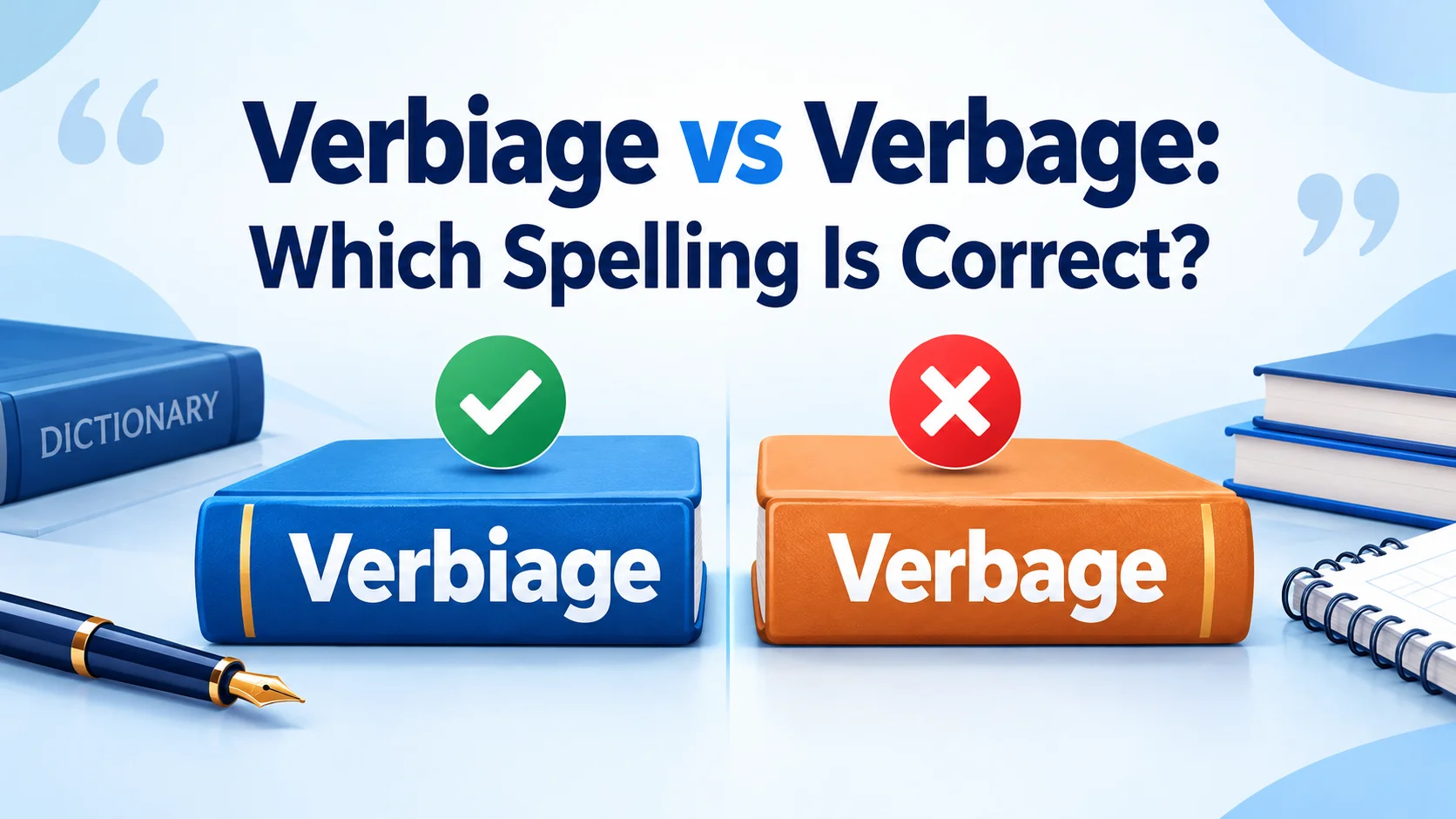
Verbiage vs verbage is a common spelling question, especially when writing professional emails, academic assignments, business reports, or website content. Although both forms appear online, verbiage is the standard spelling in modern English. Verbage is generally considered a misspelling in standard edited writing. Knowing which form to use helps you communicate clearly and avoid an unnecessary spelling error.
The confusion often arises because verbiage is not pronounced exactly as its spelling might suggest to someone encountering it for the first time. Writers may hear the word in conversation, remember its general sound, and accidentally leave out a letter. Others assume that verbage is correct because it resembles the familiar word verb. However, English spelling does not always follow predictable patterns, so recognizing the established form is important.
Understanding the difference involves more than memorizing a spelling. Verbiage can refer to the wording used in a document, but it can also describe excessive or unnecessarily complicated language. These meanings depend on context. In this guide, you will learn the correct spelling, the word’s definition, its pronunciation and origin, how to use it naturally, and which alternatives are more precise in different situations.
Verbiage vs Verbage: The Quick Answer
Verbiage is the correct standard spelling. Verbage is generally a nonstandard spelling that should be avoided in formal, academic, and professional writing.
| Word | Correctness | Example |
| Verbiage | Standard English spelling | The editor removed unnecessary verbiage from the report. |
| Verbage | Generally considered a misspelling | Use verbiage instead of verbage in the report. |
The word verbiage is a noun that refers to the words or language used to express something. It frequently has a negative connotation when describing language that contains more words than necessary.
For example:
- Neutral: The lawyer reviewed the verbiage in the contract.
- Negative: The introduction contains too much verbiage.
In the first sentence, verbiage refers to the wording of a document. In the second, it suggests that the writing is unnecessarily wordy.
What Does Verbiage Mean?
Verbiage means the words or wording used to communicate an idea. In many contexts, particularly in editing and professional communication, it refers to excessive, complicated, or unnecessary language.
The meaning depends on how the word is used. A person might discuss the verbiage of a legal agreement without criticizing it, or complain about excessive verbiage in a report that could have been much shorter.
Verbiage as Wording or Language
In its neutral sense, verbiage refers to the language used in a document, statement, policy, or other form of communication.
Consider these examples:
- The company revised the verbiage in its employee handbook.
- The contract’s verbiage was changed to clarify the payment conditions.
- The announcement uses friendly, accessible verbiage.
In each sentence, the word describes the language chosen to convey information. It does not necessarily suggest that the writing is poor.
However, wording is often the simpler choice when referring to the exact words used in a sentence. For example, “We changed the wording of the policy” is direct and natural.
Verbiage as Excessive or Unnecessary Words
The word is also frequently used to criticize writing that contains too many words, repetitive explanations, or unnecessarily complicated expressions.
Examples include:
- The report contains unnecessary verbiage.
- The speaker’s verbiage made a simple explanation difficult to follow.
- The editor removed the verbiage and strengthened the main argument.
In these examples, the concern is not simply that the writing is long. The problem is that extra language makes the message less effective.
Practical tip: If you want to criticize wordiness specifically, wordiness or verbosity may express your meaning more precisely than verbiage.
Verbiage Definition and Part of Speech
The word verbiage is a noun. It refers to language or wording, often with an implication of excessive expression,
It commonly appears in phrases such as:,
- Unnecessary verbiage
- Excessive verbiage
- Legal verbiage
- Technical verbiage
- The verbiage of a contract
It is generally treated as an uncountable noun in everyday English.
For example:
- Correct: The verbiage is difficult to understand.
- Correct: There is too much verbiage in this paragraph.
- More natural: The document contains several confusing phrases.
Avoid treating verbiage as a verb. Instead of saying “Please verbiage this paragraph,” write “Please revise this paragraph” or “Please simplify the wording.”
What Does Verbage Mean?
Verbage is a spelling that people sometimes use when they intend to write verbiage. It commonly results from misremembering the word, spelling it according to its perceived pronunciation, or assuming it follows a familiar pattern associated with verb.
In standard contemporary English writing, verbiage is the form to use.
You might encounter verbage in online discussions, informal messages, or unedited documents. Its appearance in these places does not make it the preferred spelling in professional communication.
For example:
- Nonstandard: The proposal contains unnecessary verbage.
- Standard: The proposal contains unnecessary verbiage.
If you are proofreading a report, essay, website article, or business email, replace verbage with verbiage when that is the intended word.
One qualification is worth noting: historical records may document variant spellings that are not recommended in contemporary standard writing. For ordinary communication today, there is no practical reason to choose verbage over verbiage.
Verbiage vs Verbage: Key Differences
The main distinction is that verbiage is the established standard spelling, whereas verbage is generally treated as a spelling error in edited English.
| Feature | Verbiage | Verbage |
| Standard spelling | Yes | No, in standard edited English |
| Intended meaning | Wording or excessive language | Usually intended to mean verbiage |
| Part of speech | Noun | Intended as a noun |
| Formal writing | Appropriate when used correctly | Avoid |
| Example | The verbiage needs revision. | The verbage needs revision. |
Verbiage vs Verbage Examples
Here are additional examples showing how to choose the correct spelling.
1: Business writing
- Incorrect in standard edited English: The email contains too much verbage.
- Correct: The email contains too much verbiage.
2: Academic writing
- Incorrect in standard edited English: Remove the unnecessary verbage from your essay.
- Correct: Remove the unnecessary verbiage from your essay.
3: Legal documents
- Incorrect in standard edited English: The lawyer revised the contract’s verbage.
- Correct: The lawyer revised the contract’s verbiage.
The difference is consistent in all three examples. The spelling changes, but the intended meaning remains the same.
Why Do People Confuse Verbiage and Verbage?
Several factors explain why writers make this mistake. Understanding them can help you recognize similar spelling problems in other English words.
Pronunciation Creates Confusion
The pronunciation of verbiage can make its spelling difficult to remember. The middle vowel is unstressed, so some speakers may not clearly distinguish every sound.
When people learn unfamiliar words through conversation, they often remember the sound before they remember the spelling. Later, they may write the word as they think it sounds.
For example, someone who frequently hears verbiage in workplace discussions might remember it as “verbage.” This is understandable, but pronunciation alone is not always a reliable guide to English spelling.
The Word Looks Related to Verb
The first four letters of verbiage resemble the familiar word verb. This visual similarity can encourage people to assume that verbage is the logical spelling.
However, a word’s appearance does not necessarily reveal its full spelling or history. Although verbiage has a historical connection to words and language, its standard spelling includes the i before age.
English Has Irregular Spelling Patterns
English vocabulary comes from several languages, including French, Latin, and Germanic languages. As a result, familiar spelling patterns do not always apply consistently.
Writers sometimes make mistakes by applying a spelling rule that works for one word to another word with a different history.
The practical solution is simple: when a word looks unfamiliar, check its spelling rather than relying entirely on how it sounds or resembles another word.
Typing Errors and Repeated Online Mistakes
Typing quickly, using voice-to-text software, or relying on memory can produce spelling errors. Online content may also repeat incorrect spellings, making them appear more familiar.
Search engines can help users find information even when a query contains a misspelling. Therefore, seeing results for verbage does not establish that it is the preferred spelling.
When accuracy matters, consult a reputable dictionary or a reliable editing tool.
How to Pronounce Verbiage
The pronunciation of verbiage varies slightly between English accents. The Cambridge Dictionary gives the following IPA pronunciations for American and British English.
English meaning – Cambridge Dictionary
+1
| Variety | IPA | Approximate pronunciation |
| American English | /ˈvɝː.bi.ɪdʒ/ | VUR-bee-ij |
| British English | /ˈvɜː.bi.ɪdʒ/ | VUR-bee-ij |
The first syllable receives the main stress. The American pronunciation has an r-colored vowel, while the British pronunciation shown here uses a different vowel sound.
Some speakers use a shorter pronunciation that sounds approximately like “VUR-bij.” This variation can contribute to spelling confusion, particularly for people who have learned the word orally.
How to Remember the Pronunciation and Spelling
Try breaking the word into parts when learning it:
VER-BI-AGE
Then remember the complete spelling:
V-E-R-B-I-A-G-E
Saying the word slowly while writing it can help reinforce the letter sequence. However, this is a memory technique rather than an exact representation of every speaker’s pronunciation.
The important point is that differences in accent do not change the standard spelling.
The Origin and History of Verbiage
The word verbiage entered English through French in the early eighteenth century. Its history is connected with French verbiage and verbier, meaning to chatter, and verbe, meaning “word.” The latter is ultimately related to the Latin verbum, also meaning “word.”
Etymology, Origin & Meaning
+1
This connection helps explain why verbiage refers to words, language, or expression. Its association with excessive language also reflects how the term has been used to criticize communication that relies on too many words.
The word’s history provides useful background, but it should not be confused with a modern spelling rule. Even if verbage appears plausible because it resembles verb, the established standard spelling remains verbiage.
For readers interested in word histories, an etymological dictionary can provide more detail about how the spelling and meaning developed over time.
How to Use Verbiage Correctly in a Sentence
The most effective way to use verbiage is to consider the point you want to make. Are you referring to the actual language in a document, or are you criticizing writing that uses too many words?
Verbiage Used to Mean Wording
Use the word when discussing the language chosen for a message or document.
Examples:
- The lawyer reviewed the verbiage in the settlement agreement.
- We changed the website’s verbiage to explain the return policy.
- The announcement’s verbiage was revised before publication.
- The team agreed that the verbiage of the new policy was clearer.
In these examples, the word identifies the language used. It does not automatically mean the writing is unnecessarily long.
Verbiage Used to Mean Wordiness
Use verbiage when the context suggests that unnecessary words interfere with clarity.
Examples:
- The introduction contains too much verbiage.
- The editor removed excessive verbiage from the article.
- The speaker’s verbiage obscured the main argument.
- The instructions could be shortened by removing repetitive verbiage.
In these cases, the word has a critical tone. It suggests that the language needs editing.
Verbiage in Formal and Professional Writing
The word is acceptable in professional communication, particularly when discussing document language or editing.
For example:
“The proposed changes will simplify the verbiage in the customer agreement.”
This sentence is grammatically correct, but a simpler alternative might be:
“The proposed changes will simplify the wording of the customer agreement.”
The second version may be preferable for a broad audience because wording is more familiar and direct.
Choose the word that suits your reader. A sophisticated word is not automatically a more precise word.
Is Verbiage Singular or Plural?
In ordinary usage, verbiage is generally an uncountable noun. It usually takes a singular verb and does not need a plural form.
Examples:
- The verbiage is confusing.
- The verbiage needs to be revised.
- There is too much verbiage in the introduction.
When discussing individual parts of a document, use a countable noun such as phrases, sentences, clauses, or passages.
For example, instead of saying “The contract contains three verbiages,” write “The contract contains three confusing clauses.”
Verbiage Examples in Everyday and Professional Contexts
The meaning and tone of verbiage become clearer when you see how it works in different settings.
Verbiage in Business Communication
Example: “The manager removed unnecessary verbiage from the project proposal.”
The proposal contained more explanation than the reader needed. Editing reduced the unnecessary wording and made the recommendation easier to identify.
Another example is:
“The company revised the verbiage in its customer-service policy.”
Here, verbiage refers to the policy’s wording. The sentence does not imply that the original language was excessive.
Verbiage in Legal Documents
Example: “The lawyer reviewed the verbiage of the contract before the parties signed it.”
This sentence refers to the language used in a legal document. Precision matters because changing a word or phrase can affect how a provision is interpreted.
Legal verbiage is not automatically bad writing. Contracts may need detailed language to specify obligations, exceptions, deadlines, and remedies. The goal is clear and precise drafting, not simply the shortest possible document.
Verbiage in Academic Writing
Example: “The instructor advised the student to remove unnecessary verbiage from the introduction.”
The advice suggests that the introduction takes too long to reach its main point.
For academic writers, the solution is not to remove every detailed explanation. Supporting evidence, definitions, and qualifications may be essential. Instead, remove repetition and sentences that do not advance the argument.
Verbiage in Websites and Online Content
Example: “The article’s opening paragraph contains unnecessary verbiage before answering the reader’s question.”
Online readers often want a direct answer before they explore additional details. A long introduction can delay that answer.
A useful editing approach is to place the main point early, then provide supporting context, examples, and qualifications. This improves usability without sacrificing important information.
Verbiage in Everyday Conversation
Example: “There was so much verbiage in his explanation that I forgot the original question.”
The speaker is criticizing a long or complicated explanation.
In casual conversation, however, too many words or a long-winded explanation may sound more natural. The best choice depends on your audience and the tone you want to convey.
Verbiage vs Similar Words: What Is the Difference?
Several English words are related to wording and language, but they are not interchangeable in every context. Choosing the right one makes your writing more precise.
Verbiage vs Wordiness
Wordiness specifically refers to using more words than necessary.
Example: “The paragraph’s wordiness makes the instructions difficult to follow.”
Verbiage can refer to the language itself or, in a critical context, to excessive wording.
Use wordiness when you want to identify the problem directly. Use verbiage when discussing the language of a document or when its critical sense fits your sentence.
Verbiage vs Verbosity
Verbosity describes the quality or tendency of using too many words.
Example: “The report suffers from verbosity.”
Compare this with:
“The report contains unnecessary verbiage.”
The first sentence emphasizes excessive expression as a characteristic of the report. The second focuses on the unnecessary wording itself.
Verbiage vs Vocabulary
Vocabulary refers to the words a person knows or uses, or the set of words associated with a language or subject.
Example: “The student has an extensive vocabulary.”
By contrast, verbiage refers to wording or language used in a particular context.
A person can have a large vocabulary and still write concisely. Likewise, a person can use simple vocabulary but produce excessively wordy writing.
Verbiage vs Wording
Wording means the particular words used to express something.
Example: “Please change the wording of the final sentence.”
This is often the clearest alternative when referring to a document’s language without criticizing it.
Verbiage may sound more formal or suggest unnecessary language, depending on context. In everyday communication, wording is frequently the better choice.
Verbiage vs Jargon
Jargon refers to specialized words or expressions used by a particular profession, group, or field.
Example: “The technical jargon in the manual confused new employees.”
Jargon and verbiage describe different issues. Jargon concerns specialized language, while verbiage concerns wording and can imply excess.
A technical document may contain necessary jargon but little verbiage. Conversely, a document can contain excessive words without using any specialized terminology.
Verbiage vs Terminology
Terminology means the specialized words and expressions associated with a subject or profession.
Example: “The medical terminology in the report requires explanation.”
Terminology is not inherently unnecessary. In a specialist document, precise technical terms may be essential. Verbiage becomes a concern when the language is unnecessarily long, unclear, or repetitive.
| Word | Main meaning | Best used when discussing |
| Verbiage | Wording or excessive language | Language in a document |
| Wordiness | Use of too many words | Unnecessary length |
| Verbosity | Excessive use of words | A tendency toward long explanations |
| Vocabulary | Words known or used | Language knowledge |
| Jargon | Specialized expressions | Professional or group-specific language |
| Terminology | Technical or subject-specific terms | Precise language within a field |
| Wording | The particular words chosen | How a message is expressed |
Does Verbiage Always Have a Negative Meaning?
No. Although verbiage frequently carries a negative connotation, it can also refer neutrally to the wording used in a document.
Consider these two sentences:
- Neutral: “The verbiage in the agreement was updated after the review.”
- Negative: “The agreement contains unnecessary verbiage that makes its conditions difficult to understand.”
In the neutral example, the word simply refers to the language that was changed. In the negative example, it criticizes excessive wording.
This distinction matters in professional communication. If you tell a colleague that their document contains too much verbiage, they may interpret your comment as criticism of their writing.
If you only mean that the language needs changing, consider saying:
- “We should revise the wording.”
- “This clause could be clearer.”
- “Let’s simplify this paragraph.”
These alternatives explain the requested improvement without implying that the original document is unnecessarily wordy.
Is Verbiage Appropriate in Formal and Professional Writing?
Yes. Verbiage is an established English noun and can be used in formal, academic, business, and legal writing.
However, appropriateness depends on the sentence and audience. A technically correct word may not always be the clearest option.
For example:
- Formal: “The verbiage in the agreement requires clarification.”
- Plain English: “The wording of the agreement needs to be clearer.”
- Editing feedback: “Remove unnecessary wording from the introduction.”
- Critical assessment: “The report suffers from excessive verbosity.”
Each sentence communicates a slightly different emphasis.
In legal writing, verbiage may refer to the actual wording of a provision, In editing, it often suggests unnecessary language, In customer communication, wording may be more accessible.
Expert recommendation: Choose words according to meaning, not formality alone. If your audience might misunderstand verbiage, use a more direct alternative.
Common Mistakes to Avoid When Using Verbiage
Writing Verbage Instead of Verbiage
This is the main spelling mistake. Remember that the standard spelling includes an i after b.
Incorrect: “The document contains excessive verbage.”
Correct: “The document contains excessive verbiage.”
Assuming Verbiage Always Means Bad Writing
The word can refer neutrally to language or wording. Read the sentence before deciding whether it criticizes the document.
For example, “The legal verbiage was revised” does not necessarily mean the original wording was poor.
Confusing Verbiage With Vocabulary
Vocabulary concerns the words a person knows or uses. Verbiage concerns wording or language in context.
A writer can use a sophisticated vocabulary in a concise paragraph, or simple vocabulary in a long-winded explanation.
Using Verbiage When Verbosity Is More Precise
If you are describing someone’s tendency to use too many words, verbosity may be more accurate.
For example, “The speaker’s verbosity made the presentation longer than necessary” emphasizes the speaker’s style rather than the wording of a particular sentence.
Treating Verbiage as a Verb
Verbiage is a noun, not a standard verb. Use verbs such as revise, edit, shorten, simplify, or clarify to describe what you want someone to do.
Incorrect: “Please verbiage the report.”
Correct: “Please simplify the wording of the report.”
How to Remember the Correct Spelling of Verbiage
If you repeatedly confuse the two spellings, a simple memory technique can help.
Remember the Letters in Verbiage
Write the word as:
V-E-R-B-I-A-G-E
The most important distinction is the i before a. When proofreading, look specifically for the incorrect form verbage.
Associate Verbiage With Wording
When you encounter the word, connect it with the phrase “the wording of something.”
For example: “The verbiage in the report needs revision.”
This association reinforces both the spelling and the meaning.
Use a Simple Memory Sentence
Try memorizing this sentence:
“The verbiage in the agreement was revised.”
Writing the sentence a few times can help you remember the correct sequence of letters. You can also save the word in a personal spelling list if it is one you regularly use in professional writing.
Check Before Publishing
Before submitting an essay, publishing an article, or sending an important document, search for verbage and verify whether you intended to write verbiage.
A spellchecker may catch the error, but unfamiliar words and context-dependent mistakes can escape automated checks. When in doubt, consult a reputable dictionary.
Conclusion
When choosing between verbiage vs verbage, use verbiage. It is the standard spelling in modern English and the appropriate form for professional documents, academic assignments, business communication, and published content. The word can refer neutrally to the wording of a document or critically to excessive language, so always consider the context before using it. One final actionable tip: Before submitting an important piece of writing, search for verbage and replace it with verbiage wherever that is the intended word. Then check whether verbiage itself is the clearest choice for your audience; sometimes wording or wordiness communicates the point more directly. A common mistake to avoid is assuming that a spelling is correct simply because it looks logical or appears frequently online. Remember the standard form, understand its meaning, and choose language that makes your message clear. Good writing is not about using complicated words; it is about using the right words for the situation.
Frequently Asked Questions
Q1. Is verbage ever an acceptable spelling?
In standard contemporary English, verbiage is the spelling readers should use. Although verbage appears in informal material and may be documented as a historical variant, it is generally treated as a misspelling in modern edited prose. For professional or academic work, choose verbiage.
Q2. What is a simple synonym for verbiage?
The best synonym depends on your intended meaning. Use wording when referring neutrally to the words in a document. Use wordiness when criticizing unnecessary length, or verbosity when describing excessive use of words. These alternatives are not identical, so choose the one that fits your sentence.
Q3. Can verbiage be used in a positive sense?
Yes, although a positive interpretation is not always the most natural one. The word can refer neutrally to language that has been revised or selected for a document. However, because it often suggests excessive wording, language or wording may be safer when you want an entirely positive or neutral tone.
Q4. Is verbiage countable or uncountable?
Verbiage is generally an uncountable noun in everyday English. You would normally say “too much verbiage” rather than “three verbiages.” When you need to count specific parts of a document, use nouns such as phrases, sentences, clauses, or passages.
Q5. What is the difference between verbiage and verbosity?
Verbiage refers to wording or language and can imply unnecessary words. Verbosity describes the quality or tendency of using too many words. For example, a report may contain unnecessary verbiage, while a speaker may be criticized for verbosity. The distinction helps you describe the problem more precisely.
