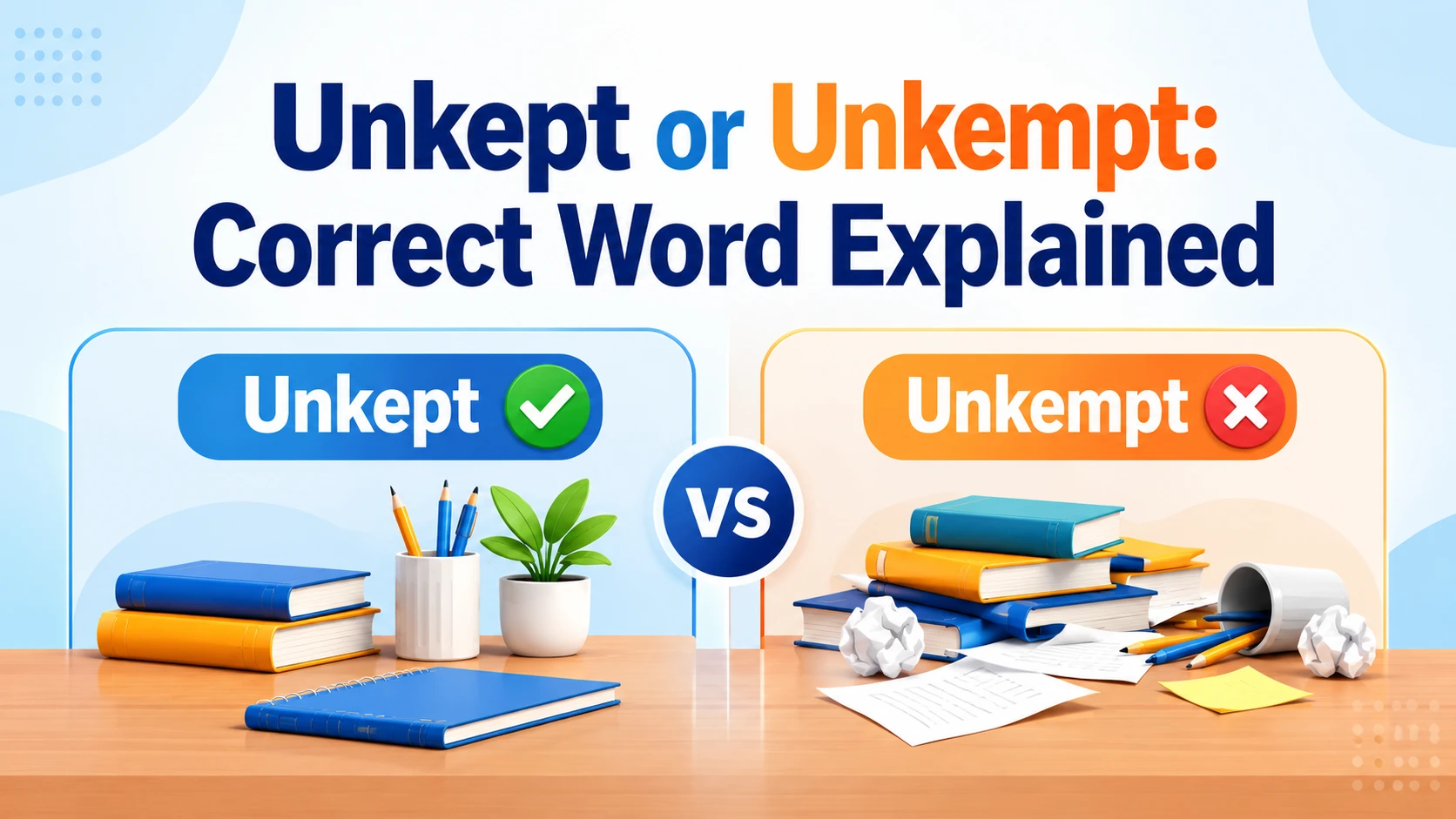
Unkept or unkempt can be confusing because both forms look as though they could be built from the familiar word kept. However, they don’t function the same way in modern English. If you’re describing someone whose hair, clothes, or general appearance looks messy or neglected, unkempt is the standard word. For example, you might say, “He arrived with unkempt hair.” The extra m isn’t optional. It is part of the established spelling of the adjective.
The confusion becomes more interesting when unkept appears in phrases such as unkept promises or unkept commitments. In those cases, readers may reasonably wonder whether unkept is actually a word or simply another spelling mistake. The answer depends on the meaning and construction. This guide explains the distinction, shows how each form works, compares related words such as untidy, messy, disheveled, and neglected, and gives you practical rules for choosing the right expression.
The key is not to memorize a complicated grammar rule. Instead, connect each form with the idea it normally expresses. Unkempt is strongly associated with something that looks poorly groomed, untidy, or neglected. Unkept, when used literally, means something that has not been kept, maintained, fulfilled, or observed, although other expressions are often more natural. Once you understand that difference, you’ll know which spelling belongs in professional writing, everyday conversation, descriptions, and phrases involving promises or obligations.
Unkept vs Unkempt: Which Word Is Correct?
The answer depends on what you mean, but unkempt is the word you want when describing a messy or poorly groomed appearance.
For example:
- She had unkempt hair after the long journey.
- The man’s unkempt beard made him look tired.
- The abandoned property had an unkempt garden.
- His appearance was noticeably unkempt.
The spelling unkept is different. It can occur as a literal formation meaning “not kept,” particularly in expressions involving something that was supposed to be maintained, fulfilled, or observed. However, many contexts are more naturally expressed with words such as broken, neglected, unfulfilled, or unmet.
| Word | Main idea | Typical use | Example |
| unkempt | Messy, untidy, poorly groomed | Hair, appearance, grounds, surroundings | His hair looked unkempt. |
| unkept | Not kept, maintained, fulfilled, or observed | Literal negative construction; less common | The agreement contained several unkept obligations. |
| untidy | Not neat or orderly | Rooms, desks, clothing, spaces | Her desk was untidy. |
| disheveled | Untidy or disordered in appearance | Hair, clothing, appearance | He looked disheveled. |
| neglected | Not given proper care or attention | Buildings, gardens, duties, relationships | The property looked neglected. |
The simple rule
If you’re describing messy hair, a poorly groomed beard, an untidy appearance, or an overgrown property, use unkempt.
Messy or poorly groomed → unkempt
If you mean something was not kept, maintained, fulfilled, or observed, unkept may be possible, but a more precise alternative is often preferable.
What Does “Unkempt” Mean?
Unkempt is an adjective meaning untidy, messy, neglected, or poorly groomed in appearance.
The word is especially common when describing people, hair, clothing, gardens, yards, buildings, and other things whose condition can be visually judged.
Consider these examples:
- His unkempt hair stuck out in every direction.
- The interviewer’s clothes were neat, but his beard looked unkempt.
- The backyard had become unkempt after months without maintenance.
- The once-beautiful garden now looked unkempt.
- She apologized for her unkempt appearance after the overnight flight.
The word often suggests more than simple disorder. Unkempt can imply that something has not received the care or grooming normally expected.
Unkempt meaning in plain English
Think of unkempt as describing something that has been allowed to become messy or poorly maintained.
For a person, it can refer to:
- messy hair
- an untrimmed beard
- wrinkled or neglected clothing
- an overall poorly groomed appearance
For a place, it can refer to:
- overgrown grass
- neglected gardens
- poorly maintained grounds
- a neglected-looking exterior
How “unkempt” describes appearance
The strongest use of unkempt involves visible condition.
For example:
After three days of camping, his hair looked unkempt.
The sentence doesn’t necessarily mean his hair was dirty. It means it looked untidy or poorly groomed.
That distinction matters.
Someone can have messy hair without being dirty. Likewise, an unkempt garden may simply be overgrown rather than contaminated or damaged.
Common nouns used with “unkempt”
Some combinations sound particularly natural:
- unkempt hair
- unkempt beard
- unkempt appearance
- unkempt clothing
- unkempt garden
- unkempt lawn
- unkempt yard
- unkempt grounds
- unkempt property
The word is therefore broader than personal grooming, although appearance remains its strongest association.
What Does “Unkept” Mean?
Unkept can be understood literally as the negative form of kept: something that has not been kept, maintained, fulfilled, or observed.
However, that doesn’t mean it is always the best word to use.
English speakers generally prefer more specific expressions in many situations.
For example, instead of:
He made an unkept promise.
Most writers would naturally choose:
He broke his promise.
Or:
He failed to keep his promise.
Likewise, instead of saying a property is unkept, neglected or poorly maintained is usually clearer.
Why “unkept” looks logical
The confusion comes from a very reasonable pattern:
keep → kept → unkept
That formation appears grammatically understandable. The problem is that English does not always create its most natural vocabulary through simple prefixing.
Unkempt is an established adjective with its own history and meaning. It isn’t simply a misspelled version of unkept.
When “unkept” may appear
You may encounter unkept when the writer intends the literal meaning “not kept.”
For example:
The old building had been unkept for years.
Even here, neglected or poorly maintained may sound more natural to many readers:
The old building had been neglected for years.
This is an important writing principle: a word can be understandable without being the most idiomatic choice.
Unkempt vs Unkept: The Meaning You Actually Need
The easiest way to separate the two is to ask what kind of condition you’re describing.
Use “unkempt” for visible messiness
When the subject looks untidy, poorly groomed, or neglected, unkempt is the natural choice.
Examples:
The reporter described the suspect as having unkempt hair.
The gardener was asked to clear the unkempt grounds.
His once-neat beard had become unkempt.
Use “unkept” only when “not kept” is genuinely intended
If you’re talking about something that was supposed to be kept, maintained, or fulfilled, unkept can express the literal negative idea.
But don’t automatically use it simply because you need the opposite of kept.
For example:
| Intended meaning | Better expression |
| A promise wasn’t honored | broken promise |
| A commitment wasn’t fulfilled | unfulfilled commitment |
| A garden wasn’t maintained | neglected garden |
| Hair wasn’t groomed | unkempt hair |
| A property wasn’t maintained | poorly maintained property |
| A rule wasn’t followed | rule was not observed |
This approach produces clearer writing because the replacement word tells readers exactly what failed to happen.
How to Use “Unkempt” Correctly in a Sentence
Unkempt normally works as an adjective.
Describing hair, beard, and grooming
This is one of the most common uses.
His unkempt hair made it obvious that he had rushed out of the house.
She arrived with an unkempt hairstyle after spending the night traveling.
The detective had an unkempt beard and a wrinkled coat.
Notice that unkempt describes the appearance. It doesn’t necessarily tell us why the person looks that way.
Describing clothing and appearance
You can also use unkempt for an overall appearance.
He looked unkempt during the early-morning interview.
The employee appeared unusually unkempt at the meeting.
Be careful with professional writing here. Describing someone as unkempt can sound judgmental. If you need neutral language, consider:
- casually dressed
- poorly groomed
- disheveled
- untidy
- wearing wrinkled clothing
The best choice depends on what you actually observed.
Describing places and property
Unkempt can describe outdoor areas and places that haven’t received adequate care.
The house was surrounded by an unkempt garden.
The park’s northern section looked unkempt after months of neglect.
Visitors complained about the unkempt grounds.
In these contexts, overgrown or neglected may sometimes be more precise.
Using “unkempt” without exaggerating
Not every messy thing is unkempt.
A desk covered with papers might be cluttered. A room with clothes on the floor might be messy. A person’s hair that hasn’t been brushed may be unkempt.
Choosing the most specific adjective makes your writing stronger.
How to Use “Unkept” Without Creating a Grammar Mistake
The safest approach is to treat unkept as a literal construction rather than as a replacement for unkempt.
When “unkept” means “not kept”
The word can communicate that something hasn’t been maintained or preserved.
For example:
The property remained unkept throughout the winter.
This is understandable, but many editors would prefer:
The property remained neglected throughout the winter.
The second sentence is more direct and idiomatic.
Why “unkept promise” causes confusion
The phrase unkept promise is understandable because a promise is something you are expected to keep.
However, the more established expressions are:
- broken promise
- promise not kept
- failure to keep a promise
For example:
He apologized for breaking his promise.
That sounds more natural than:
He apologized for making an unkept promise.
Better alternatives improve precision
When unkept feels awkward, don’t force it. Ask what specifically wasn’t kept.
Was it:
- a promise?
- a commitment?
- a deadline?
- a rule?
- a garden?
- a building?
- a secret?
- an agreement?
Then choose the natural expression for that context.
Unkempt vs Similar Words: Which One Fits Best?
Choosing between synonyms is often more useful than simply memorizing a spelling rule.
Unkempt vs untidy
Untidy means not neat or orderly.
Her bedroom was untidy.
Unkempt suggests neglect or poor grooming and is especially natural for appearance.
Her hair looked unkempt.
A room can be untidy without being unkempt.
Unkempt vs messy
Messy is broad and informal.
My desk is messy.
Unkempt is more descriptive and often carries a stronger suggestion of neglected grooming or maintenance.
Unkempt vs disheveled
Disheveled is especially useful for a person’s hair, clothing, or general appearance.
He looked disheveled after the long flight.
It often suggests disorder caused by circumstances, whereas unkempt can imply ongoing lack of grooming or care.
Unkempt vs neglected
Neglected focuses on a lack of care.
The garden was neglected.
Unkempt focuses more strongly on the resulting untidy appearance.
The garden was unkempt.
Both can be correct, but they emphasize slightly different things.
Unkempt vs overgrown
Overgrown is particularly precise for vegetation.
The backyard was overgrown with weeds.
Calling it unkempt is possible, but overgrown tells the reader exactly what happened.
Is “Unkempt” Always Negative?
Usually, unkempt carries a negative or critical tone.
If you describe someone’s appearance as unkempt, readers will probably understand that you consider the person insufficiently groomed.
That doesn’t mean the word is always rude. Context matters.
In neutral reporting
A factual description might use the word without expressing strong personal judgment:
The photograph showed the suspect with an unkempt beard and shoulder-length hair.
Here, the word describes a visible feature.
In personal descriptions
The same adjective can sound more critical:
His unkempt appearance made a poor impression at the interview.
If you want to sound professional and neutral, describe the observable details instead:
His hair was uncombed, and his clothing was heavily wrinkled.
This avoids turning an observation into a broad judgment.
Unkempt in British and American English
Unkempt is a standard English word in both American and British English.
There isn’t a standard American spelling such as unkempt versus a British spelling such as unkept. The established spelling is unkempt in both varieties.
That means you can safely write:
- unkempt hair
- unkempt appearance
- unkempt garden
- unkempt grounds
whether your audience uses American or British English.
Regional vocabulary can vary in other areas, but this particular spelling distinction isn’t one of them.
Common Mistakes With Unkept and Unkempt
Mistake 1: Writing “unkept hair”
If you mean messy or poorly groomed hair, use:
unkempt hair
Not:
unkept hair
Mistake 2: Assuming “unkept” is simply the opposite of “kept”
The logic seems reasonable, but natural English doesn’t always work that way.
If something isn’t maintained, neglected or poorly maintained may be better.
If a promise isn’t honored, broken is more natural.
Mistake 3: Using “unkempt” for every kind of disorder
A messy desk isn’t necessarily unkempt.
Use:
- cluttered for too many objects
- untidy for lack of order
- messy for general disorder
- unkempt for poor grooming or neglected appearance
Mistake 4: Assuming “unkempt” only describes people
It can describe places and things as well.
an unkempt garden
unkempt grounds
an unkempt property
The common thread is a neglected or untidy appearance.
Practical Sentence Examples: Unkempt vs Unkept
Correct examples with “unkempt”
- His unkempt hair needed a trim.
- The garden looked unkempt after the rainy season.
- She apologized for her unkempt appearance.
- The abandoned property had become unkempt.
- His beard was beginning to look unkempt.
Examples where “unkept” can convey “not kept”
- The building had remained unkept for years.
- The grounds were visibly unkept.
- Several obligations were described as unkept.
However, in the last examples, more idiomatic alternatives may be preferable:
- The building had been neglected for years.
- The grounds were poorly maintained.
- Several obligations remained unfulfilled.
Incorrect or awkward substitutions
He had unkept hair.
Better:
He had unkempt hair.
The man’s beard was unkept.
Better:
The man’s beard was unkempt.
She made an unkempt promise.
Incorrect meaning. A promise can be broken or unkept, while unkempt describes untidiness.
A Simple Memory Trick for “Unkempt”
The easiest memory aid is to associate unkempt with grooming and neatness.
Think:
Kempt = neat or well-groomed
Unkempt = not neat or well-groomed
You don’t need to use kempt in everyday conversation. The important thing is recognizing that unkempt is a fixed English adjective.
Remember the “M”
If you keep accidentally writing unkept, pause and picture:
UN + KEMPT = UNKEMPT
That extra m is part of the word.
A useful mental association is:
Messy → M → unkempt
It isn’t a linguistic rule. It’s simply a practical spelling aid.
Conclusion
Unkept or unkempt isn’t a choice between two interchangeable spellings. Unkempt is the established word for something that looks messy, untidy, poorly groomed, or neglected, especially a person’s hair, beard, appearance, garden, or grounds. Unkept can be understood as “not kept,” but it is far less useful in ordinary writing and is often better replaced with a more precise expression such as broken, unfulfilled, neglected, or poorly maintained. One final actionable tip: when your sentence describes appearance or grooming, choose unkempt. A common mistake to avoid is assuming that unkept is simply the correct spelling of the same word. Remember the extra m and connect it with messy appearance. Once that association sticks, this spelling problem becomes much easier to avoid.
Frequently Asked Questions
Q1. Is “unkept” a correct English word?
Unkept can occur as a literal formation meaning “not kept,” but it is much less common than unkempt and often isn’t the most natural choice. When describing messy hair, poor grooming, or neglected appearance, unkempt is the standard word.
Q2. Is “unkempt” the correct word for messy hair?
Yes. Unkempt is a standard adjective for hair that looks messy, poorly groomed, or neglected. You can also use it for beards and overall appearance. For example, “His unkempt hair made it obvious that he hadn’t had time to prepare.”
Q3. What is the difference between an unkempt person and an unkept promise?
An unkempt person has a messy or poorly groomed appearance. An unkept promise means a promise that was not kept, although broken promise is generally more natural. The two words are therefore connected visually but serve very different purposes.
Q4. Can “unkept” be used instead of “unkempt”?
No, not when you mean messy, untidy, or poorly groomed. Use unkempt for that meaning. Unkept may occur when something literally has not been kept or maintained, but context often calls for a more precise word such as neglected or unfulfilled.
Q5. What is an easy way to remember how to spell “unkempt”?
Associate unkempt with messy or poorly groomed and remember the m. A simple memory phrase is: “Messy appearance = unkempt.” If you’re talking about hair, a beard, clothing, or neglected grounds, unkempt is almost certainly the spelling you need.
