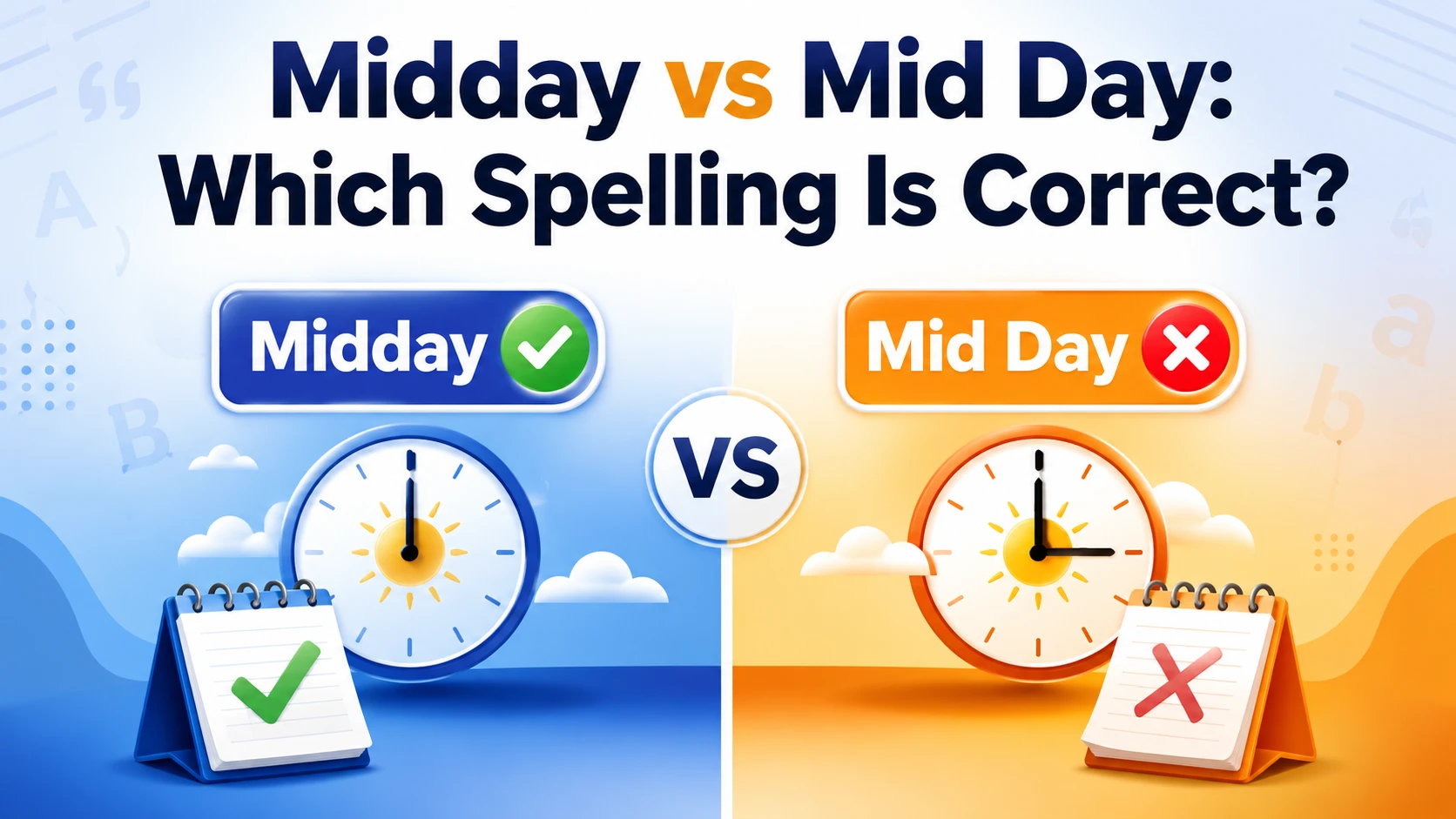
Midday vs mid day is a common spelling question because mid and day are both familiar English words, so writing them separately can seem perfectly logical. In standard modern English, however, midday is the usual spelling when you mean the middle part of the day. For example, “We arrived at midday” is standard, while “We arrived at mid day” is generally not the preferred form. The distinction matters most in professional writing, school assignments, websites, schedules, and edited publications, where consistent modern spelling helps your writing look polished and deliberate.
The confusion becomes more interesting when you compare midday, mid-day, and mid day. English compounds don’t always follow one predictable formula. Some become closed compounds, some remain open, and others use a hyphen. Historical usage can also leave older spellings behind. That means you shouldn’t assume that every word beginning with mid- must be written the same way. Instead, the established spelling of the particular word matters. In this case, midday is the normal modern form, while mid-day may appear in older or stylistically specific material.
There is also a meaning question hiding behind the spelling issue. Midday and noon overlap, but they aren’t always interchangeable, especially when precision matters. Noon conventionally refers to 12:00 p.m., whereas midday can describe the middle portion of the day more generally. If you’re writing a timetable, appointment notice, scientific record, or deadline, an exact time may be clearer. If you’re describing heat, sunlight, travel, work routines, or a general part of the day, midday is often more natural. This guide explains the spelling, grammar, time meaning, exceptions, common mistakes, and best practices in detail.
Quick Answer: Is “Midday” One Word or Two?
The standard modern spelling is midday, written as one word.
✅ We expect to arrive at midday.
❌ We expect to arrive at mid day.
When midday refers to the established time-of-day concept, it functions as a single lexical unit in ordinary modern English.
Midday Is the Standard Modern Spelling
Use midday when you mean:
- the middle part of the day
- the period around noon
- a general time around the center of the daytime period
Examples:
- The temperature will rise by midday.
- We should reach the hotel around midday.
- The midday sun was unusually bright.
- Please finish the work by midday.
Is “Mid Day” Ever Correct?
Usually, mid day isn’t the spelling you want when referring to the established time-of-day expression.
However, English can sometimes place two words next to each other for grammatical reasons. A historical text, quotation, unusual construction, or specialized context may therefore contain mid day. That doesn’t make it the normal modern spelling of midday.
What About “Mid-Day”?
Mid-day is a form you may encounter, particularly in older material or certain editorial styles. It isn’t generally necessary when you’re simply referring to the middle of the day.
For ordinary contemporary writing, the safest choice is:
midday
What Does “Midday” Mean?
Midday refers to the middle part of the day, particularly the period around noon.
It isn’t always necessary to interpret the word as one exact clock reading. In everyday language, people often use it as a general time reference.
Midday as a Time of Day
Consider:
I’ll call you around midday.
The speaker probably isn’t promising to call at exactly 12:00:00. The phrase allows some flexibility.
Likewise:
The roads become crowded around midday.
This describes a general period rather than a precise timestamp.
That flexibility is one reason midday is useful in descriptive writing.
Does Midday Mean Exactly 12 p.m.?
Not necessarily.
There are two related ideas:
- Astronomical or literal middle of the day
- Ordinary conversational use around noon
In everyday English, midday can describe a period centered around noon. If the exact time matters, noon or a clock time is usually clearer.
For example:
The presentation starts at noon.
is more precise than:
The presentation starts at midday.
The second sentence may be perfectly understandable, but it doesn’t communicate the same level of time precision.
Midday as a Noun and Modifier
Midday can appear as a noun:
We arrived at midday.
It can also modify another noun:
The midday heat was intense.
Here, midday tells us what kind of heat is being discussed.
Other examples include:
- midday sun
- midday meal
- midday break
- midday temperature
- midday traffic
- midday light
This flexibility makes midday common in both ordinary and formal writing.
Midday vs Mid Day: What Is the Actual Difference?
The biggest difference is not meaning but modern spelling and grammatical status.
When you mean the recognized time-of-day expression, midday is the established form.
| Form | Modern everyday status | Typical use | Example |
| midday | Standard | Middle of the day | “We arrived at midday.” |
| mid day | Not normally the standard spelling | Separate words in unusual/contextual constructions | Context-dependent |
| mid-day | Less common alternative | Older or stylistic usage | “The mid-day meal…” |
Why “Midday” Is Normally Written as One Word
English contains many compound words. A compound forms a unit from two or more words.
Over time, compounds can develop different spellings:
- open: ice cream
- hyphenated: well-known
- closed: notebook
There isn’t a universal rule saying exactly when a compound must become one word. Established usage determines the conventional spelling.
Midday is one of those established closed compounds.
Why “Mid Day” Can Look Reasonable but Still Be Wrong
The logic behind mid day is understandable:
mid + day = mid day
But English spelling doesn’t always preserve the visible structure of a word’s components.
For example, nobody normally writes:
note book
for notebook.
Likewise, when midday is being used as the established noun meaning the middle part of the day, splitting it into two words is generally unnecessary and nonstandard.
Why You Shouldn’t Invent Compound-Word Rules
A common editing mistake is assuming:
“If one mid- word is hyphenated, all mid- words should be hyphenated.”
That isn’t how English compounds work.
The spelling of each established compound should be checked according to current standard usage and the style guide relevant to your work.
Is “Mid Day” Ever Grammatically Correct?
This question requires a little nuance.
When the Two Words May Appear Separately
There can be constructions in English where mid functions independently rather than forming the established compound midday. Such constructions are uncommon in ordinary modern prose when the intended meaning is simply “the middle of the day.”
For most writers, the practical distinction is more useful than an exhaustive list of unusual constructions:
If you’re referring to the time period known as the middle of the day, write midday.
Don’t choose mid day simply because both components have recognizable meanings.
Historical and Older Usage
Readers may encounter mid day or mid-day in:
- older books
- historical documents
- archived newspapers
- older dictionaries
- quotations
- literary texts
- reproductions of original documents
English spelling has changed over time. A historical source may preserve a form that isn’t the preferred spelling today.
That doesn’t mean the older spelling was necessarily a typographical mistake.
The Practical Modern-Writing Rule
If you’re writing a new article, email, report, essay, webpage, or business document, use:
midday
If you’re quoting a historical source, reproducing an original document, or discussing historical spelling, preserve the source’s form when accuracy requires it.
Midday vs Mid-Day vs Mid Day: Which Form Should You Use?
These three forms shouldn’t be treated as equally interchangeable.
The Three Forms Compared
| Spelling | Recommended for ordinary modern writing? | Main consideration |
| midday | Yes | Standard closed compound |
| mid-day | Usually unnecessary | May occur in older or stylistic writing |
| mid day | Generally no | Not the normal spelling of the time expression |
The key point is simple: midday is the default modern choice.
Is “Mid-Day” Wrong?
Calling mid-day absolutely “wrong” would be too simplistic.
You can encounter the hyphenated form in published material, especially older writing or sources that follow particular editorial conventions. A writer reproducing that source may have a legitimate reason to retain it.
But if you’re creating fresh general-purpose English today, there’s little reason to choose mid-day over midday.
Which Form Is Best for Professional Writing?
For most professional documents:
midday
is the cleanest choice.
For example:
Please submit your report by midday.
This looks natural in:
- business emails
- reports
- websites
- instructional material
- newsletters
- general correspondence
- school and university writing
If your organization follows a specific style guide, consistency with that guide should take priority.
Midday vs Noon: Are They the Same?
Midday and noon are closely related, but they’re not perfect synonyms in every context.
What “Noon” Means
Noon conventionally means 12:00 p.m., the point at which the clock reaches twelve in the middle of the day.
For practical communication, noon is often the better word when an exact conventional time is intended.
The appointment is at noon.
This sounds more precise than:
The appointment is at midday.
What “Midday” Means
Midday is broader.
It can refer to:
- the middle of the day
- the period around noon
- conditions occurring around noon
- a general daytime reference
For example:
The midday heat made walking uncomfortable.
It would sound unusual to replace midday with noon in every such sentence.
When to Use Noon Instead of Midday
Choose noon when precision is the priority.
Use it for:
- appointments
- meeting times
- deadlines
- event schedules
- transportation instructions
- formal time references
Choose midday when you’re describing a general period.
Noon vs Midday Examples
| Situation | Better expression | Example |
| Exact appointment | noon | “The meeting begins at noon.” |
| General period | midday | “Traffic increases around midday.” |
| Weather | midday | “Midday temperatures will be high.” |
| Deadline | noon | “Send the form by noon.” |
| Descriptive writing | midday | “The midday sun flooded the courtyard.” |
Expert tip: If a reader needs to know exactly when something happens, give them a clock time or noon. If you’re describing when something generally occurs, midday gives you useful flexibility.
Midday vs Afternoon: Where Is the Boundary?
The relationship between midday and afternoon can cause another subtle misunderstanding.
When Midday Occurs
Midday centers on the middle of the daytime period, around noon.
Afternoon generally refers to the period after noon and before evening.
The boundaries aren’t always treated as rigid blocks in ordinary conversation.
Is Midday Part of the Afternoon?
Not exactly in the way the words are normally conceptualized.
Midday identifies a central point or surrounding period. Afternoon describes the broader part of the day following noon.
That’s why these expressions sound natural:
The midday heat was intense.
The early afternoon remained hot.
The first focuses on conditions around the middle of the day. The second describes a later period.
Midday vs Afternoon Examples
Compare:
We arrived at midday.
This places the arrival around the middle of the day.
We arrived in the afternoon.
This gives a broader time range.
If exact timing matters, neither phrase may be sufficient:
We arrived at 1:30 p.m.
That’s much more precise.
How to Use “Midday” Correctly in a Sentence
Knowing the spelling is only half the job. You also need to know how the word behaves naturally in a sentence.
Midday as a Noun
Common constructions include:
We reached the town at midday.
The rain began around midday.
Temperatures peak near midday.
Here, midday functions as the time reference.
Midday Before a Noun
Midday can also work as a modifier:
The midday sun was harsh.
They took a midday break.
The midday meal was served outside.
In these examples, midday tells the reader what kind of sun, break, or meal is being discussed.
Midday in Professional Writing
In workplace communication, midday is useful when exact timing isn’t essential:
I’ll send the revised proposal by midday.
But if missing the deadline could cause a problem, a more precise time is better:
I’ll send the revised proposal by 12:00 p.m.
The best wording depends on the consequences of ambiguity.
Midday in Everyday Conversation
These expressions are particularly natural:
- at midday
- around midday
- by midday
- before midday
- after midday
- until midday
Examples:
Let’s leave around midday.
She expects to finish by midday.
The weather should improve after midday.
Common Sentence Patterns With Midday
| Pattern | Meaning | Example |
| at midday | At or around the middle of the day | “We stopped at midday.” |
| around midday | Approximately that time | “Call me around midday.” |
| by midday | No later than that point | “Finish it by midday.” |
| before midday | Earlier than that period | “We’ll leave before midday.” |
| after midday | Later than that period | “The storm arrived after midday.” |
| until midday | Continuing up to that point | “The store remains closed until midday.” |
Common Phrases and Collocations With Midday
Certain combinations sound especially natural because they’re established in everyday English.
At Midday
The temperature reached its peak at midday.
This is useful when describing an event or condition occurring around the middle of the day.
Around Midday
We’ll probably arrive around midday.
This is one of the best choices when you don’t know the exact time.
By Midday
The package should arrive by midday.
Here, by establishes a latest expected point rather than an exact arrival time.
Before and After Midday
Please finish the inspection before midday.
The winds became stronger after midday.
These phrases provide useful temporal boundaries without requiring a precise timestamp.
Midday Sun and Midday Heat
These are common descriptive combinations:
The midday sun was difficult to look at directly.
We avoided walking during the midday heat.
They occur frequently in weather, travel, environmental, and descriptive writing.
Midday Meal and Midday Break
A midday meal generally refers to a meal eaten around the middle of the day. Depending on the context, that meal may simply be called lunch.
A midday break refers to a break occurring around that time.
These expressions don’t necessarily imply a specific clock time.
Midday in American and British English
Is “Midday” Used in Both Varieties?
Yes. Midday is standard in both American and British English.
There isn’t a major US-versus-UK spelling difference in this word.
You don’t normally need to change:
midday
to:
mid-day
simply because you’re writing for a British audience.
Are There Regional Differences in Meaning?
The core meaning remains essentially the same, but conversational time references can vary.
For example, lunchtime may occur at different times depending on someone’s routine, workplace, school schedule, or cultural setting.
Likewise, someone saying:
I’ll see you around midday.
is giving an approximate time rather than a strict appointment at exactly 12:00 p.m.
American vs British Usage Examples
Both varieties can naturally use:
We arrived at midday.
The midday sun was strong.
The meeting is scheduled for noon.
The more important distinction is precision and context, not regional spelling.
Midday in Professional, Academic, and Public-Facing Writing
The correct spelling is only one part of good usage. Professional writers also need to decide whether midday is precise enough.
Business and Workplace Writing
Midday works well for approximate expectations:
The shipment should arrive around midday.
But for appointments:
The meeting starts at noon.
or:
The meeting starts at 12:00 p.m.
may be clearer.
Best practice: Match the level of precision to the reader’s needs.
Academic Writing
Academic writing may use midday when describing a general observation:
Samples were collected around midday.
If the exact collection time affects the study, however, researchers should record and report the actual time.
For example:
Samples were collected at 12:15 p.m.
is more reproducible than:
Samples were collected at midday.
The latter may be appropriate for a broad narrative but not for every research method.
Journalism and News Writing
Journalists may use midday when the exact minute isn’t important:
The storm reached the coast around midday.
If the timing is central to the story, a specific time provides greater clarity:
The storm reached the coast at 12:18 p.m.
Schedules and Public Information
Schedules should generally favor precision.
Compare:
Bus departure: midday
with:
Bus departure: 12:00 p.m.
The second is much more useful operationally.
Rule of thumb: Use midday for a general time reference and an exact time for instructions or schedules.
Midday, Noon, Lunchtime, and Related Time Expressions
These words overlap, but each emphasizes something slightly different.
Midday vs Noon
Midday is a broader time-of-day expression.
Noon is conventionally associated with 12:00 p.m.
The park gets busy around midday.
The appointment is at noon.
Midday vs Lunchtime
Lunchtime is tied to a meal and can vary substantially.
Someone may have lunch at 11:30 a.m., 12:30 p.m., or even later.
Therefore:
I’ll call you around lunchtime.
doesn’t necessarily mean:
I’ll call you exactly at noon.
Midday vs High Noon
High noon specifically evokes noon and is often used in dramatic, literary, historical, or figurative contexts.
The duel was scheduled for high noon.
It’s not simply a more formal version of midday.
Mid-Morning and Mid-Afternoon
This comparison is particularly useful because learners sometimes expect every mid- expression to follow the same spelling pattern.
Common forms include:
- mid-morning
- mid-afternoon
- midday
The spelling differs because English compounds have developed according to established usage. You can’t reliably predict the spelling simply by looking at the prefix.
Comparison Table: Related Time Expressions
| Expression | Main idea | Precision | Natural example |
| midday | Middle part of the day | Moderate | “It gets hot around midday.” |
| noon | 12:00 p.m. | Higher | “The meeting starts at noon.” |
| lunchtime | Usual lunch period | Variable | “I’ll call at lunchtime.” |
| high noon | Noon, often dramatic or literary | High/contextual | “They met at high noon.” |
| mid-afternoon | Middle portion of afternoon | Moderate | “We’ll leave in mid-afternoon.” |
| mid-morning | Middle portion of morning | Moderate | “The symptoms appeared mid-morning.” |
Why Writers Get “Midday” Wrong
The mistake usually isn’t caused by ignorance. It’s often caused by a reasonable but unreliable assumption about English spelling.
Treating Every “Mid” Compound the Same Way
Writers may see:
mid-morning
and assume:
mid-day
must follow the same pattern.
But compound spelling isn’t completely predictable. Established usage decides whether a compound is closed, hyphenated, or open.
Writing by Word Parts
Because mid and day are both independent words, mid day looks logical.
That’s exactly why it can survive in drafts.
The problem is that standard spelling isn’t always a transparent reflection of a word’s components.
Mixing Different Styles Within One Document
A writer might use:
midday
in one paragraph and:
mid-day
later.
Even if readers understand both, inconsistent spelling can make an article or report look poorly edited.
Best practice: Pick the standard modern form and use it consistently unless you’re quoting a source.
Confusing Spelling With Meaning
Another mistake is assuming that midday, noon, and lunchtime all mean exactly the same thing.
They don’t.
- midday → general middle-of-day period
- noon → conventionally 12:00 p.m.
- lunchtime → customary meal period
Choosing the right word improves precision as well as spelling.
A Practical Editing Checklist for “Midday”
Before publishing or submitting your writing, run through this short checklist.
Check the Spelling
- Do I mean the middle part of the day?
- If yes, have I written midday?
- Have I accidentally used mid day?
- Have I switched between midday and mid-day unnecessarily?
Check the Meaning
- Do I actually mean noon?
- Am I describing a general period rather than an exact time?
- Would a clock time be clearer?
Check the Context
- Is this a historical quotation?
- Is mid-day part of an established source style?
- Is the form part of a proper name?
- Does my organization’s style guide specify a different treatment?
Check for Precision
If a reader needs to act at a particular time, avoid unnecessary ambiguity.
Instead of:
Submit your application by midday.
consider:
Submit your application by 12:00 p.m.
when the exact deadline is important.
Midday vs Mid Day: Examples of Correct Usage
Real examples make the spelling rule easier to apply.
Everyday Examples
I’ll call you around midday.
We reached the village at midday.
The store becomes busy by midday.
Let’s meet sometime around midday.
Workplace Examples
Please send the revised document by midday.
The delivery is expected around midday.
We’ll review the figures during the midday break.
Academic Examples
Observations were collected around midday.
The researchers recorded temperatures at midday.
When the exact measurement time matters, however, a specific timestamp is usually better:
The temperature was recorded at 12:05 p.m.
Travel and Transportation Examples
The train should arrive around midday.
We’ll reach the airport by midday.
For an actual timetable, use the scheduled time:
Arrival: 12:10 p.m.
That removes ambiguity.
Weather Examples
The midday sun was intense.
Temperatures are expected to rise sharply by midday.
The storm may weaken after midday.
These are natural uses because weather descriptions often concern a period rather than one exact minute.
Quick Ways to Remember “Midday” Is One Word
Memory Rule: Think of It as a Time Period
When you mean the established concept the middle of the day, remember it as one vocabulary item:
midday
Don’t rebuild its spelling from mid + day every time you write it.
Don’t Automatically Copy the Structure of Other Words
English compounds don’t follow a single mechanical pattern.
The fact that mid-morning is commonly hyphenated doesn’t mean midday should be.
Likewise, seeing an older source use mid-day doesn’t mean you need to reproduce that spelling in new writing.
The Editing Shortcut
Use this simple rule:
If you mean the middle of the day, your default spelling is “midday.”
Then ask a second question:
Do I need an exact time?
If yes, use noon or a specific clock time.
That two-step test solves most real-world cases.
Conclusion
When you’re deciding between midday vs mid day, the practical answer is straightforward: use midday when you mean the middle part of the day. It is the standard modern spelling and works naturally in everyday, academic, professional, journalistic, and online writing. Although you may encounter mid-day or mid day in older texts, historical material, quotations, or unusual contexts, those forms shouldn’t normally replace midday in new writing. It’s also worth separating spelling from precision. Midday describes a general period around the middle of the day, while noon points more specifically to 12:00 p.m. One final actionable tip: choose midday for a general time reference and noon or an exact clock time when precision matters. A common mistake to avoid is assuming every mid- compound follows the same spelling pattern.
Frequently Asked Questions
Q1. Is “midday” one word or two?
Midday is normally one word in modern standard English when it means the middle part of the day. For example, “We arrived at midday.” The forms mid-day and mid day may appear in older or specialized material, but midday is the preferred everyday spelling.
Q2. Is “mid day” ever correct in modern English?
Mid day is not normally the preferred spelling of the established time expression. You may encounter the two words separately in unusual grammatical, historical, or quoted material. For ordinary contemporary writing, however, use midday rather than treating mid day as an equivalent spelling.
Q3. Is “mid-day” an accepted spelling?
Mid-day can be found in English, particularly in older texts or certain editorial styles. However, it isn’t generally the form you need for new everyday writing. If you’re simply referring to the middle of the day, midday is the safest and most conventional modern choice.
Q4. Does midday mean exactly 12 p.m.?
Not always. Midday centers on the middle of the day and can refer to a period around noon. If you need to communicate an exact conventional time, noon or a specific clock time is clearer. Context determines how much precision the word needs to provide.
Q5. What is the difference between midday and noon?
Noon conventionally refers to 12:00 p.m., while midday can describe the broader period around the middle of the day. The words overlap considerably, but noon is usually preferable for precise appointments, deadlines, and schedules, whereas midday works well for general descriptions.
