
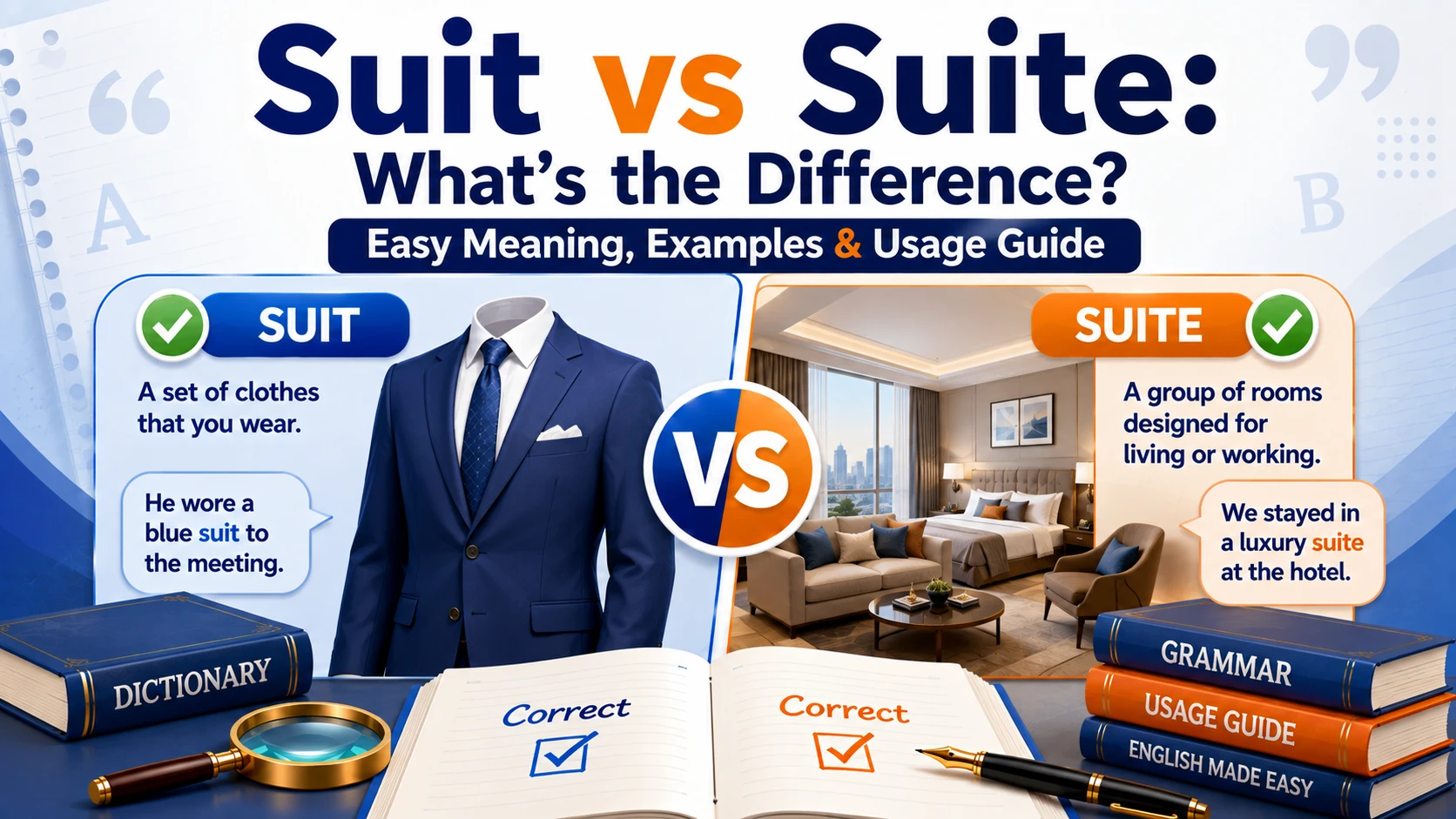
Suit vs suite is a common English spelling confusion because both words are pronounced the same in most varieties of English, yet they have very different meanings. Suit can refer to clothing, a legal case, a category in a deck of cards, or something that is appropriate for someone. Suite, on the other hand, usually describes a group of connected rooms or a collection of related things, such as software or services.
The confusion becomes easier to solve once you stop relying on sound and start looking at context. If you’re talking about a jacket and trousers, you need suit. If you’re booking several connected hotel rooms, you need suite. But there are less obvious cases, too. You might say something suits your needs, play a card from a particular suit, or purchase a software suite. Each meaning gives you a useful clue.
This guide explains suit and suite from grammar, meaning, pronunciation, and real-world usage. You’ll learn how each word functions, why suit can be both a noun and a verb, why suite is normally a noun, and how the words differ from related terms such as fit. You’ll also see practical examples, common mistakes, decision rules, and a short practice test so you can choose the correct spelling confidently.
Suit vs Suite: The Quick Answer
The easiest distinction is this:
Suit usually means clothing, something appropriate, a card category, or a legal action. Suite usually means a group of connected rooms or a related collection of things.
| Word | Main idea | Part of speech | Example |
| suit | Clothing | Noun | He wore a dark suit. |
| suit | Be appropriate | Verb | This schedule suits me. |
| suit | Card category | Noun | Hearts is a suit in a standard deck. |
| suit | Legal action | Noun | The company filed a suit. |
| suite | Connected rooms | Noun | We booked a hotel suite. |
| suite | Collection of related things | Noun | The company sells a software suite. |
| suite | Musical composition | Noun | The composer wrote a piano suite. |
Suit and suite are pronounced the same
In standard American English, suit and suite are generally pronounced /suːt/. That makes them homophones: words that sound alike but have different spellings and meanings.
Because pronunciation doesn’t help you choose the spelling, meaning and context become the deciding factors.
The fastest way to choose between them
Ask yourself what you’re describing:
- Something you wear? → suit
- Something that is appropriate? → suit
- A category of playing cards? → suit
- A legal case? → suit
- Connected hotel or living rooms? → suite
- A group of related software or services? → suite
- A group of musical pieces? → suite
That simple test solves most everyday cases.
What Does “Suit” Mean?
Suit is the more versatile of the two words. It has several established meanings, and its grammatical role changes depending on context.
Suit as a noun: clothing you wear
The most familiar meaning of suit is a set of clothes designed to be worn together, traditionally consisting of a jacket and matching trousers or a skirt.
Examples:
- She bought a black suit for the interview.
- He wore a gray suit to the wedding.
- My new suit needs to be altered.
- The salesperson recommended a navy suit.
A suit can be formal or relatively casual depending on its design and context. A business suit, wedding suit, and leisure suit don’t necessarily serve the same purpose.
Suit as a verb: to be appropriate or convenient
Suit also works as a verb. In this use, it means to be suitable, appropriate, convenient, or pleasing for someone or something.
Examples:
- Friday afternoon suits me.
- This job suits her personality.
- Does this time suit you?
- The flexible schedule suited his needs.
Notice that the verb has nothing to do with clothing in these sentences.
This is one of the most important meanings to understand because learners sometimes assume that suit only refers to formal clothing.
Suit in playing cards
In card games, a suit is a category of cards that share a symbol.
In a standard 52-card deck, the four suits are:
- Hearts
- Diamonds
- Clubs
- Spades
For example:
- The ace of hearts belongs to the hearts suit.
- She played a card from the same suit.
- Spades is the trump suit in this round.
This meaning is completely unrelated to clothing, even though the spelling remains the same.
Suit in law
In legal English, a suit can mean a legal action or proceeding brought by one party against another.
Examples:
- The company filed a suit against its former contractor.
- The court dismissed the suit.
- He faced a civil suit over the disputed contract.
In modern everyday American English, lawsuit is often clearer than simply suit when discussing legal action.
Suit as a set of related items
In some contexts, suit can describe a set or group designed for a particular purpose.
For example, spacesuit, diving suit, and protective suit refer to specialized clothing or equipment worn on the body.
The meaning remains connected to the idea of something worn or used as a complete outfit.
Grammar patterns for suit as a verb
The verb suit commonly appears in several useful structures.
Suit someone
Use suit + person when something is appropriate or convenient for that person.
- That arrangement suits me.
- The new hours suit her.
- Does Tuesday suit you?
Suit someone’s needs
This pattern is common in professional and everyday writing.
- The plan suits our needs.
- This software suits the company’s needs.
- A smaller apartment may suit their needs better.
Suit someone’s taste
Here, suit means to match someone’s preferences.
- Modern furniture suits my taste.
- That style doesn’t really suit her taste.
Suit someone well
This can describe a person’s appearance, personality, circumstances, or lifestyle.
- That haircut suits you well.
- The leadership role suits him well.
Common expressions with suit
Some familiar expressions make the word easier to remember.
Suit yourself
Suit yourself means that someone can do whatever they prefer.
- “I’m going to stay home.”
- “Fine, suit yourself.”
Depending on tone, it can sound neutral, dismissive, or slightly annoyed.
Suit up
Suit up means to put on a particular outfit or protective clothing.
- The players suited up before the game.
- Everyone had to suit up before entering the laboratory.
Follow suit
Follow suit means to do what another person has just done.
- The manager resigned, and several employees followed suit.
This expression doesn’t mean following someone who is wearing a suit.
Suit and tie
A suit and tie generally refers to formal or business-style clothing.
- The invitation says suit and tie required.
What Does “Suite” Mean?
Suite has fewer everyday meanings than suit, but it appears across several important fields.
Suite as a group of rooms
The most familiar meaning of suite is a group of connected rooms used together.
A hotel suite may contain a bedroom, living area, bathroom, and sometimes additional spaces.
Examples:
- We booked a suite overlooking the ocean.
- Their hotel suite had a separate sitting room.
- The presidential suite was on the top floor.
The key idea is multiple related rooms functioning as one accommodation or space.
Hotel and residential suites
In hotels, a suite is generally more extensive than a standard room.
In residential real estate, suite can also refer to a set of rooms within a larger building.
For example:
- The executive lives in a luxury suite.
- The apartment has a private bedroom suite.
- Guests were shown to the bridal suite.
The exact layout of a suite varies by property, so the word doesn’t guarantee a specific number of rooms.
Suite as a set of related things
Suite has a broader meaning: a collection of related items designed or considered together.
Examples include:
- a suite of services
- a suite of products
- a suite of tools
- a suite of applications
Here, suite doesn’t involve physical rooms at all.
Suite in business and office settings
An office suite is a group of offices or rooms occupied or used as a unit.
For example:
- The company moved into a larger office suite.
- Her law firm occupies the entire suite on the third floor.
- Please report to Suite 405.
That last usage is particularly common in business addresses. Suite 405 identifies a specific office unit within a larger building.
Suite in software and technology
In technology, a software suite is a collection of related programs sold or provided together.
For example, a productivity suite may contain applications for:
- word processing
- spreadsheets
- presentations
- email or communication
- file management
You may also encounter terms such as security suite, creative suite, and business software suite.
The important semantic idea is a group of related tools working within one broader product family.
Suite in music
In music, a suite is a collection of movements or pieces intended to be performed together.
The term has a long history in Western classical music, although its use isn’t limited to one period or style.
For a general reader, the easiest definition is:
A musical suite is a group of related musical pieces or movements presented as a larger work.
Grammar and usage of suite
Suite is normally a noun.
You can use it as the subject, object, or complement of a sentence:
- The suite was expensive.
- We reserved a suite.
- This software suite includes five applications.
You generally should not use suite as a verb.
Incorrect:
- ❌ This option suites me.
Correct:
- ✅ This option suits me.
The distinction matters because suit and suite sound identical when spoken.
Common expressions and compound terms with suite
Hotel suite
A collection of hotel rooms or connected accommodation.
Executive suite
Depending on context, this can mean a set of offices used by senior executives or a luxury hotel accommodation.
Bridal suite
A room or group of rooms associated with a wedding, especially where the bride prepares or stays.
Office suite
A group of offices or a designated office unit.
Software suite
A collection of related software applications.
Suite of services
A group of related services offered together.
For example:
- The bank offers a suite of financial services.
Suit vs Suite: The Core Difference
The spelling difference becomes straightforward once you identify the underlying meaning.
Suit is associated with wearing, suitability, cards, or legal action.
Suite is associated with rooms, collections, or groups of related things.
| If you mean… | Use | Example |
| Formal clothing | suit | He bought a new suit. |
| Something appropriate | suit | This schedule suits me. |
| Cards | suit | Hearts is a suit. |
| Legal action | suit | They filed a suit. |
| Hotel rooms | suite | We reserved a suite. |
| Office space | suite | Her office is in Suite 210. |
| Software collection | suite | We use a productivity suite. |
| Musical collection | suite | The orchestra performed a suite. |
| Related services | suite | The company offers a suite of services. |
Why the words sound identical but mean different things
English spelling preserves the histories of words rather than representing pronunciation perfectly.
As a result, suit and suite ended up with different spellings while sharing essentially the same modern pronunciation.
This is why saying the word aloud isn’t enough. A listener can understand you from context, but a writer must select the correct spelling.
Why spelling alone can cause confusion
A sentence such as “This suits me” is easy to understand when spoken. If you write “This suites me,” however, the spelling reveals the mistake.
The same problem appears with:
- hotel suite
- business suite
- software suite
A useful editing habit is to ask what the word means before checking how it sounds.
Suit vs Suite in Real Sentences
When to use suit for clothing
Use suit when you’re referring to the clothing itself.
- I need a new suit for the interview.
- His suit was tailored professionally.
- She wore a blue suit to the ceremony.
When to use suit to mean “be suitable”
Use the verb suit when something works well for a person, purpose, preference, or situation.
- Morning meetings don’t suit me.
- This design suits the building.
- Would next Monday suit you?
When to use suit in card games
Use suit when talking about hearts, diamonds, clubs, or spades.
- Which suit is your strongest?
- He played a card from the same suit.
When to use suit in legal contexts
Use suit or the more specific lawsuit for a legal proceeding.
- The plaintiff brought a suit.
- The company is facing a lawsuit.
When to use suite for hotel rooms
Use suite for connected or grouped accommodation.
- Our suite had two bedrooms.
- The hotel upgraded us to a suite.
When to use suite for offices and business spaces
Use suite when identifying a group or unit of offices.
- The dentist’s office is in Suite 300.
- We rented an office suite downtown.
When to use suite for software and technology
Use suite when several related applications or tools are packaged as one collection.
- The company purchased a security suite.
- This software suite includes design and editing tools.
When to use suite for a collection or series
Use suite for a related group of services, products, or artistic works.
- The agency provides a suite of marketing services.
- The composer created a suite of musical movements.
Suit as a Verb: Grammar You Need to Know
The verb suit deserves special attention because it causes one of the most common spelling mistakes.
“Suit” means “be right for” or “be appropriate for”
Compare:
- This time suits me.
- This position suits her.
- The arrangement suits everyone.
The object after suit is often a person or group.
Suit vs fit: what’s the difference?
These verbs overlap, but they’re not interchangeable.
Fit usually concerns size, shape, or physical compatibility.
Suit usually concerns appropriateness, appearance, preference, or convenience.
Compare:
- The jacket fits me.
→ The jacket is the right physical size. - The jacket suits me.
→ The jacket looks good on me or matches my appearance.
A jacket can fit perfectly but not suit you.
That distinction is extremely useful in clothing conversations.
Suit someone: understanding the object
In “This suits me,” me is the object of the verb.
The sentence means that the thing being discussed is appropriate or pleasing for the speaker.
- The new schedule suits me.
- That color suits her.
- Remote work suits him.
How to use suits with he, she, and it
In the present tense, use suits with a third-person singular subject:
- The job suits him.
- This color suits her.
- The schedule suits everyone.
But use suit after I, you, we, and they:
- It suits me.
- It suits you.
- It suits us.
- It suits them.
How to use suit in questions and negatives
Questions:
- Does Friday suit you?
- Would this arrangement suit everyone?
Negatives:
- Friday doesn’t suit me.
- This arrangement doesn’t suit our needs.
Notice that after doesn’t, the verb returns to its base form: suit, not suits.
Past tense and participle forms
The common forms are:
- suit — base form
- suits — third-person singular present
- suited — past tense
- suited — past participle
- suiting — present participle
Examples:
- The plan suited us.
- The role has suited her well.
- The arrangement is suiting everyone.
Suit vs Fit: A Related Confusion
This distinction deserves its own section because it explains why people sometimes use suit incorrectly even when they know the spelling.
“This suit fits me” vs “This color suits me”
The meanings are different:
| Sentence | Meaning |
| The suit fits me. | Its physical size is right. |
| The suit suits me. | It looks appropriate or attractive on me. |
| The schedule fits my routine. | It works within my available time or circumstances. |
| The schedule suits me. | It is convenient or appropriate for me. |
Fit describes size, shape, or physical compatibility
Use fit when you’re checking dimensions or physical suitability.
- These shoes fit me.
- The table won’t fit through the doorway.
- This case fits the device.
Suit describes appearance, preference, or appropriateness
Use suit when something seems right for a person or situation.
- That haircut suits you.
- This job suits her personality.
- The evening appointment suits me.
Examples that make the distinction easy
Imagine trying on a jacket.
If the sleeves are too short, it doesn’t fit.
If the size is perfect but the color looks terrible on you, it may not suit you.
That’s the practical difference.
Suite in Different Contexts
Hotel and travel context
In travel, suite normally signals a larger or multi-room accommodation arrangement.
However, don’t assume every hotel uses the word identically. Room categories vary by property.
Workplace and corporate context
An office suite is a practical term for a group or unit of office rooms.
A business address might look like:
245 Market Street, Suite 410
Here, suite identifies the specific office unit.
Technology and software context
A software suite groups several related applications under one product family.
The advantage is often integration. Instead of buying and managing unrelated programs, users can work with tools designed to operate together.
Music and the arts
A musical suite groups related movements or pieces into a larger artistic work.
This meaning is distinct from the hotel meaning, but the underlying concept is similar: a collection of related parts presented as a whole.
General meaning of a related set
The broadest useful idea behind suite is a coordinated collection.
That’s why phrases such as suite of services and suite of tools make sense.
The items don’t have to be rooms. They simply need to form a related group.
Common Suit vs Suite Mistakes
Mistake: using suite when talking about clothing
Incorrect:
- ❌ He bought a new suite.
Correct:
- ✅ He bought a new suit.
Mistake: using suit for a hotel room
Incorrect:
- ❌ We stayed in a luxury suit.
Correct:
- ✅ We stayed in a luxury suite.
Mistake: using suite as a verb
Incorrect:
- ❌ This schedule suites me.
Correct:
- ✅ This schedule suits me.
Mistake: confusing “suits me” with “fits me”
Incorrect when discussing physical size:
- ❌ These trousers suit me perfectly.
(If you specifically mean the size is correct.)
Better:
- ✅ These trousers fit me perfectly.
If you’re talking about appearance, however:
- ✅ These trousers suit me.
Mistake: choosing the spelling based only on pronunciation
Because both words sound alike, pronunciation isn’t a reliable spelling strategy.
Instead, identify the meaning first.
Mistake: assuming every meaning of suit relates to clothing
A suit can be a lawsuit, a card category, or a verb meaning “be appropriate.”
Context matters more than the most familiar definition.
Mistake: treating suite as interchangeable with suit
They are not interchangeable.
- business suit = clothing
- business suite = a group or unit of business offices or services
One letter changes the meaning substantially.
Suit vs Suite in Everyday Situations
Shopping for clothes
Customer: Do you have this suit in navy?
Here, suit refers to clothing.
Choosing an outfit for an event
That style suits you.
Here, suits is a verb meaning that the style looks appropriate or attractive on the person.
Booking a hotel
We reserved a suite for three nights.
Here, suite refers to the accommodation.
Describing an office
The accountant’s office is in Suite 204.
Here, suite identifies an office unit.
Discussing business software
The company adopted a new software suite.
Here, suite means a collection of related applications.
Talking about playing cards
Hearts is a suit in a standard deck.
Here, suit identifies a category of cards.
Reading a legal document
The plaintiff filed a suit against the defendant.
Here, suit refers to legal proceedings.
Suit vs Suite in American and British English
Is suit spelled differently in British and American English?
No. Suit has the same spelling in both major varieties of English.
Is suite spelled differently in British and American English?
No. Suite is also spelled the same in American and British English.
Do pronunciation or usage differences affect the choice?
The words are generally pronounced the same, although pronunciation can vary somewhat by speaker or regional accent.
The important point is that the spelling distinction remains meaningful.
What US English writers should use
For US English, use:
- suit for clothing, suitability, cards, and legal action
- suite for connected rooms and related collections
There is no American-English spelling variant that eliminates the distinction.
Pronunciation: Why Suit and Suite Are Easy to Confuse
How both words are commonly pronounced
Both are generally pronounced /suːt/ in American English.
That is essentially the sound of “soot” for many speakers.
Why identical pronunciation does not mean identical meaning
English contains many homophones:
- right / write
- flower / flour
- pair / pear
- site / sight
- suit / suite
You distinguish these words through context and spelling.
Homophones and context
If someone says, “I booked a suite,” you understand from booked and the surrounding context that they probably mean accommodation.
If someone says, “That color suits you,” the grammar tells you that suits is functioning as a verb.
Other English words that create similar confusion
The lesson extends beyond suit and suite: sound alone cannot determine spelling.
When writing, ask:
- What does the word mean?
- What grammatical role does it have?
- What words commonly appear around it?
Those three questions solve many homophone problems.
Common Phrases and Collocations With Suit
Phrases involving clothing
- business suit
- formal suit
- tailored suit
- three-piece suit
- suit jacket
- suit trousers
- suit and tie
Phrases involving suitability
- suit me
- suit your needs
- suit your purpose
- suit your taste
- suit the situation
- suit someone well
Phrases involving cards and law
- card suit
- same suit
- trump suit
- legal suit
- civil suit
- file a suit
Common Phrases and Collocations With Suite
Hotel and accommodation phrases
- hotel suite
- luxury suite
- presidential suite
- executive suite
- bridal suite
- honeymoon suite
Business and office phrases
- office suite
- executive suite
- private suite
- Suite 100
- office suite number
Technology and software phrases
- software suite
- productivity suite
- security suite
- business suite
- design suite
“A suite of” as a common grammatical pattern
The construction a suite of + plural noun is particularly useful in professional writing.
Examples:
- a suite of services
- a suite of tools
- a suite of products
- a suite of solutions
- a suite of applications
Here, suite means a coordinated collection rather than physical rooms.
How to Choose Suit or Suite in Seconds
Step 1: Are you talking about clothing?
Use suit.
She bought a new suit.
Step 2: Are you saying something is appropriate?
Use suit.
That schedule suits me.
Step 3: Are you talking about cards or a lawsuit?
Use suit.
Spades is a suit.
The company filed a suit.
Step 4: Are you talking about connected rooms?
Use suite.
We stayed in a hotel suite.
Step 5: Are you talking about a collection of related products, tools, or services?
Use suite.
The company offers a suite of services.
The five-second decision rule
Use this mental shortcut:
Wear it, suit it, play it, or use it → SUIT.
A group of rooms, tools, services, or related things → SUITE.
It isn’t a perfect rule for every specialized use, but it handles the overwhelming majority of everyday cases.
Suit vs Suite Memory Tricks That Actually Work
Suit = something you can wear
Picture a business suit hanging in a closet.
Suit = clothing.
Suite = a set or group
Think of several connected hotel rooms.
Suite = a group.
Then extend the same idea:
- group of rooms → hotel suite
- group of offices → office suite
- group of programs → software suite
- group of services → suite of services
Remember “suite” through hotel rooms
If you can walk through several connected rooms, think suite.
Remember “suit” through “suits you”
The phrase “That suits you” is an excellent memory anchor because it shows suit functioning as a verb.
A one-line memory rule
A suit can be worn or can suit you; a suite is a set of related things.
Suit vs Suite Examples for Beginners
Simple sentences with suit
- He wore a suit.
- I need a black suit.
- That color suits you.
- Friday suits me.
- Hearts is a card suit.
- They filed a legal suit.
Simple sentences with suite
- We booked a suite.
- The hotel has 20 suites.
- Her office is in Suite 500.
- They bought a software suite.
- The company offers a suite of services.
- The orchestra performed a musical suite.
Paired examples showing the contrast
Suit:
The blue suit looks professional.
Suite:
The hotel suite has a blue sofa.
Suit:
This appointment time suits me.
Suite:
The clinic occupies an entire office suite.
Examples with different grammatical forms
- Suit: This jacket suits you.
- Suited: The position suited his experience.
- Suiting: The new arrangement is suiting the team.
- Suite: We reserved a suite.
- Suites: The building contains several office suites.
Real-Life Mini Scenarios
Scenario: buying a formal suit
You’re shopping for an interview outfit.
“I need a suit that looks professional.”
The noun refers to clothing.
Scenario: choosing a color that suits you
A friend helps you choose between two jackets.
“The navy one suits you better.”
Now suits is a verb meaning that the color or style is appropriate for your appearance.
Scenario: booking a hotel suite
You’re reserving accommodation for a family.
“We need a suite because we’d like separate sleeping and living areas.”
The word refers to a group of connected spaces.
Scenario: describing an office suite
You’re giving someone a business address.
“The company is in Suite 620.”
Here, suite identifies an office unit within a larger building.
Scenario: purchasing a software suite
A business needs several integrated programs.
“The company purchased a complete software suite.”
The word refers to a collection of related applications.
Scenario: discussing a lawsuit
You’re talking about legal proceedings.
“The business is defending itself against a suit.”
Here, suit means legal action.
Scenario: playing cards
You’re explaining a card game.
“You must follow the same suit if you can.”
Here, suit refers to a card category.
Practice: Suit or Suite?
Fill in the blank with suit or suite
- I bought a new gray ______ for work.
- Does Thursday ______ you?
- We stayed in a luxury hotel ______.
- The company moved into an office ______.
- Hearts is one of the four cards ______.
- That haircut really ______ you.
- The company purchased security software ______.
- The plaintiff filed a legal ______.
- The hotel upgraded us to a larger ______.
- This arrangement doesn’t ______ our needs.
Choose the correct word in context
1. “This color really ___ you.”
- A. suite
- B. suits
2. “Our ___ has a separate living room.”
- A. suit
- B. suite
3. “The company offers a ___ of digital services.”
- A. suit
- B. suite
4. “He wore a dark ___ to the ceremony.”
- A. suit
- B. suite
5. “Spades is a card ___.”
- A. suit
- B. suite
Correct answers
| Question | Answer | Why? |
| 1 | suit | Clothing |
| 2 | suit | Appropriate/convenient |
| 3 | suite | Group of rooms |
| 4 | suite | Office unit |
| 5 | suits | Verb meaning looks appropriate |
| 6 | suits | Verb meaning looks appropriate |
| 7 | suite | Collection of software |
| 8 | suit | Legal action |
| 9 | suite | Group of rooms |
| 10 | suit | Verb meaning be appropriate |
Challenge questions for advanced learners
Consider these:
“The job suits her, but the office suite doesn’t.”
This sentence uses both words correctly for completely different reasons.
Suits is a verb meaning the job is appropriate for her.
Suite is a noun referring to the office space.
That kind of sentence is a useful test because it forces you to identify meaning rather than rely on pronunciation.
A Practical Suit vs Suite Decision Checklist
Before submitting an email, article, assignment, or business document, run through this quick check:
- [ ] Is the word referring to clothing? Use suit.
- [ ] Does it mean “be appropriate for”? Use suit.
- [ ] Is it about cards? Use suit.
- [ ] Is it about legal action? Use suit.
- [ ] Is it referring to connected rooms? Use suite.
- [ ] Is it an office unit? Use suite.
- [ ] Is it a collection of software or tools? Use suite.
- [ ] Is it a collection of services or products? Usually use suite.
- [ ] Am I relying only on pronunciation? Check the meaning again.
Expert tip: When proofreading, search specifically for both suit and suite. Homophone errors are easy to overlook because the sentence may sound perfectly correct when you read it aloud.
Conclusion
The difference between suit and suite becomes much easier when you focus on meaning rather than pronunciation. Suit can mean clothing, something that is appropriate, a card category, or a legal action. It can also function as a verb, as in “That schedule suits me.” Suite is generally a noun describing connected rooms or a related collection, such as an office suite, hotel suite, software suite, or suite of services. One final actionable tip: whenever you’re unsure, replace the word mentally with its meaning. If you mean wear, suitability, cards, or legal action, choose suit. If you mean a group of rooms or related things, choose suite. A common mistake to avoid is writing “suites me” when you mean “is appropriate for me.” The correct form is “suits me.” Once you connect each spelling to its core meaning, this pair becomes a quick context check rather than a spelling gamble.
Frequently Asked Questions
Q1. Is it “suit” or “suite” for clothing?
Use suit for clothing. A suit is a coordinated set of garments, traditionally including a jacket and matching trousers or a skirt. For example, “She bought a black suit for the interview.” Suite is never the standard spelling for this meaning.
Q2. Is a hotel room a suit or a suite?
The correct spelling is suite. A hotel suite generally consists of multiple connected or designated living spaces, although the exact layout depends on the hotel. A standard single hotel room isn’t necessarily called a suite, so check the property’s room description.
Q3. Is “suite” a verb?
In standard modern English, suite is normally a noun, not a verb. If you mean “be appropriate for,” use the verb suit. For example, write “This schedule suits me,” not “This schedule suites me.” This is one of the most common spelling errors involving these homophones.
Q4. Are “suit” and “suite” pronounced the same?
Yes, they are generally pronounced the same in American English, making them homophones. Both are commonly pronounced /suːt/. Because pronunciation doesn’t distinguish them, writers must use meaning and context to select the correct spelling.
Q5. What is the difference between “suit” and “fit”?
Fit usually describes physical size, shape, or compatibility, while suit often describes appearance, preference, convenience, or appropriateness. A jacket can fit you perfectly without suiting you. Likewise, a work schedule can suit you without having anything to do with physical size.
